
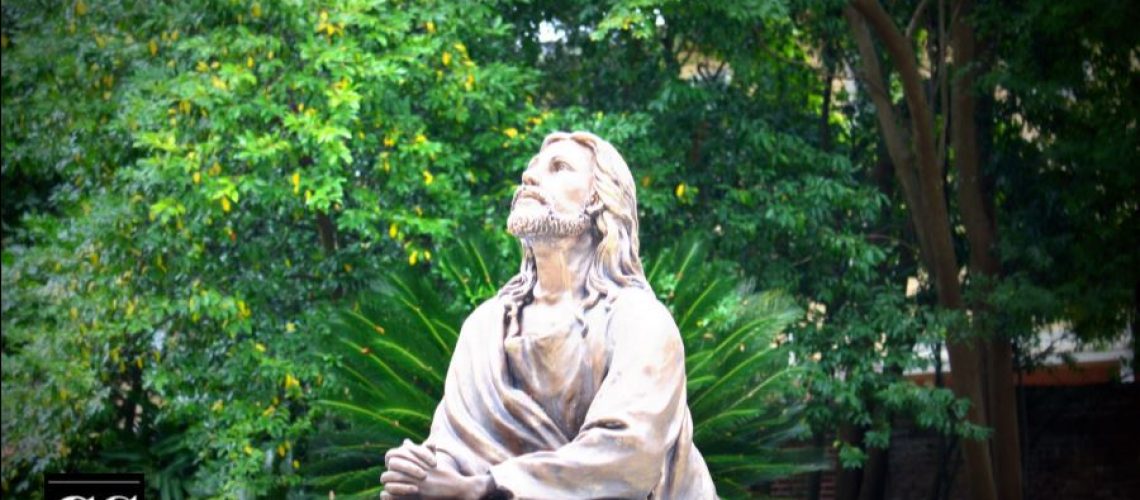
As a spouse and father of three, it can sometimes feel like a guilty luxury to get away to attend to your spiritual needs. If anyone asks me how I manage it, my answer is always the same: “I have an awesome wife.” Much like in a marriage, with the passage of months and years, one’s spiritual landscaping begins to need weeding, pruning, and attention.
Anyone who has been married for more than a few years knows a periodic “date night” does a marriage good. The same kind of intentional time set aside for one’s lover equally applies to one’s relationship with the Lord. Especially when you are called to lead your family as the spiritual head of the household.
Our Lord’s example
The truth is, it has been at least a few years since I have had any kind of retreat. The fact that men even feel compelled to “go up a mountain” to “find God” is almost offensive to women running a household who feel they don’t even have two seconds to themselves to go to the bathroom in peace. Nevertheless, we see our Lord in scripture doing just this, “And having dismissed the multitude, he went into a mountain alone to pray. And when it was evening, he was there alone” (Matthew 14:23).
He also regards the “better portion” as belonging to Mary, who eschews her sister Martha’s preoccupation with doing in order to sit at the feet of Jesus in contemplation (Luke 10:38-42). Whereas busy mothers may be compelled by necessity to find God in the everyday tasks before them, fathers may equally feel pushed to go out alone to tend to their spiritual garden, especially when it has become overgrown with weeds and brush.
Hermitage heaven
Thankfully, I had such an opportunity to disconnect and spend some intentional time in silence, solitude, and prayer for the past few days at a hermitage upstate. I had a small cabin to myself with electricity and an outhouse but no running water. There was no formal schedule, as it was not a guided retreat, but there was the opportunity for Mass and Adoration at the chapel with the four friars who lived on site and a few other guests.
It was time well spent, and I would encourage anyone interested in deepening their prayer and spiritual life to find a monastery or retreat center to get away to once a year if possible. It also helps the religious communities with their monetary needs when you patronize them in this way.
What makes for a fruitful retreat? I’m no expert, but from this experience and past ones, a few qualities came to mind that I thought I would expound on for anyone else looking to “go alone to a quiet place and rest awhile” (Mark 6:31).
Nature’s calming grace
There was something very therapeutic about being in nature the past few days – the rolling woodland and ponds, the gravel paths, the expansive night sky, and the falling leaves which were changing color majestically as Fall was getting underway. Maybe it is because I first experienced God in the natural environment prior to my conversion, so it feels like a honeymoon or sorts. Or maybe it is that nature is bigger than us and inspires a kind of fear and awe that mirrors how we should feel before our Creator.
There is a reason why most contemplative communities are removed from the bustling streets of urban areas. Regardless, the natural environment lends itself to contemplation, well, naturally. “When I consider your heavens, the work of your fingers, the moon and the stars, which you have set in place, what is mankind that you are mindful of them, human beings that you care for them? LORD, our Lord, how majestic is your name in all the earth!” (Psalm 8:3-4, 9).
The power of silence
I found the past few days a good opportunity to re-read Cardinal Sarah’s The Power of Silence while in my cabin. The subtitle says it all: Against the Dictatorship of Noise. “Today,” he writes, “many people are drunk of speaking, always agitated, incapable of silence or respect for others…the conquest of silence has the bitter taste of ascetical battles, but God willed this combat, which is within the reach of human effort.”
It is amazing when you stop to think about how little silence we experience in our daily lives. When I lived in the inner city and would take the neighborhood boys camping, away from the gang and drug-fueled streets of the city, they were not only not used to the silence of nature but intimidated and frightened by it. Even for myself, often the only time I typically experience silence is driving to work, or settling in for bed. “Keeping quiet by mastering one’s lips and tongue is a difficult, blazing, and arid work,” Cardinal Sarah exhorts the man of God. He is one hundred percent correct. Undertaking this retreat was intimidating in some ways, because I have grown so attached to the noise and dings of my daily life that silence has become an unnerving and intimidating stranger I needed to get reacquainted with. Which brings me to my next point.
Detachment
One of the first challenges in this “difficult, blazing, and arid work” of entering into more fruitful contemplation was burying my phone somewhere. I am as guilty as the next man of being too habitually accustomed to responding instinctually like one of Pavlov’s dogs to every ding and vibration emanating from this technology that has reached near-appendage status for most of society. Without a doubt, it is one of my biggest challenges in modern life.
So I made a conscious choice to turn it off and lock it in my car for the duration of my retreat. Our devices have become like the modern-day trifles which command our attention as St. Augustine describes in his Confessions, “The very toys of toys, and vanities of vanities, my old mistresses, still enthralled me; they shook my fleshly garment, and whispered softly, Do you part with us? And from that moment shall we no more be with you forever? And from that moment shall not this or that be lawful for you forever?'” (Confessions, VIII, 26)
And what was the result? Well, for one thing, I slept unbelievably soundly. And I didn’t really miss that much – no emergencies, a few emails and notifications, some texts that could wait. It was a good practice (one I hope to continue). I even had to pick up a wristwatch on the drive there in order to keep track of time, and I ended up really liking having it on my wrist!
St. John of the Cross noted that a bird can be tethered to the earth whether by a small string or a large rope (Ascent, Chapter 11, #4). In essence, any attachment, no matter how small, will hinder our flight to God, so we must actively work on detachment. We attach to such things because we feel God is not enough. Of course, this is a lie from the Enemy meant to keep us tethered to this earth and the things of it. The reality is that “friendship with the world is enmity with God” (James 4:4).
Simplicity
Our lives, even those of the most impoverished of people, are generally replete with unrecognized luxuries: indoor plumbing, hot water on demand, grocery stores, internet and television sets…the list goes on. I find that a retreat is often an opportunity to simplify and escape this common luxury of the senses. In stripping it down as a kind of novelty, we discover that much of what we think we need to exist is superfluous and unnecessary.
There is a reason the hashtag #minimalism is a strongly trending keyword on social media these days; people are drowning in the complicated mountains of products and experiences they have ensconced themselves in, and they desire an escape. In the natural environment, in silence, in detachment, we find a simplicity of the senses, which is as refreshing as a cool spring.
We don’t actually need much to live – simple food to eat and water to drink, books to read, a place to sleep. Everything else we can enjoy for free from God’s hand. “So do not worry, saying, ‘What shall we eat?’ or ‘What shall we drink?’ or ‘What shall we wear?’ For the pagans run after all these things, and your heavenly Father knows that you need them. But seek first his kingdom and his righteousness, and all these things will be given to you as well” (Matthew 6:31-33).
Schedule
Having a set daily schedule can be a helpful method of structuring one’s day when most of the superfluous distractions have been stripped away. Rising early and making a morning offering, reading the scripture for the day, attending Mass, reciting the Angelus, the Liturgy of the Hours, and an examination of conscience before bed are good general ways to structure one’s day whether on retreat or in the midst of daily life in the world.
A schedule helps us avoid lounging around and falling into sloth, as Solomon writes, “How long will you lie there, you sluggard? When will you get up from your sleep?” (Proverbs 6:9) This takes some discipline, but no one’s spiritual life is worth anything without discipline in any case. So take advantage of any opportunity you get to live it out.
Direction
Good spiritual direction is not always easy to come by; sometimes a good confession and reading orthodox, spiritual books are as close as you are going to get. Having suffered under malignant spiritual direction in the past, I would rather at this point have no spiritual director than one who is suspect. But regardless, if spiritual direction is available to you as part of a guided retreat, take advantage of it.
Prayer
It should go without saying that prayer – our lifeline to God – should be at the heart of any spiritual retreat. As St. Alphonsus’ warning of this spiritual priority is succinct: “If you pray, you will be certainly saved; if you do not pray, you will be certainly damned.” Whether it is formal prayer from a breviary, the rhythm of the monastic Hours, quiet contemplation or Adoration, a walking Rosary, or reading Scripture, there is no shortage of opportunities to pray while on retreat. It is the raison d’etre of any Catholic “time away.”
We deepen our relationship with God through prayer and improve our prayer lives by stripping away the things that prevent us from undertaking it. The effort doesn’t have to be momentous or heroic. If anything, is a kind of “mountaintop” experience that we are not meant to stay in. In being afforded the “luxury” of retreat, we are really being charged as missionary disciples of the Lord Jesus. We must become “contemplatives in action,” taking what we have learned under the tutelage of Silence and bringing it back to a world which so desperately needs peace and solace in its midst.
Back to earth
As I said, I’m thankful for the time away to “honeymoon” with the Lord, even if it was only a few days. The natural setting, the silence, the opportunity to detach and simplify, living by a schedule under spiritual direction, and deepening my prayer life were all highly beneficial to my soul, and I would recommend a retreat experience to anyone who is able to undertake it.
Now if you’ll excuse me, I have to take the garbage out, pick up dinner, and basically make up for the time I was away. Happy wife, happy life!


[…] Minority Report Christians, Beware the Metaverse – David Larson at Crisis Magazine A Recipe for a Fruitful Retreat – Rob Marco at Catholic Stand FSSP Pastor Arrested on Child Pornography Charges in Providence […]