

“She died a holy death,” a priest who knew her well told me. Just the day before her death from an aneurism, she’d come up to my wife and me before daily Mass. Smiling, she exclaimed, “Her Immaculate Heart will triumph!” She continued on to Confession, Mass and Communion that day. That evening, she spent a Holy Hour in front of the Blessed Sacrament. Then she went home, and went to sleep. She never woke up.
At her funeral Mass, the principal celebrant was a young priest whom she’d instructed in the faith when he was a teen. Four other priests and a couple of deacons joined him. Many people, young and old alike, paid their respects to this holy woman. She left a legacy and God’s fingerprints on so many souls who, to this day, continue to cherish fond memories of her and still miss her immensely.
Where Are You Headed?
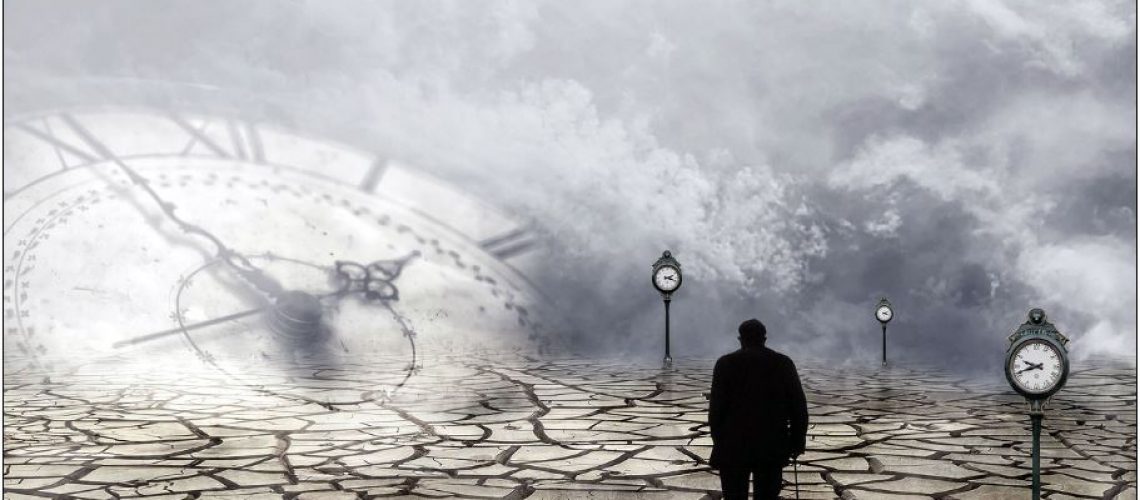
When your time comes, what sort of memories will you leave? But even more importantly, where will your immortal soul be headed? You never know the day or the hour–when your time card will be clocked out forever. None of us knows this. What we do know is that no one is getting out of here alive. Nothing you’re doing now will help you avoid physical death. Our time here is very short–for some much shorter than for others.
If, as I write this with friends and relatives in mind, you’re on the back nine of the golf course of this temporal life, I pray that you’re looking to finish up the game well. If you’ve been away from the Church for any period of time, I am begging you to reconsider what you’ve been doing. Please think about where you are now, and what eternity holds for you at this time.
The Father Is Calling You
Perhaps looking at where you are now and what it portends for your eternal future causes you some discomfort. That can be a good thing. Your conscience is working, God is letting you know that some changes are in order. He’ll help you with these changes. First, though, you’ve got to want to change. He gave you a free will and an intellect, and he won’t push Himself on you.
Like the father in the parable of the prodigal son, though, He’s waiting. Yes, He is waiting to welcome you when you decide to come back home to Him. Does something seem to be missing in life? Have you been feeling that tug–something drawing you somewhere, pulling on your heart? That’s His grace–He’s whispering in your ear that He wants you to come back to Him.
Take That First Step
Just how do you take that first step? Pray–talk to God–tell Him about your concerns, and ask for His help. He won’t refuse you. Talk to someone at a parish near you, or to a committed, practicing Catholic friend or relative. Ask them for a referral to a priest with whom you can talk about coming home.
The priest, or a solid Catholic friend or relative can help you begin to get ready to go to confession. The Sacrament of Reconciliation/Penance, or Confession, is what will set you free. It will bring you back into communion with our loving God. The Catechism of the Catholic Church tells us that Christ instituted this sacrament for all of us members of His Church (we’re all sinners), and that it:
“…offers a new possibility to convert and recover the grace of justification. The Fathers of the Church present this sacrament as ‘the second plank [of salvation] after the shipwreck which is the loss of grace.” (CCC 1446)
What a blessing to have this sacrament available after the shipwrecks we face in the loss of grace! You will feel a tremendous load lifted from you shoulders upon returning to Confession. And you’ll receive graces to strengthen you in your daily battles. Go ahead and make that call today–reach out to someone for assistance.
But What About My Past?
If you’re thinking, “God won’t forgive me–too much sinful water has passed under the bridge of my life,” you are wrong–so wrong. God’s mercy is greater than any sin you or anyone else has committed. He does want us to confess our sins with contrition, do penance, make reparation and resolve to change our lives so as to avoid those sins going forward though. (cf. CCC 1490 – 1492) But His ocean of mercy exceeds any sins you may have committed.
Do you want to enjoy a sense of serenity, of peace, even amidst the tribulations and concerns of day-to-day trials? Get to confession–before it’s too late. You’ll be wildly amazed at God’s great love and kindness. But don’t just take my word for it–see for yourself.
Be More Than a “Good Person”
“But I’m a good person; God’s going to take me to Him one way or the other.” I addressed this in a previous article. Scripture is clear that not everyone will be saved. Hell is real, and many people end up there. Quotes from some saints of the Church (two of whom in this group are doctors of the Church) attest to this. God doesn’t tell us we need to be a “good person” to be saved. Rather, we must respond to God’s grace. We need to follow His commandments. When we fall, He calls us to repent and start over, with the help of His sacraments. It’s about the choices we make every day, in every moment and act. Are we cooperating with God, or are we cooperating with the devil? Are we truly living our life today with the end in mind?
Die a Holy Death–Live the Way You Want to Die
Like the holy woman mentioned at the beginning of this article, will you experience a holy death? Perhaps you haven’t thought about this before. If you did, you may have thought it unattainable. But you can do this.
A priest in a recent homily encouraged us to, “Die a good death; prepare now for it. Live now, the way you want to die.” In other words, to die a holy death–to make it out of this life to enjoy the Beatific Vision in the next life, start now. Start now, before it’s too late.
For the love of God, for the sake of your immortal soul, start now.
…man dies once only, and upon this death depends his eternity. Where the tree falls, there it shall lie. If, at the hour of death, someone is living in bad habit, the poor soul will fall on the side of hell. If, on the other hand, he is in the state of grace, it will take the road for heaven. Oh, happy road! (St. John Vianney).




12 thoughts on “A Holy Death”
Do receiving the last sacraments of the church before one’s death guarantee a happy/holy death?
Ekwutozia Martha, thanks for your question!
The Catechism of the Catholic Church explains that the sacrament of the anointing of the sick can give strength, peace and courage in difficult situations. This includes strength against the enemy’s temptations to discouragement and despair. It includes union with the passion of Christ, and the benefit of the communion of saints interceding for the recipient. In addition to the anointing, the Eucharist offered as viaticum is powerful for those who are about to leave this temporal life. (CCC 1520-1525)
All sacraments provide grace through their power as sacraments (“ex opere operato”). How much grace we take advantage of essentially comes down to our disposition at the time of reception (Aumann, Spiritual Theology, citing Council of Trent).
Thus, the holy woman about whom I wrote the article, seemingly put in the effort to cooperate with God’s daily actual graces continually—daily relational (mental) prayer, daily vocal prayer, daily Mass/Communion, frequent Eucharistic adoration and Confession, and ongoing spiritual reading, together with works of mercy such as assisting with youth catechesis at the parish. I’d guess that the grace she received might be greater than that received by someone who only attends Mass weekly as a matter of check-the-box obligation, with little to no relational prayer, and only occasional confession, etc.
Receiving the last rites—anointing, etc. before/at death clearly will convey graces. The apostolic pardon can remit some to all temporal punishment (depending on one’s attachment to sin at the time). So, certainly we want to avail ourselves of them. In the meantime, growing as close to the Lord through relational prayer and sacraments will let us be open to even more graces from Him–i.e., living the way we want to die. Thanks again–God bless you! Dom C.
I didn’t tell you I was Eucharistic Minister for St. John Neumann Church in Yuma, but I took my name off the list after the surgery 12/12/2024 as I am not as strong after the surgery and with the treatments of radiation and chemotherapy and may not be able to ensure no spilling of Jesus’ blood or stand long enough giving out his body. If I get stronger, I will return. 🙏🏼
Barbara, thank you for reaching out. My heart goes out to you, and my prayers go up for you. What you’re doing in terms of scaling back activities and involvements makes a lot of sense. As well, it seems that you have some good spiritual basics in place.
To get closer to God—that should be our goal no matter what our health situation seems to be. To do that, mental prayer, Mass/Communion, Confession, Eucharistic Adoration, the Rosary, are all some key practices.
Fr. Boniface Hicks, OSB has a nice summary on one form of mental prayer, Lectio Divina, at: https://www.fatherboniface.org/wordpresshome/spiritual-practices/introduction-to-lectio-divina/
Attending Mass, if you’re able, once or more a week in addition to Sundays can be a spiritual booster. Spending some time in Eucharistic Adoration each week will do wonders for our overall state of soul and mind. And, Confession, even without mortal sin, we ought to look at monthly. All of these things can help us grow closer to God, to know Him better, and in so doing, to know ourselves better also.
You may also want to reach out to the Heart of Christ program for spiritual directors to see if they can connect you with a spiritual director to walk with you on this journey – [email protected] .
May God bless you and your family abundantly this Lent, and always – Dom
Barbara – one more thought I failed to mention in my last response – be sure to ask your priest to give you the sacrament of anointing of the sick.
I am fighting a severe brain tumor called Glioblastoma cancer. I wasn’t aware of Glioblastoma cancer so I did some research — it does not good. However, I’ve been in little discomfort and had minor issues (dizziness, lost of hearing on left side, and hearing light noise in my head). I am trying to ensure “A Holy Death”. I try to follow the commandments, but nobody is perfect. I go to church, pray, and plan to go to confession again. I pray to my family, especially my grandkids to have the Blood of Jesus over them. Thank you for this article.
I currently do volunteer work for our town (Vice Mayor) to ensure transparency to residents but will probably not run again, I am BOD member for a condo we own to help with transparency to owners and take care of corruption, but will not run again in October, and bought out a PT clinic so residents could continue to get treatment in a small town, but will sell as too much work. Let me know if there is more I can do to prepare for “A Holy Death”. Thank you🙏🏼
Pingback: THVRSDAY EDITION – Big Pulpit
“The Soul After Death” – 2 ESDRAS 7:75-101 (Apocrypha Scripture) – Reference: Good News Bible GNT
Dom:
What a nice, well-thought article. I knew the woman you talked about. She was really a living holy person. Prayer, Adoration and Confession (even though we are embarrassed to confess our sins – at least I am), truly lifts a tremendous load off your shoulders.
We humans tend to create, and live with habits that if we do not realize on time, we may end up regretting. If we are able to commit to daily activities such as work, exercise, entertainment, etc. Why can we not commit to a time in prayer and adoration with our Lord Jesus Christ? He is available 24/7. He never rests. Once we include this into our routine, it starts to penetrate into your heart and veins and it is a drug (in a good sense) that you want to keep forever.
In Christ,
Alfredo.
Thanks, Alfredo! You are so right–God calls us all to live virtuously with commitments to patterns of behavior and activities that will allow Him ever more deeply into our hearts. God bless you, brother!
Dear Dom,
Anyone who has been truly justified by Christ, due to their belief (faith and works) in following Him, and has been baptized as such (in repentant metanoia, permanent change of mind and heart), will never be loosed from His hand or their salvation. Given those Scriptural truths, its really a shame to see that CCC 1446 wrongly connects baptism and justification.
That connection “can” be true for a reasoned/adult convert, but it is not true for infants until they are ale to proclaim of their own free will that they believe in Jesus as the Christ (and their Lord and Savior) and will turn from their sins and follow Him and His ways. Infant Baptism doesn’t accomplish both of those things automatically.
When an a reasoned/adult has fully, freely, and faithfully received and submitted to them both, Baptism and repentance in Christ, even if their Baptism took place as an infant, then they will never turn away from their justification at all. He who is justified will also be glorified and will never leave God’s hand! They may get highly discouraged and even lazy or complacent at times, but they will never leave the Lord whom they love!
In Christ,
Andrew
Andrew, you may or may not have noticed that CCC 1446 (dealing with the sacrament of penance/confession) cites Tertullian and the Council of Trent in a footnote, so you’re taking a position contrary to more than just the CCC 1446 in your statement.
Sanctifying grace, received in baptism, as a participation in the divine nature, “…gives us a sharing in the divine justice and sanctity, since all of the attributes of God are identified with His essence. Therefore sanctifying grace is absolutely incompatible with mortal sin.” (Aumann, Spiritual Theology, pp. 73-74) Hence the need for the sacrament of penance/confession (the main focus of the paragraph in the above article), which absolves one of mortal/grave sin–these are basic teachings of the Catholic Church, my brother.
Thanks for weighing in.