
Five Signs of God’s Mercy and Power
The Miracle of the Sermon to the Fish
The banks of the river were crowded with a different congregation that day—one silvery and swimming, scales glistening beneath the Italian sun. It was in the quiet town of Rimini, steeped in indifference and stubbornness, that Saint Anthony of Padua encountered hearts closed to the Gospel message. Undeterred by the cold rebuff of the townspeople, the Franciscan saint turned away from the stone-hearted and, with profound humility, spoke to those most willing to listen: the fish of the Adriatic.
Witnesses say Anthony stood at the edge of the water and began to preach. With words full of the love and truth of Christ, he called out, not to the people, but to the creatures of the sea. What happened next is the stuff of legend—and a radiant sign of God’s power. The fish came, in droves, surfacing and gathering by the shore, lifting their heads as if to listen attentively to the holy friar. Large and small, simple and splendid, they stood as silent witnesses, filling the waters in orderly ranks that no human audience could match for devotion.
The astonished crowds, drawn by the commotion and the unmistakable sight of nature itself bowing before a messenger of God, returned in awe. Confronted by this living miracle, the people of Rimini opened their hearts. Many surrendered their resistance to the message of repentance and faith. In this gentle yet unmistakable display, the Lord affirmed not only the sanctity of his servant Anthony, but also His boundless desire for all creation—man and beast—to know His mercy.
This miracle endures as a powerful reminder that God’s word is not chained. Even when human ears grow deaf, the Creator finds a way to bear witness to truth. Saint Anthony’s sermon to the fish stands as a call, echoing down the centuries: remain faithful, even when ignored, for all of creation longs to hear the voice of its Maker through his saints.
The Miracle of the Eucharistic Mule
Imagine the bustling square of Rimini in the early 13th century. Saint Anthony of Padua—humble friar, brilliant preacher, afire with love for Christ in the Eucharist—stands confronted by townspeople hardened by skepticism. Among them is a man known simply as Bononillo, a merchant who loudly proclaims his disbelief in the real presence of Jesus Christ in the Blessed Sacrament.
Bononillo, with a sly smile, throws down a challenge: If Anthony’s Lord is truly present in the Eucharist, let his own mule—famished after three days without food—choose the consecrated Host over a basket brimming with oats. The entire city turns out for the spectacle. Saint Anthony kneels in deep prayer, the monstrance aglow in his simple hands. Bononillo, sure of his wager, parades his poor, hungry animal before the crowd, then proffers the temptation—the sweet-smelling oats.
But the miracle belongs to God alone. As Bononillo presents the oats, Anthony holds up Our Lord in the Blessed Sacrament. The crowd falls silent. With gentleness and purpose, the mule marches past the oats, bows its head with devotion, and kneels before the Eucharist. Gasps of astonishment fill the square. The truth of the Catholic faith shines forth visibly in this lowly creature’s adoration.
In that moment, the deep mystery of the Eucharist is made blazingly clear—not by argument, but by the loving action of God. Bononillo is overcome, his heart pierced by wonder, and he comes to faith. This is the power of Christ’s presence in the world: even the humblest of his creation can recognize and reverence the Lord, where proud human reasoning falters. Such are the miracles Saint Anthony brings to light—not for his own glory, but as living signs of God’s mercy and power for all who seek truth.
The Miracle of the Child Jesus Appearing to Saint Anthony
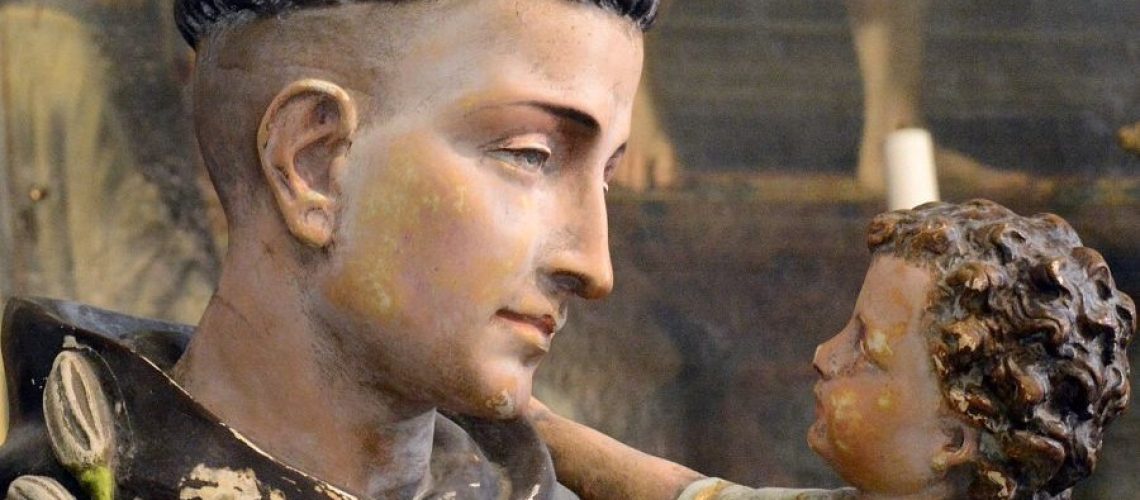
Few stories in the life of Saint Anthony of Padua radiate such tenderness and divine intimacy as the miracle of the Child Jesus appearing to him. Tradition tells us that during a period of prayerful solitude, Anthony was staying as a guest in the home of a benefactor. Late at night, he entered deep contemplation, seeking union with God. It was then that a luminous Child, surrounded by celestial splendor, appeared before him—none other than the Lord Jesus Himself.
Saint Anthony’s heart overflowed with love and reverence as he gazed upon the Christ Child. The encounter was not just a vision, but a living moment of friendship between Saint and Savior. The Child Jesus, radiant and gentle, embraced Anthony, resting in his arms as a sign of divine favor and spiritual purity. In this private moment, the mysteries of the Gospel came alive—God, once a child in Bethlehem, now comforting and strengthening His humble servant.
Word of this miracle spread gradually. The benefactor, curious about a mysterious brilliance coming from Anthony’s room, peered inside and witnessed the saint enraptured, bathed in supernatural light with the Child Jesus in his arms. Speechless with awe, he recognized the immense grace of this visitation.
For generations, this miracle has inspired the faithful to approach Christ with childlike trust and devotion, reminding us that holiness attracts the presence of God in sublime and sometimes astonishing ways. As we contemplate Saint Anthony’s encounter, we’re called to open our hearts as he did—welcoming Jesus into the quiet of our own lives, and allowing His light to transform us. Through Saint Anthony, we rediscover that, in God’s mercy, the impossible is never out of reach, and His love is constantly seeking a home within us.
The Miracle of the Restored Foot
In the tapestry of Saint Anthony of Padua’s miracles, there is one story that stands out—not only for its drama, but for the profound message it carries about repentance, mercy, and the power of God working through His saints.
The story takes us to the city of Padua, where a young man, tormented by guilt after a heated argument with his mother, committed an unthinkable act: in a fit of remorse, he took an axe and cut off his own foot. The shock and horror quickly spread among his neighbors and family. Grief overwhelmed the household. Yet, even in this darkest hour, faith held steady; they turned to Saint Anthony, already known in life for his compassion and intercessory power.
Saint Anthony was called to the young man’s side. He knelt in prayer, invoking God’s mercy and forgiveness for the wounded soul before him. Then, lifting his gaze, he gathered the severed foot and, with great tenderness, placed it back against the young man’s leg. Those gathered held their breath, witnessing what no human could accomplish on their own. Through Anthony’s prayers, the foot was miraculously restored—joined anew, as if the injury had never happened.
The miracle became a living testimony to the Church’s age-old teaching: that no sin is too great for God’s forgiveness, and no wound is beyond His healing. Through Saint Anthony’s intercession, the mercy and power of God were made visible, drawing souls to repentance, hope, and deeper faith. For all who hear this story, it serves as a call to turn to Christ, especially in our neediest moments, trusting that with God—and with the help of His saints—reconciliation and restoration are always possible.
The Miracle of the Poisoned Food
The story of Saint Anthony of Padua is adorned with many wonders, but few inspire such awe and devotion as the Miracle of the Poisoned Food. In the heart of his ministry, Saint Anthony faced opposition and even danger, yet responded always with humility and unwavering faith in the protection of God.
It was during his travels, bringing the light of the Gospel to troubled hearts, that Saint Anthony found himself invited to dine with a certain group. Unknown to him, his adversaries sought to test—if not destroy—this humble friar by lacing his food with deadly poison. Their hearts had been hardened against his message, and so, they devised a scheme that seemed clever in the eyes of the world, but was foolish in the economy of Heaven.
As the tale is lovingly preserved, Anthony was warned of the danger through a mysterious intuition or perhaps the prompting of the Holy Spirit. Rather than recoil in fear or pride, he chose instead to make a bold and faith-filled act. Before all present, he blessed the food with the sign of the Cross—invoking the protection of Christ, just as countless saints have done when faced with mortal peril.
Then, in full view of his would-be assassins, Anthony ate what had been set before him. Not only did he survive, but he was completely unharmed, a living confirmation of Christ’s promise that “if they drink any deadly thing, it will not hurt them” (Mark 16:18). Those who witnessed the miracle were struck with astonishment and, in some accounts, even converted to the faith on the spot.
This miracle stands not only as a sign of God’s power, but also as an enduring lesson for us: that trustful surrender to the Lord, marked by humble prayer and confidence, can turn even the darkest intentions into occasions of grace. Saint Anthony’s steadfastness in the face of danger encourages us to rely more deeply on the protection of God and to bless all that comes to us, consecrating our daily lives under His loving Providence.


[…] Now Whom You Will Fear: A Homily for the 12th Sunday of the Year – Msgr. Charles PopeFive Miracles of St. Anthony of Padua – Brother Jos. Freyaldenhoven at Catholic Stand MagazineF.S.S.P. Entrusted with New […]
Dear Bro JF, This will sound fantastic and beyond belief. I have always had a devotion to this saint. He has NEVER failed me in finding things and people. Once in our area there was a lost little girl. Tons of people were searching for her. I prayed to St Anthony and then went to an area somewhat far away where no one ese had been. I found the child. Gotta admit as I walked up to a crowd with parents, grandmother, sheriff and police cars lights flashing holding her up it felt like I was a hero – but it was all St A. TY for this article. Guy Texas