
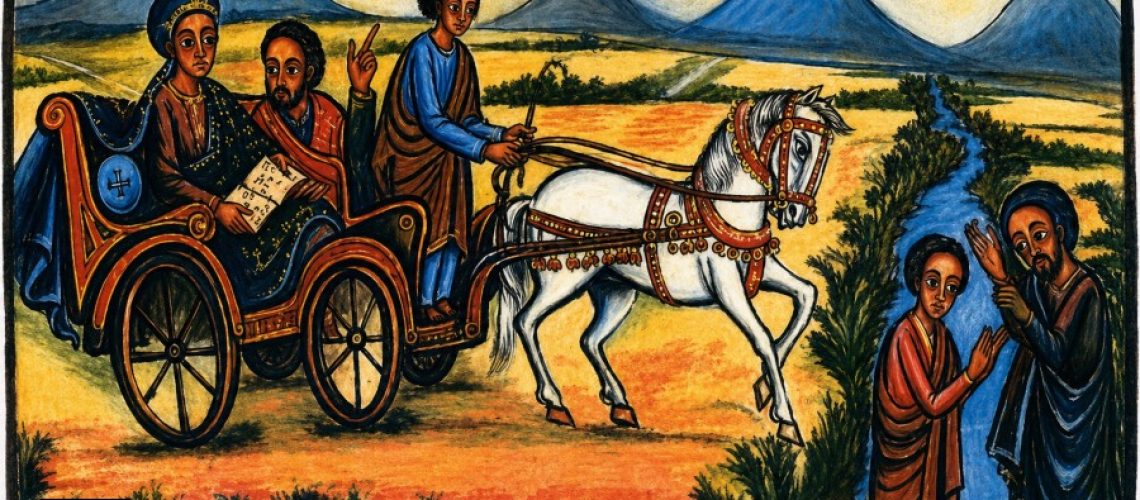
In the eighth chapter of the Acts of the Apostles, Philip the Evangelist baptises a high ranking Ethiopian court official, the treasurer of Queen Candace, who then returns to his homeland “rejoicing” (Acts 8:39, New Revised Standard Version NRSV). Early church historians, including Eusebius, explicitly affirm that this official became the first fruit of the gospel in Ethiopia, fulfilling the ancient prophecy: “Ethiopia shall stretch out her hand unto God” (Psalm 68:31; [1]). For nearly two millennia, the Ethiopian Orthodox Tewahedo Church has traced its apostolic origins to this single, divinely orchestrated encounter on a desert road in the first century.
Yet, when an article recently reasserted this in the context of debunking the misconception that St. Frumentius “introduced” Christianity to Ethiopia in the fourth century, one reader responded with a dismissive comment laced with factual errors, logical fallacies, and a supremacist bias. The reader called the story “nonsense,” claimed the eunuch was “enslaved,” and implicitly claimed that a church could not have begun simply because Philip baptized one man. This reaction is not merely an isolated internet quarrel; it is a symptom of a much older and more pervasive pattern.
The facts, however, are clear, and they have been clear for centuries.
A Divine Appointment on a Desert Road
The chronology of the early church is well documented. After the resurrection and ascension of Jesus, the Holy Spirit descended at Pentecost (c. 30 AD), birthing the Jerusalem church (Acts 2:1 4). Soon after, persecution scattered the believers, and God the Holy Spirit directed Philip, indeed, commanded him, to the desert road where he would baptise the Ethiopian eunuch. There, he encountered an Ethiopian eunuch, not a slave, but “a court official of Candace, queen of the Ethiopians, in charge of all her treasure” (Acts 8:27, NRSV). He was a literate, educated man, reading aloud from the prophet Isaiah. Philip explained the scriptures, and the eunuch asked to be baptised.
What happens next is theologically decisive. Immediately after they came up from the water, “the Spirit of the Lord snatched Philip away; the eunuch never saw him again but went on his way to Ethiopia rejoicing” (Acts 8:39). God deliberately removed the foreign missionary. No evangelist accompanied the new convert. The clear implication is that the gospel was now to be carried to Ethiopia by an Ethiopian, not by a later foreign missionary.
The Witness of Early Church Historians
The reader who dismissed this tradition as “nonsense” would do well to consult Eusebius, the father of church history. In his History of the Church, Eusebius writes that the eunuch “became the first fruit of the faithful throughout the world” and that he “proclaimed the gospel to his countrymen, fulfilling the prophecy, ‘Ethiopia stretches out her hand unto God’ (Psalm 68:31)” [1]. Rufinus of Aquileia adds that the eunuch “preached the gospel in Ethiopia and founded a church there” [2]. These are not fringe claims; they are the unanimous testimony of early Christian historiography.
Furthermore, the reader’s objections rest on several logical errors. First, a false dichotomy: either the eunuch’s baptism instantly created a full institutional church, or it had no significance. Neither position is claimed by the article. The argument is that a powerful, educated, high ranking official returning to his homeland after a miraculous divine encounter would naturally share his faith, and that early church historians confirm he did, and that he founded a church.
The reader’s claim that the eunuch was “enslaved” is not a minor factual error. It functions discursively to diminish an influential Ethiopian official, a trusted minister of the royal treasury, into a subordinate, powerless figure. Acts 8:27 explicitly identifies him as a “court official… in charge of all her treasure” (NRSV). This misreading is not neutral historical correction; it is a form of theological and racial marginalisation. It refuses to grant agency to a figure who, according to the biblical narrative itself, was chosen by God to receive the gospel and carry it home [3].
The debate over the Ethiopian eunuch is not a mere antiquarian squabble; it speaks directly to how the global Church remembers its own history. The Ethiopian tradition claims that God himself chose to bring the gospel to Ethiopia through an Ethiopian in the first century, without any foreign missionary. Hence, Ethiopia is often regarded as the only African country that has never been colonised, and its Christian tradition is therefore understood to have remained authentic.
To dismiss that tradition is a form of historical negationism that scholars such as Trouillot have identified as an act of power. When certain histories are silenced, the dominant narrative becomes naturalised as universal truth [4].
In conclusion, the reader’s comment contains factual errors (the eunuch was not enslaved), logical fallacies (false dichotomy, selective application), and supremacist bias. The historical and biblical record stands firm. Eusebius [1], Rufinus [2], and the text of Acts itself all affirm that a high ranking Ethiopian official, baptised by an apostle and filled with joy, would naturally share his faith in his own homeland. The misconception is completely debunked. And the Ethiopian church, ancient and unbroken, continues to bear witness to the gospel it received not from a fourth century missionary, but from one of its own sons on a desert road, rejoicing as he carried the good news home.
References
[1] Eusebius. (1989). The history of the Church (G. A. Williamson, Trans.). Penguin Classics. (Original work published 4th century)
[2] Rufinus of Aquileia. (1997). The church history of Rufinus of Aquileia: Books 10 and 11 (P. R. Amidon, Trans.). Oxford University Press. (Original work published early 5th century)
[3] Roberts, J. D. (2021). Liberation and reconciliation: A Black theology (2nd ed.). Orbis Books.
[4] Trouillot, M.-R. (1995). Silencing the past: Power and the production of history. Beacon Press.


[…] RomeroGrateful, Not $ Beholden – Thomas J. Neal, Ph.D., at Neal Obstat Theological OpiningWhy Does the Ethiopian Eunuch Deserves a Place in Christian History? – Catholic Stand MagazMy Full Response to Fr. Gabriel Lavery – The Journal Of American […]
The Ethiopian church is unique in that it was not the result of schism from a larger body. Its isolation is explained simply by its remoteness from the major centers of ancient Christianity. It has every right to be considered a member of the church catholic, even if it is not formally connected to Orthodoxy or Roman Catholicism. That they retain some Judaic elements in their religion that elsewhere disappeared is not due to any rejection of an official order to desist from such practices — they just never got the memo. The persistence of these elements argue for a Christian presence in Ethiopia much earlier than the 4th century.
It seems, the apostolic seed didn’t bloom to fruition as Ethiopia is only
1-2 % Catholic but is still primarily a Christian nation which bears witness to this narrative.