

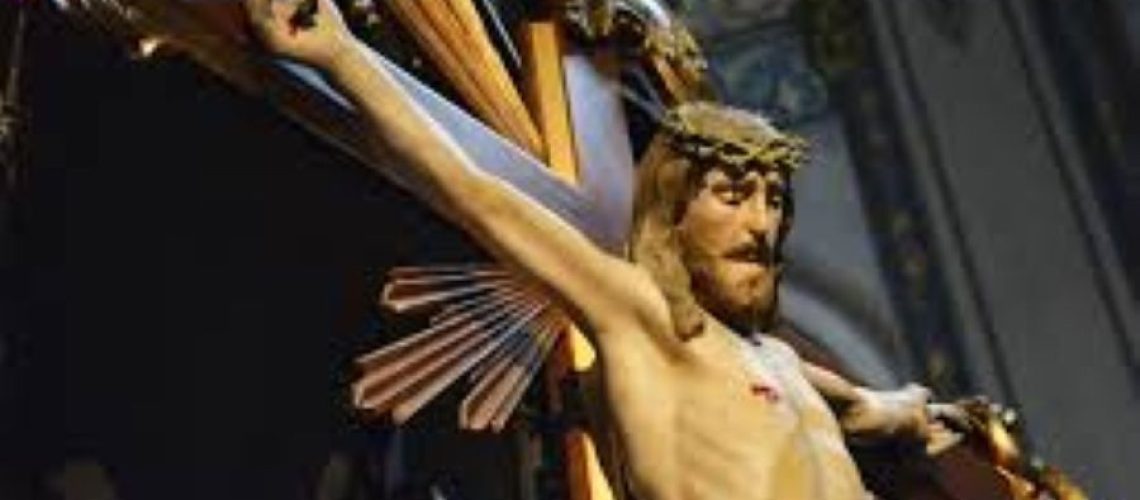
In 2021, I posted an essay titled “A Simple Explanation of the Catholic Faith.” To my surprise, some folks have commented to me about it recently.
The comments were all the same. They asked for a follow-up article offering a simple explanation of “Why I am Catholic.”
Simply put, my answer to this question is “There is no other option.” I am convinced that the Church is the one true Church Jesus Christ established. It offers the fullness, joy, and hope of God’s grace that no other faith, church, religion, philosophy, or world view can match.
Unfortunately, a few simple “one liners” won’t explain this response. There is much more to the “no other option” story.
I am sure there are as many different reasons for being Catholic as there are members of the Church. However, what follows is my testimony.
As a means of conversion
A term often used for someone like me who joins the Catholic Church after being either non-religious or having belonged to another religion is “convert.” However, we are really a convert to Jesus Christ. A way to think of it is as a faith journey to a relationship with Him. In turn, that relationship is a transformative process to become more like Him.
So where does the Catholic Church fit in? One way to think of it is that the Church is a vehicle we ride in for that journey to a relationship with God. So, becoming a Catholic is like stepping into that vehicle – but getting in it for a long, long ride that lasts a lifetime.
As a means to answer life’s questions
We humans are by nature questioning beings. Especially as we get older and experience more of life, we raise questions about our existence. Why am I here? What’s the meaning and purpose of my life? Is there anything after death?
We also raise questions about the world around us such as Why are things the way they are? Why do humans act the way they do? Why is there evil? The world seems a mess so how can we survive in it and/or make it better?
I have found that the Church through its teaching magisterium with links to holy tradition and sacred scripture provides the fullest answers to such questions.
What is it about the Church?
I often live up to my namesake, Thomas. I can be a doubter, whether its religion, science, or politics, I ask questions. I use the lens of my training in the scientific method, in history analysis, and as a military cop on the principles of the burden of proof and rules of evidence.
Over the many years, through experience, study, and reasoned reflection I fully trust that the Catholic Church best provides the means for conversion, transformation, and answering my questions. I offer the following conclusions I’ve come to that confirm that trust.
Authenticity
Authenticity refers to the fullness of truth of God’s revelation of who He is and what is our relationship to Him. The Catholic Church acknowledges there is a transcendent (existence or experience beyond the physical level) view, that of something greater than oneself or any immediate experience, and even the physical world. It’s a recognition of a spiritual component to life.
The “Word” or gospel (good news) is this spiritual component. Sacred scripture, holy tradition, and the Church’s magisterium explains the good news. The magisterium is the teaching office of the Church that provides a “living transmission” of the “Word.” It helps to assure that the Church teaches divinely revealed truths, not just human interpretations and opinions.
I believe it is through the Catholic Church that the fullness of Gods revelation is discovered, understood, and experienced.
Authority
Authority refers to the fact that the Church traces its roots back to Christ himself. The “deposit of faith” he gave the Apostles has been passed down through the generations of their successors (the popes, archbishops, bishops) to today, in one unbroken line.
Christianity is based on real history, not some abstract philosophy. That history tells us that Christ passed on the deposit of faith to the Apostles and commissioned them to build his church.
The Apostles wrote the bulk of the canon of sacred scripture we call the New Testament. (The rest of the New Testament was written by their close associates.) The Apostles also established the Church structure and the magisterium to pass on the whole of sacred tradition. Most, but not all, of this tradition was put down in writing. This holy tradition was passed on to succeeding bishops (even to this day) through apostolic succession.
Succeeding Bishops decided upon the books for the sacred scripture, known throughout the world as the Bible. They also defined core dogmas and doctrines.
The nature of the Church was made clear in sacred scripture by the Apostle Paul in his first letter to Timothy (1Timothy 3:15):
“ . . . you should know how to behave in the household of God, which is the church of the living God, the pillar and foundation of truth.”
A sacramental view of the world
A sacramental understanding of the world God can be known and experienced through the world He has created. The Catholic Church has a fully sacramental understanding of God’s saving activity. Likewise, God’s grace is given us through the visible signs of the sacraments of the Church. Christ instituted these sacraments and the Church He established carries them out.
The most important sacrament is the Eucharist where I get to enter into communion with God. Christ instituted the Eucharist to provide us His body and blood as life sustaining “soul food.” We receive Him into our bodies at Mass for our spiritual nourishment. We cannot obtain this nourishment through any other means.
The true presence of Christ in the Eucharist has been, and always will be, the defining characteristic of the Church.
An understanding of human nature as saints and sinners
The Church’s history, tenets, doctrines, and sacraments offer the most reasoned frame of reference for understanding human nature – its failings and virtues.
The Catholic Church is a Church of both saints and sinners. When Catholics do bad things by themselves, or even in the name of the Church, it is because they have chosen to disregard or distort what the Church teaches.
Associated with this frame of reference are the role models the Church gives us – the saints. The saints are truly worthy of imitation. They show how we humans can overcome our faults and live full and virtuous lives.
An uplifting culture of life
The Church offers a sense of purpose and connection to something greater than me. The belief in a loving God who created humanity and the world provides meaning in a complex world. We are creations of a personal God who created us in his image and likeness. We glorify God by loving Him and our neighbors. The Church’s considerable acts of charity worldwide, with a preference for the poor, provide impetus for our individual actions.
The Church provides clear ethical and moral guides to help us navigate life’s gray areas with principles rooted in compassion and justice to live virtuous lives. We do this by living out God’s commandants, and doing works of mercy as he commanded.
Catholic beliefs offer hope. We receive Christ’s mercy through the Sacrament of Reconciliation. He forgives our sins and gives us on-going second chances that provide hope that positive change in our lives is possible. We are, after all, all sinners in need of change. We are all “works in progress.”
The Catholic Church community of shared beliefs, rituals, worship, and charity aid us to combat loneliness and provide support for tough times.
The Church’s teaching on redemptive suffering that human pain and hardship can serve a higher purpose when offered to God offers solace. It helps to change the focus on suffering from being meaningless to purposeful. By uniting our struggles with Christ’s sacrifice, we can share in his redemptive act. Suffering thus becomes a way in which we grow closer to God.
The Church provides answers to the big question of what happens after death. The promise of salvation that Jesus taught is comforting in times of uncertainty. There is an afterlife. Because of the sacrifice of Jesus Christ, we can be united with and in perfect communion with God in heaven. Death is just one stage in life’s journey back to God.
I believe that without Christ and what he taught, and without the Church and the beliefs that emerged from His teachings, there would be no acknowledgment of human freedom and dignity, no end to slavery, and no respect for all human beings (both born and still in the womb). There would be no transcendence in the world that would only be political, mechanistic, and utilitarian. Such a world would be a cold and barren reality.
Transformation and perseverance
As previously mentioned, I believe the conversion process to Christ requires a transformation.
The Catholic Church has provided me the challenge, the support, the motivation, and the tools to bring out “the better angles” in me. It is a continuing process to overcome the pridefulness, the selfishness and self-centeredness which I doubt would be possible without the Church.
Positive change in one’s life is still and always will be an ongoing process. It requires a discipline which the Church offers in many ways through prayers, novenas, retreats and of course, the sacraments.
The Church helps one to persevere through the ups and downs of life as we continue the faith journey of conversion and transformation. As St. Paul writes in Romans 5:3-5:
“ . . . we even boast of our afflictions, knowing that afflictions produce endurance, and endurance, proven character, and proven character, hope, and hope does not disappoint because the love of God has been poured out into our hearts through the holy Spirit that has been given to us.”
Conclusion
I’ve obviously offered more detailed reasons beyond a “simple” explanation for being Catholic. If I were to give the operative word to summarize those reasons it is “hope.” The Church offers hope for me and for the world at large.
Others, however, have given some pithy “one liner” responses to the “why Catholic” question. One individual worth mentioning is G. K. Chesterton.
In his essay Why I Am Catholic he writes that, “The difficulty of explaining “Why I am a Catholic” is that there are ten thousand reasons all amounting to one reason: that Catholicism is true.”
Finally, in all humility I accept the Catholic Church with an attitude that is reflective of Chesterton’s famous quote: “A Catholic is a person who has plucked up courage to face the incredible and inconceivable idea that something else may be wiser than he is.


8 thoughts on “Why Catholic? There is No Other Option”
Pingback: For 2,000 Years Catholicism Has Not Changed – Catholic Stand
Pingback: SVNDAY EVENING TOP-10 - BIG PULPIT
Guy;
Amen
“This is my body, this is my blood” pretty well sum it up for me. Guy, Texas
Capt Crisis:
Your comment comes across as just another one of your emotes for whatever bones you have to pick with the Church with no basis if fact or history. Sure, you can cherry pick where Catholics have done bad things. But they are not the norm. As I stated in the essay when Catholics do bad things its when they disregard or distort the teachings of the Church.
The inaccuracy of your charges are blatantly off the wall. The historical record overwhelming shows the Church has been at the forefront of expansion of human freedom and dignity, education, workers rights, the decent wage and caring for the common good.
The historical record from the New Testament to today shows the Church’s evangelization has always been about an invitation not a demand.
Most people did indeed convert to Catholicism because there “was no other option”. They would be killed, burned at the stake, or at best unable to get decent jobs or education.
Lionel:
I assume your comment refers to the Church’s teaching of “no salvation outside the Church” as another reason for being Catholic. I have read many different interpretations of “no salvation outside the Church”. They range from a strict literal conclusion of individual “card carrying Catholic” to a universalism of all being saved. As I see the Catholic position expressed in the Catechism the notion of “unawareness” by pious folks seeking God is also offered as a “possibility”. CCC paragraph 847 cites that possibility of salvation for those outside the Church, by God’s grace. John Paul II also eludes to that in his comments on Dominus Iesus (see cite below).
Christ is the source of salvation (as Peter states in Acts 4:12), and the Church is his body. That is the link. As stated in the essay, the Church is the fullest and most complete presentation of that revelation that can bring us the Christ. In the end, it’s up to God’s grace to allow other possibilities.
https://www.ccjr.us/dialogika-resources/documents-and-statements/roman-catholic/pope-john-paul-ii/jp2-00oct1
Outside the Catholic Church there is no salvation has been a dogma of the Catholic Church defined by three Church Councils based upon the Bible ( John 3:5,Mark 16:16 etc) and supported by Vatican Council II ( Ad Gentes 7) which is inserted in the Catechism of the Catholic Church (846). So Vatican Council II ( AG 7) is aligned with the dogma EENS of the Council of Florence and invisble and hypothetical cases of LG 8,14,16,UR 3, NA 2, GS 22 etc in Vatican Council II are not objective exceptions for Ad Gentes 7 and neither for the Council of Florence 1442 etc on EENS. So the Church has a coherence in doctrine and theology. The Catechism of the Catholic Church is aligned with all the other Catechisms