

When I was a child (from 1950 to, well, who can say?) the term “the opposite sex” struck me as odd. Opposite of what? Was I the only one who thought it odd? Many years later I received an email-circulated cartoon featuring the unofficial use of the Peanuts characters Lucy and Charlie Brown, with Lucy asking Charlie, “Are you the opposite sex, or am I?” Opposites are funny things. Without deep-diving into Aristotle’s treatment of contradictories and their relative impact on the validity of any dialectic exercise, suffice it to say that the concept of opposites is not such a simple matter. The colors black and white, thought of as opposites, to some extent define each other. Perhaps male and female define each other, but do they do so as opposites? At any rate, even if they are not opposites, at no time during my childhood did the culture treat the sexes as anything resembling interchangeable.
However, in today’s deeply gender-destructive culture, any discussion about the differences between the sexes is immediately labeled as sexist. We can expound innumerable differences between innumerable genders with wild abandon, but heaven help us if we raise the specter of difference between the sexes.
That said, those real, measurable differences are, admittedly, generalizations. For example, men generally have better visual depth perception than women and excel over their female counterparts in those areas that require a keen appraisal of spatial relationships. More than one gentleman acquaintance of mine has quipped something to the effect, “My wife is very musical; she drives by ear.” But that male/female difference is certainly not absolute, and some women clearly outclass some men in this regard.
Yet the difference, at least at the statistical mean level, is significant and real. Conversely, it is widely held that female superiority can be demonstrated regarding the relative ability to multitask. In an age of rampant statistical analysis, one can easily demonstrate, by means of normal-distribution bell curves, how any population compares to any other regarding their ability in any specific arena. In such an analysis, one will usually find that there is considerable overlap between the two populations at the edges of their respective bell curves.
In simple English, what the data shows is that, even if most women are better multitaskers than men, some men will be better at it than some women. But those overlaps do not negate the difference at the mean or sufficiently demonize the generalization. Those overlaps, however—being, in many instances, as much as 70% to 90% of the population—demand restraint on our part in the application of the generalities. Clearly, regarding the title of this article, we began to see that defining the two sexes as “opposite”, even from a simple data-analysis point of view, is hardly appropriate.
So, what is a proper attitude to take concerning those real, undeniable general differences? Some, of course, argue that these differences—raw physicality aside—are simply culturally acquired, and will vanish when we become a fully sexually-egalitarian society. But this belief is largely a reaction to the perennial exaggeration of sexual differences; for, while these qualities are probably culturally enhanced, studies of the human brain paint a picture that simply cannot entirely be dismissed as the product of enculturation or environment. Others conjecture, quite believably, that these differences are the product of adaptation; that hunters with better spatial perception and women with better social skills were better survivors.
Historically, little if any restraint was practiced in the application of these (oft exaggerated) generalities to social norms, creating challenges at the level of individual social interaction—challenges to both women and men who did not fit the exaggerated mold. And yet the enculturation of these differences, if family integrity is to be used as the measure, did not necessarily have bad effects on society at large.
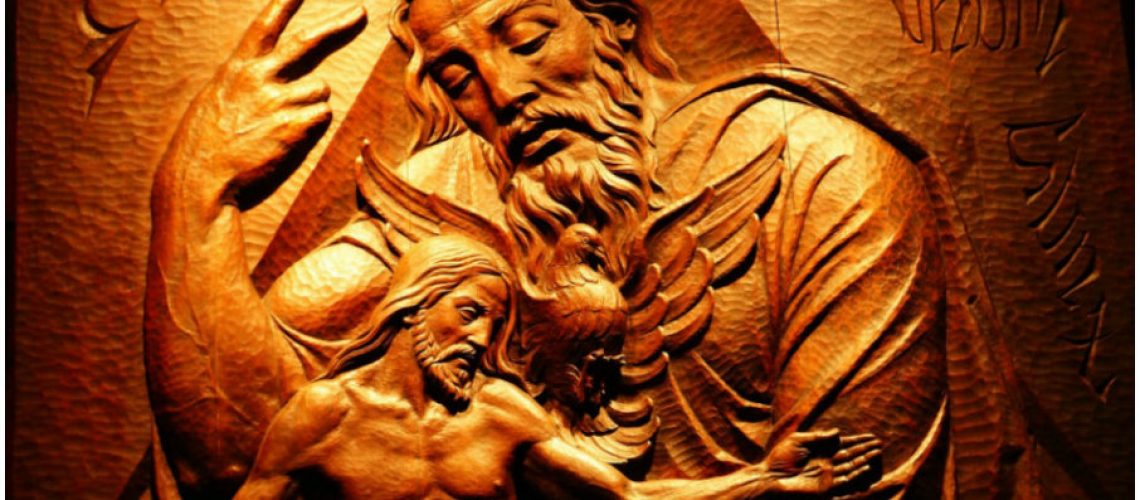
St. Pope John Paul II, in his seminal work The Theology of the Body speaks eloquently of the complementarity of the sexes—pieces of a divine puzzle that form a masterpiece when assembled. Drawing inspiration from John Paul, my conceptualization of Trinitarian life is greatly affected. The product of that contemplation, as is often the case, is more than can be adequately transcribed, but the following is my meager attempt. Please note that I have no intention of offering any sort of doctrinal novelty, only my humble thoughts.
When addressed as “good teacher,” Jesus, no doubt, perplexed his listeners by responding with “only God is good.” The question immediately arises: If only God is good, what about us? Of course, Christ’ meaning was more subtle—if only God is good, then all of the things that appear good to us start with God and are somehow infused with him. In John Paul II’s parlance, the sexes are complementary, that is, they complete each other. If complementarity is a good thing, then it is a principle rooted in God and the Trinity is the perfect and inexhaustible source of it. On this principle lies the totality of what follows.
Delving into Scripture, we find that God is love, and while any attribute assigned to any person of the Godhead is true for all three, each person of the Trinity personifies a particular aspect of perfection. We know, for example, from Sacred Scripture, that the second person of the Trinity is the Logos, “the Word made flesh.” He is truth personified. Truth cannot exist without love; it is the hallmark attribute of love. It is love’s witness, love’s servant. Without love, there is no truth, nothing worth proclaiming.
Our Christian faith informs us that, while the three persons of the Trinity are all equally God, there is certainly a principle of primacy in the Godhead: if there was no Father, there would be no Son; if there were no Father and Son, there would be no Spirit. Therefore, if God is love, clearly God the Father is the personification of love.
In the mind of the ancients, the generation of new life was the faculty of manhood. From Abraham to Aristotle, lacking the physical sciences to guide them, they had come to believe that a man’s seed is complete, needing only the fertile ground provided by a woman, thus the words seed and fertility. Though the Trinity, with the exception of the Incarnation, is pure spirit, and therefore, unsexed, it is easy to see that our ancestors in the faith, in giving expression to a God who creates us “in his image and likeness”, would need to see the Creator as a father. Had the Creator been represented as a mother, they would have been left to wonder from where the seed had come and in whose image we are made, for they would have been left with the image of a creator who was, to their limited understanding, merely fertile ground.
Of course, in a specifically Christian context, regardless of our modern scientifically-enhanced understanding of procreation, it is the existence of Mary, the mother of the Word Incarnate, that renders the titles God the Father and God the Son paramount.
God the Father is the personification of love. The communication of that love—and therefore, the indispensable complement of love—is truth. The depth of the complementarity of love and truth is infinite and inexhaustible.
God created a perfect world, a world wherein every creature fulfilled its purpose perfectly. Yet, before the creation of man, not one of those creatures was an emissary of love, for, without free will, none could witness to the Love who had created them. And so, this perfect world mirrored the splendor of God, but it was a dull mirror. Into that dullness, God cast his light: Adam walked the earth, an emissary of truth to witness to perfect love.
And yet, there was no one to whom he might give witness. The reflection, though no longer dull, was as yet incomplete. In man joined with woman, the mirror image of God—created through the Son, the truth of God—becomes complete, perfected in natural symmetry by the reflection of the Father, the Creator. I see men as the reflection of the Redeemer, the reflection of truth personified. The male of the species seems inescapably driven to philosophize, to expound, to proclaim and sing. And yet it seems that he would have no songs to sing were it not for that reflection which completes the symmetry of the image of God: woman, the reflection of eternal love, the reflection of God the Father.
Of course, while the Father is the personification of love, and the Son is the personification of truth, along with the Spirit they comprise one being and hold these traits mutually, not exclusively. Similarly, we expect truth from women, and love from men, for these traits, are not exclusive, but mutual and supportive.
In the final analysis, this exercise serves a single purpose: to foster an appreciation for the inexhaustible depth of complementarity in our God and in ourselves. Love and Truth personified hold for each other an infinite fascination. The holy passion of Love for Truth and Truth for Love takes on a personhood of its own: The Holy Spirit.
Thus, the passion between a man and a woman is among the holiest of gifts. Sexual passion has gotten a bad name because we humans are notoriously horrible at controlling it. Our bodies are the physical expression of our souls. Sexual passion is the physical counterpart of spiritual passion; that is, the fascination of Love and Truth for each other. Sexual passion is a secondary expression and is powerful and beautiful when it accompanies the primary expression, but is a sinister lie when it stands alone.
After more than fifty years of marriage, I understand more things about my wife and about womanhood than I did on that day long ago when we tied the knot. But in those swiftly-passing fifty years, my appreciation of the scope of that which I sought to wrap my head around has grown geometrically, while my feeble actual understanding has proceeded doggedly in a linear fashion. Such is life. Wisdom is more about knowing what we don’t know than it is about knowing. We will fully understand the differences—the complementarity—between men and women just as soon as we fully understand the Trinity. What a sad day that would be: a day in which infinity becomes so small.





9 thoughts on “What Ever Happened to the Opposite Sex? Part 1: Trinitarian Complementarity”
Pingback: Priest ‘Slimed’ in Exorcism, Eucharistic Host Allegedly Beats Like Human Heart in Miraculous Viral Video, and More Great Links! - JP2 Catholic Radio
Pingback: What Ever Happened to the Opposite Sex? Part III: The Sex Life of the Celibate - Catholic Stand
Pingback: What Ever Happened to the Opposite Sex? Part II: Gender Is a Social Construct? - Catholic Stand
Pingback: THVRSDAY EDITION – Big Pulpit
It matters that Jesus was male because it affected his interaction with people and with the community, just as being female would have. We cannot assume that God had no reason whatsoever to choose the sex he chose. This was ordained by the Trinity and foretold by the prophets for centuries. Christ was fully human and fully God. As the Second Person of the Trinity, that is, as God, like the Father and the Holy Spirit. he is unsexed.
“JP II was not about to let women be priests though!”
As were none of the pontiffs before him. The example was set by Jesus. It, quite simply, is not as simple as the pope snapping his fingers and making it so; that’s not how the Church works. I (and the universal Church) respect God’s choice and expect that he had reasons enough to choose what he did.
To say that priests must be male because Jesus was male, is simply not logical. Why? Paul VI gave it a shot in Inter Insigniores and could not come up with a convincing answer. All he could say was that only men look like Jesus. Which makes no sense. Does that mean that priests have to have beards? Have long hair? Be Jews?
This essay breaks new ground. I don’t remember anyone calling God the Father “unsexed” before.
You are also correct in pointing out how earlier Catholic teaching was uninformed as to conception. They really did think that the woman had nothing to contribute except a patch of fertile ground. Unfortunately Catholic teaching has not caught up with the discovery of the mammalian ovum (which was 200 years ago). To have a valid marriage the woman doesn’t have to have a uterus, but the man has to have a penis capable of ejaculating “true semen”.
However complementarity is a new invention with no clear support either in the Bible or prior Catholic teaching, except as a rationale for male dominance.
Complementarity as concerns the sexes is clearly not “a new invention” and has no proclivity for establishing male dominance.
St. Pope John Paul II’s Theology of the Body does a wonderful job of explaining the concept of the complementarity of the sexes and does a good job grounding it in both scripture and tradition. I highly recommend it.
JP II was not about to let women be priests though!
Jerome does not try to hide his view that the Second Person in the Trinity is male (i.e., he believes that it does matter that Jesus was male and not female). Women cannot be priests. Women have no voice in the Church. They have to obey what men tell them. Sounds like subservience to me!