
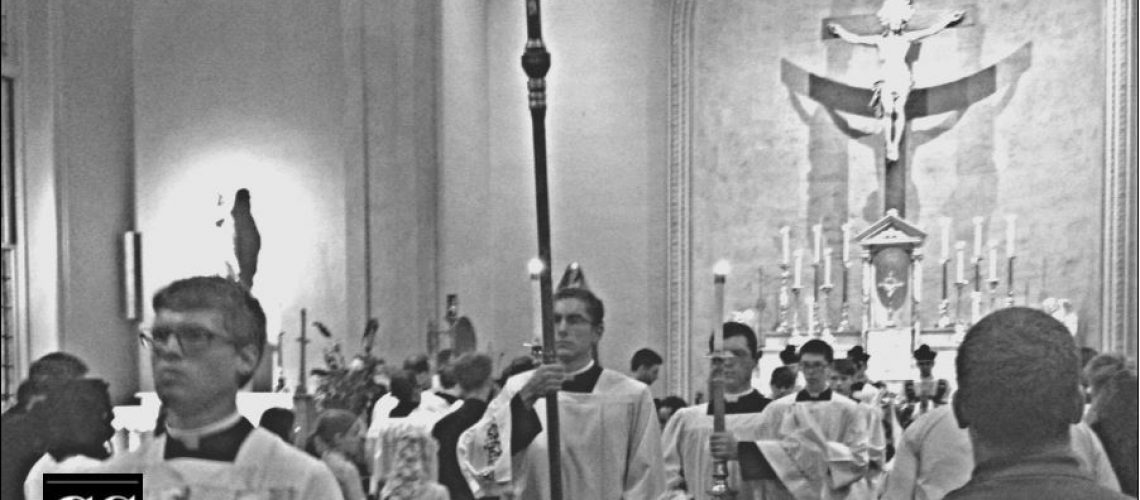
Recently I found an old picture from my grade school days. It was taken inside the church in the parish where I grew up (circa late 50s to early 60s). Just like that, it escorted me back in time.
In the picture, the church was filled with all the kids from the school and many parishioners. The photo was taken from the church balcony, but what the occasion was, I do not know. As I stared at that picture, however, my memory jumped into overdrive.
They called us Altar Boys
Back then, I was part of a unique group of young men called “altar boys.” Boys historically served at the altar during Mass to encourage priestly vocations. Traditionally boys became acolytes (altar servers) as the first step in the “minor orders” of a seminarian’s training for the priesthood. This changed in 1972 when St. Pope Paul VI issued the motu proprio Ministeria Quaedam. (Also see here for more information.)
In 1994 the Congregation for Divine Worship and Discipline of the Sacraments (CDWDS) issued a ruling saying that the correct interpretation of Canon 230.2 allows for girls to be altar servers. The CDWDS further clarified the ruling in 2001 saying “that diocesan bishops could not oblige priests to implement a diocesan policy allowing for female altar servers.” (See here for more information.)
I began my tenure as an altar boy in fifth grade. We were around ten or eleven years old. This was the earliest age Father Hyland would allow us to enter “service to the Lord.” Recruiting and training altar boys was serious business to Father Hyland.
If you wanted to become an altar boy you had to let your teacher know. Your teacher would then inform Father and he would personally interview you.
We were youngsters, and Father Hyland, in his wrinkle-free, black cassock and shiny black shoes, was an intimidating figure. His white, cellulose priest collar seemed so tight that you thought he might choke at any moment. And the aftershave lotion he wore was so intense that it took several seconds to get used to the powerful fragrance.
The “Interview”
We stayed after school for the “interview.” Father was in a classroom, and the “wannabe” candidates would stand out in the hall. Father called us in one at a time.
I can still remember how terrified I was when my turn came. After all these years, I only remember the first question, “Well, son, tell me, why do you want to be an altar boy?”
I do not remember how I answered or what I said. All I can recall is being handed a small booklet with the Latin responses printed out phonetically. This was so we could learn to pronounce every syllable correctly. Ad Deum qui laetificat juventutem meum and underneath was printed Ad Deum qwee lay tif ee cot yu ven tu tem mayhem (or something like that). The last thing I remember of that meeting was him saying, “Be here tomorrow after school.”
Learning to speak Latin
Learning to speak in Latin and when to respond was a challenge. When you got to the Suscipiat Dominus sacrificium etc., at the end of the offertory prayers, there was a tongue-twister that gave all of us trouble.
Today, in the Novus Ordo Mass at the end of the Offertory, the priest, facing us, says: “Pray, brethren, (brothers and sisters), that my sacrifice and yours may be acceptable to God, the almighty Father.” The congregation responds, “May the Lord accept the sacrifice at your hands for the praise and glory of his name, for our good and the good of all His holy Church.”
I included the above in English to give you an idea what we fifth graders had to learn in Latin way back when. In Latin the priest says, “Orate Fratres, ut meum ac vestrum sacrificium acceptabile fiat apud deum Patrem omnipotentum.” The altar boys would promptly respond, “Suscipiat Dominus sacrificium de manibus tuis, ad laudem et gloriam nominis sui, ad utilitatem quoque nostrum, totiusque, ecclesiae suae sanctae.”
The part of the response highlighted above gave us all fits. A few of us got through it somewhat unscathed, but for some reason, most of us suddenly had marbles in our mouths and what would come out was a language of unknown origin. It took a year or two for most of us to get it “almost” right. We were lucky because Father Hyland, demanding as he was, knew us. He knew we would never pass the Latin test we had to take before being officially presented with our Surplus (the white puffy shirt with the over-sized sleeves we wore over our cassocks).
The Altar Boy Exam
The final exam required before being elevated to “Altar Boy” status was verbal. Father brought us into church one at a time and began saying a “rehearsal” Mass. He would start at the beginning of the Mass and keep going. We needed to respond at the proper time. If we did not make the correct Latin response, we would have to write the Confiteor 10 times for extra homework.
That night, besides doing Mother Mary Gabriel’s fractions, I had to write the Confiteor in Latin 10 times. I remember wanting to watch “Captain Video and His Video Rangers” so bad, but I couldn’t. I had to write the Confiteor. You had to really want to be an altar boy to stick it out.
All of us passed our exam, however, and received our Surplus. Years later, I realized that Father knew we would never get it right, so we all “graduated.” After all, we were 5th graders, and he knew we were afraid of him.
Father Hyland may have been a demanding taskmaster, but we were the best altar boys in the south Bronx. At least, that is what Mother Mary Augustine told us.
The Masses
I served as an altar boy into my first year in high school. Back then, we had the regular Low Mass, celebrated by one priest and two altar boys without music. There was also the Missa Cantata Mass, which was the Mass done in song. It had one priest, and a master server plus two servers called acolytes.
The Solemn High Mass was, and still is, the most beautiful presentation of the Mass. This holy offering of the Mass includes three priests; the celebrant, the deacon, and the sub-deacon, usually all priests. There is the master altar boy, the crème de la crème of all the other altar boys. That position Eddie O’Reilly and I ascended to in eighth grade. Two other acolytes were responsible for the censer and boat (the incense and charcoal guys).
When the occasion called for it (Christmas, Holy Week, etc.) there were also Torchbearers and a Cross Bearer. Yup—there would be altar boys all over the place. A Solemn High Tridentine Mass is still something to behold.
Much was expected of us
Much was expected of us. We wore black cassocks during the week and red on Sundays and Holy Days. We also wore those stiff, celluloid collars with the big red or black bows tied in front of them. I hated them, especially in the summer.
I also did not like serving at funerals. The only upside was that we would get called out of class to serve. The fact is, there were many funerals and, even as a kid, I would rather have stayed in class. And every Monday night was a Novena and Benediction at 7 p.m. We all took turns serving at those devotions.
There was one great perk in being an altar boy. It was when you were assigned to serve at a wedding. You always received an envelope with money. Sometimes one dollar. Sometimes two dollars or five. Once, Ronnie Murray and I got $10 each, but Father Quirk made us give it back. He said it was too much. He let us keep two dollars each. We were really ticked off we and said a lot of grumbly things. But we made things right – we went to confession the following Saturday.
You know, it is a funny thing, but I am quite happy I found that old picture. I had a lot of wonderful memories hidden away that came back to life. Sometimes an unexpected journey back in time can be a beautiful thing.


I’ve already forgotten how I arrived at your pages, but I certainly enjoyed your article, as well as the many comments from former altar boys. From the posts, I see that I may be the senior (in age) altar boy here. haha!!
I was brought to a Catholic orphanage in 1952. I don’t think I’d been at the “home” for that long before a new group of recruits was needed to serve mass. I was the first from our group to serve mass, and I was pretty proud of it!
When my grandparents fetched me from the convent, I continued to serve mass in the tiny northern community we lived. The young priest there couldn’t believe his luck!
My warmest regards to all you fellow servers. God bless every one of you. And thanks for the chance to reminisce, Larry. [Comment Edited due to length]
Excellent article! It really brought me back to my days as an alter boy at St. Francis de Sales Church in Holland MI. I was born in 1960 and remember the days when mass was said, or sung, in Latin, but as I grew up that changed and the mass was said in English. I also attended St. Francis de Sales School and seem to remember becoming an alter boy around 3rd or 4th grade. I was part of the second wave of boys in my class to do so, and it was a piece of cake by that time. No scary interviews or intensive training. The first wave had to learn the Confiteor and they were mighty proud of that. We didn’t have to learn it, and I remember when I broke the news to the first alter boys that I would be serving mass that weekend they all protested, saying that I couldn’t be ready already. One of the boys demanded that I recite the Confiteor right then and there, and my reply of “We don’t have to say the Confiteor anymore” brought much surprise and disbelief. “Says who?” they demanded to know. “Deacon Mike” I responded. To this day, I am still amused that I knew that information before they did.
My other memory is of always trying to call dibs on the “Bells” alter boy position, so that you could ring the bell during the consecration of the Eucharist. The next best position was “Book”, where you would hold the book for the priest while he said a prayer to the congregation. So, if another alter boy beat you to the punch and called “Bells” before you did, you quickly followed with “Book!”, so as not to be relegated to one of the other jobs where it seemed like you just sat for most of the mass. Fond memories. Thanks for reminding me.
Hi Larry,
I recall my birthday in Rome, Italy as I was being processed to come to America. I Had not yet learned how to serve mass and so the priest got mad at me. I would in time arrived in the Midwest and attend Catholic Grade School in Des Moines st. Anthonys and serve mass. I always had trouble with the Latin responses at the foot of the altar. My time in those years : 1954 to 1957 were precious if I look at them from today: 2025. I loved funerals and their processions in the region of Venice in my native country of Italy. I would join a monastery and abbey in 1961 and my proudest moment was when as a lay brother served as a subdeacon I guess it was then. My mother always wanted me to be a priest: a high calling of hers for me to be a priest in her family. I was an orphan in Italy having lost my family for some crazy reason and so I immigrated to the States to find a family who would have me. It was not a great time trying to fit into a family that never prized my Italian heritage. And so I say great work writing this stuff , Larry. I value your story highly.
Reading all of your stories about being Knights of the Altar are all so inspiring. I serve the Traditional Latin Mass at my home parish, and it is something that greatly moved me to finally discern the priesthood. Listening to (or reading, namely) your testimonies makes me want to keep such a thing alive as a future Priest for the next generation, God willing. I have a friend who just turned 70 who echoes similar fond memories of serving. He still serves to this day and actually taught me how to serve Low Mass, with that phonetic guide for the prayers… “How to Serve Low Mass and Benediction.” God’s blessings to all. Also, if you want to go to the Old Mass, see if there’s an FSSP or ICKSP Church nearby!
[…] altar boy. (My experience was similar to that of Larry Peterson’s, as he related in his article “We Learned Latin and Were Known as “Altar Boys.”) My success rate, however, is rather dismal. Even the monetary inducement for serving at […]
Dear Larry,
I was an altar boy in the Bronx too in the 1960’s at St. Clare’s parish. What parish were you in? Your posting brought back a lot of memories.
I found it by looking for the Latin passage of “Suscipiat…” to explain to my wife what it meant. I laughed out loud when I read your description of trying to memorize that response. We all had trouble with it, and the ending was not much more than mumbling. The priest was a Father Anthony who was usually very patient, but certainly he would lose it when no one could get the Suscipiat right, and we were surpressing giggling a each others’ mangling of it.
Your mentioning of the cassock and Surplus (I had forgotten that’s what it was called) also reminded me of my mom (who passed in 2018 at the age of 96) ironing it to be ready for me. It was important to her that I was presentable on the altar.
I actually liked getting out of class weekday mornings for funerals. As I remember it made quite an impression on an 11-year old to see families mourning over a loved one who had died, while the other kids were learning fractions. So one was connected to something bigger and made conscious of mortality in a natural way, even one’s own mortality, at quite a young age. I think kids and even adults nowadays do not have this experience.
I’d be happy to hear from you.
With Best Wishes and Ad majorem dei gloriam
Emil Mottola
Hi Emil (That was my dad’s name) I came from Morris Ave at 163rd St St. Angela Mericis’s. walking distance to Yankee Stadium. St. Clares is not very close to where I came from. but memories of days gone by are certainly similar. I did go to Mt. St. Michael which was probably fairly close to you. Would you believe, i just tried to recite the Suscipiat and did it. Can;t believe i remembered it. LOL… Thanks for connecting Emil. Maybe we can chat sometime. here is my site cradlingcatholic.com
I just noticed that you sent this message in Feb 2022. Going on two years ago Can’t believe it
God bless
Larry Peterson
I served the Latin Mass for 8 years …. we rattled off the Latin quite mindlessly as they do now at Latin Masses. We got a big box of chocolate candy every Christmas and Easter and our priest took altar boys to the beach in Ocean City Md. during the summer. Never any impropriety of any kind.
Why Paul VI allowed a suspect Msgr to murder the Mass is unfathomable to me. A straight translation to the vernacular wouild have been wonderful and we could have preserved tradition by keeping the Sanctus, Pater Noster, Agnus Dei, Ecce Homo and a few other Latin touches. The miscreants did all they could to signal obeisance to the Prods. And then they make this sad Pope a Saint – my eye
I go to a Maronite Catholic Church now and the reverent Liturgy is a blessing. But I still say the Pater Noster and Ave Marias at least daily.
Interesting you mentioned how there was never any impropriety of any kind. In all the years I was around different priests (we always had four in our parish) there was NEVER any impropriety either. I do miss those days.
God bless,
Larry P
In 1958 I became an altar boy. I served at Mass until 1973. Oh how I miss those days. Carefree and only praying I didn’t make a mistake.
Me too Gregory me too.
I will turn 70 next week, and I served as an altar boy from 1961 until 1967. I don’t remember much of the latin, but I do remember, “Ad Deum Qui…” and strangely enough, “totiusque ecclesia sui sancti”. A proud moment was when Fr. Ventresca told my parents I had “altar presence”.
Flash forward to a few years ago when visiting in the Dallas, Texas area. At Sunday mass all of the altar servers were adult women in albs. They also had 10 Eucharistic ministers, all women, for about 200 people. The celebrant gave communion to the ministers, and then sat down while they distributed communion to the congregation. Strange indeed.
I was trained to be an Altar Boy and served faithfully for several years. When I was about 13 the new pastor decided hat I had to go … as I was taller than he was.
I am now a western rite Russian Orthodox Priest and loving it.
Hi Father–That is so fabulous that you found your PLACE as a Russian Orthodox priest. God bless you Father. I shall remember to pray for you.
Larry P
Hello again, Larry. Actually I never felt cheated when I was told in second grade that I would be allowed on the altar for my First Communion but never again until the day of my wedding. That’s just the way it was and I was fine with that. Actually I would still be fine with that.
My younger brother was an altar boy from fifth grade on. I remember my mom and dad sitting at the kitchen table helping him learn the responses. The altar boys knew in general what they were saying because everyone used the St. Joseph Missal with the Latin on the left and the English on the right. We certainly understood the parts of the Mass and what was going on. When I made my First Communion in second grade, I was told that I would never be allowed onto the altar (beyond the communion rail) until the day of my wedding. My brothers had quite a special privilege.
Hi Jean–Thanks for the comments. I still have two St. Joseph Missals as you described. Sometimes I sit and flip though one. It is so cool to take a quick trip back to those days. And yes—I imagine many young women of that time felt cheated by not being allowed into the sanctuary. Well, those days are gone. Not an issue any longer. Did you know that during the 13th century people rarely received Holy Communion. The Fourth Lateran Council of 1215 mad it a REQUIREMENT for people to receive at least ONCE a year. So over the centuries many things have changed . What NEVER changed is the REAL PRESENCE of Christ truly present in the Blessed Sacrament.
God bless,
Larry P
\
My time as an altar boy at St.Peter the Apostle in a tiny fishing village in Cape Cod introduced to me the Mystery of Mysteries. That experience has been with me for almost 60 years. It is the reference point that guides me through the confusion and chaos of the last 50 years. I often pray for Fr Mayhew and Msr. Duarte who made the choice to bring me into the intimacy of thw sacrament at thw age of 7. I still see it in Latin Rite masses. I can see myself in little bespectacled kids bowing and praying in Latin. This will never be destroyed.
YES Dr. G.,
I love the phrase, “Mystery of Mysteries” and that is what it was and still is. It has also been my footing throughout my life. God bless
Larry P
One of the downers of being a server was getting the pump water at 6:45 A.M., for the 7:00 AM low Mass. Especially in a cold January Minnesota winter. We survived and were better for it.
I thought braving the cold NYC winters by walking up four block to the convent to serve Mass was harsh. I imagine that was “cake” compared to January in Minnesota. The memories are great though, aren’t they?
What wonderful memories, Mr. P! I grew up in the 60s and 70s, but because I listened to my father’s, uncles’, and husbands stories, it brings it all back.
My husband, at the age of 60, still is a server when needed, as are many of the men in my parish. They consider it a great honor. My dad and uncles did the same. The young boys who do not want to serve do not know what they are missing. In fact, since our parish school closed decades ago, there is a group of men who serve at funerals. The parish has cassocks and surplices in their sizes.
It has always amazed me that my father and his brothers, and so many other boys of that time, could memorize the Latin – but they did, and did it well. Because their parish was very close to Goodyear Tire and Rubber headquarters, when WWII started, there were shifts. The pastor had Masses at 5:30 AM and throughout the day to accommodate the rubber workers and defense plant workers, and dad and my uncles were up and at ’em whenever Msgr. Dowed asked.
I still – after 33 years – regret not being able to catch the altar boys at our wedding to give them a gift for serving at our Mass. It was a Saturday afternoon, and I am sure they had ball games to get to.
Thank you, Mr. P, and God bless and protect you!
We “old timers” from the Latin Mass days were blessed to be part of all that. Thank you so much sharing your memories. Nowadays, the spirituality that was in the air back then seems to have evaded us. We all need to pray hard for the Holy Spirit to help us in recapturing it. God bless
Thanks for the memories. There are many of us old “altar boys” out here who remember fondly the days of our service at the altar.
In our parish, we had a kindly sacristan who thought of us altar boys as her grandsons and would treat the whole group to cook outs regularly. We also enjoyed the tips for serving at weddings and funerals – plus the getting out of class for a little while.
As Archie and Edith sang “Those were the days”
Yes indeed, “Those were the Days” TY
I think the spelling of surplus is surplice, no?
HA! Good eye Dennis. You are absolutely right.. OOPS on me SURPLICE is the correct spelling.
You are correct.
[…] ISSUE: Transforming the Culture – Deborah Sucich at Ignitum Today We Learned Latin & Were Known as “Altar Boys” – Larry Peterson at Catholic Stand Shia LeBeouf To Star as Padre Pio in New Movie, What Could […]
Sir, as a 75 year old Roman Catholic, I too remember those days – watching the very ‘handsome’ Alter Boys on a daily basis because we had Low Mass every morning before school started. We grade school girls watched every move and prayed along with their responses as well. We too learned Latin by ‘sound’, not by understanding. Actually the Requiem Masses were my favorite as the upper classes were required to attend and chant the Gregorian the Latin Mass. Stunning music. Much thanks for the stroll down memory lane. Such a shame all has fallen by the wayside – at least in our Parish.
Thanks for sharing Mary—As an altar boy I did not like being around so many crying people. We were closely involved with the funeral service (standing at the casket with the priest(s) having the holy water and incense at the ready, carrying the cross etc We were just kids and sometimes the overflow of emotions from the nearby family was hard for some of us to deal with.
Larry:
a fellow old timer from same time period – only
on the west coast, L.A. The memories synch up.
As Littleelf said, a testimony to the universality of our faith. An edifying stroll down memory lane. Thanks!
THANK YOU Bob–Glad you liked it
God bless
Larry P
A marvelous essay, Mr. Peterson. Although I am from a Kentucky diocese, I share either the same or similar memories, a testament to the universality of our faith. We had to have passed the second grade to qualify as an altar boy. We also were given the Latin transcript and tested. Our enforcer was Sr. Adelaide, a five foot something Benedictine powerhouse who ensured we knelt upright and played our roles correctly. I well remember the excitement of graduating to Acolyte and Censer, the weddings and funerals and especially the Friday Benedictions. For High Masses we four would sit on a bench in cassock and surplus waiting for father to vest and it was there I engaged in a fist fight with a fellow server, now a dentist, who laughs with me about it to this day. I thank God for this foundation that that moored me when later in life I drifted and nearly drowned, and I thank you for sharing these memories.
Thanks for sharing you experiences. The story about the fist fight is priceless. Do you guys remember WHY you fought? lol
I think it was over the cassock – he had taken my preference – although it is just as likely a failing in my family line: On the occasion of my son’s first confession, when his confessional was read out by alphabet, he and a string of boys ran at breakneck speed. On his arrival second he proceeded to engage in a fight with the first place winner at the door of the confessional!
Coming from a home where I spoke Italian (Sicilian), I had an easier time with Latin pronunciation even though I didn’t know what I was saying. I don’t recall being formally interviewed or quizzed, although we were told to review the English translation of the Latin; but that didn’t appear to be important. In my Italian parish, we generally gave Latin an Italian pronunciation, and many of us had no problem.
Thanks Peter Those were the “good old days”, weren’t they?
Wonderful and wonderful! As an adult convert to Catholicism, I’ll never catch up with all these wonderful bits of knowledge.
Thanks for sharing.
Your welcome Mary. We experienced a rich trove of traditions and customs that are rarely used today. But devotions such as Benediction, Adoration, Novena’s and others are still in effect and, on occasion, in Latin.
Take care,
Larry P
Yes Ida, we experienced a rich trove of traditions and customs that are rarely used today. But devotions such as Benediction, Adoration, Novena’s and others are still in effect and, on occasion, in Latin.
Take care,
Larry P