
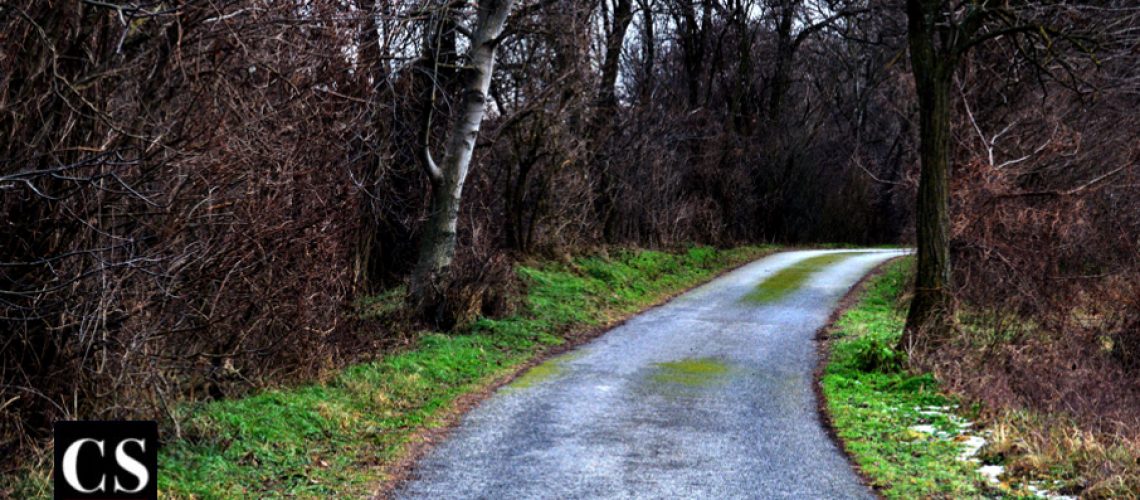
For our fortieth wedding anniversary, my husband and I traveled to New England. Autumn leaves painted the Berkshires and the Green Mountains like a multicolored carpet. Moderate temperatures made for invigorating walking, and we were blessed with fine weather. Our destination was based largely on these seasonal factors, but we also had spots of interest that we wanted to see. In our wandering among those places, unexpectedly, the trip became a series of pilgrimages.
Blessed by Fellow Pilgrims
The idea of pilgrimage occurred to me at one of our first stops, the National Shrine of Divine Mercy in Stockbridge, Massachusetts. We visited the gift shop and bought presents for our grown children and small grandchildren, and a book or two for our own edification. Across the property was the chapel. It happened that we arrived just in time for their holy hour.
As is often the case, the presence of other people in the little church added another dimension to our visit. Other travelers to this beautiful place had also made time to pause and worship. We were blessed by the presence of fellow pilgrims in the presence of the Lord.
Other than Sunday Mass at a church in Vermont, the Divine Mercy Shrine was the only obviously religious place that we planned to visit. But God is everywhere, and on this trip that became apparent.
An Author and an Activist
We visited “The Mount”, where author Edith Wharton lived from 1901 to 1911. Wharton was among the early 20th century elite, writers, movie stars, and socially prominent individuals who made their home in New England, away from the bustle of the city. She was dedicated to making her mansion and the vast gardens around it lovely. I marveled at the difference between my lifestyle and that of Edith Wharton when discovering the many rooms at The Mount which had been occupied by servants and staff.
Wharton’s divorce in 1913 made changes in her life. Finding it difficult to maintain success as a divorced woman in America, Wharton left behind the home into which she had put so much energy. She moved to Paris and entered a romantic relationship with a correspondent for The Times of London.
The Massachusetts birthplace of Susan B. Anthony, where we stopped next, contrasted with Wharton’s expansive manor. Edith Wharton’s home reflects the kind of worldly success she had. Her novels include upper-class heroines and explore the manners of elite society. On the other hand, the home of Susan B. Anthony is evidence of hard work, simplicity, and child-rearing.
A young docent led us on a tour of the plain and practical house where Anthony lived as a young child. Her parents, a Quaker and a Baptist, had raised their children with Christian principles, and the family led a simple yet industrious life. The front living room had been transformed into a general store by Susan’s father, Daniel. Handmade quilts, toys, and embroidery samplers revealed something of the daily activities of the children.
One of the last rooms we saw at the museum depicted the causes for which Susan B. Anthony is known. I knew that she was a passionate fighter against slavery and in favor of women’s suffrage. These issues led to her renown as a social reformer. I also was vaguely aware that there is a Susan B. Anthony List, but not clear on what it encompasses. I learned on the tour of her home that Susan B. Anthony advocated against abortion. Even in the 19th century, abortion had emerged as a solution to problem pregnancies. Mindful of the plight of women pushed by men to end their pregnancies, Anthony saw abortion’s ill effects on women’s well-being. She actively opposed the New York-based abortion provider and midwife known as Madame Restell.
History and Truth
As the tour guide reached the part of her recitation that included Anthony’s pro-life stance, we could sense tension among some other guests. Anthony’s activism against slavery and in favor of women’s suffrage was admirable to everyone present. But it was clear that one tourist, in particular, could not accept what the docent so calmly and matter-of-factly explained about our heroine’s commitment to women and to the unborn. She questioned the truth of what was stated, and suggested that Anthony was something of a hypocrite. It was a tense moment, but the docent concluded the tour graciously, neither flinching at nor conceding to the discomfited guest’s remarks.
I admired the Susan B. Anthony Birthplace Museum’s honest reporting of all her causes, both those that are popular now and that one which was unpopular to at least one guest. History and truth cannot be altered to suit the tastes of the culture.
This reflection made me aware that our pilgrimage had not ended with the Divine Mercy Shrine. Our own commitment to the unborn, and to mothers who need support throughout their crisis pregnancies, was reflected in Susan B. Anthony’s respect for life. For Susan B. Anthony, this respect included the slave, the oppressed woman, and the unborn child. Our pilgrimage had brought us to the home of a Christian social reformer.
Another surprise for me was a signature on the home’s guestlist. An autograph book had been kept at the house for over a century. Illustrious names appeared, one of them a hero of mine. Written in her familiar block letters, with some effort, was the signature of Helen Keller, whose biography comprises a pro-life message. Physically blind and deaf since the age of eighteen months, Helen Keller proved that life is worth living.
A Steep Pilgrim Walk
Our pilgrimage continued to an estate in Stowe, Vermont. The Von Trapp Family Lodge commemorates the family of Maria and Captain Georg von Trapp, the subjects of the Broadway musical and movie, The Sound of Music. Generations of fans, moved by the tremendous story of this family, have enjoyed the estate. Our tour included the lodge built for guests, the farm where the family worked after immigrating to America, and wonderful hiking trails in the hills. A gated-off corner of space enclosed the family cemetery. The tour guide explained that the local bishop had blessed the ground so that it was indeed a Catholic cemetery.
We learned on the tour that both Von Trapp’s sons had fought for America in World War II. One son, Werner, found himself in a particularly dangerous battle during the war. He promised God that if he survived the battle, he would build a chapel back home. Honoring his promise, Werner built a stone chapel behind the family’s lodge.
Walking up the steep, wooded hill to the chapel became part of our pilgrimage. The woods were in their glory, colorful and brisk. The leaves crunched beneath our feet, and guests on the way down told us the climb would be worth it. I gathered a few vibrant fall leaves and placed them on a rock for a picture. About a half mile uphill, we saw a small, stone chapel, rugged, sturdy, and beautifully rustic. It had spaces for windows, although no glass filled them. When I leaned over a window ledge to see inside, another pilgrim told us that we could walk in the door.
Leaves and twigs had made their way into the chapel through the windows. Along the wall opposite the door stood an altar. A box labeled “Prayer Intentions” sat at the side of the altar, but the number of intentions so exceeded its capacity that papers overflowed. Dozens of scribbled prayers remained on the altar. It was humbling to see the faith of so many people, visiting out of interest in the famous family, and stopping to write a prayer intention at a small, stone chapel in the woods.
We didn’t realize when we left New Jersey that we were on a pilgrimage. Yet isn’t that what life on this earth is? We are the pilgrim Church, wandering here until our time of encounter with our Lord.


I don’t see how one can link to the Susan B. Anthony List (SBA), not be sure what it’s about. Then go on to mention abortion. The Susan B. Anthony List is one of the bigger Pro-Life organizations in the country. Their President, Marjorie Dannenfelser regularly appears on the EWTN pro-life weekly show with Prudence Robertson.
That actually brings me up to the next point a bit, I agree that New England has many great locales to visit pertaining to our Catholic faith (Our Lady of LaSalette in Attenboro as well). So, this really is not a dig at New England, I see the same thing in Minnesota, California and New Mexico. Why do these places with all of these Catholic sites have such lenient policies towards the right to life. I guess, even Ohio with all the good things they have joins the “choice” club. It’s frustrating, you have the Bible belt and the right to life seems to be respected more. But Indiana, the Dakotas and so on are doing well in this category as well. It’s just something I often think about.
Faithful,
Thank you for reading the article.
If you look again, you’ll see that I wrote, “I was also vaguely aware that there is a Susan B. Anthony List, but not sure what it encompasses.” That is: WAS, past tense. Now that I have researched in order to write the article, I do know what the Susan B. Anthony List is. It is wonderful that writing helps us to learn more, as we research our topics thoroughly.
For your second point, I must say that I don’t see where anything I wrote in this article exposes a lenient policy toward right to life. However, we are on the same side in that we work and pray for all to realize the great gift and the sacredness of life.
Sincerely,
Mary
Yes, it is a very good article. I did not in any way, mean to be combative in my response. I happened to see just this past week pictures of that chapel of the Von Trapp family in VT. A lot of stone.
The Divine Mercy Shrine in Stockbridge even has an article for the June 8th reflection “Chaplet Miracles Outside an Abortion Clinic” that might be an article of note to some readers here. All this said, I think my point was how un-pro-life the laws are in some states. Father John O’Connor started the order of the Sisters of Life. A great order. I guess, I only pondered how frustrating the laws are regarding the right to life in some states. I did not really care to mention them by name and will drop this subject. Best to pray the Chaplet told to St. Faustina by Jesus.
Your essay was wonderful reading this morning and I learned so many things about your New England area. The “discomfort” you describe whenever abortion is discussed by “pro-choice” folks is their unwillingness to face the fact that another human being is killed. Deep in their consciousness, they know it’s wrong and hypocritical, but their need to be included with the “cool” side stops them from admitting that.
Truth will prevail. As with slavery, abortion will be defeated.
Thank you again for your wonderful essay!
Cynthia,
Thank you for your kind words. Yes, despite what we tell ourselves to rationalize our behaviors and attitudes, ultimately the Lord speaks his truth in the depths of our hearts. And so we need to help people to hear what is in the depths of their hearts.
Thanks for reading the article!
Mary