
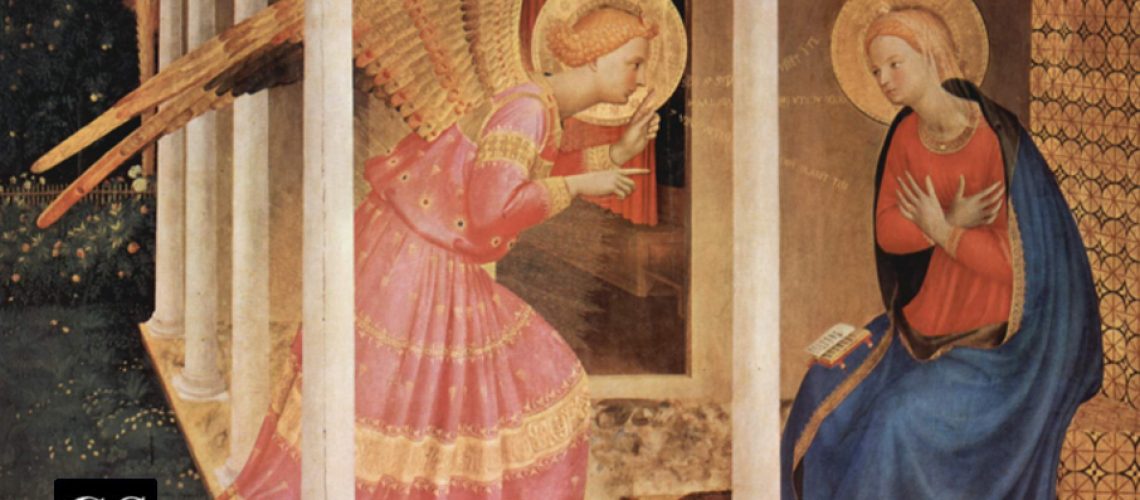
As Advent progresses, our thoughts turn increasingly to the Blessed Virgin Mary. Her Immaculate Conception, her sinless life and her many merits inspire us to turn to her for help. After all, as we pray in the Memorare, “never was it known that anyone who fled to her protection, implored her help, or sought her intercession was left unaided.”
With this mindset regarding Mary, I was surprised some time ago to hear a perspective of the Annunciation that criticized the Virgin Mary for her response to the angel Gabriel. The argument accused Mary of doubting the angel’s announcement to her. It cited the fact that Mary’s initial reaction to Gabriel is a question, not an assent.
Naturally, I found this criticism disturbing, as any cradle Catholic, Marian devotee might. Accusing Mary of doubting the angel’s words seems to mar the beloved “fiat” that led to our salvation.
Parallel Encounters with Gabriel
A study of the first chapter in the Gospel of Luke confirms the holiness of Mary’s response to Gabriel. Before this, however, the reading shows a less desirable response from another recipient of a visit from the angel: Zechariah. Close reading of these parallel encounters reveals the difference between doubt and whole-hearted faithfulness.
Both narratives relate that Gabriel tells the visionary, “Do not be afraid” (Luke 1:13, 30). Thus, one can surmise that both Zechariah and Mary expressed some surprise or fear of the apparition. In both stories, Gabriel announces an impending birth, and in both the child to be born is to be illustrious in some way. Encountering Gabriel, both Zechariah and Mary ask a question and express a perspective. It is the type of question that distinguishes the faithful response from the skeptical one.
Zechariah’s Question
The familiar narrative of Gabriel’s announcement to Zechariah includes a glowing account of the child Zechariah and Elizabeth are to conceive. Gabriel promises Zechariah joy and gladness at the birth of a son named John. The angel prophesies that John will be filled with the Holy Spirit, and will turn people toward the Lord “in the spirit and power of Elijah” (Luke 1:13-17). Being elderly and having a wife beyond normal child-bearing years are impediments to Zechariah’s ability to believe Gabriel. He questions, “How shall I know this?” and gives reasons why it is impossible.
Gabriel’s reply to Zechariah may well have sent shivers down the man’s spine. Imagine the magnificence of the angel, as that being proclaimed, “I am Gabriel, who stand before God. I was sent to speak to you and to announce to you this good news” (Luke 1:19). Zechariah is then told that he will be mute because of his disbelief. Dire consequence, indeed, for his hesitation to accept the angel’s happy declaration.
How Similar Was Mary’s Question?
The argument referenced in the beginning of this article claims that Mary’s question was similar to Zechariah’s. Yet Mary receives no dire consequence for her question. Why does Zechariah suffer for daring to question the angel, while Mary is blessed, and delivers a triumphant Magnificat a few lines later?
Let’s look at the question Mary asks. Gabriel announces that Mary will conceive and bear a son who will be called “Son of the Most High,” and who will inherit the throne of David. Mary says, “How can this be, since I have no relations with a man?” (Luke 1:31-34). Like Zechariah, her question is followed by the reasons why what the angel has declared seems impossible. However, her question does not necessarily indicate doubt. “How can this be?” can imply acceptance of the angel’s word, while merely expressing a wish to understand how the prophecy will come true. Mary asks, literally, how will this happen? She needs to know what she is agreeing to before she consents.
Conversely, Zechariah’s question, “How shall I know this?” expresses disbelief, and challenges Gabriel, as if to ask for a sign. He wants proof before he can know the prophecy is valid.
Still, let us remember, in all humility, not to judge Zechariah. How many of us at age 80 or so would readily believe a vision that told us we would become parents at that time of life? It is enough to consider how many times we have reacted with skepticism or disbelief to gospel truths or teachings of the Church that we found difficult to accept.
The Holiness of Mary’s Response
One could even argue that Mary’s question makes her assenting reply more meaningful. In response to Mary’s question, Gabriel explains, “The Holy Spirit will come upon you, and the power of the Most High will overshadow you” (Luke 1:35). This is something no other human has experienced. How will anyone believe that Mary’s pregnancy is miraculous, and not a result of infidelity?
Mary’s agreement to the plan is all the more deliberate, and all the more holy, because of both what she has learned from her question and what she cannot yet know. She knows she will bear a child who has no human father. And she agrees to that. Further than that she does not need to know. Mary does not consider the consequences to herself. She does not ask, “Who will take care of me?” nor “Will I be all right when the child is born?” She trusts in the Lord who has made this plan.
May we never hesitate to turn to Mary for assistance. May we imitate her holiness, faithfulness, and trust in the Lord. And if we need to ask questions of our Lord, may our questions never express doubt, but always demonstrate our trust in him for answers, in his time.


[…] Knight9 December – Feast of St. Juan Diego. Amazing Miracle Story! – Fr. Z’s BlogTwo Questions for Gabriel – Mary Ennis Meo at Catholic StandBefore & After: St. Mary’s Catholic Church in […]