
“What is truth?” Pontius Pilate’s question might very well be our own today. Over the last century and more, truth as a concept has had its hard-edged, impersonal character softened to something malleable and customizable. Where once the Enlightenment thinkers once sought to divorce fact (a relatively recent concept) from value, the postmodern thinker now considers facts themselves to be subjective, truth-neutral opinions or “social constructs.” As Catholic Stand co-founder Stacy Trasancos recently wrote, even the concept of (objective) reality is under assault from—of all institutions—the physical sciences. Everything we think we know is an illusion.
Or is this epistemic dead end itself an illusion, the product of philosophical wrong turns taken in the liberal spirit’s retreat from the Middle Ages?
Does the House Exist?
Let me propose a simile: A house stands on a hill in a suburban development—perhaps a three-bedroom, split-level home with a basement, like the one I grew up in. Gather some people around it. Let them come from various countries, various social classes, even different times in history. Let them be male and female, religious and irreligious, straight and gay, cisgender and transgender, whatever and its opposite whatever. In other words, let them be as diverse as individual people are.
Placed at different points and times around the house, the people all gain different ideas of the house’s width, length, height, age, and aesthetics. Their ways of portraying the place to others also vary: It’s too large, too small, too similar to other houses, or too distinct; it’s charming, it’s an eyesore, etc. One takes snapshots while another sketches it in pencil, and a third uses watercolors or creates a pointillist oil rendition. One person figuratively transports the house to sit on the edge of a seaside cliff. Their impressions and conclusions are as diverse as the people are.
It would be one thing to say that all their impressions reveal something about the house. It would be another, more dubious thing to say that all their impressions are of equal value in describing the place. Finally, it would be yet a third and more outrageous thing to suggest that the house wasn’t real, that it was a projection of all their minds (including the one person who used various contracting tools to measure it in exhaustive detail). Especially if the person who suggested it were promoting their own impressions as authoritative.
Yet that’s where we are now: A significant segment of the intelligentsia busily denies that there is such a thing as objective truth, even as they insist that their facts ought to be treated as the only ones that matter. Now it seems that the physical sciences, the last bastion of objective reality in the secular world, have lost their epistemic footing.
Projecting Our Limits
This denial of objective truth is not so much hypocrisy as it is unconscious blindness to the self-contradictions of unrealist epistemologies. By their own arguments, subjectivists have no way of knowing that what’s true of them is true of anyone else. Similarly, relativists’ “truths” are products of their cultures, social classes, and environments, while perspectivism is valid only from specific points of view. The unrealist’s only self-consistent answer to any question ought to be, “I don’t properly ‘know’ anything about anything,” followed by silence. Otherwise, their theories become so many ad absurdum arguments in favor of epistemic realism.
It’s not that unrealist arguments have no valuable insights or that realism is without any problems. We are mind-dependent in that everything we learn about the world is filtered through our imperfect senses and fallible minds. We are subject to cognitive biases and distortions, to physical and psychological pathologies. We don’t all start learning from the same place, nor do we understand all the same things in the same manner. Some things we know are concrete and specific, others more abstract, generalized, and therefore disputable. The realist only argues that knowing objective truth is possible, not that it’s easy.
The fallacy comes from projecting our limits onto the universe, transforming uncertainty and ignorance into pseudo-knowledge. If we can’t know what causes particles to shift from one state to another, then that state change has no cause. If we can’t measure something exactly, its occurrence—even its existence—is inexact, indefinite. Such beliefs are essentially appeals to ignorance: If you can’t prove A to be true, then A must be false (or vice versa). The result of these assumptions? An experiment that some claim proves the moon isn’t there when no one looks.
Skepticism, SPABs, and Wigner’s Friend
The current state illustrates the danger of Cartesian skepticism, the technique of beginning inquiry from doubt. Skeptics argue that if a condition C could exist in which a commonly accepted truth T is false (T only if ~C), then we can doubt the truth of T. But does condition C exist? No matter, the skeptic answers; that it could exist is sufficient to undermine T’s credibility. Logically, we can’t know C not to exist, so we can’t say T to be true. Within such reasoning, it’s conceivable that we’re all sims in a game designed by superpowered alien beings (SPABs).
Again, however, we’re arguing from ignorance. If C is merely a doubt for doubt’s sake—if it can lead us nowhere, or contribute nothing further than doubt—then we can have some confidence in the truth of T. Skepticism is not self-validating. At some point, skeptics must show their grounds for doubt to be reasonable, even if those grounds aren’t compelling or conclusive. Without those grounds, the SPABs are no better than invisible pink unicorns, flying spaghetti monsters, and other boggart-Gods atheists use to horse-laugh theists. Using the law of parsimony, we can excise SPABs as unnecessary.
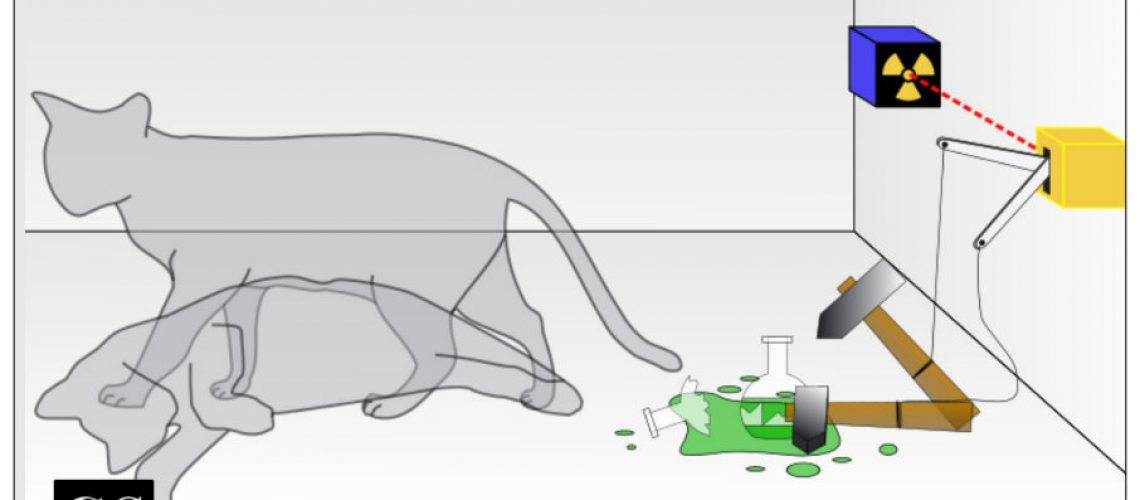
If the “Wigner’s friend” experiment about which Dr. Trasancos writes calls into question the reliability of scientific observation, it necessarily challenges the facts on which the researchers based their experiment and their conclusions. In other words, by invalidating science, the experiment would invalidate itself. Indeed, the experiment was based on a patently unverifiable assumption: particles behave differently when they’re not observed. We don’t need to believe Schrödinger’s cat is both alive and dead while it’s in the box simply because quantum mechanics has to take both states into account. We can simply accept that we can’t know its current state.
Truth, Reality, and Faith
Ironically, the Catholic René Descartes introduced the skeptic’s technique of doubt to prove the soul’s existence. In doing so, Descartes functionally severed the mind from the body, and thus the mind from the physical universe outside the body. Descartes’ intellectual descendants, the idealists, went further. If St. Paul could not trust the body’s appetites, the idealist could not trust the body’s senses, their reports, or the mind which makes them intelligible. We could only know what was inside our heads, and we couldn’t even be sure of that. Under such conditions, how can we know what truth or reality is?
Jesuit philosopher Fr. James V. Schall reminds us, “We begin with something than which nothing is clearer. We begin with the fact before us that something is. If we doubt this, we can make no further progress. We cut ourselves off from what is immediate to us” (emphasis mine). Existence precedes essence: Before knowing what something is, you have to know that it is. To be real is different yet inseparable from being; where essence is being as intelligible, reality is being in action, motion, or change. To deny a thing’s reality is to deny its existence.
Truth, at its simplest level, is a statement of what is. Philosopher Claude Tresmontant reminds us that pistis, the Greek word in the New Testament we translate as “faith,” itself translates the Hebrew emunah, which means “objective certitude regarding the truth” (The Hebrew Christ, 151). We can’t begin to prove anything unless there are some fundamental things we can take as certain without needing evidence. And one of those things in which we must have faith is that some things are, that “there is an ‘is.’” Another is that that “is” is intelligible.
We don’t have to know everything. We just have to be able to know what we know, to know that we know.
Conclusion
Catholic writers, with some exceptions, tend to focus on spiritual and moral truth. However, our physical being logically precedes our spiritual and moral being. Western skepticism has worked backward over the last 500 years, doubting and denying those premises that lead to unwelcome conclusions, finally to come knocking at the door of first principles. Postmodern thought takes pride in contradicting common sense as “regressive,” treating as axiomatic their conviction that the “Great Conversation” was so much barbarian idiocy. We’re at a stage where “Truth is whatever yields the desired result” isn’t a cynical dismissal but rather a nonpartisan operating principle.
From what little we know of Pontius Pilate, it may have been his operating principle.
Occasionally, though, we see and hear signs that people know what truth is. We believe in “inconvenient truths,” so long as they don’t inconvenience us. We know that “facts don’t care about our feelings,” so long as we’re not the ones offended by them. Perhaps in time, we’ll remember that some truths have a hard-edged, impersonal character, that we must adapt to them because they won’t adapt to us. On that day, when the world becomes real again and the moon is there even when no one looks at it, we’ll find that knowing the truth makes us truly free.


[…] “Truth, Unrealism, and the Danger of Skepticism,” I argued that Cartesian skepticism poses a threat not only to science but also to knowledge […]
Hard not to see an irony in the latest article on this website being an anti-vaccine piece that denies the demonstrated realities of the Covid virus:
https://catholicstand.com/open-letter-to-the-catholic-bishops/
If you had actually read the post, you’d have known that it didn’t deny a single reality of the covid-19 virus. What it does challenge is the safety and efficacy of the vaccine (in fact, it denies that the mRNA shot is a vaccine). I’m not in a position to either support or attack the post, although some of the sources he cites appear at face value to be obscure, even sketchy, and I’m quite tired of the right-wing “threat to freedom” narrative anyway. But at least I had the courtesy to read to the end rather than making up my mind about the contents halfway through the lede.
[…] ‘Pregnant People’ Terminology Prompts Backlash from Women – Lauretta Brown at Daily Register Truth, Unrealism, & the Danger of Skepticism – Anthony S. Layne at Catholic Stand The Disturbing Case of Father Michael Guidry – […]
https://www.insideedition.com/for-the-father-of-a-sandy-hook-victim-conspiracy-theories-are-much-more-than-just-internet-fodder
Creating an alternate “truth” is these days overwhelmingly a right-wing proclivity. This particular one is the doing of Alex Jones, whom Trump has praised as a good buddy, and who has never had one word of criticism directed at him on this site.
That would give him the attention he craves. You, of course, are free to submit a piece about him as a guest columnist. I’ll even do the editing myself if you ask. Just be sure to check the submissions guidelines. Far more worrisome to me than the bilge Jones publishes is the fact that there’s such a big market for it.
I’m flattered by your remark though I don’t have the time to do a carefully written and researched piece.
This is a timely article, and I think it hits on a number of topics affecting both our church and our world. The meaning of truth has been lost, and unfortunately it cuts across the spectrum of ideologies. On one side, people want to have their own “truth”, and they also tend to think everyone else should also be entitled to their own version of the truth. I agree that this is wrong. We can’t get anywhere if we can’t accept basic facts. On the other side of the spectrum, we have a slightly different version of the same thing. While decrying those who want to have their own truth, the other side has decided to define the truth as whatever they want to be true regardless of evidence. It has spawned “alternative facts”, the Big Lie about the election, QAnon, baseless vaccine skepticism, and more. I think both sides of this phenomenon are directly related to one another, and we need to tone things down and bring people back the middle where we can base discussions around facts.