

When I originally wrote “Not Of the World: Catholic Tradition and Separation” in 2018, I had in mind the devotional and disciplinary practices that filled pre-Vatican II Catholicism. However, the word tradition can mean different things, especially within “churchspeak.” For many people, tradition consists of no more than doing a particular thing at a prescribed time, for no other reason than because that particular thing has always been done at that time. But that isn’t tradition; that’s merely custom or habit. Doing something simply because your parents, grandparents, and other forebears did it is not what makes a tradition.
What Does “Tradition” Mean?
Let’s start with the word itself: Tradition comes from the Latin traditio, “handing over, surrender; transmission,” and is related to the verb tradere, which means among other things “to teach.” The Vulgate uses traditio and tradere to translate the Greek παράδοσις (parádosis) and παραδίδωμι (paradídōmi), words St. Paul uses in specific contexts related to teaching. Paradídōmi is especially connected with the verb πᾰρᾰ́λᾰμβᾰ́νω (parálambánō), “to take upon, take in pledge, receive by hearing or report”:
For I received [parálambánō] from the Lord what I also handed on [paradídōmi] to you, that the Lord Jesus on the night when he was betrayed took a loaf of bread, and when he had given thanks, he broke it and said, “This is my body that is for you. Do this in remembrance of me.” In the same way he took the cup also, after supper, saying, “This cup is the new covenant in my blood. Do this, as often as you drink it, in remembrance of me.” For as often as you eat this bread and drink the cup, you proclaim the Lord’s death until he comes. (1 Corinthians 11:23-25)
Paradídōmi and parálambánō refer back to oral tradition, the most ancient method of teaching used by humans. Even though the Imperial-era Jewish and Hellenic cultures were relatively literate, teaching was primarily through oral tradition. The most basic form of oral tradition stripped the lesson to its essentials, which teachers then drilled into their students through rote repetition. The more elaborate forms used by poets and storytellers would build on these bare bones, but the basic tradition could survive generations of transmission with little loss of fact or meaning. (So no one should compare oral tradition with the “Telephone Game”!)
Thus St. Paul:
But how are they to call on one in whom they have not believed? And how are they to believe in one of whom they have never heard? And how are they to hear without someone to proclaim him? And how are they to proclaim him unless they are sent? As it is written, “How beautiful are the feet of those who bring good news!” … So faith comes from what is heard, and what is heard comes through the word of Christ. (Romans 10:14-15, 17, emphasis mine)
Tradition and Scripture
Tradition, in this sense, is synonymous with teaching, especially teaching done through repetition. However, it’s teaching meant to be handed down from generation to generation. In its transmission, it creates not only continuity but communitas, the unique bond that distinguishes a community from a mere gathering of individuals. This is the basis for what we call Sacred Tradition or the apostolic tradition: the faith as passed down to us from the very beginning from the apostles’ oral teachings. Tradition is not just old teaching that’s preserved but was always meant to be kept intact.
In many discussions of Catholic beliefs, especially when defending against Protestants, people tend to treat Sacred Tradition as if it were something apart from Sacred Scripture. However, only within Sacred Tradition is there such a thing as Sacred Scripture. Outside of it, the Bible is only a compendium of old books that mention God. The Bible does not contain its own hermeneutical and exegetical rules; those too are products of the apostolic tradition. Tradition thus determines not only the content of the canons but their interpretation. This is how St. Augustine of Hippo understood the relationship:
Perhaps you will read the gospel to me, and will attempt to find there a testimony to Manichaeus. But should you meet with a person not yet believing the gospel, how would you reply to him were he to say, “I do not believe”? For my part, I should not believe the gospel except as moved by the authority of the Catholic Church. So when those on whose authority I have consented to believe in the gospel tell me not to believe in Manichaeus, how can I but consent? (Against the Fundamental Letter of Manichaeus 5)
Bugle Calls and the Eucharist
The smaller, more specific rituals and rites that we call “traditions” also perform teaching functions, whether to pass on a particular belief or to train us in a particular way of life. Take, for example, military bugle calls:
With the advent of the radio and loudspeakers, the need for horns to signal commands rapidly disappeared. However, bugle calls still play a role in governing military life, from the first “Reveille” a new recruit hears at boot camp to the final “Taps” played at a serviceperson’s burial. Like oral traditions, bugle calls can create powerful communal bonds—esprit de corps—and instill a common ethos that civilians, except for family members, don’t always understand. (Witness Robin Williams’ reaction when soldiers attending a performance in Kuwait suddenly turned away from him for “Retreat” and “To the Colors.” [Caution: mild profanity.])
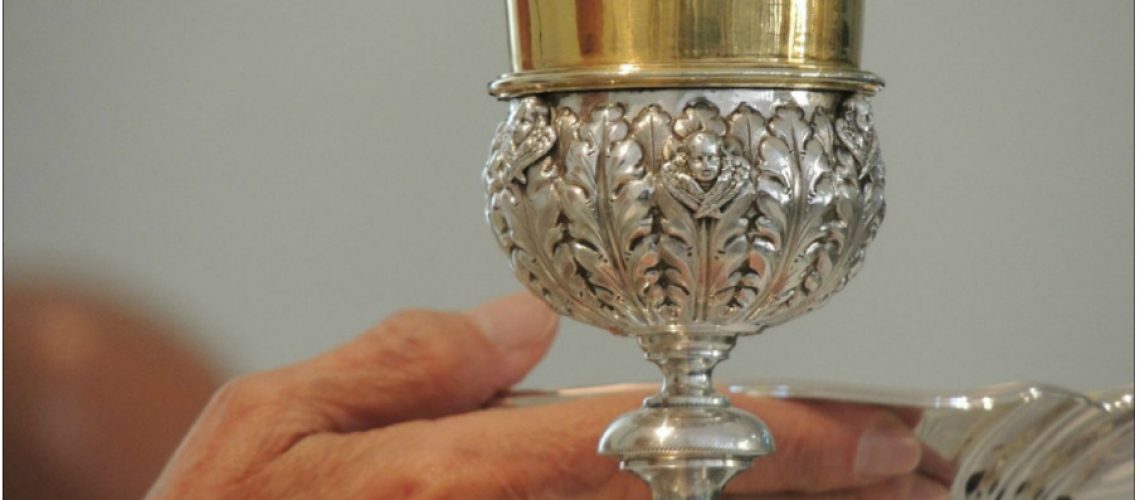
The most powerful such ritual, the one at the center of Catholicism, is the Eucharistic celebration. Fundamental to this tradition is our faith that the priest isn’t simply rehashing Christ’s actions at the Last Supper, but rather is re-presenting them; that is, bringing them from the past into the present. For that small slice of time, the priest is Christ offering his true Body and Blood to the faithful; he is acting in persona Christi, “in Christ’s person.” And our partaking of the Eucharist is, in St. Paul’s words, sharing or participating in his Body and Blood (1 Corinthians 10:16).
In other words, the smaller traditions don’t exist for their own sake. They serve to perpetuate and inculcate the faith, as well as to build the Church as a community distinct from other communities. Of the two functions, the former is prior to the latter in logic and necessity. A tradition which doesn’t teach the faith—or, worse, distorts it—may still keep us distinct, but it’s a distinction we can and should do without. On the other hand, a church without traditions isn’t a community, let alone one that can maintain doctrinal continuity over time.
Continuity and Community
Continuity with the original apostles and first disciples explains why the Church is at great pains to protect Sacred Tradition. There are differences between organic and artificial change, true reform and mere innovation. Jesus and the apostles, we can reasonably assume, only taught one gospel message. That one gospel message, like the mustard seed in Jesus’ parable (Matthew 13:31-32; cf. Mark 4:30-32, Luke 13:18-19), has grown and put out ramifying branches. But it isn’t supposed to become some hybrid plant or slowly change into something different, like the mustard bush inexplicably turning into a mulberry tree or a holly hedge.
The Latin-rite Church’s traditions aren’t the only valid means of ensuring the gospel message’s continuity. In fact, there are five other liturgical traditions comprising 23 distinct rites, from the Coptic Catholic Church to the Syro-Malankara Catholic Church, all in communion with Rome. And despite almost a thousand years’ separation, the Orthodox Churches are closer in doctrine to the Catholic Churches than are the Anglican and Lutheran communions. To give full justice to the Eastern Catholic Churches’ traditions is not to deny or lessen the value of Latin-rite traditions. Only we Western Catholics can demean our own rich cultural legacy.
The smaller Catholic traditions served to hand down (tradere) not only the faith but a communal way of life that sustained and nourished it. That way of life is now largely a thing of the past, destroyed by the economic, social, and political changes of the last 100 years. Simply reintroducing these older traditions, I believe, won’t suffice by themselves to revitalize Catholicism in an age of ersatz “virtual communities.” At the same time, though, we can hardly rebuild Catholic communities as real, physical presences—the village it takes to raise a child, so to speak—without reinstating old traditions.
Or even creating new traditions.
Conclusion: The DNA of the Church
Tradition can become mere stale custom when we lose sight of the function it plays in passing on the Catholic faith, when we do things simply because we’ve always done them. At the same time, we’re right to be suspicious of the silly modern assumptions that everything newer is better, that change is good merely for being change, and that to be old is to be wrong or irrelevant. Our mission to spread the gospel message is also a mission to protect the gospel from disintegration and distortion—to keep the faith as well as to hand it on.
Tradition, in this sense, isn’t just in the DNA of the Catholic Church. Rather, it is the Church’s DNA, the complex double-helix that carries the identity of the Church through the ages. All living things suffer change over time. Yet they carry markers that distinguish them from other living things, even those most similar to them. The living Church has suffered many changes over the centuries, yet she is still the same Church against which Jesus said the gates of Hades would never prevail (Matthew 16:18). So she will remain, as long as we hold fast to the traditions passed on to us (2 Thessalonians 2:15).





6 thoughts on “Tradition, Custom, and Continuity of the Faith”
Pingback: THVRSDAY EDITION – Big Pulpit
Here is a thought:
“Jesus and the apostles, we can reasonably assume, only taught one gospel message…”
Why say, “we can reasonably assume” when we know that Jesus and the Apostles taught only one gospel message?
We know that Jesus and His Apostles only taught one Gospel, and that was and is the Lord Jesus Christ’s Sufferings, Death, Resurrection, and Ascension into Heaven, and is seated at the Right Hand of God His Father.
There is no other Gospel Good News.
God bless, C-Marie
Why say it? Well, you can say it when you’re attempting dry humor, which apparently fell flat. God bless.
It’s interesting that Jewish traditions reach back over 3000 years and are practiced in their
(almost) original forms. I wonder what the Mass will be like in another 1000.
Vatican II, in Dei Verbum 21 says: “Therefore, like the Christian religion itself, all the preaching of the Church must be nourished and regulated by Sacred Scripture.”
Sacred Scripture is the part of tradition that regulates the remainder of tradition.
Before the printing press, it could not be widely distributed because it was hand-written and costly. Now it is available for free and widely distributed. With the help of the Holy Spirit which all Christians are supposed to have, we can now all read it for ourselves with spiritual discernment. Scripture is no longer available only to the clergy and those who could afford it.
There is now a wider pool of the faithful who are able to participate in tradition (see Vatican II’s Dei Verbum 8 and Lumen Gentium 12).
One can argue that Martin Luther, John Calvin, John Wesley, and other reformers read Scripture “with spiritual discernment.” Saint Vincent of Lérins observed in the fifth century that “owing to the depth of Holy Scripture, all do not accept it in one and the same sense, but one understands its words in one way, another in another; so that it seems to be capable of as many interpretations as there are interpreters” (Commonitory 5). In other words, you can often pour into Scripture the content you want to pour out of it. That hasn’t changed in 1,500 years, not even with the printing press. Indeed, widening the pool of readers also increased the potential sources of error. “Therefore,” St. Vincent concluded, “it is very necessary, that the rule for the right understanding of the prophets and apostles should be framed in accordance with the standard of Ecclesiastical and Catholic interpretation.” (loc. cit.)
The Church’s understanding is that neither Scripture nor Tradition are subordinate to the other, but rather part of a three-legged stool that includes the magisterial authority of the Church. “It is clear, therefore, that sacred tradition, Sacred Scripture and the teaching authority of the Church, in accord with God’s most wise design, are so linked and joined together that one cannot stand without the others, and that all together and each in its own way under the action of the one Holy Spirit contribute effectively to the salvation of souls.” (Dei Verbum 10) The sense of the faithful has always been one of the deposits of faith, and it’s well that we have more direct access to Scripture for the nourishment of that sense. But there’s still a valid raison d’être for the teaching authority of the Church: The spirit that offers us guidance isn’t always the Holy Spirit.