
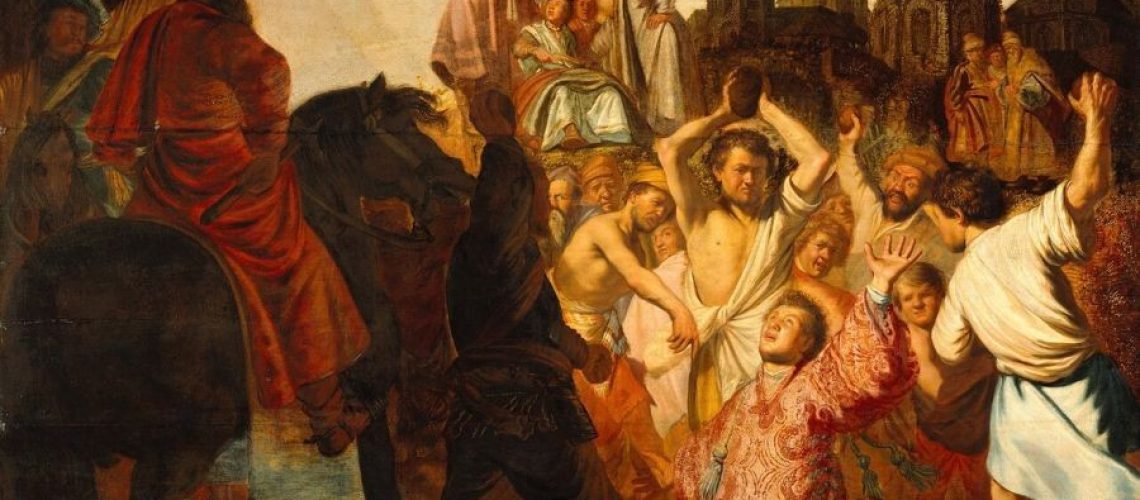
History remembers two very different kinds of people. It remembers tyrants for the suffering they caused and it remembers martyrs for the faith they refused to surrender.
Ironically, the virtue of the martyrs became visible precisely because of the cruelty of the tyrants. The tyrants sought power while the martyrs sought truth. The tyrants relied upon fear but the martyrs relied upon God. Without the darkness of persecution, the brilliance of heroic faith would not have shone so brightly.
A Paradox
This paradox is one of Christianity’s greatest mysteries. God never wills evil, yet He allows evil so that a greater good may emerge. St. Augustine expressed this beautifully in his “Enchiridion On Faith, Hope, and Love” (Chapter 8, par 27).
“For God judged it better to bring good out of evil than not to permit any evil to exist.” – St. Augustine
The tyrants intended to destroy Christianity. Instead, they became the unwilling instruments through which the Church displayed some of her greatest saints.
Imagine a diamond lying in a dark cave. Under ordinary light it appears beautiful, but when placed beneath an intense beam, every facet sparkles. The pressure that formed the diamond and the light that reveals it work together to display its beauty. So it is with the martyrs. Their faith already existed within them, but persecution revealed this brilliance for the world to see.
Jesus Himself prepared His disciples for this reality. He never promised them comfort or worldly success. Rather, He warned them, “If the world hates you, realize that it hated me first” (John 15:18). And again He tells them, in John 16:33, “In the world you will have trouble, but take courage, I have conquered the world.”
The martyrs believed these words. They understood that following Christ meant carrying a cross before wearing a crown.
The first Christian martyr, St. Stephen, provides a remarkable example. As stones rained upon him, he did not curse his executioners. Instead, he prayed, “Lord, do not hold this sin against them” (Acts 7:60).
His prayer echoed the words of Jesus from the Cross: “Father, forgive them, they know not what they do” (Luke 23:34).
Stephen’s executioners displayed hatred. Stephen displayed charity. The greater the cruelty, the more radiant his forgiveness appeared.
Trying to Stamp Out Christianity Backfired
Throughout the first three centuries, Roman emperors attempted to eradicate Christianity. Nero blamed Christians for the fire that devastated Rome. Domitian demanded worship as a god. Decius required citizens to sacrifice to pagan idols. Diocletian launched what historians call the Great Persecution. They imprisoned bishops, burned churches, destroyed sacred books, and executed countless believers.
Yet every attempt to extinguish the Gospel produced the opposite effect.
The early Christian writer Tertullian observed this remarkable truth in his Apologeticus (chapter 50) when he declared, “The blood of Christians is [the] seed [of the Church].”
Every execution became a sermon. Every martyr became a witness. Every act of cruelty strengthened the resolve of those who remained.
It is much like trying to extinguish a forest fire with the wind. The harder the wind blows, the farther the flames spread. The tyrants believed they were suffocating Christianity. Instead, they were fanning its growth.
This teaches us something profound about virtue itself. Courage cannot exist where there is no danger. Patience cannot exist where there is no trial. Forgiveness cannot exist where there is no offense. Mercy cannot exist where there is no injury. Likewise, martyrdom cannot exist where there is no persecution.
The tyrants did not create the martyrs’ virtue, just as a storm does not create the strength of a lighthouse. The lighthouse was already built upon solid rock. The storm merely revealed its strength.
Christ’s Cross
The Cross of Christ stands as the greatest example of this truth.
The Roman authorities, together with those who rejected Jesus, intended His crucifixion as the ultimate humiliation. They believed they had silenced Him forever. Yet what appeared to be history’s greatest defeat became history’s greatest victory.
St. Paul writes, “We know that all things work for good for those who love God” (Romans 8:28).
The Cross demonstrates that God’s providence can transform humanity’s worst evil into humanity’s greatest blessing. The Resurrection forever changed the meaning of suffering. Since Easter morning, suffering united to Christ is never meaningless.
This perspective changes how Christians understand hardship.
Most people pray for lives free from suffering. The saints prayed for faithfulness within suffering. They recognized that comfort often hides our weaknesses, while trials reveal our dependence upon God.
Gold is purified by fire. Steel is strengthened in the furnace. Athletes grow stronger through resistance. Likewise, faith grows stronger through testing.
St. Peter reminds believers, “In this you rejoice, although now for a little while you may have to suffer through various trials, so that the genuineness of your faith, more precious than gold that is perishable even though tested by fire, may prove to be for praise, glory, and honor at the revelation of Jesus Christ” (1 Peter 1:6-7).
The tyrants thought they were burning away Christianity. God was refining it like pure gold.
Martyrdom Continues
Even today, martyrdom continues. Throughout the world, Christians still face imprisonment, torture, discrimination, and death because they refuse to deny Christ. Their witness reminds us that martyrdom is not merely an event of the past but an enduring reality.
Yet there is another form of martyrdom experienced by every Christian.
Most believers will never face lions in an arena or execution by the sword. Instead, they are called to what the Church has often described as a “daily martyrdom.” Every time a Christian forgives an enemy, remains honest when dishonesty would be profitable, defends the unborn, serves the poor, remains faithful in marriage, or publicly professes Christ despite ridicule, he or she dies a little to self.
Jesus said, “If anyone wishes to come after me, he must deny himself and take up his cross daily and follow me” (Luke 9:23).
The world still presents countless “tyrants.” Some are governments. Others are ideologies, addictions, temptations, peer pressure, selfish ambition, or fear itself. These forces attempt to separate us from Christ. Yet every temptation resisted becomes another opportunity for virtue to grow.
Ultimately, the story of the martyrs is not just about the tyrants.
Few people today admire Nero, Diocletian, or countless other persecutors. Their monuments have crumbled, their empires have disappeared, and their names often evoke only shame. The martyrs, however, continue to inspire millions of believers centuries after their deaths. The tyrants sought temporary power. The martyrs received eternal glory.
Virtue Endures
The lives of the martyrs proclaim the promise of Christ: “Remain faithful until death, and I will give you the crown of life” (Revelation 2:10).
In the end, tyranny always destroys itself. Virtue endures forever.
The cruelty of the tyrants revealed the courage of the martyrs, but it never defined them. Their strength came from Christ. Their hope rested in the Resurrection. Their victory was won not by violence but by love.
Thus, the paradox remains one of Christianity’s most profound lessons: while the tyrants intended to extinguish the light, they only made it shine more brightly. God transformed instruments of death into witnesses of eternal life, proving once again that His providence is greater than human evil and that no darkness can overcome the light of Christ.


[…] Cosima Clara Gillhammer’s Light on Darkness: The Untold Story of the Liturgy – NLMThe Virtue of the Martyrs Could Not Be Seen Without the Cruelty of Tyrants – Cathol Stand MagFix Your Focus – A Homily for the 19th Sunday of the Year – Msgr. […]