
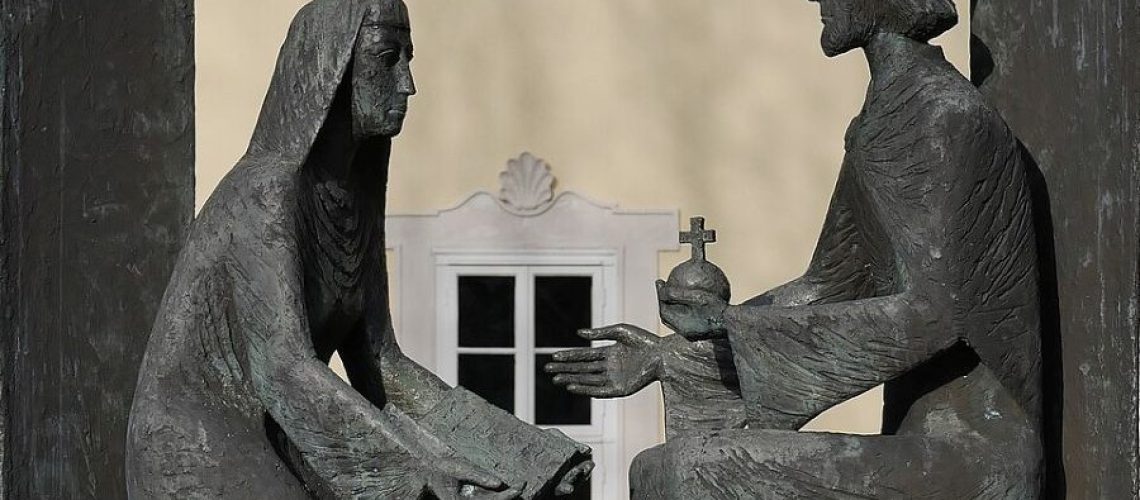
Far beyond the claims of post-modernity, the first female authors did not emerge in the West during the 18th, 19th, or 20th centuries. While few and far between, we see their voices developing in monastic communities during the alleged Obscura Tempora. Long before contemporary conversations about women’s voices in the Church and in our culture, a forgotten Saxon canoness quietly picked up a stylus and decided to answer the great playwrights of the ancient world. The result was one of the most remarkable literary projects of the burgeoning Middle Ages. Her name was largely forgotten for centuries, only recovered by chance during the Renaissance, with the aid of some sympathetic scholars. She is Hrotsvitha of Gandersheim.
We know little of the life of Hrotsvitha. She resided at a time and place when significant biographical information was scarce. We do know that she lived at the imperial abbey of Gandersheim Abbey, a wealthy and intellectually vibrant religious community founded in the 9th century during the centralization of the Frankish church. Unlike many convents of the period, Gandersheim functioned like a proto-university. It thrived as a court of learning on the German frontier. Its Augustinian canonesses were not cloistered in the strict sense. They engaged with the world, and were educated. They were often aristocratic women who participated in the growing cultural life of the young Holy Roman Empire. The relatively anonymous nun, Hrotsvitha, was one of them. By the middle of the 10th century, she would be emblematic of a growing intellectual movement, and in turn, would become the first female playwright of the West.
However, her distinctive literary project began with a substantial problem. Throughout the early Middle Ages, students continued to read the plays of the great Roman dramatist, Terence, whose formal prose made him a staple of Western Latin education. Terence’s comedies often involved themes that were welcome and familiar to a pagan Roman audience: seduction, deception, and sexual intrigue. However, for a new Christian intellectual class, particularly for professed canonesses, these themes created an uncomfortable moral situation. The composition of the Latin was no doubt beautiful, but the subject matter was less than wholesome for a monastic audience. More often than not these pagan themes were seen as grounds for moral censorship, as they were regarding a potential threat to pass before the eyes and ears of the faithful. Hrotsvitha, keen as she was, observed this, and her response was ingenious. If Terence’s artistic style and composition was so compelling, why not imitate his dramatic form while transforming its moral content? Hrotsvitha wanted to celebrate “the laudable chastity of Christian virgins” in the same ornamentation that had once glorified licentious Roman behavior. Hrotsvitha’s dramatic vision was an ambitious one, she would try to out-Terence Terence.
The result was a collection of six plays that read like the moral inversion of classical works of comedy. In Hrotsvitha’s dramas, male persecutors attempt to seduce or destroy Christian women, only to be confounded by the women’s great courage and faith. One of her best-known works, Dulcitius, tells the story of three Christian sisters who refuse the advances of a Roman governor. When he attempts to assault them in prison, divine intervention grants him a state of general confusion, and his amorous embrace comes to rest on a set of kitchen pots instead, emerging from the room covered in soot and humiliation. It is slapstick with an underlying theological point: all earthly power collapses when confronted with the truth of spiritual integrity.
In Callimachus, Hrotsvitha dramatizes the resurrection of a young woman whose beauty had attracted the obsessive attention of a local pagan admirer. The narrative of the story becomes a prolonged meditation on the fundamental need for repentance and God’s divine mercy. Hrotsvitha, across the corpus of her works, transforms classical theatrical tropes into vehicles for the Christian imagination and moralism. Like with later playwrights like Bertolt Brecht, Hrotsvitha saw theater as the opportunity to explore contemporary mores and advocate for social and political change. That being said, her surviving work did not stop with theatrical drama. She also wrote epic poems and several historical works, including a short work celebrating the reign of the German Emperor Otto I, who had recently consolidated the medieval East Francian kingdom into a united state. In these works, Hrotsvitha reveals herself not only as a poetess, but as a proto-national historian deeply aware of the cybernetic interplay between the political and religious worlds around her.
What makes Hrotsvitha especially striking is not merely that she wrote, but that she wrote with clear self-awareness about what she was doing. That is not to say that she was engaged in some detached academic exercise. In her preface, she acknowledges the novelty of her work: a woman’s pen, composed in Latin and entering a literary tradition where female voices are largely unheard of. Rather than apologizing for the novelty of her own voice, or engaging in any self-aggrandizing claims, she frames her work as a small act of devotion. If God grants talents, she suggests, those talents should be used in His praise.
She died in 973. Of the few biographical details of her life, we can say this. Her works held mild circulation during the early medieval period, mostly within German monastic circles, but it appears that she was quickly forgotten after her death. She would have completely disappeared. The body of her work remained largely unknown for five hundred years, until the humanist scholar Conrad Celtis rediscovered and published them in 1501. Her rediscovery caused some sensation, with claims of forgery and falsification at first by Latin scholars. The German literati thought it was impossible that this 10th-century woman had produced a body of Latin drama that was so biting and insightful, and then would be almost entirely forgotten.
Today, Hrothsvitha is still largely overlooked. While she is a pioneer of women’s literature and writing, she is rarely mentioned in Catholic circles, and entirely ignored in secular ones. She was not trying to launch a novel literary movement or challenge the structures of medieval society with her work. Her goal was more specific and, in some ways, more gently radical, and would not be fully realized until the birth of scholasticism in the 12th century. She wanted to baptize the cultural inheritance of the classical world, giving the arts their proper place within this newly emerging Christian civilization.
In an age when the Church often finds itself debating the relationship between faith and culture, Hrotsvitha’s experiment feels surprisingly modern. She neither rejected classical learning nor absorbed it uncritically. Instead, she transformed it. An Augustinian canoness in a Saxon abbey, writing nearly eleven centuries ago, adroitly demonstrated that the most enduring cultural revolutions sometimes happen not through the noise of protest but through the arts.

