

I have been fascinated with the images in the Book of Revelation most of my life. New interpretations come out almost monthly with incredibly different outlooks: preterist, futurist, allegorical, and spiritual. Muslims have written interpretations, even Carl Jung, D. H. Lawrence, and Edgar Casey. In 2019, four famous atheists wrote a book giving their opinions of the final book of the Bible. There is no consensus on what Revelation means as a whole, and I don’t think the Church has made a magisterial opinion on it. Therefore, I would like to jump into the fray and present my own opinion about one of the most fascinating and discussed images in the Book of Revelation: the four horsemen.
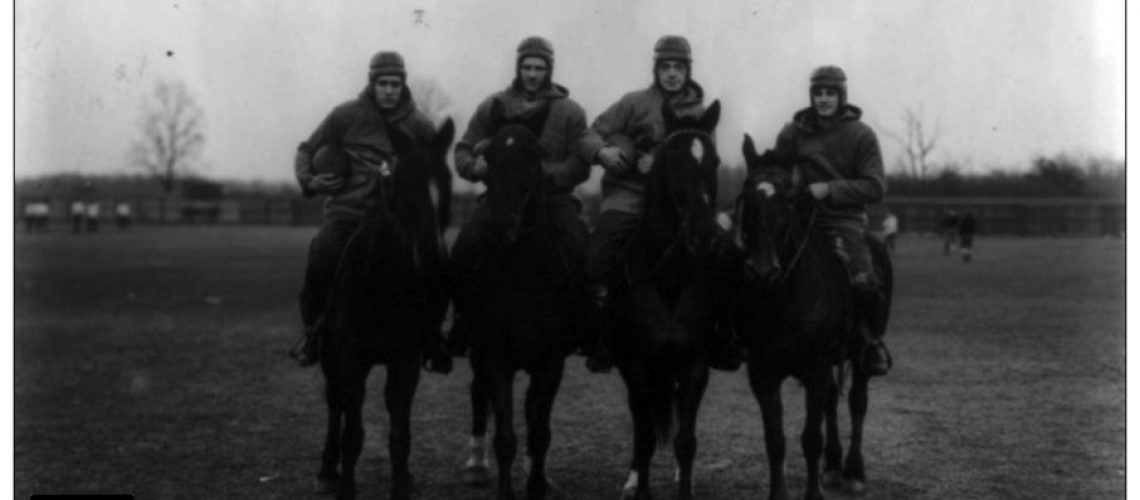
There have been many attempts in America to identify the four horsemen. Probably the most widespread has been to identify them as four symbolic warriors of the end times punishing the wicked. The white horse is identified either as the Antichrist or as Jesus Christ, brandishing a sword, riding out to slay the wicked. Whichever interpretation one comes down on, the four horsemen warrant a deeper, more symbolic interpretation.
The Question of the Author
A critical interpretative key is to identify the source of the visions. Most commentators on Revelation are convinced that Revelation came directly from the mind of John the Evangelist when he wrote Revelation in A.D. 96 on Patmos.
I came across the writings of J. Massyngberde Ford (in The Anchor Bible Series), who proposed that the Revelation of John the Evangelist was a combination of his own preaching and his repetition of the preaching he heard from John the Baptist. She argued that the Greek in Chapters 4 through 11 is noticeably different than the Greek in Chapters 1-3 and in the gospel and Epistles of the Evangelist.
I think she is correct. Chapter 4 contains a vision that is recognized as a theophany showing what God is like. I think this vision vividly shows and explains who the Lamb of God is. It depicts the relationship between the Father, the Holy Spirit, and the Son as well as the Lamb being taken up into the central throne that is occupied by the Father. This indicates that the Lamb is really God, just as Jesus is truly God and truly human, and the vision likely came from John the Baptist, who, as we know, used that very image to point Jesus out to the disciples (John 1:29).
The Main Vision
Revelation 4:1 starts out saying John had another vision: “Come up here and I will show you what must happen after this.” John sees a throne in heaven surrounded by twenty-four thrones with elders on them and with four living creatures full of eyes front and back clustered around the central throne.
This vision shows a scroll sealed with seven seals in the right hand of the Father. A voice asks “Who is worthy to open the scroll and break the seals?” Nobody is, except the Lion of the tribe of Judah, the Lamb standing as though slain having seven horns and seven eyes. When the Lamb takes the scroll to open it, the four living creatures and twenty-four elders bow down before the Lamb singing “Worthy are you to open the seals for you were slain and by your blood did ransom men for God.” This vision has to be announcing Jesus Christ; again, most likely with its origin in John the Baptist.
John the Evangelist was a disciple of the Baptist for a couple years before he met Christ, and he accepted Christ right away. The image of the scroll with seven seals signifies a contract between God and someone who will comply with the conditions of the contract. The vision shows that nobody is able to comply with those conditions except the Lamb. This certainly looks like what the Baptist might have been announcing concerning the Messiah. When someone is found who is able to comply, the seals are opened and, one-by-one, the four horsemen come riding forth.
God confers a sovereign free nature onto human beings, and the contract shows what is likely to happen if humans abuse their freedom while they are still burdened with concupiscence. Tempted by fallen angels, they run amok exercising their own free will without regard to complying with God’s will. Nobody is worthy to open the scroll unless they are able to make recompense to God for humanity’s defiance of God’s will. The Lamb is obviously worthy because He is the divine Son of God, who, in His human nature, made full reparation for the sins of the entire human race and can deal with the monster that could emerge from this rebellious condition.
The Horrors Symbolized by the Horses
The horrors symbolized by the release of horsemen are fourfold. First is the horror of human ambition that not only refuses to serve God but wants to exert one’s own will and be served by others. It is fueled by human pride and arrogance and by a total disregard of what God wants. It rides out of the human heart, like the white horse, in a spirit of conflict and envy, conquest and tyranny, exploitation and greed.
The second horror is the reaction of humans who, not willing to serve God, are hardly likely to accept servitude to other humans. Their resentment will spread through the world, like the red horse, in a wave of rage calling for resistance and war also without regard for what God wants.
The third horror is the result of such activities. The tasks God requires us to do remain undone, and what we have already accomplished is attacked and destroyed. Ruin results and famine, blind terror, and despair. These spread behind the combatants like the black horse as a scourge that afflicts the innocent as well as the guilty and ruins everyone’s happiness.
In the wake of these three comes the fourth horror: sickness and death, the pale horse. This is the worst horror of all: humans seemingly abandoned by God, torn from the joys of this life and thrust into the unknown terror of death. These unfortunate experiences must be corrected if humans are to enjoy the extraordinary blessing of being created with free will. These horrors are endemic to the human race. Individual human beings are only in this life a few generations, but human life itself continues generation after generation until the end of the world.
Very Real Scenarios
In my lifetime, I have seen that the four horsemen are still emerging from the human race. I was ten years old in 1941 when the United States entered WWII. Commodore Perry had demanded, in 1853, that Japan open up to trade with the rest of the world. Japan then commenced a rapid re-organization of her culture, shedding ancient traditions and commencing modernization. In my youth, I remember the influx of cheaply made windup toys: airplanes, cars, etc. These were the early products of Japan’s industrialization. It brought trade and wealth to Japan.
Behind the scenes, Japan also built up its military, eventually making their navy the most powerful in the world: 10 aircraft carriers with 1500 highly trained carrier pilots, 10 battleships, 38 cruisers, 112 destroyers, 65 submarines and various auxiliary vessels and a huge standing army.
The demand for strategic raw materials was immense. Japan could not easily acquire what they needed to continue building their modern culture. The United States opposed their rapidly growing military might and tried to curtail it by embargos, etc. Japan thus felt they must defeat the influence of the United States in the pacific by war.
The White Horse
Japan launched a surprise naval attack on Pearl Harbor on December 7, 1941, in order to cripple the American pacific fleet before the US could take action against Japan. It was a bold and daring attack, and it could have worked if all three of American carriers had not been taken to sea, but it was wicked for Japan to do this. I remember the shock and fear that I and my young friends felt and the reaction of older Americans and our government.
The Red Horse
The American culture immediately turned against Japan. The Japanese people, especially within Japan, were characterized as sneaky yellow villains. I found out later that Japanese Americans were forced into internment camps. The United States immediately declared war on Japan. A few months later, General Doolittle led a surprise raid of small bombers transported by aircraft carrier to launch a punitive attack on Tokyo. It caused a lot of damage in Tokyo, killing a lot of people, but it was not a strategic victory. I remember being jubilant about it. The hatred and venom of this retaliation is also wicked.
The Black Horse
American war policy was to beat the Japanese into unconditional surrender. After four years of massive war causing immense casualties, especially for the Japanese, Japan finally reached a condition where it could no longer wage war. The United States demanded unconditional surrender. Japan refused. The United States dropped two atomic bombs on Japan.
The Pale Green Horse
If Japan had an atomic arsenal of its own, the ensuing atomic war could have ruined human life on earth. Today, around nine nations have not merely atomic, but nuclear arsenals. A nuclear war today, I think, would most likely put human life on this planet close to extinction.
Wars similar to WWII have plagued the human race generation after generation – the Babylonian Empire, the Persian, the Greek, the Roman Empire – one after another, all through history. Humans can’t stop this aggression, but the Lamb can. I don’t like the rigors and suffering caused by human pride and aggression, but I trust the Lamb. He is God and knows what He is doing.
A Warning about Free Will
This vision of the four horsemen is a warning about the logical possible results of God conferring free will on humans. If any humans defy God while the devil is still at liberty to tempt them and while they are still saddled with concupiscence, some of them will inevitably pursue their own selfish interests. This will happen until another world war takes place, which would be a total disaster, given the modern capacity for self-destruction. I think the human race is still in that phase, and that phase will last to the end of time.
The vision of the seven seals was meant to teach humanity to realize that free will comes at a very high price. Those humans who use their free will correctly will wind up with a freedom unimagined because they will eventually be free persons having intelligence like God and able to recognize who God really is. They will form a relationship with Him as free sovereign persons that love God and freely choose to obey Him. Free will is an outstanding gift from God. Those who will never choose submission to God will have to be punished.
As if to reaffirm that point, Revelation’s final battle scene (Revelation 19:11-16) depicts the Lamb as a warrior mounted on a white horse brandishing a sword to slay the wicked.


1 thought on “The Urgent Lessons of the Four Horsemen”
The four horseman is one of those beliefs that cause even unbelievers to sit up and take note. It perfectly fits the human condition, God’s justice and mercy available to all who want it. Several films have been made on the subject, none perfect but the Glenn Ford version is as good as any. Hopefully one day someone will produce a version as close to the intent of Revelation as The Passion of the Christ was to Matthew.