

Most Christians, including many Catholics, do not believe in the Dogma of the Perpetual Virginity of Mary. Many point to the numerous references in the four gospels that Jesus indeed had brothers and sisters as evidence that this dogmatic teaching cannot be true.
Is he not the carpenter, the son of Mary, and the brother of James and Joses and Judas and Simon? And are not his sisters here with us? (Mark 6:3).
On its surface this passage from Mark’s Gospel certainly seems to refute the truth of this dogmatic teaching of the Church. But from its earliest days, the Church has held that Mary was a perpetual virgin. Mary’s perpetual virginity was declared a dogma of our Catholic faith at the Second Council of Constantinople in 553 AD.
To substantiate that the Dogma of the Perpetual Virginity of Mary is indeed true, requires an analysis of several passages from both the New and Old Testaments as well as quotations from early Church Fathers.
The first of these biblical passages comes from Luke’s Gospel.
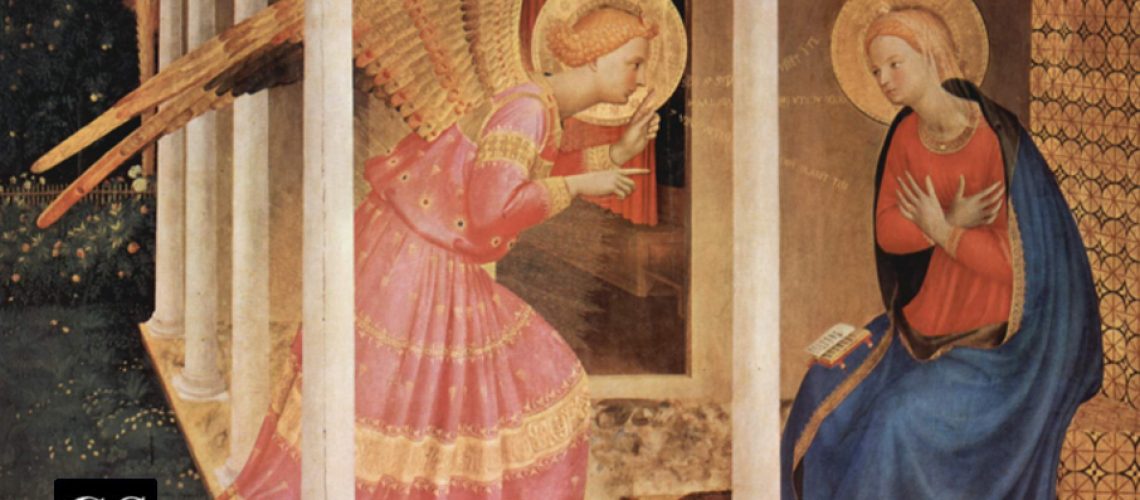
In the sixth month, the angel Gabriel was sent from God to a town of Galilee called Nazareth, to a virgin betrothed to a man named Joseph, of the house of David, and the virgin’s name was Mary. And coming to her, he said, “Hail, favored one! The Lord is with you!” But she was greatly troubled at what was said and pondered what sort of greeting this might be. Then the angel said to her, “Do not be afraid, Mary, for you have found favor with God. Behold, you will conceive in your womb and bear a son, and you shall name him Jesus. He will be great and will be called Son of the Most High, and the Lord God will give him the throne of David his father, and he will rule over the house of Jacob forever; and of his kingdom there will be no end.” Mary said to the angel, “How can this be, since I have no relations with a man?” (Luke 1:26-34).
Doesn’t Mary’s response to the Angel Gabriel seem odd in light of her betrothal to Joseph? Mary’s response to the Angel Gabriel reveals she has had no sexual relations with a man and further strongly implies that there is no intention on her part to have such relations in the future. In the Jewish culture of that time, Mary and Joseph are by virtue of their betrothal, already married but not yet living together. This temporary living arrangement generally lasted between six to twelve months.
It’s important to note that in this passage the Angel Gabriel is silent on when she will conceive. How then does Mary’s response make any sense, knowing that she will soon be living with Joseph as his wife?
It would only make sense if Mary had taken a perpetual vow of virginity which some married women of that time took. The biblical basis for such a vow of virginity can be found in chapter 30 of the Book of Numbers.
If she marries while under a vow (of virginity) to which she bound herself, and her husband learns of it, yet says nothing to her on the day he learns it, then the vows to which she bound herself remain valid (Numbers 30:7).
Therefore, if Mary had taken a vow of virginity before her betrothal to Joseph, and informed Joseph of such a vow, and he did not object to it on the day she told him of it, her vow of virginity would have remained valid and in effect.
This seems quite possible in light of Church tradition which holds that Mary at a very young age, quite possibly as young as three, was sent by her parents to be raised in the Temple. As such she would have been open to a life of virginity.
And yet there are several gospel passages which appear to substantiate the claim that Mary had other children after giving birth to Jesus. Here is another passage which purports to support such claims.
When Joseph awoke, he did as the angel of the Lord had commanded him and took his wife into his home. He had no relations with her until she bore a son; and he named him Jesus (Mt 1:24-25).
The operative word in this passage is “until.” In the lexicon of today’s English language the meaning of the word “until” implies that what was true up to a specified point in time, is no longer true after that point in time occurs.
For example, the phrase “ Bill said he never voted until he was twenty-one years old,” infers that Bill voted after he reached the age of twenty-one.
The original Greek texts of the gospels were written in Kione Greek, the common language of the eastern Mediterranean at that time. The Greek word used in this verse for “until” is “heos”, and the meaning of that word makes no such assertion about the period after its point of reference, but only the period before.
Here are two examples in Matthew’s Gospel to illustrate this point.
The Lord said to my Lord, sit at my right hand, until (heos) I put your enemies under your feet (Matthew 22:44).
Does this verse mean that Jesus will not be sitting next to his Father after his enemies are put under his feet? Of course not. The meaning of the word only refers to the period before his enemies are put under his feet!
Here’s a second example in which Jesus is addressing his disciples.
And behold, I am with you always, until the end of the age (Matthew 28:20).
Does this mean that Jesus will not be with his disciples after the end of the age? Again, of course not! So we must be mindful that our current understanding of the meaning of the word “until” was not how its meaning was understood by the people living in Israel in the first century!
Now if Mary had indeed taken a perpetual vow of virginity and Joseph “had no relations with her until she bore a son”, it stands to reason that Joseph had accepted her vow of virginity. Afterall, Joseph as a righteous man would not have broken the law as referenced in the Book of Numbers, which is as follows:
If, however, he annuls them sometime after he first learned of them, he will be responsible for her guilt (Numbers 30:16).
What has been presented thus far conveys that Mary was a virgin up until the birth of Jesus and no inference can be made about her having sexual relations with Joseph after his birth. In addition, if Mary had made a vow of virginity, which is strongly suggested in her dialogue with the Angel Gabriel, and Joseph did not object to that vow on the day he learned of it, any sexual relations with Mary by Joseph would have resulted in his sin, which further supports the case for her perpetual virginity.
But how do these factors explain away this passage quoted above from Mark’s Gospel?
Is he not the carpenter, the son of Mary, and the brother of James and Joses and Judas and Simon? And are not his sisters here with us? (Mark 6:3).
The key words in this passage are “brother” and “sisters”. The Greek word for brother and sisters in these texts is “adelphoi” which was used principally but not exclusively to depict brother and sister. It was at times used to depict half-brother, half-sister and cousin as well.
In fact, the gospels strongly suggest that the so-called “brothers” of Jesus are in fact the sons of another woman named Mary. Most likely the wife of Joseph’s brother, whose name was Clopas. That would make this other Mary the sister-in-law of Mary, the mother of Jesus. The following passage of the crucifixion from Mark’s Gospel provides further evidence:
There were also women looking on from a distance. Among them were Mary Magdalene, and Mary the mother of the younger James and of Joses, and Salome. These women had followed him when he was in Galilee and ministered to him (Mark 15:37, 40-41).
In this gospel passage, this other Mary is referred to as the mother of two sons whose names match the very names quoted in (Mark 6:3) above. Additionally, this Mary is mentioned as having “followed him when he was in Galilee and ministered to him” which makes no sense if this passage was referring to his own mother.
And then there’s this passage from John’s Gospel:
Standing by the cross of Jesus were his mother, and his mother’s sister Mary the wife of Clopas, and Mary of Magdala. When Jesus saw his mother and the disciple there whom he loved, he said to his mother, “Woman behold your son.” Then he said to the disciple, “Behold your mother.” And from that hour the disciple took her into his home (John 19:25-27).
In this passage, the other Mary is identified as Jesus’ mother’s sister. It’s highly unlikely that St Anne, the mother of Mary, would have had two daughters both named Mary. It is far more likely that this reference to sister means sister-in-law. And her children would therefore be cousins of Jesus by marriage.
Further, in Chapter 15 of the Acts of the Apostles, James is referred to as the leader of the Church in Jerusalem. Church tradition has always held that this James was also an Apostle and a cousin of Jesus along with his brother Judas, not to be confused with Judas Iscariot.
This would confirm three of the four brothers; James, Joses and Judas as cousins of Jesus and not his brothers!
The final piece of evidence to support that Jesus had no brothers or sisters, is Jesus’ giving his mother to his beloved disciple. If Jesus truly had brothers and sisters, Jesus would not have done this to his mother or to his siblings. As this act would have shown great disrespect to them, by virtue of the norms and customs of Jewish society of that time.
Here is a quote on this point from St. Athanasius, who is widely credited with writing much of the Nicaean Creed which we recite at mass each Sunday.
For, if she had other children, the Savior would not have ignored them and entrusted his Mother to someone else; nor would she have become someone else’s mother. She would not have abandoned her own to live with others, knowing well that it ill becomes a woman to abandon her husband or her children. But, since she was a virgin and was his Mother, he gave her as a mother to his disciple, even though she was not really John’s mother, because of his (John’s) great purity of understanding and because of her untouched virginity (De virginitate, Athanasius).
One final argument in support of the Dogma of the Perpetual Virginity of Mary can be found in the Old Testament. And it relates to the Ark of the Covenant. For those of you not familiar with the Ark of the Covenant, it was a container that God instructed the Israelites to build, made of acacia wood and plated with pure gold. The ark had four rings cast of gold that were attached to it along with two poles made of acacia wood and also plated with gold.
These poles were put through the rings on the sides of the ark, for purposes of transporting it. Only the priests were allowed to carry it. Once the poles were placed through the rings they were never to be removed. Inside the ark were the stone tablets of the ten commandments, some of the manna from heaven, and Aaron’s staff.
No one was permitted to touch the ark as it contained the very presence of God, the shekinah glory which made manifest God’s presence as a pillar of cloud above the ark by day and a pillar of fire above it by night. Here is one account from the First Book of Chronicles when someone unfortunately did just that;
As they reached the threshing floor of Chidon, Uzzah stretched out his hand to steady the ark, for the oxen were tipping it. Then the Lord became angry with Uzzah and struck him, because he had laid his hand on the ark; he died there in God’s presence (1 Chronicles 13:9-10).
Now if Uzzah died by merely touching the ark with his hand, does it not stand to reason that Mary, who as a pure and holy vessel in her own right by carrying in her virginal womb the Son of God for nine months, would remain perpetually a virgin holy and undefiled throughout her life!
As was pointed out at the beginning of this article the Church from its very beginnings believed in the perpetual virginity of Mary. Here is a quote from the fourth century by St. Jerome who strongly believed in Mary’s perpetual virginity.
Do you want to know how he was born of a Virgin and how, after his birth, his Mother remained a virgin? The doors were locked, yet Jesus entered. There is no doubt that the doors were locked. He who entered through the locked doors was not a phantom or a ghost but a true body. For what did he say? “Look at me and see that a ghost does not have flesh and bones as I do” (Homily on John, Jerome).
To say he was knowledgeable of Sacred Scripture is a gross understatement. St Jerome was no mere early Christian but an important Church Father. As an extraordinary linguist he was the person responsible for translating all of the Old and New Testament books of the bible into one common language. That work produced the Latin Vulgate Bible.
In conclusion, this article highlights that much of the disbelief in Mary’s perpetual virginity can be attributed to the lack of understanding of the differences in meaning of the Kione Greek words for “until” (heos) and “brothers” and “sisters” (adelphoi) when translated into the English language.
In addition, there are a number of cultural differences at play that confound us. Such as married women having taken vows of virginity as well as the shame a woman would bear being cared for by someone other than the woman’s offspring, if indeed such offspring existed.
Mary is a virgin just as her Son is a virgin! Let us cast off any doubts concerning Mary’s perpetual virginity and believe in this important dogmatic teaching of the Church! By doing so we honor her and give greater glory to our Lord!
I would like to recommend an excellent book authored by Brant Pitre entitled “Jesus and the Jewish Roots of Mary.” It was an invaluable source of information for this article. Indeed his reasoning and logic in defense of this dogmatic teaching was used extensively by me in writing this article. In my opinion, Brant Pitre is one of the finest and most influential Catholic apologist writers of our time.





12 thoughts on “The Truth Concerning Mary’s Perpetual Virginity”
I was beginning to think I may have been the only one to connect Mary’s perpetual virginity to Numbers 30. Thank you for making the case and explaining it so well. I’m in deacon formation and, Good Lord willing, will be ordained in June 2027.
And for the reader who doesn’t understand how a virgin has a birth and still remains a virgin, you are ignoring the passage that says Mary was pregnant by the power of the Holy Spirit.
Pingback: SVNDAY LATE MORNING EDITION | BIG PULPIT
Mary’s role in salvation history was to be the Mother of the Redeemer. That role continued throughout her life from the moment she miraculously conceived Jesus until her dormition and glorious assumption. Her God given role was to remain a pure virgin and vessel of the Lord and to devote herself to her Son’s mission and to support the early life of the Church.
If, as you may believe, she had other children that would only serve to detract from the belief that she conceived Jesus and thereafter remained a virgin after his birth.
That might explain why she could not have had other children but it does not explain why her conception of Jesus had to be “immaculate”. She had to stay virgin for him too? There was obviously a pregnancy and she delivered. One could say that God planted the sperm but that would not require her to be “virgin”.
It is Mary not Jesus who was immaculately conceived.
Are you suggesting that Jesus, the Son of God had a human biological father????
If you believe that your views are absurd and completely opposed to the teachings of the Church!
“Immaculate” was the wrong word to use, sorry.
Mary being impregnated (whether by God or by human) cannot be a virgin. If you are saying that only by being a virgin could she be dedicated to being the mother of Jesus, that is an odd position to take. Mothers are, by definition, not virgin.
About 17% of Catholics (according to a 2017 poll) don’t believe in Mary’s perpetual virginity. The truth is, many don’t care. It seems irrelevant. What’s wrong with the idea that Mary had sex?
If you can’t comprehend it I’ll never be able to explain it to you sufficiently…
A great many Catholics don’t understand why it’s such a big deal. It is part of your job as a deacon to explain these things, and you took it upon yourself to write a long post on the topic. Is there an explanation?
It seems like the Church is saying that a woman who has had sex — even once — can no longer be called pure, without sin, an “unwithered rose”. Is that it? If not, then let us know.
With all due respect, it’s not about Mary having sex or not as much as it is about everything about Mary–soul, womb, etc. being a fitting “ark” for the Son of GOD. From her being conceived Immaculately at her birth all the way up to the Incarnation was preparing a proper and fitting place for Our Lord.
It’s not irrelevant and while some don’t care doesn’t make it any less important. Mary is a vital part of Salvation History and if Catholics or other Christians ignore her and the vital role she plays even now then much is lost for those people and I pray they open their hearts at some point.
You do understand WHO was “immaculately conceived” right? Not Jesus, but Mary at her birth. Any objections to that well you might as well claim GOD can’t do anything then unless HE fits your expectations and views. As GOD is OMNIPRESENT, Mary’s birth to GOD is now not in some distant past so HE can grant whatever graces He (GOD) to whomever HE wishes right? Mary was part of His plan for Salvation so doesn’t it stand to even our faulty reasoning that GOD would make whatever preparations He required beyond what we can understand or comprehend? I think the problem is OUR ARROGANCE AS HUMAN BEINGS not the Dogmas the Catholic church has transmitted as part of the Deposit of Faith.
I think St Jerome explained it very well in his quote which I included in the article. Simply put God can do anything. Far beyond our feeble minds can comprehend….