
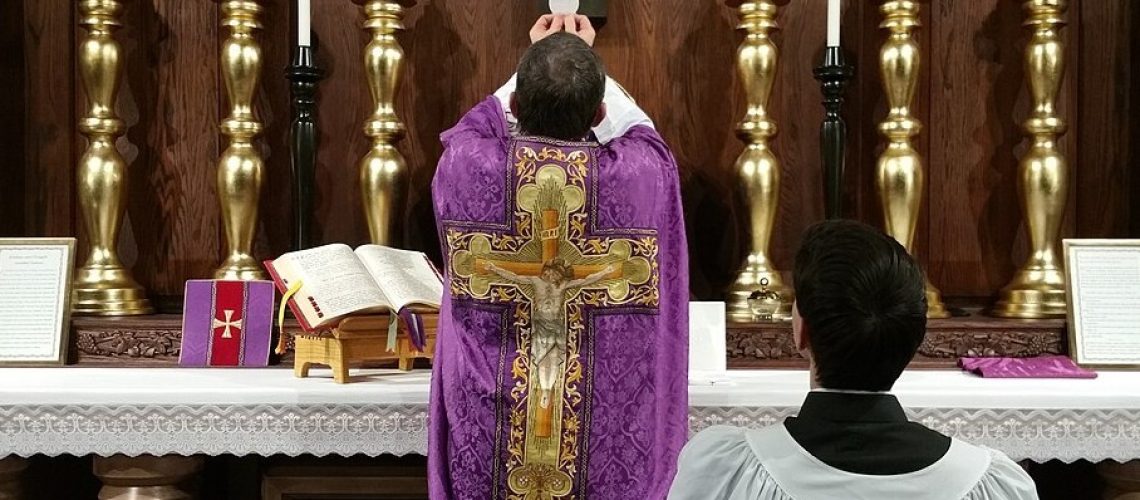
It’s now been 57 years since Pope Paul VI announced that the Novus Ordo (NO) Mass is the official ordinary Mass of the Catholic Church. And it’s an announcement that many Catholic still have a hard time accepting.
It’s kind of hard to believe this announcement is still causing controversy after 57 years. I thought Pope Benedict VI’s moto proprio Summorum Pontificum (SP) had put the controversy to rest, but along came Pope Francis and Traditionis Custodes (TC). He not only overturned SP, but, for all intents and purposes, he outlawed the Traditional Latin Mass (TLM). And the controversy started up all over again.
I’d like to know why some people have such a hard time accepting a good compromise. It seems, for some, that it’s always their way or no way. They can never accept a good, rational middle ground, which is what SP offered.
The controversy makes me wonder if the communist infiltration of the Church in the 1930s came to fruition over the last 60 or so years. How many men in seminaries and already ordained priests did these wolves in sheep’s clothing influence? And did they, in fact, manage to highjack Vatican II with the intent of creating dissention?
Off and on I also wonder whether the Novus Ordo Mass, or at least turning the altar around and having the priest face the people (versus populum), is one of the fruits of their labor.
I’m not a fan of the NO Mass, but the Church says it is a valid and licit liturgy, so I accept it as such. The vast majority of Catholics who actually go to Mass also obviously accept it as valid and licit. But so, too, is the Traditional Latin Mass. And the Church has never forbidden any valid form of the Mass – until Pope Francis became pope.
The Battle Continues
Three articles popped up on August 25 and 26 of this year addressing the TLM vs. the NO topic.
Dissident Jesuit priest Fr. Thomas Reese expressed his dislike for the TLM in an article entitled “Why I hate the old Latin Mass: A confession” at Religion News Service. In addition to expressing his dislike for the TLM he lauded what he feels are the strong points of the NO.
The next day EWTN News ran an article entitled “Pope Leo: Vatican II reformed the liturgy to promote active participation.” The article was about the conclusion of the Pope’s general audience teaching series on the catechesis in Sacrosanctum Concilium. The headline states the essence of his teaching, but the Pope also supplied some background.
“The need arose for the faithful to celebrate the liturgies more consciously and actively, not ‘as strangers and silent spectators’ but participating fully in the salvific mystery,” the Pope is quoted as saying.
“The need arose” is a pretty vague statement. I don’t recall a clarion call by the faithful during the 50s and 60s for a new version of the Mass. There was, however, a ‘liturgical movement’ in existence since before 1900 that was attempting generate more interest in the treasure that is the Mass. But this was a clerical led effort as opposed to a laity ‘grass roots’ movement.
In the 1930s, 40s, and 50s, according the Dr. Peter Kwasniewski this movement got more radical. These clerics thought the Mass needed to be remade into something new and different to allow more participation by the faithful.
But the faithful did participate in the TLM. Some prayed, some said the rosary, and some followed along with their missals. Granted this is not to the extent or in the way they participate in the NO. But is more participation better than the humble and more reverent participation afforded by the TLM?
Despite the accolades proponents heap on it, the NO has changed the focus of the Mass. The priest, who now faces the faithful, is the center of attention instead of Jesus Christ. The priest now seems to be more of an MC than a priest acting in persona Christi. To me, versus populum is a monumental (intended?) error. What’s more, this change was not even called for in Sacrosanctum Concilium.
Isn’t this one of the chief aims of communism – man replacing God as the center of the universe?
Pope Leo’s Oops
The third article, at Diane Montagna’s Substack, “Liturgy Wars—The Latest Volley: A Papal “Thus” by Dom Alcuin Reid, “an internationally recognized liturgical scholar,” cuts to the heart of the matter.
Pope Leo’s recent remarks, he writes, almost certainly “originated in the Dicastery for Divine Worship.”
The prefect of the Dicastery for Divine Worship is Cardinal Arthur Roche, one the chief cheerleaders for and a chief proponent of the NO. He was, in 2002, named chairman of the of the International Commission on English in the Liturgy, which oversaw the translation of the Latin liturgical texts into English. So, it’s not much of a surprise that Pope Leo’s remarks would laud the NO.
The critical flaw in Pope’s Leo’s remarks, however, according to Dom Reid, is the use of the work “thus” when he said, “the liturgical reform promoted by the Second Vatican Council is thus firmly rooted in the living tradition of the Church.” Reid calls the statement the “greatest liturgical non-sequitur of the past sixty or so years.”
His argument, in a nutshell, is that “whilst the “thus” is clearly believed by the drafter, it does not follow from the evidence produced in the text.” In other words, “the Church” has not constantly reformed the liturgy of the Mass over 2,000 years. It has simply allowed local variations of the Mass to co-exist.
Even after he promulgated the TLM in 1579, St. Pius V allowed “any ritual of the Mass older than 200 years to continue alongside the Tridentine Mass.”
So, it really is wrong to say, “the liturgical reform promoted by the Second Vatican Council is thus firmly rooted in the living tradition of the Church” [emphasis added]. The living tradition of the Church has always allowed local variations of the Mass to co-exist. But there have not been continual liturgical reforms promulgated by “the Church,” (i.e., the Vatican, or any Councils).
Dom Reid also argues that “A radical reform of the liturgical rites was not in fact necessary in order to make the liturgy more accessible after the Second Vatican Council — a reality that the full, conscious, actual and extraordinarily fruitful participation in the unreformed rites today makes perfectly clear.”
Progressive(?) Resistance
I find Pope Francis’ and now Pope Leo’s resistance to allowing the TLM to be said in parishes extremely disconcerting.
I wrote to Pope Francis in 2023 asking him to rescind TC. I received no response, but then again, I really did not expect one. I also wrote to Pope Leo last year asking him to rescind TC. And again, I received no response.
(I could be snarky and say that the listening part of synodality apparently does not require responding, but this would not be fair. Fun fact: According to Rome Reports, “Every day, no less than 220 pounds of letters arrive for Pope Leo XIV.” At one ounce per letter that would equal 3,520 letters. It’s a good bet he only reads a very, very small number of them.)
Pope Leo stated in an interview last year that the Latin Mass issue is “obviously very complicated.” I suspect progressive bishops and cardinals are the ones complicating the issue. Yet it’s these same clerics insisting on a Synodal Church that listens to all opinions.
Cardinal Roche penned a letter criticizing the TLM and defending Pope Francis’ ban on the Traditional Latin Mass. But many clerics, including Fr. Gerald Murray during an episode of The Prayerful Posse, have pointed out how poor the Cardinal’s arguments are.
A Course Correction is Needed
Phil Lawler, at Catholic Culture, recently wrote a two-part article opining that Pope Leo needs to reverse course. He should repair the damage caused by Traditionis Custodes by trashing it and reinstating Summorum Pontificum. He wrote:
“If the goal of Pope Francis was to enhance Church unity, his 2021 apostolic letter has been a failure. The initiative was based on false information and a faulty judgment. Its practical effect has been to increase the tensions between tradition-minded Catholics and the hierarchy.”
In the article he also notes that a number of prominent Vatican officials “have reached that same conclusion.”
On top of all this, it’s hard to believe that Pope Leo has not heard that the official report by the Congregation for the Doctrine of the Faith used as the basis for TC actually was actually in favor of leaving SP stand.
Something is amiss in the Vatican. I pray that the Holy Spirit gives Pope Leo the insight to make some much needed corrections.


I read the Fr. Reese article as far as his comment that “with better catechesis,” TLM people would learn to appreciate the new liturgy. For well-catechized Catholics, I expect, the shoe is on the other foot.
Gene, you seem to lament this just criticism on occasion and I more than agree.Not unlike the military, what the pope, magisterium and local diocesan authorities have given, in this case, is an unholy order that is causing great harm. If a priest in good standing is not allowed to engage in TLM, he should do so anyway. If, as it it said, this form of liturgical worship is growing and needs to be celebrated,then do it and see if it doesn’t cause a … Latin wave.
The kids at the Novus Ordo see the grown-ups acting like adolescents and head for the exit at the first opportunity. We’ve “actively participated” ourselves right into an empty church. Nice work, guys.
Gene, As always, thank you and thank you. Such a grand article. You say potato…I say Novus Disordo. Look at what has happened to and in the Church over these last 57 years. The millions who have left the organized Church; the heresies spread; the Chruches and parishes closed, some sold. My opinion: due in some not small part to the Novus Disordo entertainments. And to me-another opinion-not without intent to harm the Church and the faithful. I feel better now..TY…lovely way to start the week. Guy, Texas