
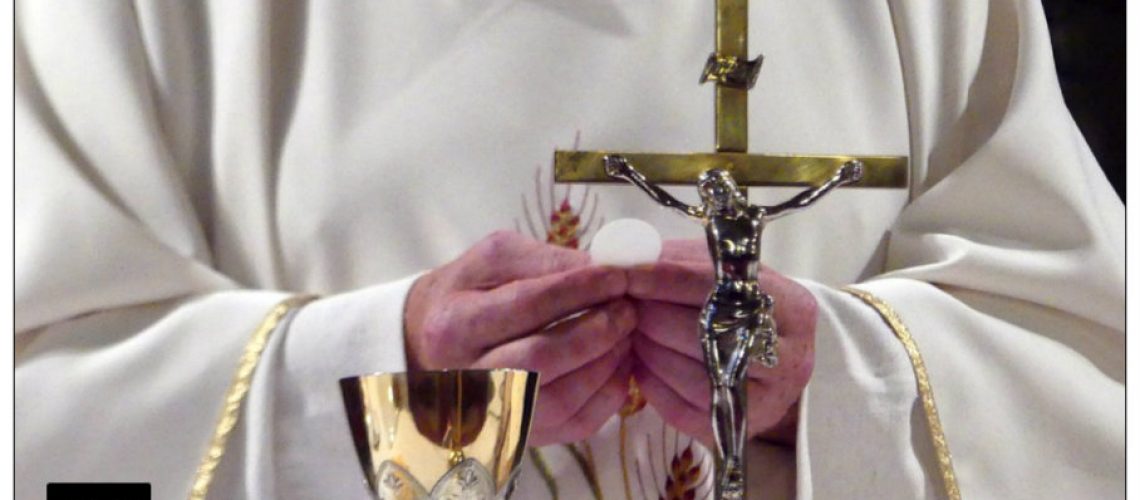
It’s Sunday morning, and you arrive at Mass flustered and late. Your children have pushed you to the brink of insanity and some strangers are sitting in your pew. The part of the homily you caught left you confused, and you are seriously thinking about getting up and leaving. What will it matter anyway? You are in a rotten state of mind, and in a bad way. Considering the way you feel, you determine that you must be in a state of Mortal Sin, and not in a state of Grace. The Holy Spirit, your advocate, provides the consolation and calm needed to realize your emotions have temporarily gotten the best of you, and you stay for Communion confident that you are indeed reconciled with God.
The following week, after arriving on time and back in your regular seat, you notice a person who has publicly endorsed behavior that is clearly sinful in the eyes of the Church. Once again, you lose your peace, but this time it’s not about you, it’s about your neighbor. Even though a “conversation” is occurring with the Holy Spirit, you are not privy to it. You conclude that the person should not be allowed to receive Communion in the court of personal opinion that has appointed you judge and jury. The sentence of excommunication seems reasonable because the person is undoubtedly guilty of persistent Mortal Sin.
In the examples above, grace is necessary to shed light on the condition of one’s soul before receiving Communion. In the first case, the movement of the Holy Spirit confirmed that the “lines of communication” and friendship with God were intact, and grace prevailed. In the second case, it was incumbent on the public figure being observed, and that person alone, to determine separation from God through Mortal Sin, and whether to queue up in the Communion line. An understanding of Mortal Sin is contained in the Catechism of the Catholic Church in the following three paragraphs (CCC 1857-1859):
For a sin to be mortal, three conditions must together be met: “Mortal sin is sin whose object is grave matter and which is also committed with full knowledge and deliberate consent..
Grave matter is specified by the Ten Commandments, corresponding to the answer of Jesus to the rich young man: “Do not kill, Do not commit adultery, Do not steal, Do not bear false witness, Do not defraud, Honor your father and your mother.” The gravity of sins is more or less great: murder is graver than theft. One must also take into account who is wronged: violence against parents is in itself graver than violence against a stranger.
Mortal sin requires full knowledge and complete consent. It presupposes knowledge of the sinful character of the act, of its opposition to God’s law. It also implies a consent sufficiently deliberate to be a personal choice. Feigned ignorance and hardness of heart do not diminish, but rather increase, the voluntary character of a sin.
As tempting as it might be, judging another person’s culpability in a sinful act, behavior or stance is simply impossible through human understanding and reasoning. In fact, judging one’s own state of grace is not possible without the light of the Holy Spirit. Venial sins, public or private, do not deprive us of a place at the Eucharistic table no matter how well-known and obvious they might be. There is a cumulative effect to be considered when considering sins both big and small that should be acknowledged before the reception of Communion. The Catechism explains how venial (lesser) sins factor into our relationship with God:
Venial sin weakens charity; it manifests a disordered affection for created goods; it impedes the soul’s progress in the exercise of the virtues and the practice of the moral good; it merits temporal punishment. Deliberate and unrepented venial sin disposes us little by little to commit mortal sin. However venial sin does not break the covenant with God. With God’s grace it is humanly reparable. “Venial sin does not deprive the sinner of sanctifying grace, friendship with God, charity, and consequently eternal happiness (CCC 1863).
God’s amazing grace is available to all and can only be blocked by an individual’s Mortal Sin. This “radical possibility” can be realized through free will but does not have the last word in the state of the soul. Repentance and forgiveness, through the sacrament of Reconciliation, are as close as the nearest Catholic church.
Mortal Sin that is not confessed and redeemed by God’s forgiveness can indeed deprive us of Sanctifying Grace, and temporarily exclude us from the sacrament of Communion. It is important to note that the state of Grace of a given person cannot be judged by anyone “from the outside looking in”, and the judgement of persons must be left to the judgement and mercy of God.
Let us pray to remain in friendship with God in a state of grace, to receive communion worthily, and to leave the judgment of persons to God in His infinite mercy.


re Refusing Communion to “public sinners”. A specific example would be speaker of the House Pelosi, President Biden, and other politicians who profess to be Catholic.
The USCCB recently spent time debating this issue. A group of bishops complained that refusing public sinners Holy Communion was weaponizing the Eucharist. St. Paul clearly states that receiving unworthily means eating and drinking condemnation.
One wonders how can any bishop hide behind ‘weaponizing the Eucharist’ rather than having pity on a soul who is in danger of eternal condemnation, and thereby denying them communion.
One has to wonder how much of this is just plain cowardice on the part of those bishops. For the bishops to follow St. Paul’s explicit teaching, would unfortunately subject them to criticism, negative press, and dealing with the push back from Catholics who don’t like what St. Paul had to say. Alas, sometimes you have to man-up and do the hard thing for the good of souls.
[…] The State of Grace, Holy Communion, and the Judgement of Persons – Deacon Greg Lambert at Catholic Stand […]
[…] the God of Natural Law and Idol? – J. Budziszewski, Ph.D., at The Underground ThomistThe State of Grace, Holy Communion & the Judgement of Persons – Deacon Greg LambertPerpetual Eucharistic Adoration Live – Big PulpitOrdinations in […]
True as far as it goes, and given the likely audience for this piece, I can understand how there would not be the same emphasis on the fact that, if you are conscious of having committed a sin whose object is grave matter, you *must not* receive the Eucharist until you have been absolved in the Sacrament of Reconciliation (as to do so is sacrilege–a grave sin in and of itself, which leaves the sinner in a worse place than before).
Unlike the general public–for whom, given our culture and the observed neglect of the confessional, the emphasis needs to be on avoiding the sacrilege–it can be safely assumed that most reading already know this, and act accordingly.
That said, the main issue involved in known public sinners receiving the Eucharist is not sacrilege (an obligation noted in church law in Canon 916).
It is scandal (Canon 915). It is the false implication given to others from their conduct, that what is in fact sinful is not, which in turn leads those observers into committing or supporting that same sin themselves.
Jesus had words about that. They involved millstones being hung around the neck, and being hurled into the sea.
That is why, for public sinners, *for their own sake,* public recantation and repentance is needed before they can be readmitted to Communion.
Though, again, returning to the author’s post, the responsibility for refusing admission to publicly obstinate sinners lies with the priest, not the layperson. So from the pew, as the good Deacon said, our responsibility is to see to ourselves, and pray for all others.
Well, yes. Glad to see this, after seeing so many posts here saying the opposite.