


Many years ago I was living in San Francisco, my faith life was mostly rot, and I was working at a Catholic University, under the supervision of two openly homosexual bosses. In the library of this university I found and read a book entitled Heterosexism. I was intrigued by the premise that by promoting same-sex civil unions or marriage it would be a great help in reducing the rampant promiscuity of homosexual males. This was long before the push for same-sex \”marriage\” became a national craze. My thinking at the time was not rooted in a Catholic worldview, as my faith practice had diminished to a whisper of what it had been in the first few years of my dramatic conversion to Catholicism. Fast forward to today – with a wife and several children – my faith life is thriving – my orthodoxy rock solid. I consider the movement for same-sex \”marriage\” as one of the greatest threats to the security of our religious freedom as Catholics. The Church is on the cusp of being officially and popularly regarded as dangerously bigoted – akin to racist – all due to the unwavering teachings of the Church with respect to homosexual acts and the legal definition of Marriage.
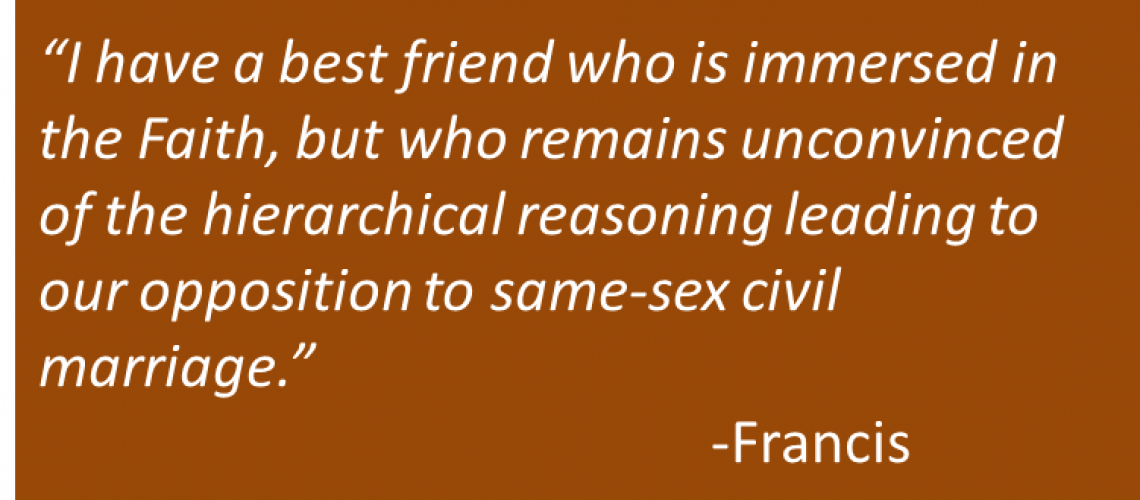
For me today, the official view of the Catholic hierarchy seems practically self-evident- but I know that without faith immersion, the mind can play tricks on you. In addition, I have a best friend who is immersed in the Faith, but who remains unconvinced of the hierarchical reasoning leading to our opposition to same-sex civil marriage. I want to help him and the legions of others like him who are motivated by good intentions, but all of the books and articles I have thrown his way have not sealed the deal yet. And so I offered him the opportunity to put down his arguments for this blog, anonymously, as he is not interested in publicly disagreeing with the Hierarchical view; he knows to be a faithful Catholic he cannot do so without breeding scandal. But his conscience is torn at the moment. I want to push him over the top, and I need the help of thoughtful, intelligent, articulate and kind orthodox Catholic defenders of the Church’s viewpoint on same-sex \”marriage\”. So, my brothers and sisters in Christ, here are my friend’s own words in challenging the hierarchical viewpoint. Please take as many of the following points, and offer the most reasonable response without resorting to counterproductive personal attacks or flippant disregard. My friend is on his way to becoming a professor and I want him to be convicted on this teaching and counsel, so that he can become a great ally of the hierarchy, and not someone who feels compelled to sit silently on the sidelines as a matter of personal conscience. So here we go:
1) Marriage has traditionally been between a man and a woman.
True, but lots of traditions have been discriminatory. Tradition often gives us much-needed pause before changing too rapidly. But tradition is not a valid justification for public policy. There have been traditions against treating women as equal partners in a marriage, traditions against miscegenation, traditions promoting polygamy et cetera, none of which most opponents of same-sex \”marriage\” accept today.
2) Marriage between one man and one woman isn\’t a religious doctrine; it\’s natural law that precedes the church and state.
The problem with this argument is that it cherry picks one element of traditional marriage while ignoring others. It is wrong to say that the marriage that existed before the Church and government was between one man and one woman. If anything, it was common for men to have more than one wife, and in fact, the Church likes to take credit for liberating women from this very tradition. Some address this problem of letting polygamy creep into the logic by saying that only a monogamous relationship can conceive life in a single act. This distinguishes monogamy from polygamy, but so what? I thought we banned polygamy because it is exploitative of women, not because it\’s impossible for a man to impregnate two women at the exact same time.
3) If same-sex \”marriage\” is permitted, why not marriage to children or animals?
This argument is particularly offensive because it seems to belittle the sincere love that homosexuals have for one another by comparing it to a perverse, exploitative, and criminal relationship. The obvious distinction is that with same-sex \”marriage\” we\’re talking about consenting adults, a principle the opponents of same-sex \”marriage\” presumably share, unless they would tolerate the marriage of a 50 year old man to an 11 year old girl.
4) We cannot establish policy that encourages people to sin.
This is a principle that seems to have been conceded a while ago. There are any number of temptations to sin promoted by government. Why do we accept and even subsidize the existence of other churches and religions when this makes it more likely that people will be led away from Jesus Christ? Why do we accept and even promote freedom of speech when it is so often used to expose people to immoral values? Why allow same-sex \”marriage\” to exist independent of religious marriage, thus tempting people into believing they can have a true marriage without God? Why do we accept the right of women to lead non-Catholic churches, when according to the Church, God clearly intended men to be the religious leaders? These are all indirect temptations to error and sin because of civil rights and liberties.
5) The only purpose of sanctioning marriage is to promote the birth and care of children.
This is the original purpose in terms of the state\’s involvement in the institution, but it is an argument that seems foreign to many if not most people today. I would wager that a strong majority thinks that marriage also has the purpose of two people making a public commitment to each other regardless of whether they are going to raise children or not. Even if a couple never intends to raise kids, there is still arguably a benefit to the state in promoting marriage, because the institution, on average, promotes better health and stability. This is probably true of homosexual couples as much as it is of heterosexuals.
6) The real purpose of same-sex \”marriage\” advocates is to destroy the Church and other traditional institutions.
Almost every movement and cause has its radical faction. If the Second Amendment is strongly supported by Neo-Nazis, would that mean that no one should support gun ownership rights? Policies need to be justified or condemned on their own merits, not according to guilt by association.
7) Same-sex \”marriage\” rights will cause the Church to be considered a discriminatory institution, opening it up to legal assault.
I agree that any law sanctioning same-sex \”marriage\” should protect religious institutions from being forced to perform such marriages themselves. The state can have a civil definition of marriage, while each church has its own religious one. I also think the threat of litigation may be exaggerated. To my knowledge there has been no serious movement to legally force the Catholic Church to ordain women, despite a strong feminist movement. And in a pluralistic society we sometimes have to pay for things we don’t like. If not, then I should be able to claim a 20-25% federal income tax credit during unjust wars.
8) The Church teaching on marriage has been consistent and shouldn’t change with the times.
This consistency is only true in the narrow sense of maintaining the same definition of marriage within its own institution. The Church objected when during the French Revolution, civil marriage was instituted without any religious affiliation. But the Church changed its view and today accepts the legal freedom of marrying outside of it. This opens the door for the Church to say that while it prohibits same-sex marital unions within its own institution, governments may have their own distinct reasons for instituting civil marriages.
9) Social science demonstrates the benefits of being raised in a traditional two parent household with a mother and a father.
It may be true that most scientific studies indicate that a traditional family environment leads to the best social outcomes on average. But this does not mean that homosexual couples do a poor job of raising children – only that on average they don\’t do as good a job as married couples. But the same goes for single parents, divorced parents, and other categories. The social science research on homosexual parenting is way too thin so far to draw any confident conclusions.
© Francis. All Rights Reserved.




52 thoughts on “The Same-Sex \”Marriage\” Challenge: Let The Debate Begin Here”
I can’t seem to reply to a reply, so a few points I wanted to make in response to SSL’s response to me…
Yes, for a number of reasons, I think it would be far better to have two separate ceremonies. I don’t have any confidence that the Church’s religious freedom on this issue will be respected in the future. Once society accepts same sex marriage as a right, then it’s only a matter of time before an institution that doesn’t honor that will be raked over the coals. I hope I’m wrong.
I think the reason contraception and no-fault divorce laws are not given much attention as threats to marriage and the well-being of children is ultimately because of what I said – it’s all about the adults. No one *really* cares about what’s best for children when it comes down to it. They make and pass laws primarily to appease the desires of adults.
I should have made a better distinction between the social science question and the rights of a child. I *have* seen a number of studies focused on the effects of divorce that demonstrate the importance of a married father and mother in a child’s life (see Judith Wallerstein’s longitudinal study for one). But even if studies end up showing there are no discernible differences in parenting outcomes (however that would be measured… hard to really assess a child’s true well-being), the fact remains that a child has a right to know – if at all possible — his or her father and mother, and to be raised by them if at all possible. It should be the goal of a society to promote this as the ideal and to help fill in the gaps when it isn’t possible. Denying a child this right to both parents is denying them a basic part of themselves. And we’re beginning to see effects of this in the area of children conceived with sperm from anonymous donors. When we legally sanction a gay relationship as a marriage, on equal par with male-female marriage, we are in essence saying that same sex marriage is an equally worthy institution in our society. And if we hold that one of key reasons to have marriage in the first place is as a formative structure in which to conceive and raise future generations, then what are we saying?
The logic behind the gay rights movement *is* tolerance, but I can’t help but notice that many of the individuals and groups who hold that banner high are NOT tolerant of those who have a problem with same sex marriage — they call it bigotry and hatred, on par with racism and denying people of color basic rights. This is why it will probably, eventually, become a big problem for the Church.
Alexa, I have been married 37 years and when I got married I never thought of it as a “formative structure”. I married because of love. Lust was the initial reaction to seeing her the first time, then after some time came love. It is love that forms bonds which last. Perhaps, those of the same sex who wish to marry experience your opposition and the Church’s opposition to them as violence?
Alexa,
Although I think you may be right about future threats to the Church, I still think the same logic would have predicted great social pressure to make the Church ordain women. But who knows, perhaps this is coming as well.
I am familiar with the Judith Wallerstein study and certainly don’t mean to argue that both a mother and father are not important in a child’s life. I was originally asked to identify what common arguments I hear for SSM and point out the weaknesses I find in these. In terms of social science, I see a lot of overselling (not from you, but from many others). I think a common and rational response to studies like Wallenstein’s and others frequently cited is that they don’t provide direct evidence on same sex parenting. There is nothing wrong with bringing them up, as long as we don’t exaggerate what they actually demonstrate.
In terms of what we are saying when we establish SSM as equal to traditional marriage, I’m not sure that we are saying much more than that we as a society respect and encourage public life commitments between two adults that love each other. Within the traditional civil law there is a wide range of couples that could legally marry that we might still want to discourage from doing so. An 18 year old boy can legally marry a 90 old woman, but it would be hard to argue that society views this kind of coupling as equal to any other.
Still, your emphasis on what effect SSM will have on children is the right one I think, and I wish more of the public debate had this focus. It may be reasonable to point to studies like Wallerstein’s and Regnerus’s and say that we should tread more cautiously before exposing children to unfair formative structures as you call them. The difficulty though is that unless we’re willing to say that easy divorce laws need to be overturned and that single people should not be allowed to artificially conceive, etc., then we appear to be unfairly discriminating against a very small segment of society. Again, why fight SSM so much when we have little knowledge about the effect of SS parenting, while allowing divorce and single parenthood to continue to have the damaging effects (on average) for which we have ample evidence?
I agree that many in the SSM movement have some intolerant words for the Catholic church and its loyal followers. But I also can’t blame non-Catholics who aren’t steeped in the theology to see the Church’s view as discriminatory. There is not an easy sound bite to explain why it isn’t, and so the challenge to convincingly convey the Church’s teaching on homosexuality is an extremely difficult one.
I wanted to draw attention to this fellow’s blog:
http://beatushomo.blogspot.com/
He is a gay, celibate Catholic convert who makes arguments in support of the Catholic position on marriage and sexuality.
Cheers
Thank you for sharing that excellent site.
“I thought we banned polygamy because it is exploitative of women, not because it’s impossible for a man to impregnate two women at the exact same time.”
And you thought wrong.
The most fundamental premise of monogamy is that it is the *natural and observable* basis of the healthiest most functional family paradigm.
And this paradigm is the most basic element of a healthy and functional society. Every society that has endured and prospered for any significant length of time on the face of the earth has drawn it’s most basic frame work from the predominant paradigm of monogamous heterosexual unions.
So what can we glean from this self-evident observation?
Simple: Marriage is not ratified by tradition for tradition’s sake. But rather, marriage has become a tradition based on the self-evident experience of our natural design.
“The obvious distinction is that with same-sex “marriage” we’re talking about consenting adults, a principle the opponents of same-sex “marriage” presumably share, unless they would tolerate the marriage of a 50 year old man to an 11 year old girl.”
So now you are adhering to some traditional parameters to define your new definition of “marriage”?
Why?
Since we are in the age of “redefining” and ultimately bastardizing all the precepts of those moldy old simple-minded non-inclusive out-dated moral prejudices of “hate”, why shouldn’t we redefine ALL the definitions and moral parameters in our new open-minded frenzy of “tolerant” relativism? After all, you DO want to be as “inclusive” as you possibly can be – no? And if natural design is no longer a definable barrier – then let’s have at it, shall we?
So to that end: Define “adult”. Define “consent”. Define “love”.
Now then, children are frequently subjected to actions against their “consent” for the sake of “love” – are they not?
And if children are encouraged to recognize their same-sex sexual identity while in their prepubescent years, (ala sex education in the public school system and the sexual recognition of same-sex identities in the Boy Scouts to name just two examples) then wouldn’t it be a wonderful and “loving” thing for these children to experience the fullness of their same-sex identity at the “loving” hands of a “loving” adult?
Why not?
And as far as animals: Do we get the animals “consent” when we slaughter them for food, clothing, and various other commercial items? Or when we force them to labor for our needs? And can’t the animals experience pleasure via a sexual encounter with a human-being as long as it was instigated and exploited in a caring, nurturing and ultimately “loving” way?
After all, humans CAN feel “love” for animals – can’t they?
Isn’t it time we set all those moldy old closed-minded traditions on their collective head in the name of inclusive tolerance and expanded horizons of human love?
After all, you don’t want to be a bigoted closed-minded “hater” – do you?
“The object of opening the mind, as of opening the mouth, is to shut it again on something solid. Otherwise, it is akin to an open sewer taking in all things equally.” – G.K.Chesterton
If I follow the logic here, it is that to allow for any additional tolerance in the law is to say that we must therefore allow anything and everything. This logic becomes pretty hard to sustain if we place ourselves at an earlier, much less tolerant time in history.
I will reiterate a simple pragmatic point about the bestiality analogy. If you want to guarantee that you lose the argument in society at large, keep pretending there is no difference between consensual love between two adults and sex with animals. As much as we might like to believe that our pets “love” us, there is no way for them to convincingly express a commitment to love us in marriage. It is a little disappointing that this is still part of the debate.
A few thoughts in general:
1. In some debates going forwards, the distinctions made here may be useful. I am thinking of the distinctions between tolerating, criminalizing, and refusing to enshrine in law (conferring legitimacy upon) and so on that we have drawn here.
2. At least one difficulty for same-sex marriage advocates is the attempt to create boundaries between SSM and other relationships which partake of the same arguments.
3. I saw on one of the last posts the suggestion, which I often see, that the Church “pull out” of the secular marriage game and the State allow the Church to have sacramental marriages. That will not work for many reasons – for better or for worse, the Church remains in the game.
4. The late Fr. John Neuhaus had a saying, now called “Neuhaus’s Law”, which runs as follows: “Where orthodoxy is optional, orthodoxy will sooner or later be proscribed”. Though not directly stated, broader implications are that, if the Church bends in things such as SSM, sooner or later it will be forced to perform SSM. While some argue that this could never happen, stories such as lawsuits against Hasidic Jewish shopkeepers for having a dress code based upon their religion do not give me hope (http://www.firstthings.com/blogs/firstthoughts/2013/02/21/nyc-sues-hasidic-shopkeepers-over-dress-codes/).
5. Those opposed to gay marriage are fighting a rearguard action. It’s not just that the young are more tolerant, it’s that they are more logical. For Catholics, and for many Christians, opposition to gay marriage and opposition to extramarital sex, contracepted sex, pornography, and sodomy (for example) are all of a piece. Trying to close the gate now is trying to keep one horse in the barn when the other 50 are out and about. What justifies opposition to gay marriage when Catholics and Christians have, in great measure, been silent about many of these other things?
And to add, a quote from G.K. Chesterton, simply for the fun of quoting the man:
The truth is that nobody has any business to destroy a social institution until he has really seen it as an historical institution. If he knows how it arose, and what purposes it was supposed to serve, he may really be able to say that they were bad purposes, or that they have since become bad purposes, or that they are purposes which are no longer served. But if he simply stares at the thing as a senseless monstrosity that has somehow sprung up in his path, it is he and not the traditionalist who is suffering from an illusion.
SSL,
Why is there a debate in your mind about which moral codes should be enacted into law? You should advocate for your beliefs like everyone does. Atheists vote for what they think is best for our culture, shouldn’t we do the same? It shouldn’t matter if you think you will lose the battle should it?
You keep saying that you don’t know if it is right to impose your belief’s in a pluralistic society. You’re not, the Church is not. We are advocating for what we think is best for ourselves, our children and our fellow citizen’s.
If we do not vote for what we believe in, you can be sure that others will not be so hesitant. In a pluralistic society you are one voice among many, and you cannot be heard if you don’t open your mouth. I have never understood when people say the Church should not be allowed to impose it’s views on the rest of society, it’s utter nonsense. Of course we hope that our vote will carry the day and society will adopt the things we value. If we believe what God has revealed through history, scripture and the traditions of the Catholic church, how could we want otherwise?
If there were a majority of Hindus or atheists, would you expect them to hold off on voting what they believe in, because they might impose laws that we don’t agree with? Of course not. It already happens all the time. If I can vote to repeal no-fault divorce, abortion laws or any number of immoral laws I will.
I believe in what the Church teaches and I vote to defend my belief’s and protect against sin and temptation, which I believe hurts every soul.
So what if we have already let laws pass that are sinful and have to fight a seemingly losing battle in the court of public opinion? Does this mean we capitulate on everything? I for one will continue to fight for the good and the true, even when it seems all hope is lost. Because I know my Lord has already won the final battle for me.
If you truly believed what the church taught on this point there should be no doubt in your mind how you would vote. It seems to me that the problem you are trying to solve is not how to respond to some legislation, but where to place your trust and belief. I sense that you don’t want to be the one saying no to two people that love each other even though they are of the same sex.
The thing is, we aren’t telling people that they can’t love each other if we tell them that they are not married. We are being truthful and telling them that marriage is an institution that has requirements that they don’t meet. They can still continue to love and be committed to each other and get all the things they ask for through legal means. If they decide to become parents they can gain parents rights, but I don’t think that we should give those same consideration to every couple that wants to be called married if they don’t have that innate capacity.
It is one thing to express our views about morality – as I mentioned in an earlier post, all of those should be publicly expressed. It is another to try to push all of them into law which is what you’re suggesting. You yourself point out the problem with this logic when you acknowledge that Hindus and atheists would force their views upon us if they had the majority. It’s precisely this logic that makes most people recognize that we’re all better off in a pluralistic society not trying to impose all of our beliefs on everyone else. Remember the golden rule? Just as you wouldn’t want atheists forcing their morality on you, nor should we do the same. Obviously there are limits to this logic. In the case of abortion, innocent human lives are being destroyed, and so we must try to use the civil law to stop this. But in the case of personal sexual morality, the question of how much to enforce in the civil law is more complicated. So with all due respect, I disagree that my quandry is “utter nonsense”.
I will have to reply to my own post since I cannot reply to SSL’s below.
SSL,
You misunderstand me. We are not talking about legislating “personal sexual morality” I don’t know how you would even go about doing that. We are talking about legislating public sexual morality. Those policies that affect the public for good or ill. If you believe that marriage has a special purpose beyond just two people loving each other a lot, why wouldn’t you vote to keep the special status of marriage?
I believe marriage serves a unique purpose in society that can only truly be carried out successfully by man and a woman in a permanent,exclusive relationship. So I would vote to not change or water down that historically self-evident truth just to appease people that seek official validation of their relationship. Am I imposing my beliefs on the public? I am certainly attempting to. Who isn’t.
There are those on the other side of the debate that feel that as long as two consenting adults want to commit for life they should be able to call their relationship marriage. So they vote to impose this belief on public policy. If enough of them vote, they win and I have the choice to obey the law or peacefully revolt.
You say that I wouldn’t want atheists to force their morality on me and maybe on a personal level that’s true. But we live in a republic and people force policy on me all the time. We vote, and when my vote is cast on the losing side, I have to obey the law of land or be willing to face the consequences.
Why would you vote against your own belief? Unless you have bought into the belief that same sex relationships are inherently no different than a marriage between a man and a woman.
Instead of trying to respond to a number of different people, I’m going to offer something of a summary response. I’m impressed by the comments and am grateful for being given a number of new insights to consider.
Many people have emphasized the distinction between tolerating immorality versus legitimizing it or promoting it. This may in fact be a crucial distinction, though I am still thinking about it. My fear is that it may be a deceptively simple distinction. What in fact do we mean by legitimizing? I would think it has to mean that the government confers certain benefits – otherwise it’s not practically different from the refusal to criminalize. In the case of marriage, benefits are conferred, so this would qualify. However, is it true that the Church doesn’t tolerate other laws which confer legitimacy on other disordered behavior? There are any number of churches that are given tax exemptions (and hence legitimacy) to preach a false gospel and lead people away from the true Church – isn’t that legitimizing something pretty potentially damaging to people’s souls? We continue to tolerate the construction and maintenance of nuclear weapons, even though such weapons, we are told by the Magisterium, are immoral. Should we as Catholics be protesting against the “legitimizing” of these immoral bombs? I know some people that do, but they’re a rare breed. These may not be perfect examples, and may not be directly equivalent, but I raise them to suggest the possibility that this notion of “legitimizing” something versus not criminalizing it, may not hold under greater scrutiny.
In one exchange, I also suggested that it isn’t just the government that legitimizes, and at least one respondent seems to think that it is ok for the Church to tolerate private individuals and organizations legitimizing gay marriage, just not the government. But this seems problematic to me. If the argument is that gay marriage is going to destroy the institution, ruin children’s lives, etc. etc., then shouldn’t we also be promoting the criminalization of it in the private realm? If not, then it seems that all we really care about is not being directly or indirectly complicit.
The issue of what social science tells us has come up in interesting ways. My main point continues to be that the research is thin so far, at least in terms of true comparisons between gay and straight couples. Some have said that since I acknowledge that much social science research indicates the best outcome for kids is within a loving two parent heterosexual married household, why would I advocate anything different? Again, the question is not about what the perfect world would look like, but what amount of freedom is appropriate in a pluralistic society. What if social science indicated that the best outcomes for children occur when they attend a Baptist church? Would we as Catholics argue that therefore, children should only be allowed to be raised in Baptist churches? Of course not. I am not even trying to make the case for gay parenting. If anything, I think that is an area we should be more cautious about, because it no longer just affects consenting adults. The main point is that just because one situation is superior to others doesn’t mean that the law should only tolerate the best one. And if social science can demonstrate that gay parents are as effective or better than divorced parents, single parents etc, then we will need to justify why the law should permit some arrangements that appear to be worse (or no better) than the ones it prohibits.
I agree with those who point out that contraception and divorce have already seriously wounded marriage. I would argue these have and will continue to cause much more harm than gay marriage. And yet there seems to be very little enthusiasm for fighting these battles. Some might say that’s because the battles have already been lost. And yet we don’t accept that logic for abortion. Why for other issues that cause so much demonstrable harm to children after they’re born? If Catholics are going to fight so hard against gay marriage, it should at least be in combination with those things we know cause at least as much harm to the marriage institution and children. Otherwise we risk appearing like we’re largely motivated by an anti-gay intolerance, not so much a desire to protect marriage and children.
As expected, there has been some confusion about what I’m actually proposing in terms of civil versus religious law. In no way do I mean to suggest that the Church change its own rules. My concern is with how we draw the line between what moral teachings should be promoted (all of them) versus which must be enacted into law (not so easy to answer).
I think this is an excellent thread and appriciate most of the thoughtful comments back and forth in clarifying the churches “why.” But at least where this is an issue for someone who does consider himself a Catholic, I think there is a much more direct line of reasoning:
Does the church have the authority and/or ability to proclaim the truth about any other moral issue? If so, where does that authority from? Under what circumstances does that authority ever cease to exist? If the answers to those questions are 1)Yes, 2) God, 3) Whenever I remain unconvinced… I would suggest a follow up question – In all of my past expiriences, has my own intellect always proven capable of deducing correct moral positions (ie. have I never changed my mind about something’s rightness or wrongness after a clarifying expirience)?
I’m not trying to be dogmatic, but am speaking as someone who has been wrong about morality a LOT. In my expirience there are some things we can learn from books and philosophy, and there are other things we are taught by the cold hard lessons of life. I have often times found my own rationalizations to be wrong when I finally came to fully understand a church teaching. I have never ever found a church teaching that I first understand, and then later come to reject. So when in doubt, I try err on the side of “I might be wrong about this…”
There seems to be two meta-arguments being employed here. First that there is nothing immoral about a gay union. Second, that even if it were immoral, the state should stay out of this particular moral debate.
Due to the limitations of this format, I will limit myself to the second, focusing particularly on question/sections 4, 5, 9 and 10.
The author makes the point that lots of things that are immoral are allowed by the government. But that is wholly different from *encouraging* a certain behavior. Neo-Nazi’s owning guns and ridiculous free speech is merely tolerated, not encouraged. This is done because the consequences of enforcing the proper behavior is greater than the consequences of tolerating the wrong behavior.
This argument is a valid and good one, and there are numerous topics today which are reasonably debated on these lines.
Frankly, we already had and settled this argument in regards to gay unions. When the Supreme Court struck down anti-sodomy laws, they finalized what was already a nation-wide trend. Today gay people are allowed set up legal contracts that give them the privileges each partner gives to each other in marriage and they can call each other spouses, have wedding ceremonies, etc.. In that sense, gay marriage is already tolerated.
What we do not currently do is encourage this behavior by giving it government recognition and benefits. To meet this threshold, it is no longer a question of whether the penalty of enforcing the right behavior being greater than the penalty of allowing it. Now the threshold much higher, whether encouraging it is good for the country.
And the author unintentionally points to something that clearly shows the opposite by making this comment: “I would wager that a strong majority thinks that marriage also has the purpose of two people making a public commitment to each other regardless of whether they are going to raise children or not.”
This didn’t use to be the case.
Only since the sexual revolution, particularly contraception and no-fault divorce, has public opinion swung this way. And it is a horrible, horrible trend. It has led to the increase of all sorts of sexual ills that are plaguing the country, not the least of which is the collapse of the family, something that the author admits is a bad thing by referencing the benefits of a two-parent family, is the biggest tragedy of the 20th and 21st centuries.
What this points to is that it is not a question of whether gay marriage will destroy the institution itself as stated in question/section 10. The institution has already been seriously wounded and without societal changes could face a tragic death, whether or not gay marriage is allowed. Thus the question is instead whether gay marriage will *further* destroy marriage from its current wounded state.
And the answer is yes. Encouraging gay marriage only sends us further down this path. It further enshrines that sex and marriage is not about kids by recognizing/encouraging unions that are fundamentally incapable of introducing children into the world.
Taking a step back, I believe the trends of the sexual revolution are otherwise slowly being undone. Divorce rates are starting to drop. The percentage of people who indicate their reason for getting married is to start having children has grown dramatically. Just as the societal collapse didn’t happen overnight, nor will its reverse. But it is beginning to happen.
Giving gay marriage government recognition can not help this trend and can only harm it.
Just a couple of thoughts; not really “arguments” per se.
My first thought is that to say that there is a tradition of heterosexual marriage, and there have been traditions against miscegenation, is to set up a false equivalency. There are traditions and there are traditions. There is certainly a thread of thought in the west (I can only claim to have any authority talking about the European tradition) that the wife is inferior, that marriage is only for conservation of property/bloodline; but there is also a thread going back promoting love, mutual respect, the equal dignity of both partners, etc. This is something that people have disagreed about, not just an idea that has changed from one time to another. The same goes for views about race. While we can say that at X time and place, Y view was dominant and defended on grounds of tradition, still other people could (and did) argue against it on ground of *another* tradition. Granted, I am simplifying this for a comment box, but I think when you look at the history of the idea that marriage is contracted between a man and a woman, there is just no comparison. The only possible counter tradition I can think of is the Church’s own traditions surrounding mystical marriages (Christ and his Church; brides of Christ; priests/bishops married to their ministry) — which I don’t think can be brought in here, as it’s clearly otherworldly.
Even in the case of polygamy (which it is correct to say that Christianity eradicated and was rather proud about so doing) the relationship is husband+wife1, husband+wife2, husband+wife3… I may be wrong, but whatever the relationship between the wives, and whatever role they may play in managing the number of people in the marriage, the bonds are primarily between the husband and each wife, no? The wives are not married to one another?
Finally, in relation to the last point. If some people want to use contraceptives in their marriage, why should that affect anyone else’s marriage? If some people feel that their marriage can be dissolved by divorce, why should that weaken anyone else’s marriage? If some people feel that love is the only prerequisite for sexual intercourse, why should that affect other people’s fidelity or chastity? But we know, after the experiences of the twentieth century — or we have good reason to suspect — that they *do*. The ideal of marriage has been diversified, we might say, in civil society and although our freedom to conduct ourselves according to the beliefs of our Church has not been compromised, nevertheless can we really claim that marriage, as an institution, held up against the Catholic ideal, hasn’t been harmed? Now, in part this is because members of the Church, lay and clerical, have been a bit soft and presented these options, once ratified by the larger society, as valid for Catholics/Christians. At the same time, however, it is hard to say that these changes haven’t created a major shift not only in the way people think about marriage but also in the way they behave at all stages of their relationships. Maybe then the conclusion is that society can have gay civil marriages and we just need to tighten up our teaching; but contemplating the evidence of the 20th century makes me far more understanding of the Church’s view that the line must be held (as it were).
SSL, I agree with you. As a person who has worked in the field of human relationships for three decades I have listened to the stories of the history of pain passed from one generation to the next long before the so-called sexual revolution took place. It is violence within and outside the family which has torn the institution apart and it is violence which continues to harm each of us. Marriages and families have always been dysfunctional but it was hidden from public view until the cultural revolution of the ’60’s gave us the freedom to express the truth of our “family secrets”. The argument against SSM does not address the real danger to families which has existed since the beginning of recorded history. However, I do see that it is easier and safer to argue against it than it is to end the violence which ultimately attacks and wounds the souls who only desire to love and be loved.
Pingback: The Catholic Stand blog…
On point number 9,
True, the data overwhelmingly points to better outcomes for children in intact biological families.
You then go on to say “But this does not mean that gay couples do a poor job of raising children – only that on average they don’t do as good a job as married couples. But the same goes for single parents, divorced parents, and other categories.”
This, to me, is liking saying that influenza, TB and the common cold are already breaking out, why not add malaria to the mix?
We already have dysfunctional families because of the break-up of traditional marriage, why add another sub-optimal family situation to the mix? Why not focus on strengthening and promoting the traditional understanding of marriage. We all know, whether we consciously admit it or not, that this is best choice for future generations and it is what the church is promoting. Why not join in the great work and mission of the church?
Help us to heal this hurting culture and point us back toward God. We are not being unfair to people attracted to the same sex if we say that their relationship is not the same as a marriage, we are being truthful, which is the more loving response.
SSL,
In answer to 3., I would say I would agree with you, if that was what traditionalists were saying. I have come up against this misrepresentation many times. People see the words pedophile, polygamy, bestiality, etc. and they are offended and can’t see a larger point that uses shocking terms to highlight the incongruity of thought of some SSM arguments.
IF, and it is a big if, you believe marriage is just a contract between consenting adults to publicly declare their committed relationship, how do you then logically limit marriage to just same sex couples? You could claim that polygamy exploits someone, but where’s the data that proves it?
Isn’t that what same sex proponents say? Where is the data to prove that there might be harm to children, as if it wasn’t intuitively obvious that requiring a third party to conceive and denying the child both a mother or a father isn’t starting out life with one hand tied behind their backs.
…I’m guessing your friend didn’t notice that his responses to the basic defenses sometimes contradicted themselves in the logic used?
“That’s offensive” is not using the metric of “justified or condemned on their own merits,” and using that reaction in the same list where one promotes “Hitler liked dogs” type argument against a different and unequal point, and the frequent slagging on polygamy. (“The second amendment” is a specific policy, which the Church does not have a stance on; “marriage is between a man and a woman” would be more along the lines of “you have a right to self defense because you are a person.” The prototypical Neonazi does not favor self-defense, especially on the part of their target.)
Which points to another point: he (generic) offers no reason that polygamy (which does have historical precedence) is so much worse than homosexual marriage. (which, as pointed out, does not)
If “stability” and “health” are such an obvious and direct result of sharing a household, then non-sexual polygamy– something like a nunnery or monastery, group housing of voluntarily chosen association– is what he should be pushing for; that would actually remove the goal of destroying heterosexual marriage. In order to defend the point of homosexual marriage without also defending every other possible combination in unlimited number would have to show why polygamy lacks the magical improvements offered by simply “being married.”
Rationally, your friend would have to find out what aspect of being married offers the benefits that they claim would flow forth– and why simply living with someone would not offer the same results. He would have to make sure that just because he thinks that possibly “most” people that he know get married without an intent to have children; he’d have to dig into the census data, most likely. Starting point: about 30% of those who are over age 15 have not been married.
Not very good arguments at all, just the same old shifting ground, appeal to emotion and assumed cause and effect. I’m sad, because the few times I’ve met a homosexual marriage supporter who was willing to hold both sides to the exact same non-emotion based standards, they changed their mind; some of those who do not have gone so far as to admit that they are just looking for arguments to support what they already think.
I think that part of showing the illegitimacy of the gay marriage argument is to show it’s source and methods.
For over 2-plus millennia gay marriage would have been thought unthinkable by everyone. Why has that changed? There are three main reasons:
1. There are two equal opposite errors in sexist arguments. The first is to say that men and women are different, and therefore not equal. The second is to say that they must not be different, to be equal. In reality men and women are different AND equal. We see the second fallacy played out often today, for example -women in combat. A plumber may have a female and male coupling, both are equal and different. Only if he thought that they were not different, would he try to make a marriage. He would soon find otherwise.
2. Today sex is for pleasure only, but that is not reality. Sex is about babies and bonding, where pleasure is a consequence, but not the purpose. Only a man and a woman can become two in one flesh, only a man and a woman can conceive a child. No one will every find that they have gay parents on ancestors.com. Yes, nature has discriminated.
3. Today marriage is thought to be all about the adults, and not children, but this too is unreal. The reason marriage exists at all is for family, and the reason society blesses marriage at all is for the new citizens that come from marriage. Please, please, don’t say that the gay marriage movement is about two men or two women settling down to raise a family. It’s not.
Next the methods of promoting the gay marriage argument.
1. Hyjack words that have their real meaning in true marriage: husband, wife, family, love.. And skew words like discrimination, equality…
2. Shout down anyone who disagrees. Call them bigots for example, but bigotry is “unjust” discrimination. There is nothing unjust in saying that marriage is between a man and a woman, that everry child has a mother and father..
3. Because 1& 2 are difficult to sustain, enforce by rule of Law.
Pingback: THURSDAY MORNING EDITION | Big Pulpit
I, too, think the distinction between “refusing to criminalize and positively conferring legitimacy” is important.
The Church does not support civil gay marriage because of her teaching about natural law as it pertains to marriage. The most compelling reasons, however (IMHO), are found in theology of the body — which digs deeper into the meaning of the body, and the meaning of marriage. Too much to go into here, but I encourage SSL to look into it.
I think the Church is wise to be wary of gay marriage for other reasons:
Sanctioning gay marriage will, over time, further alter the public’s view of love, marriage, sex, and child-rearing. Contraception has already irrevocably changed how we view all of that. Gay marriage is another fruit of the disconnect between the unitive and procreative aspects of natural marriage. This doesn’t mean every couple must produce children, but that marriage is primarily designed for the good of the couple AND the raising of offspring.
When marriage simply becomes a legal contract between consenting parties who want to be committed to one another, it *does* open the door to other marriage arrangements — polygamy (and polyandry), and unions of three or more people (there is a movement for this right now), to name a few. Perhaps it seems a stretch now, but in 20 years? Probably not so much, especially the more complicated begetting children becomes (in vitro, surrogacy, etc.)
It’s also hard to imagine that 20-30 years down the road, religious freedom will win out over the right to marry who you want, where you want. The Church’s — any church’s — refusal to marry homosexual couples will eventually be a hate crime. Religious freedom should never be taken for granted.
Gay marriage also denies children a mother and a father — legitimizing it. While we accept that there are many amazing single parents raising kids, we don’t consider that arrangement to be ideal for a child. A missing father or mother is a missing father or mother and gay marriage would have us deny this fact to children by pretending their same-sex parents are in every way just as good for them. This doesn’t mean a gay person or couple can not be a loving parent and raise a wonderful child — they can and do. No, my point is about the rights of the child. And social science *does* show that children do best with a loving mother and father who are committed to one another. I think it is terribly irresponsible to not deal with this issue head-on when talking about gay marriage. Marriage — heterosexual marriage included — has become all about adults now – and not about children.
While I agree gay marriage is tough issue, I think there’s a prophetic wisdom in the Church’s stand on this.
All this said, I for one believe gay marriage is inevitable, no matter the Church’s stand. Why? Because the majority of those under 30 are for it, and they are the future voting public, the future politicians, lawyers, and judges. Therefore, I think the Church should probably get out of civil marriage entirely and leave it to the state — and separate civil marriage from sacramental marriage entirely.
I agree with much of what you’ve written, especially your last statement. It seems like a better option than fighting a losing battle and unintentionally playing the role of the intolerant villain to much of modern society. And to me it wouldn’t be a surrender as much as acknowledging that civil marriage and sacramental marriage are two different institutions. In Latin America, it is common to have two separate ceremonies, one civil and one religious.
Your points about other potential negative consequences are well taken. Still, I expect that civil gay marriage will be much less damaging than contraception and easy divorce laws have already been (and continue to be). I don’t quite understand why these threats to marriage and the well being of children seem to be taken much less seriously than gay marriage.
Related to that, I agree that there is plenty of social science demonstrating that a loving mother and father is far superior to single parenthood and other arrangements. But to date no study (to my knowledge) has used a large enough random sample of gay couples and straight couples to properly assess the difference in parenting outcomes, ceteris paribus. Until then, I think we need to be careful about what we claim social science has demonstrated.
The concern about hate crimes may be correct – time will tell. But since the logic behind the gay rights movement is tolerance, I think forcing the Church to perform gay weddings will be a much harder sell. And as I mentioned above, since there doesn’t seem to be much interest in forcing the Church to ordain women (a “discrimination” that affects many more people than the proscription of gay marriage), there may be room for optimism. But perhaps you’re right and I’m being naive.
David, Thank you for your response and your encouragement, but it appears to me that you’re making a case for theocracy. I think there can be a distinction between what we think is moral and what we think must be enforced by law.
——————————–
SSL I’m not sure where you gleam that I’m trying to make a case for Theocracy. The distinction I’m making is between our call to obey only the civil laws that are just. What you are trying to accommodate is a law, which would not be just according to the teachings of the Church, which are based upon the Divine law and natural law.
To cut to the chase here – there are a couple of questions you should ready to ask yourself:
1. Do I believe (what Catholics are obliged to believe) that what the Church teaches is true because it has been revealed by God.
2. Are homosexual acts the work of Satan or the work of God.
3. Why can’t I accept what the Church teaches – is it a personal issue of pride or arrogance, or has the Church failed to articulate its nearly 2,000 year old teaching on the Sacrament of marriage to me in a way that I can accept.
4. Is it possible for me to faithfully assent to something that I cannot understand? (HINT: We have many Saints in Heaven that couldn’t understand everything, but faithfully assented to it out of trust in God).
5. If I cannot faithfully assent would it be better for me to join a Church that agrees with me, rather than belong to a Church that doesn’t agree with me?
“The overarching question for me, is to what if any extent should Catholics tolerate some immorality in the law for the greater good of freedom in a pluralistic society (something that we ourselves benefit from)?”
Ah! Here, then, is the problem that forms the heart of your argument. Society tolerates the immoral part of homosexual relations – the physical acts themselves – already. They are not illegal in any state any longer (due to a Supreme Court case or two). What is being asked is not that Catholics, or any other Americans, tolerate homosexual relationships, but that they legally recognize such marriages as “as valid as” male / female marriages.
The Church recognizes that all laws, being made by men, are imperfect. And, it recognizes that the law need not criminalize every immoral act. (I think Andrew Hains at Ethika Politika does a very good job of explaining (for instance) St. Thomas Aquinas’s position on questions of the relationship of law and morality – http://www.cfmpl.org/blog/2011/12/12/tolerable-prostitution/.) However, refusing to criminalize and positively conferring legitimacy are two entirely different things. They are often conflated by those who compare of slavery and denial of legalization of gay marriage as equivalent civil rights issues.
So, at what point, then, ought the Church to draw a line and say “enough is enough – this immorality, but not that – no further.” And, if the claims are between egalitarians such as yourself and the claims of the Church, whose claims should be normative and why?
David, Thank you for your response and your encouragement, but it appears to me that you’re making a case for theocracy. I think there can be a distinction between what we think is moral and what we think must be enforced by law.
Jonathan, Your distinction between refusing to criminalize and positively conferring legitimacy is interesting. I’ll have to think about it some more, and thank you for the link. So are you comfortable with a situation in which there is no criminal sanction for churches that perform same-sex weddings and for businesses, hospitals, etc that confer benefits to same-sex couples, as long as the law itself does not positively confer legitimacy?
“So are you comfortable with a situation in which there is no criminal sanction for churches that perform same-sex weddings and for businesses, hospitals, etc that confer benefits to same-sex couples, as long as the law itself does not positively confer legitimacy?”
That is much the situation we have now. I do not prefer it, but I accept it, and would not criminalize it. The same would be true of my refusal to criminalize a same-sex couple who want to put on rings or otherwise indicate their own belief that they are married, and privately contract to live that way.
Pingback: The Gay Civil Marriage Challenge: Let The Debate Begin Here | CATHOLIC FEAST
I am the anonymous friend mentioned in the article and would like to clarify that these are arguments about why I find it hard to understand the Church’s insistence against CIVIL marriage. They are not meant to be arguments in favor of allowing gay marriage within the Church itself, just in case that was not clear. I have already been identified as promoting moral relativism and progressive egalitarianism. I don’t necessarily dispute those labels as guiding principles of some (though not all) civil laws. Should our society have a base assumption of equal rights unless there’s a compelling reason to deny them? I think so. I don’t like the phrase moral relativism and certainly don’t consider myself a relativist (I oppose abortion and all other forms of unjust violence, for example), but a certain amount of relativism when creating law for a pluralistic society is probably at times beneficial. The overarching question for me, is to what if any extent should Catholics tolerate some immorality in the law for the greater good of freedom in a pluralistic society (something that we ourselves benefit from)? We may be tempted to push as many of our religious principles onto the law books, but were we to live in a country where Christians are a persecuted minority, we might prefer that a more relativistic or progressive egalitarian principle guide public policy.
SSL perhaps you are confusing the role of man created governments with the role of Christ’ pilgrim Church on earth? There’s no room for moral relativism in the Church in regards to faith and morals. Either homosexual marriage is a sin or it’s not. If it’s a sin and offends God, then why should the Church compromise with the truth? And why would those who love God not hate what (not who) offends him?
In regards to toleration and accommodation. Again, how is the Church supposed to tolerate and accommodate that which offends God? This isn’t to say that we are asking the world to throw aside its civil law and replace it with our canon law. What we are doing is merely what all Christians are called to do; that is, share the truth that leads to eternal life, reject the lies that lead to Hell.
I don’t want to over complicate your calling SSL, and end up being lukewarm about your assignment here. Simply stand up for truth. There should be no room in our heart to tolerate or accommodate what offends God, inasmuch as there must be room in our heart to love in truth those who offend God.
Reply to Jonathan:
1) It looks like this one is put to rest.
2) I read the journal article by George et al. It’s very sophisticated, but most of the logic they use would support polygamy until they say that polygamy can’t be marriage because conception can only happen between two people at any one time. Once I got to that argument I kind of rolled my eyes and thought, good luck convincing the majority with this line of reasoning. I’m sure he’s brilliant, but George is hard to translate for a popular audience I suspect.
3) What makes it uncomfortable is that it is offensive to homosexuals to compare their sexual inclination to that of much more extreme disorders. Although I accept the Church’s teaching on human sexuality, and therefore believe that homosexuality is disordered and that homosexuals are therefore called to a life of celibacy, I don’t think that their sexual inclination is on par with lust for children, animals, or their own family members. And in terms of practicality, this attempt at equivalence will be a losing argument in the culture at large. But I concede that I can’t provide the perfect philosophical justification as to why homosexual marriage would be permitted, but incestual marriage not, other than an appeal to public health as I mentioned earlier. I don’t recall how George et al get out of this trap themselves, but it applies equally to them.
4)I like this point you make, and am still considering it. I go back and forth from being convinced by the distinction and not. Your pornography example is a bit problematic though. If we oppose publishing pornography because it is disordered, shouldn’t we also oppose the legality of speech which is blasphemous? It would be weird to argue that public displays of sex are worse than cursing God. But if we criminalize blasphemy what becomes of our beloved rights to free speech and religion? Also, you use the word legitimize, but it is not only the law that legitimizes. There would be de facto legitimation of homosexual unions if churches, businesses, etc. recognized them, but earlier you expressed that you would not oppose this. So it seems like you’re saying that if individuals or institutions want to legitimize same sex marriage, we as Catholics should tolerate that, but when society through its democratic and representative procedures chooses to legitimize same sex unions, we must oppose it. The distinction starts to get a little flimsy doesn’t it?
5) Nothing to add. The Church was prophetic in this regard.
6) This is a great question. It is really a question of whether gay marriage rights should be a matter of minority protection or not. In general, as mentioned in a previous post, I think the default position should be to assume equality under the law unless there’s a compelling enough reason not to -this kind of attitude protects us as Catholics as well. So if the culture were to shift back to an intolerant view of gays, I would want to see a compelling case as to why their rights, now established, should be rescinded.
7) Perhaps I should have used the phrase “most extreme” instead of “purest”. It doesn’t take too much cynicism to imagine the abuses that might arise from a legal doctrine that says that churches shouldn’t be forced to do anything that goes against their beliefs.
8) By pluralistic society I simply mean that we coexist with non-Catholics and if we want our rights and freedoms to be honored then we recognize that we must honor those of people who don’t share our values (or normative anthropologies – confession: I don’t know what that means). And because this is the case, we don’t expect the law to perfectly conform with all of our religious beliefs. Just as we don’t expect it to conform to all the beliefs of Muslims, Jews, et cetera. The nature of civil marriage itself allows for all sorts of disordered relationships to be legitimized. But we accept it to some degree because in a pluralistic society we all benefit from laws that are not drawn according to any one theology too stringently.
9) I’ve read this study before. In fact in my original post I included a reference to it, but the editor needed me to cut something out. Anyway, this is certainly an interesting study and perhaps the best of its kind so far. But I think it supports my point that the Social Science research is still too thin to lend much credence to either side. The author himself acknowledges that this study does not make causal claims and can be interpreted as both supporting and opposing the same sex marriage movement. One of the main shortcomings of the study is that the definition of gay parents is too broad and prone to bias to serve as a fair point of contrast with heterosexual parents. This was a defensible decision by Regnerus due to data limitation, but regardless, it is hardly a definitive statement on the issue. This is not to say that the study should be ignored, but I’ve seen bloggers acting as though this is the definitive proof of their arguments, and it isn’t.
10) I’m sure there’s a philosophical case to be made that all law is based on morality and all morality based on God. I’m not prepared to discuss that. Nevertheless, I think most people would agree that laws should allow people to live freely as long as they are not infringing too much on others’ rights to do the same. Abortion obviously fails this test. I’m still not convinced that same sex marriage fails in the same way, but you’ve given me lots to think about, and for that I’m grateful.
SSL, I don’t think I understand what your personal beliefs are toward gay marriage.
Are you saying that the church should stick to traditional marriage within it’s own walls, but it can have no say outside? Are you saying that the arguments that you think are being used by the church are weak and need to be punched up to be effective?
The questions you formulated to answer for yourself seem to me to be caricatures of the traditionalist stance.
I think the reason why it is so hard to respond to same sex marriage proponents is that there are so many assumptions, preconceptions, and cultural memes built into both sides of the argument that it takes a while to unpack them all and get to the real debate.
How you frame a question can determine how you answer it. If the underlying assumptions aren’t addressed and understood, the argument could revolve around false premises.
with that in mind, I ask:
What do you believe marriage is?
This should be foundational to any discussion. If we are discussing a term that has a different meaning to each of us, we get nowhere.
Is marriage just two lovers committing to each other for the long term?
Is it just some tradition established by a religion, culture, or government?
Does it matter?
I think it is wrong to think of marriage as a tradition, as if it were somehow thought up by certain cultures or religions. It is a basic human institution that has grown organically in every culture, albeit with some variations of opposite sex pairings and practices. It is the way we humans naturally form to have children and raise and protect them. The government recognized this existing reality. They did not define it.
Catholics believe that Jesus later sanctified it and told us that one man and one women should become as one for life.
Western culture later enshrined this in our legal code. The presumption being that marriage was an exclusive union between a man and women that should be a commitment for life and one that MIGHT produce children that would then be tied LEGALLY to the biological parents. The parents were to act as head of this family corporation, if you will, and for legal purposes one or the other parent can act for all. There were consequences for the party that broke this commitment and failed to adequately care for their children.
There were, of course, couples that were childless, but the law made a general provision and didn’t address each exception to the rule.
This cultural understanding of marriage has changed based on ideas promulgated from the so-called sexual revolution. The legal definition has been under assault for some time now as well, especially with the introduction of no-fault divorce. An increasing portion of our society does not hold to this traditional, organic, and sacramental understanding of marriage. Divorce and co-habitation are common and on the rise.
If marriage is just about couples committing to each other, why not include other committed unions? If marriage isn’t a permanent, exclusive union of a man and woman that is important to society because it can produce children, what is it?
There are so many important things tied to the institution of marriage that it is hard to address all my concerns in one post.
Keep in mind that it may take several generations for the effects of such a fundamental change in society to be fully understood. The changes already wrought by the sexual revolution, no-fault divorce, radical feminism, easy contraception and abortion are just now beginning to be documented and understood. The church looks pretty prescient when you look at the data. The collapse of the integral family has had overwhelmingly negative impact on this generation. I have witnessed the effects of divorce and promiscuity in my large extended family and many others. I have known no case where anyone has benefited from sexual “freedom” beyond the orgasm.
I believe we have not seen the last of the consequences and moving further away from traditional marriage will cause increasing dysfunction.
Before answering, I would like to note that the worldview expressed by the anonymous interlocutor is what I would call a “progressive egalitarian” one, or in other words, if two things are unequal (or even seemingly so), then unless there is a competing norm involved (such as “personal choice” – nobody, for instance, is forced to be married, so someone who chooses to be single is unequal to someone who chooses to be married, but it is by personal choice), there can be no justification for laws that differentiate among people who are or seem similarly situated. This worldview is present in most of the questions below, and because of that, unstated assumptions are in place that “stack the deck” so to speak and seem to invert what is – rather than arguments in favor of gay marriage, the progressive inverts and demands arguments against why gay marriage should not be allowed. (It is this same worldview, along with the demand for creation of the autonomous self, that underlies, partially or totally, the demand for women in the Catholic priesthood, contraception supplied by religious entities and employers, the equal pay amendment, and many other progressive projects.)
1) Marriage has traditionally been between a man and a woman.
True, but lots of traditions have been discriminatory. Tradition often gives us much-needed pause before changing too rapidly. But tradition is not a valid justification for public policy. There have been traditions against treating women as equal partners in a marriage, traditions against miscegenation, traditions promoting polygamy et cetera, none of which most opponents of gay marriage accept today.
Reply:
If tradition gives us pause, it may also give us a full stop, may it not? To what does one reference to decide how slowly or quickly to change? Moreover, there may be good traditions and bad traditions – unless one assumes first that a tradition that contains some sort of apparent inequality is automatically negative, there is no argument here that the marriage tradition must be overturned.
————————————————
2) Marriage between one man and one woman isn’t a religious doctrine; it’s natural law that precedes the church and state.
The problem with this argument is that it cherry picks one element of traditional marriage while ignoring others. It is wrong to say that the marriage that existed before the Church and government was between one man and one woman. If anything, it was common for men to have more than one wife, and in fact, the Church likes to take credit for liberating women from this very tradition.
Reply:
WAS it common tradition for men to have more than one wife? Anthropologists seem to conflict, and the jury is still out as to when monogamy became widespread. I call this “creeping pseudo-historicism” – because “everyone knows” that monogamy is a recent element of marriage, therefore, we are free to disregard it. However, even strong evolutionists admit that monogamy has had good benefits for order, gene selection, and so forth. And where does the Church take credit for “liberating” woman from polyamory / polygamy / etc? (It’s not that I absolutely discount the idea – I’ve just never seen it before.)
————————————————-
Some address this problem of letting polygamy creep into the logic by saying that only a monogamous relationship can conceive life in a single act. This distinguishes monogamy from polygamy, but so what? I thought we banned polygamy because it is exploitative of women, not because it’s impossible for a man to impregnate two women at the exact same time.
Reply:
You thought WHO banned polygamy and how?
Is there an argument here, or is this a “gay marriage must be legal unless you can justify it otherwise” statement?
————————————————-
3) If gay marriage is permitted, why not marriage to children or animals?
This argument is particularly offensive because it seems to belittle the sincere love that homosexuals have for one another by comparing it to a perverse, exploitative, and criminal relationship. The obvious distinction is that with gay marriage we’re talking about consenting adults, a principle the opponents of gay marriage presumably share, unless they would tolerate the marriage of a 50 year old man to an 11 year old girl.
Reply:
“Perverse, exploitative, and criminal relationship.”
Well, given that homosexual marriage is illegal in most places, and many people think that homosexual acts themselves are perverse, the comparison for most people is apt.
Secondly, since when has “sincere love” of another person been an argument for giving a relationship legal rights? See your example of polygamy above – all of the history of literature, diaries, and divorce courts is replete with “married to one, love her, but also love another” testimonies. (See, e.g., Henry VIII.) The emotional bond shared by two men cannot be the basis for granting it legal status, unless (of course) one is prepared to open the egalitarian door to (potentially) NMBLA, polygamy, consenting incest (want to put a strain on the family? Wait until Mom falls for 18 year old son when Dad just isn’t there for her), and so on. (Don’t think it happens? Read the news and visit the courts.) Can you distinguish between justification of gay marriage in this way with of-age, consenting, incest?
—————————————————–
4) We cannot establish policy that encourages people to sin.
This is a principle that seems to have been conceded a while ago. There are any number of temptations to sin promoted by government. Why do we accept and even subsidize the existence of other churches and religions when this makes it more likely that people will be led away from Jesus Christ? Why do we accept and even promote freedom of speech when it is so often used to expose people to immoral values? Why allow civil marriage to exist independent of religious marriage, thus tempting people into believing they can have a true marriage without God? Why do we accept the right of women to lead non-Catholic churches, when according to the Church, God clearly intended men to be the religious leaders? These are all indirect temptations to error and sin because of civil rights and liberties.
Reply:
First, we might call it “pursue immoral acts” rather than “sin”. “Sin” is a more juridical and / or theological concept that requires a number of things to be true. It is true that governments in the United States have permitted a great many laws to expire or be overturned in favor of egalitarianism. However, is your argument really that “well, since we already let so many immoral things occur without being illegal, then we should permit gay marriage”? I am not sure that one strengthens one’s argument by arguing in that manner. That other errors are made does not mean that one is obliged to permit additional errors…unless one is fundamentally committed to progressive egalitarianism.
——————————————————
5) The only purpose of sanctioning marriage is to promote the birth and care of children.
This may have been the original purpose in terms of the state’s involvement in the institution, but it is an argument that seems foreign to many if not most people today.
Reply:
What a strange introduction to this response. The first part admits that this is the original purpose, and the second seems to say that the purpose is no longer valid because people do not recognize it. So, are you saying that there never was a valid purpose, only shifting emotional currents underlying the laws? If so, then if the pendulum were to swing back the other way, and a (then) gay marriage law revoked, would you admit that it was valid because the majority recognized the laws as having a good purpose?
——————————————————-
I would wager that a strong majority thinks that marriage also has the purpose of two people making a public commitment to each other regardless of whether they are going to raise children or not. Even if a couple never intends to raise kids, there is still arguably a benefit to the state in promoting marriage, because the institution, on average, promotes better health and stability. This is probably true of gay couples as much as it is of heterosexuals.
Reply:
We agree that the purpose of marriage as child-raising is much weakened in today’s society. And we agree that there is a benefit to the social order. However, some recent major studies indicate that children of gay marriages suffer from the same problems as those of divorced parents – increased rates of drug use, depression, suicide, etc. Here’s a question – there is no law of which I am aware which prevents homosexual men or women from putting rings on, declaring that they are married to all the world, and living that way. Do you suggest that our weak marriage laws, where one can get married and divorced almost on a whim, somehow lend more credence or validity to a couple than their own fidelity and commitment?
——————————————————–
6) The real purpose of gay marriage advocates is to destroy the Church and other traditional institutions.
Almost every movement and cause has its radical faction. If the Second Amendment is strongly supported by Neo-Nazis, would that mean that no one should support gun ownership rights? Policies need to be justified or condemned on their own merits, not according to guilt by association.
Reply:
I agree. With that said, one can easily see on the fringes that there is a demand that the Church recognize (or be forced to recognize) the validity of gay marriage. Too often that fringe is given a voice – just as the Tea Party should deliberately disassociate with Neo-Nazis and other violent fringe groups (and has, verbally and actionably), so should advocates for gay marriage openly expel those who argue as such from the conversation. And yet, too often, they do not.
With that said, if you were successful at legalizing gay marriage on a widespread basis, using similar arguments to those employed in some ways against slavery, what arguments could you offer against those who then argued that the Church should not be exempt from such laws, just as the Church could not be exempt from laws against slavery, against discrimination based on race, (possibly) against required contraception provision?
———————————————————–
7) Gay marriage rights will cause the Church to be considered a discriminatory institution, opening it up to legal assault.
I agree that any law sanctioning gay marriage should protect religious institutions from being forced to perform such marriages themselves. The state can have a civil definition of marriage, while each church has its own religious one. I also think the threat of litigation may be exaggerated. To my knowledge there has been no serious movement to legally force the Catholic Church to ordain women, despite a strong feminist movement. And in a pluralistic society we sometimes have to pay for things we don’t like. If not, then I should be able to claim a 20-25% federal income tax credit during unjust wars.
Reply:
See my argument in 6), supra.
————————————————————-
8) The Church teaching on marriage has been consistent and shouldn’t change with the times.
This consistency is only true in the narrow sense of maintaining the same definition of marriage within its own institution. The Church objected when during the French Revolution, civil marriage was instituted without any religious affiliation. But the Church changed its view and today accepts the legal freedom of marrying outside of it. This opens the door for the Church to say that while it prohibits gay marital unions within its own institution, governments may have their own distinct reasons for instituting civil marriages.
Reply:
Today the Church resides in a pluralistic society of many religions, and has accepted the legal freedom of marrying outside of it. But it has not accepted the requirement that the civil state define marriage within the Church, nor that the civil state has the good and right definition of marriage in all instances. If this were true, the Church could not advocate for laws protecting the poor, the unborn, the handicapped, and for laws of human economics – it must need remain silent in the face of civil government rapaciousness. Nor could it deny the validity of incestuous marriages, bestiality, and any other acts traditionally outlawed in canon law.
————————————————————–
9) Social science demonstrates the benefits of being raised in a traditional two parent household with a mother and a father.
It may be true that most scientific studies indicate that a traditional family environment leads to the best social outcomes on average. But this does not mean that gay couples do a poor job of raising children – only that on average they don’t do as good a job as married couples. But the same goes for single parents, divorced parents, and other categories. The social science research on gay parenting is way too thin so far to draw any confident conclusions.
Reply:
To start with your last statement first, if it is too thin to draw any conclusions, then it cannot, by definition, support either side of an argument. Therefore, while you can argue that it does not mean gay parenting is worse, it is equally true that it does not mean that it is equal or better. You also argue that the burgeoning (flimsy is hardly a word to use of a 2,998 surveyed population, with longitudinal follow-ups, but hey…) social science research only shows that gay couples “don’t do as good a job”, implying that training or experience would change that, somehow. However, that also is not supported by the survey, and I do not think it approaches anything like giving a definitive reason WHY children of such relationships experience higher rates of drug use, depression, suicide, etc. Moreover, if we agree that gay parenting is not is good, why would we expand marriage to allow MORE of it? That would be like opening the door to even easier divorces – disastrous.
—————————————————————–
10) Changing the definition of marriage to include homosexuals will effectively destroy the institution itself.
Why would allowing homosexuals to marry destroy the institution between men and women that has been enjoyed for centuries? The state would still have the same incentives to promote heterosexual families as always, so one kind of marriage should not automatically imply the destruction of the other. Homosexuals are a small percentage of the population, and so it is more likely that the institution of marriage as experienced by heterosexuals would continue largely unchanged.
Reply:
This question seems somewhat repetitious of the previous questions of similar wording. Let me as this of you: Would you agree to a dual structure, where people who never intend to have children, and never do, and who want to contract somehow, are given civil union status, with easy divorce, whereas those who adopt children, or have children, are given marriage status with 1 year waiting periods for divorce, laws allowing for money damages in the event of alienation of affection, and the institution of “fault” required? If so, how would you justify the “unequal” nature as compared to unmarried couples?
Thank you for the questions – they made me think.
Thanks for the thoughtful rebuttals to each point. To avoid re-posting everything, I’ll identify my response by number of original argument.
1) The guiding principle for change should be something besides “tradition”, ie “that’s the way it’s always been.” If society agrees that tradition was based on a solid moral foundation or some other worthy justification, then by all means, keep the tradition. My only point here is that tradition on its own is not a good enough explanation. I agree with you that I am not here providing a positive justification for same sex marriage, just criticizing an argument against.
2)If my anthropology is wrong, I apologize, but even if polygamy was less prevalent than previously thought, the point would still be the same. The common claim that the natural state of marriage is one man and one woman is an exaggeration and a case of cherry picking the evidence, and so is not likely to convince too many people not already in the choir. To the second point, I recall the late Cardinal O’Connor making statements to that effect.
3)Technically the of-age and consent principles don’t rule out incest, but technically the one man and one woman principle doesn’t rule it out either. I would rule out polygamy and incest on the basis of exploitation and perhaps public health. Again I am uncomfortable with the comparison of homosexuals to those who engage in bestiality, pedophilia, and now incest.
4)My argument is that we can’t claim that we as Catholics never support laws that might lead to sin, when in fact we do. That’s all I’m saying. A successful argument against same-sex marriage needs to be factual and consistent.
5)I was trying to point out that this isn’t going to be a very convincing argument in a society that sees marriage as more than just facilitating the birth and raising of children. The Church recognizes that marriage isn’t only for procreation and so it shouldn’t surprise us that many people outside the Church feel the same way.
6)I’m glad we agree. I’m not sure by what basis you’re judging that the Tea Party has clearly cut ties with its offensive allies but gay marriage advocates have not.
7)The Church may not in fact enjoy total exemption. But as I mentioned, it is not being forced to ordain women, so I doubt it would be forced to perform gay weddings. The argument can be turned around as well. In the name of religious freedom, would you defend the right of a church to practice slavery or racial discrimination or polygamy if that’s what it claimed to believe? I don’t think anyone actually wants religious freedom in its purest and most extreme form.
8)I agree and am not sure why you think I think otherwise. The point of my arguments is to show that the Church’s case for CIVIL law is weak. I am not arguing against its own judgment for the laws that govern itself. It’s important to acknowledge that there is a difference between the Church arguing for moral principle versus arguing for specific law (though obviously these can overlap). In a pluralistic society there will be times when the Church must not only promote its moral vision but also a change in the laws themselves (such as the case with abortion), but this isn’t always the case. I still don’t quite understand why gay marriage is of the same order as abortion.
9)I’m not sure what study you’re referring to, but as a social scientist myself, I’d love to read it. I would be surprised if within that sample there were a large number of gay parents that could be compared to straight parents, ceteris paribus, but I may be mistaken. My point is not to promote more homosexual parenting, and in fact I find it odd that gay adoption laws seemed to pass throughout the country without much opposition (the Republican presidential nominee even supported it!), but the marriage debate has created so much concern. If anything, I think it makes more sense to tread more cautiously on the gay adoption question.
Anyway, my point was simply that appealing to social science is a bad argument at this juncture, because there is no clear definitive social science yet. That goes for both sides.
Also, by your logic, the law shouldn’t allow single mothers or fathers to raise kids.
10)I’m not sure I understand your last point. If society wants to promote marriage for reasons of family promotion, social stability, etc. then it should. The question for us Catholics is on what basis should we oppose a civil definition of marriage which includes same sex couples. If our reasons require (not include, but require) an appeal to our own particular theology, then perhaps in the interest of enjoying the benefits of living in a pluralistic society we should acknowledge that there can be a civil marriage that is inconsistent with our particular religious concept of marriage.
In response to your points:
1. Understood.
2. Natural law arguments are sophisticated and take many forms. I agree that many who argue using them are not doing so well, or doing so badly. If you take the time to engage with more sophisticated proponents, you may at least have better arguments with which to parry. I recommend the new book by Robert George, Sherif Gergis, and Ryan Anderson, for instance: http://www.amazon.com/What-Is-Marriage-Woman-Defense/dp/1594036225.
There is also a string of Christian thought that indicates that natural law is useless in modern society, because there is no common conception that would make it useful. An example is David Bentley Hart’s article in this month’s First Things entitled: “Is, Ought, and Nature’s Laws”. Unfortunately, it’s behind a paywall for now. As for Cardinal O’Connor’s remarks, I would personally want to have more substantiation for how the Church thinks than one Cardinal, however influential (unless the Cardinal backed it up with a great deal more argument, of course).
Of course, this also means that claims that “homosexuality exists in other animals, so it is a part of the natural order and should be permitted in human relationships” made by proponents of same-sex marriage fail as well.
(I note that all of these begin to run into is / ought issue, if one has certain philosophical commitments.)
3. One man and one woman does not rule out incest, obviously. I leave beastiality and pedophilia aside, which are problematic for other reasons, and simply ask why incest is not ruled out by logic arguing that if same-sex couples sincerely love each other, they should be permitted to marry. I understand it is uncomfortable, and perhaps the question is, why is it uncomfortable for you and what reasoning distinguishes? If I were to state “I cannot support gay marriage because I am uncomfortable with it”, I think you would rightly press for the reasoning behind my statement, would you not?
4. There is a difference between supporting laws that, if the individuals under those laws choose to sin in misuse (for instance, supporting laws that permit gun ownership is not supporting mass slayings of the innocent), and supporting laws that confer legitimacy on disordered acts. As a Catholic, I support unlicensed publishing of written speech – however, I do not support publication of pornography, and debate, within myself and others, as to how such publication can be limited or minimized. A principle I like to consider is abusus non tollit usum – in this case, that the abuse of a thing does not argue that it should not or cannot be legitimately used.
5. The Church argues, of course, that marriage exists for both procreative and unitive aspects, which should not be severed. This sort of reasoning is why consequences as to the effect of widespread contraception set forth in documents like Humanae Vitae came to pass in much of the same way as predicted.
6. I am still curious here as to your response to my argument as to whether, if the public were to suddenly embrace widespread agreement with the Church’s view on marriage, this would be a valid reason to prohibit, or re-prohibit, same-sex marriage?
As to disassociation, I used the Tea Party as an example of how all groups should act. With that said, I do not see calls on major same-sex rights websites to force the Church to perform same-sex marriages.
7. Religious freedom in its purest form would permit the Church to offer communion to minors, ordain only men, maintain a celibate priesthood, offer single-sex education, and so on, with no real justification provided. And this is the role of tradition, again. The Courts need not give a group suddenly popping up, calling itself a church, and claiming to be permitted polygamy and human sacrifice as a matter of religious freedom.
8. This is often a question I have had myself. My reasoning runs thusly: I think we can agree that the Church does not push for a universal institution of conversion to the Church and communion as a law. We can call those internal norms. The Church does, however, push for laws which it believes are in accord with human goods, regardless of religion. We can call those universal or external norms. Marriage for child rearing and unity, laws against murder (including the unborn), laws against theft (minor or major), laws permitting religious worship without penalty, laws against rape, and so forth. The Church is opposed to laws legalizing same sex unions just as it would be in favor of laws limiting contraception – in short, it separates the procreative function of sex from the unitive function and legitimizes it. I am not sure what you mean by “of the same order” as abortion – do you mean you cannot understand why the Church would want to worry about gay marriage in the same way it does abortion? Or, relatedly, why they both seem to be equated because the Church would keep both illegal?
With this said, there are those who do not believe in a universal anthropology of man, or limit it purely to physical. In other words, there is no overarching set of goods that all people seek, (e.g., love, worship, reasonable bodily health) or that such goods are incoherent to try and generalize, as they are always particular to the individual. In this camp are those who argue that if one’s behavior does no harm to others (physical, not spiritual, almost always) it should always be permitted.
Because the Church believes that there are universal goods, it advocates for laws that address those needs, negatively and positively. When you say “pluralistic” society, you refer to pluralistic moralities, I assume? May I also assume that you have a narrower normative anthropology than the Church, and while you would argue that all humans need food, shelter, clothing, and reasonable access to health care, you would also argue that various types of relationships should not fall within this anthropology? Of course, this also runs into the earlier questions about your discomfort with equating gay marriage and consenual incestuous relationships.
9. I am happy to provide the link – http://www.sciencedirect.com/science/article/pii/S0049089X12000610 – it’s a paywall block, but you may have access to it in other ways. Here’s an article discussing it, one of many – http://www.mercatornet.com/articles/view/a_controversial_gay_parenting_study_revisited. It is worthwhile, as well, to consider the Wallerstein study on divorce when reading the Regnerus one.
Again, there is a difference between the law “allowing” and the law “permitting” or “ignoring”. People engage in acts against their well being all the time, and the law does not criminalize such acts. This is different, however, than the law conferring legitimacy on acts. The Catholic Church is, as far as I know, against both same-sex adoption and single-parent adoption. This is not to say (nor does the Church say) that if someone divorces or is widowed, the children should be taken away and placed with an intact home.
10. There is a very big, and deep, discussion in your final point, on so many fronts. We must take care with this, as most people (including myself, until I started reading and discussing more about it) are unaware how many public claims are based in Christian theology, up to and including the idea of egalitarianism itself. I doubt that, with enough probing, one can justify support for any laws (for example):
1. Against abortion, slavery, prostitution, or sex trafficking;
2. Promoting literacy, health care for the poor (or anyone), hospitals, homeless shelters, or food banks;
3. Establishing equal justice under law, equal right to citizenship, the right not to be raped or abused,
4. Establishing almost anything in the Bill of Rights,
without reference, finally, to a theological concept. I have yet to see a convincing argument that can both make a non-theological claim for any of these ideas AND convince any given person why it is in their best interests to support and obey such a law.
Thank you, and you’re welcome. I enjoy this.
In order to be married to one another, one must be able to exist in relationship as husband and wife.
I heard about this article on Facebook. I appreciate you trying to help your friend, and this is a great work of mercy that you are engaged in to instruct the ignorant (unknowing).
The Catholic Church teaches that conjugal love is for marriage and that Holy Matrimony is a Sacrament for one man and one woman. It is through this Sacrament that the grace of God works to make one new thing out of two opposite things (not two same things or multiple opposite things or same thing) that were created to be together ‘from the beginning’.
Has your friend read what the Catechism says about this Sacrament? If he has and still remains unconvinced, then the issue isn’t with what the Church is attempted to teach him – the issue is with what he is attempting to teach himself.
I wrote an article called, ‘Three Reasons why we Oppose Same-Sex Marriage’ @ http://www.davidlgray.info/blog/2012/12/oppose-same-sex-marriage/ in which I state that there are three basic and easy to understand the reasons why same sex relations and marriage should be opposed by all people of sound mind; those being – (1) Sex between Same-Genders does not produce new life; (2) Sex between Same-Genders is disordered love; and (3) The promotion of Same-Sex Marriage is a form of eugenics.
I’m sure this article won’t convince him either, but it won’t further ground him in his opposition to a faithful response to the truth either. 😀
David you are not posting anymore of your videos please do so they are awesome..
True, Love serves to affirm and sustain Human Life.
Wow, really fantastic answers. Who would’ve thought that one of the most solid defenses of same-sex marriage I’ve ever seen would be on a Catholic site! 🙂
I think this arguement for homosexuality is called moral relativism — believing that if everybody else is doing it, it must be right. And if everybody else thinks it’s wrong, it must be wrong. In this case, your friend’s “everybody else” includes: Other traditions, other men, other homosexuals, other governments, the majority, Neo-Nazis, a pluralistic society, other church members, single parents, divorced parents, and “other categories.” In subjective morality, there are no biblical standards. Beliefs are based on which direction the wind is currently blowing and their own self pleasure. On the other hand, christian principles do not change with the ages. The same principles of right and wrong, good and evil apply to everybody. A thousand years ago as well as today. If that were not true, there would be no right or wrong whatsoever – and a society would cease to exist, much like what happened to the Roman Empire. I would remind your friend also that homosexuality and same sex marriage have’t been universally accepted by any city in this county. Rather, they being tolerated. Personally, I don’t think being gay is a sin, only practicing the homosexual lifestyle. Even though I’m a heterosexual guy, I have not had a physical relationship in my 51 years. Do I expect all Christian singles to live by my standards? Do I ridicule and put down those who have made mistakes? No. I try to accept all of them as they are today -including friends who are gay.