

Whenever something, say a pandemic, gives us grim reminders that the grim reaper’s harvest is never far in the offing, the ages-old subject of “the problem of evil” rears its head and, as always, demands answers.
The Church has many problems today: corruption in the hierarchy; apathy in the pews; a growing number of empty pews. To some extent, these problems are attributable to the trauma and confusion of the last two deadly years, but that attribution is clearly insufficient. For the Church, if it were not for the hope that is Christ, the end would appear to be in sight and to be a bitter end.
Is hope in Christ the message that we’re getting from today’s hierarchy? Perhaps so in a word, but what about in deed? It often seems to me that elements within the Church are feverishly at work transforming our otherwise beautiful social-justice teachings into the quest for paradise in the here and now.
Is this driven, to some extent, by the problem of evil? The perennial question—why would an all-loving God allow the misery that touches all of our lives? —is one that will never go away. Does it somehow explain our trending fascination with the mechanics of societal improvement rather than the road to holiness?
In the pursuit of social justice, the clerical powers that be have partnered with the questionable powers that be: government, academia, leaders of other religions, big tech, and big business; in a word, with the intelligentsia.
Concerning them, Bishop Fulton Sheen warned us that, “The intelligentsia are those who have been educated beyond their intelligence.” And the good bishop’s favorite author, G. K. Chesterton, wrote,
While there are stupid people everywhere, there is a particular minute and micro-cephalous idiocy which is only found in an intelligentsia.
In the first Men In Black movie, in response to the future agent J’s insistence that the agency’s extreme secrecy is unnecessary because “people are smart,” agent K informs him that, “A person is smart; people are dumb, panicky, dangerous animals, and you know it.”
If agent K’s description fits anyone, it fits the current intelligentsia. And speaking of them and their concerted efforts, someone keeps getting in the face of all said feverish, scientific-ish activity—in the way of these paradise-on-Earthers—someone who is really divisive, really hung up on his idea of truth, and not afraid to call a spade a spade or a goat a goat.
I think you know of whom I speak. Some within the Church, in their attempt to bring all of mankind comfortably under one big lowest-common-denominator umbrella, will simply have no place for the likes of Jesus Christ.
You won’t be getting under any umbrella with Jesus without endangering your membership at the country club of can’t-we-all-just-get-along. Socially speaking, you can’t afford to associate with someone who has the raw audacity to tell people to, “Go and sin no more” —someone who calls the intelligentsia of his time, “whitened sepulchers…full of dead men’s bones,” condemning them as the offspring of prophet-killers.
He tells people that he came, not to bring peace, but a sword—divisive, or what? With a smirk, he chides earthly-kingdom-seekers James and John, calling them “the sons of thunder.” He asks, “What…does this scripture passage mean: ‘The stone which the builders rejected has become the cornerstone’?” going on to say that, “Everyone who falls on that stone will be dashed to pieces; and it will crush anyone on whom it falls.”
Ouch. Harsh.
He blinds Saul with a flash of light, and converts him to Paul who goes on a name-calling spree, audaciously proclaiming,
Do not be deceived; neither fornicators nor idolaters nor adulterers nor boy prostitutes nor sodomites nor thieves nor the greedy nor drunkards nor slanderers nor robbers will inherit the kingdom of God.
Wow. Politically incorrect, or what?
Christ dismisses the intelligentsia wholesale and puts an illiterate, bumbling fisherman in charge of everything. And, perhaps most egregious of all, he seems at home with the fact that he, and all in his retinue by association, ends up being held in complete ignominy. It’s part of the deal. Really.
Perhaps no human being in history has been talked about more than Jesus Christ. Controversy fuels conversation. We can’t leave the subject alone, or at least, we can’t leave it alone with any success. Atheists certainly cannot. Being anti-Jesus is a veritable cottage industry—some German philosophers would have starved without it.
The priest Arius, in the fourth century, preached that Jesus was the Messiah, and was the begotten son of God, but that he was not divine. Dubbed the Arian heresy, this creed had a significant following for the next three centuries.
It is this same notion that resurfaces in every age. It was particularly prevalent during the so-called Enlightenment. In fact, Thomas Jefferson created a New Testament for himself that had all the miracles of Christ removed. Jefferson liked Jesus, but like many of his age, he embraced deism, a philosophy that recognizes a god—classical philosophy’s prime mover—but that god is not a god of love and caring; he is a god who is indifferent to us.
He/It is an observer, content to have created life, eager to see how things play out, but not working to affect them one way or the other. The god of deists is acknowledged, but not worshipped, and we are not created in its image.
But deist traits do not describe Jesus. To the deist, Jesus is too good to be God. Jesus cares. Passionately. Sacrificially. He is vulnerable. That’s a problem. How can the Omnipotent be vulnerable? The problem with Jesus is that he is too good to be human and too meek and gritty to be divine.
The problem with Jesus is us.
For millennia, humans have created gods in their own image: vindictive, proud, frightful, angry, self-seeking, sexually aggressive, vain-glorious gods.
The gods that people create are not vulnerable. Muhammad liked Jesus, but couldn’t see God in him. He considered the New Testament scriptures to be a perversion of the teachings and life of a great prophet; an attempt to make a god out of a man. The Allah of the Koran is every bit as vulnerable as Muhammad himself; that is to say, Allah is as vulnerable as a violent warlord whose conquests formed the largest empire ever known.
In Allah’s case, it seems that, once again, man created God in his own image. The Koran does not teach that we are created in the image of the Creator, and the notion is blasphemous to a Muslim.
The question before us is simple: What are the attributes of God? If we are created in the image and likeness of God, are not the best of human attributes a reflection of the Creator?
This is the crux of Christianity. Is love, real love, even possible without allowing ourselves to be vulnerable? Is real love not daring, even reckless? Indeed, if love is real, it is offered without regard to consequence. How would a pure-spirit God give us an example of love given without regard to consequence? How? By having a prophet show us? Seriously? A God of love with no vulnerability? No skin in the game?
Is vulnerability not that line in the sand between affection and love; between sentimentality and reality? If so, then it is the ultimate measure of ultimate love. It is proof of an ultimate reality.
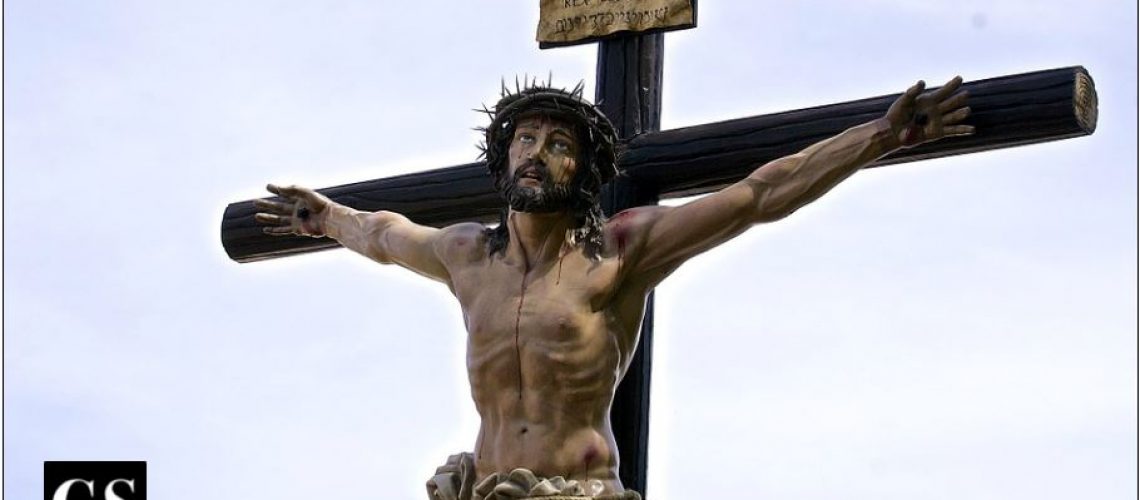
The problem with Jesus is that he is too real. He has gouges in his hands and feet. He bleeds from his side. He has thorn marks on his head. He has spit on his face. He’s dirty and sweaty and smells like a dungeon. He is reckless. To us, he is vulnerable to a flaw. But the flaw is not his.
The problem with Jesus is that he is God, and the problem with God is that he is love, and the problem with love is that it is vulnerable, and the problem with vulnerability is that it scares us. It’s not safe, and therefore, never popular.
Following Christ carries no guarantee of safety in this life. It ultimately takes us far away from our safe spaces. Unless, of course, we choose to connect with the domesticated, non-divine Jesus that is ever popular: the follow-the-science-social-justice-warrior Jesus. If you do, just bear in mind that he’s not real, and your relationship with him will bear little if any fruit.
Love is the only reality. There are thousands of fanciful gods for security seekers; but only one for truth seekers. Real love is vulnerable. The God of love is vulnerable. Love is a choice; security a ruse. The choice is ours.
It’s not like we don’t know this intuitively. Look at any of the comic book superheroes that have been created since the very inception of the graphic novel genre. Each and every superhero has a vulnerability; perhaps several, without which they would be pathetically boring, their unstoppable power rendering laughable anything remotely resembling a plot line.
Without vulnerability, bravery is impossible, and nobody gives a hoot about a superhero that’s not brave. Power devoid of risk requires no courage, no sacrifice. It is sacrifice that gives the plot—our lives—its zing, romance, and ultimacy.
And yet, every time the philosophical subject of “the problem of evil” comes up, the question that demands to be answered could just as well be phrased: What good is God if he’s not an invincible superhero that prevents all misery?
Of course, if he did prevent all misery, we would never need to make a sacrifice or suffer a loss. Life would have no romance, no plot, no challenge—no zing. Holiness would serve no purpose because no matter what anyone did everything would always turn out fine.
Invincible, superhero God would not allow one’s husband to be cruel, or one’s wife to betray him, or one’s child to disobey, revolt, suffer, or die. Nobody gets hurt by an invincible, superhero God; therefore, nobody grows spiritually in any way. No one is truly free or truly human because all are created in the image of this god with no vulnerability—no skin in the game.
Jesus said that a wicked generation asks for a sign. The sign that was sought was one that would show Christ to be the long-awaited, invincible, superhero messiah. He told his hearers, “You will look but you will not see; you will listen but you will not hear.” He knew that no sign will ever suffice for those who do not recognize God in his words or take God at his Word.
No sign will ever suffice for those who despise the love that Christians share, who see vulnerability as weakness rather than the ultimate strength that it is. Divine strength. Divine courage—the difference between a god and thee God; the difference between milk-toast, laid-back, nice, effeminate, non-judgmental prophet Jesus and the real deal; the difference between invincible, super-hero God-man Messiah and the real deal.
The real deal is the God-man who made a whip of cords and drove thieves from his Father’s house; the God-man who suffered hatred, abandonment, torture, and death for the sake of Truth; the God-man who teaches us that real love—sacrificial love—is only possible in an imperfect world filled with those who are free to refuse it.





4 thoughts on “The Problem of Evil and The Superhero Messiah of Our Longing”
Pingback: Running Toward Trauma – Some Thoughts from Cabrini and Makoto Fujimura – A Song of Joy by Caroline Furlong
Thank you for a very thought provoking writing. As a person who suffers daily, I know that I must suffer for my Lord and my God. There is no fairy tale happiness on earth. Those who think there is only keep going around on a wheel of unhappiness and dissatisfaction like a hamster. Suffer gladly, offer everything, be courageous, then be still and know that he is God.
Pingback: FRIDAY LATE MORNING EDITION – Big Pulpit
“Of course, if he did prevent all misery, we would never need to make a sacrifice or suffer a loss. Life would have no romance, no plot, no challenge—no zing. Holiness would serve no purpose because no matter what anyone did everything would always turn out fine.”
Sounds like heaven.