

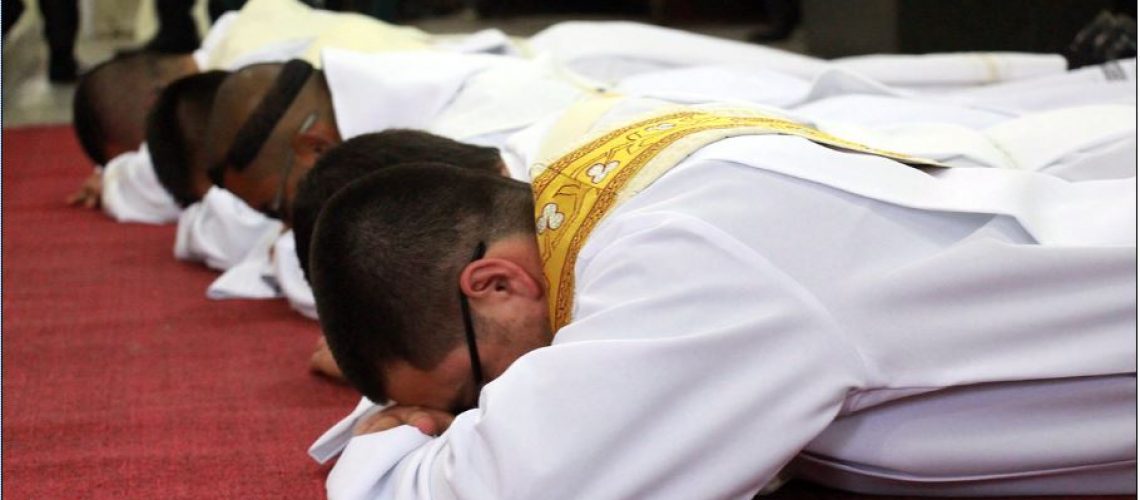
Just as Christ, the Lamb of God, was both the victim assuming the sin of all humanity, as well as the priest offering the sacrifice of the victim, so is the ‘other Christ’, the Catholic priest.
In the first part of this article, we noted most parishioners instinctively sense their Pastors do not connect priesthood with victimhood. We found clues to how certain ‘worldly’ aspects of the modern parish may be reinforcing this disconnect, especially when a decline in prayer hinders the Pastor from accomplishing the supernatural mission of saving the souls entrusted to him.
In the second section of this article, I examine further reasons for this ‘divorce’ and suggest steps to reclaim Christly Victimhood in the Priest for the good of the Church.
The Shepherd’s Staff
The shepherd employs his staff (pun intended) to clear the way through thickets for the safe passage of his sheep; and to draw straying sheep back into the flock, keeping them in line. His staff also comes handy to scare away or fight the preying wolf in order to protect the sheep. At times, his staff may help him balance while on rough ground. The staff that does not serve the purpose of the shepherd for the sheep will be instrumental in striking the shepherd and scattering his flock.
Are parish employees mentored by the Pastor to have spiritual goals? Do they have a program for discipling with an aim to cultivating apostolates that are faithful to the Gospel? Do they have an annual staff retreat? Does the Pastor ponder how some of the personal beliefs of employees hurt the mission of the Church? Is the parish staff merely “waiting on tables” (Acts 6:2) or are they configured to advance the Gospel of Christ in doing so?
If these issues do not matter to a Pastor because subconsciously he believes that faith is a personal matter, the resulting fragmentation of vision demonstrates itself before the flock. All that is left then is nepotism, silos, cliques, and moonlighting in a Catholic social club called parish. No parishioner here discovers the true joy of finding Jesus in the Temple.
‘Marx’ of Mere Good Works
Do all our parish ministries refer their members to Christ’s redemptive sacrifice? Not rarely do we find parish ministries that offer little to advance the Sacramental/spiritual life of people—either in their object or in their operation—although these groups do great works in ameliorating existential pains. Even ministries serving the liturgy are run like professional services.
Some parishes call themselves ‘inclusive’—the secular counterpart of the Catholic ‘universal’. Let us not miss that Catholics supporting the passing bandwagon of ‘Black Lives Matter’ consider ‘Love thy neighbor’ or ‘All lives matter’ to be mere platitudes. They imply that the Pastor, his flock, and the facilities of the parish are focused on preserving something cultic rather than the good of gathering ‘lost sheep’ named by them. When a parish eschews the Christ flavor, their mission is driven by causes ranging from hot-button to the soft-pedaling.
Sheen warns that the absence of Christ in good works reduces true religion to the mere practice of Marxism.
Why was it that Francis of Assisi became a saint and Marx did not? What made Elizabeth of Hungary, in her love of lepers and orphans, a saint? What made Hedwig holy in the political and social revolution that she effected in Silesia? What made Catherine of Siena a saint in her bold directives to the Papacy? What made a Vincent de Paul a saint in his gathering-in of the poor? What made them holy in their involvement in the world, while so many men and women called to a holy state today fall away from sanctity, celibacy and Christ? It is because the service of Catherine, Vincent de Paul, etc., was never separated from their Victimhood.
Parish leadership is considered to comprise of the Pastor and his staff. The latter are members of the laity, meaning those not in Holy Orders or religious life. The Pastor’s labors must, therefore, include the sanctification of these lay leaders, forming them into servant leaders who “wait on tables” in order that the Pastor is free to actualize the Word of God to His people.
“The hierarchical Priesthood is related first to the Head, then to the Body; it is also committed to the renewal actively of the Sacrifice of Christ in the Mass, through which the royal [common] Priesthood is united by spiritual sacrifices. The priest alone can complete the building up of the Body in the Eucharistic Sacrifice.”
Confusing Priesthood—Baptismal and Ministerial
The faithful Capuchin who baptized me (as Vatican II decrees got rolled out in India) left the Holy Orders and later married. My parents (to whom he was a family friend) and I, had always grieved this ‘mystery.’ Years later it dawned on me that the poor priest was one of the many lost to the identity crisis in the Priesthood in the wake of Vatican II.
With the ‘world’ entering the Church, and the Church believing herself to be marching into the world, the Vatican II’s Universal Call to Holiness seems to have remained universal in call alone—each one calling out to the other with his/her own understanding of holiness. To some, holiness was a return to the Gospel; to some others, it was a worship of the Golden Calf with degrees of hybrid holiness to run the spectrum. Sheen sees the image of ‘The Church in the Wilderness’:
“The Church up until the Vatican Council was more separated from the spirit of the world than now.”
Post-Vatican II,
“[T]here began to be a yearning for the fleshpots of modern Egypt. Some priests and religious felt much less comfortable in being identified with what they called the “establishment.” A decline in reverence for the Eucharist developed in the Church as there was a rejection of the Manna among the Israelites.”
The priests stopped teaching faithfully. The faithful started teaching in their place. People were used to listening only to priests, but he appeared only during homilies nervously to speak about Christ among other things.
“[A] priest may have professional and liturgical flirtations with Divinity, but they are all on the level of professional appearances.”
Catechesis declined. During Holy Communion, a bevy of ‘liturgical volunteers’ share the sanctuary space abreast with the Priest. In a role reversal, the staff “walks ahead” (John 10:4) of the shepherd as if the sheep were prickly bushes. Surveys within the friends’ circle guide navel-gazed decisions. Together they wonder why no one engages. It is not polite to get personal with parishioners, so they look for clues on social media. In all, a culture that sterilizes the Priest of his Victimhood.
“In God’s army, only the wounded may serve,” but professionalism calls for ‘drawing boundaries’ between the wounded from their healer; the shepherd from his sheep; the spiritual father from his children.
Undoubtedly, parish staff toil long hours for salaries incommensurate to what secular employers offer; they keep the people connected to the parish and pick up the Pastor’s slack. Yet, they are not to overstep into or undermine what is properly and desirably the ministry of consecrated Priesthood. However, while in some parishes, this is their job description, in others, the priest “[makes] the mistake of identifying his Priesthood with the will of the community and [ends] up by making a golden calf” (Exodus 32:1-4).
Victim-Priest Examples
“The decade following the Second Vatican Council was the age of marrying priests; the next decade will be the age of divorcing priests; and the third decade will be the Lord embracing His lost shepherds.”
I imagine that we are in the age of priests “divorced” from Victimhood and must hope for the next age of return to our original roots. Here is how it looks like to me:
The parish priest who visited my sick Dad in hospital and offered cash for expenses without my asking. A priest who suggested I consider him as my child in the hope that I would overcome grief over my miscarried baby. A priest who offered to plead with the Hindu parents of my husband to consent to their son marrying me. A priest who after my Dad’s funeral Mass unexpectedly joined me in the ambulance taking his body to be donated to a medical research institute.
A missionary priest who ended up raising an Ebola orphan in an African country, after leading his people through its ravages of suffering and death—all without formal training, aid, or a hazmat suit. Another who in the absence of medical help nearby, helped women deliver babies, relying only on phone instructions received from doctor friends. A priest who donated his kidney to an unrelated needy recipient. An elderly priest with COVID-19 who refused a ventilator so a younger patient could use it.
None of these instances were they necessarily administering the Sacraments. Yet, in each instance, the priest himself was a victim offering. At Mass, the priest carries these into the chalice when he intercedes for all of humanity.
The Reclaimed Victim-Priest
What measures, for instance, can an American parish take so that children receiving their First Holy Communion make regular Confessions thereafter? This itself would be a large project with far-reaching long-term goals, and eternal returns. This would call for an extreme collective focus on part of the parish staff led by the Pastor; not just those paid to coordinate religious education.
For the Pastor, this may mean heavy investment (‘Victimhood’) of himself towards the goal. He must find ways to get parents involved; perhaps be available to offer Confessions to young penitents and their parents on the evenings they have Religious Education. He may make it a point to appear at a Religious Education class, making himself known to the kids as their shepherd, waiting to teach them, and gather them to Jesus. A religion pop quiz perhaps with the toss of an unexpected candy bar. How about a periodic Religious Education town hall? Fruitful conversation threads are yielded that the Pastor can pick up with families after Mass on Sundays.
On the other hand, what do we say of the coordinator in charge who coos: “Father, I will not ask you to spend every Tuesday in the confessional.” Like an overprotective mother, she babies the priest into a ‘fear of the Cross’. Sheen calls it out:
“The Christ without the Cross cannot save, for He stands for effeminacy, permissiveness and Jesus the Superstar who uses music to solace defeat.”
This leadership of Pastor walking among and “ahead of his flock” (which includes his own staff) must touch every ministry, every decision of the parish. Looking inward and healing a divorce, a fissure or a disjoinment in one’s own vocation, knowledge, attitudes, and priorities, maybe the right approach for a Pastor to keep his flock rooted in Christ.
Pray for President and Priest
Must lay Catholics be interested in priest matters? Are we not supposed to concentrate on their own vocations? Fulton Sheen responds:
“As citizens are interested in “The Making of a President,” though they will never become President, so non-clerics may be interested in “The Making of a Priest” though they may never become priests.”
Lay Catholics have every stake in the Priesthood because families are where tomorrow’s priests are birthed. They must also learn Catechism, and about the Holy Orders. They must humbly expect their priests to be good shepherds and self-sacrificing spiritual fathers. Opportunity arising, they must speak up for and uphold the Priesthood, not hesitating to start a conversation that matters—with family, fellow Catholics, or priests themselves.
Surely, all Catholics can pray every day for their bishops and priests. The invocations in the Litany of Our Lord Jesus Christ—Priest and Victim provides a list of intentions in our longing for Victim-Priests, as well as the standards of Jesus, the Eternal High Priest, and Victim.





4 thoughts on “The Priest as a Victim—Part II”
I’m with Fr. Khouri. I came to this series of articles hoping to be inspired by some beautiful theology and stories about priestly victimhood. Instead it was pretty much “today’s priests don’t measure up.” I’m grateful for my priests who embody this so beautifully.
To Father Khouri, “The Charter for the Protection of Children and Young People is a comprehensive set of procedures originally established by the USCCB in June 2002 for addressing allegations of sexual abuse of minors by Catholic clergy,” authored no less by then Cardinal McCarrick. I remember having to sign a form agreeing to a background check before I could volunteer at the parochial school my children attended. Then, two years ago came what is appropriately referred to as “The Summer of Shame,” when it was discovered that McCarrick himself did the most foul sex abuse acts on seminarians, etc. which I do not care to rehash. This is not about one or a hundred bad priests, and I believe there are twice, thrice more good, holy priests. Would you blame the sheep for setting a higher bar for our priests? Respectfully, this is not ‘vitriol.’ What is Holy Ordination, bestowed upon by the Divine Grace of God the Holy Spirit, but a call for priests to glorify God, not in mediocrity, not above the complaining babble of their sheep, but to truly be heroic, for God’s greatest glory?
Loreto,
Let’s pray for each other.
Please remember priests are sinners too, sometimes great sinners. We all fall short of the mark but most strive to image Christ the High Priest.
Your examples of priests who have offended you are both harsh and condemning. Please remember the numerous things your holy father Francis of Assisi taught regarding priests.
Thank you for your prayer and be assured of remembrance at the altar today.
It seems, no matter what priests in general, according to the article do or say, they are deficient in their ministry.
If a priest refers back our Lord regarding the purpose of coming to church, he is not hospitable or welcoming. If a priest asks that one follow normal channels for entrance into school (not denying the possibility) he is insensitive and uncaring.
The is much idealizing and idolizing of the priesthood in this article.
Would that all priests could be like the hero priests mentioned.
The nastiness and cynical nature of the article is a sign that you have been deeply hurt by priests. I’m sorry for that. Yet, your vitriol probably does not heal these wounds.
There are incompetent, insensitive or bad priests everywhere. I include myself in the above.
My great hope is that God might be more merciful to you, Loreto, than you are to most of His priests.