
The Precious Blood And The Worth Of Every Soul
The ancient world knew, intuitively, that blood is life. To shed blood was to give life. To receive blood was to receive life. So when the Creator of the universe chose to redeem His creation, He did not send a message or a manual. He sent His own blood. In July, the Church invites us to contemplate the Most Precious Blood of Jesus, not as a relic of a violent past but as the living price of human dignity.
If we want to know how much a human soul is worth, we need only look at the price paid. Silver and gold are the currencies of empires, used to buy armies, palaces, and thrones. But as St. Peter aptly puts it, they cannot buy a single soul; only the Blood of God can.
“You know that you were ransomed from the futile ways inherited from your ancestors, not with perishable things like silver or gold, but with the precious blood of Christ, like that of a lamb without defect or blemish.” 1 Peter 1:18-19
Blood as the Currency of Redemption
St. Paul declares to the Romans that we are justified by His grace as a gift, through the redemption in Christ Jesus, whom God put forward as a sacrifice of atonement by His blood (Romans 3:24-25). To the Ephesians, he writes, “In Him we have redemption through His blood, the forgiveness of our trespasses” (Ephesians 1:7). To the Colossians, he writes, “Through Him God was pleased to reconcile to Himself all things, whether on earth or in heaven, making peace through the blood of His cross” (Colossians 1:20).
The Catechism of the Catholic Church teaches: “The cross is the unique sacrifice of Christ, the ‘one mediator between God and men’ (1 Timothy 2:5)” (CCC 618), and states that “the blood of Christ is the price of our redemption” (CCC 1992). This is not a metaphor. It is the economy of salvation: what was lost through disobedience is regained through obedience, and the cost is nothing less than the life of the Son of God.
Human dignity, then, is not a vague concept or a political slogan. It is the value of a being for whom God paid the ultimate price. You are not dignified because you are productive, beautiful, or morally impressive. You are dignified because God bought you. He does not buy what is worthless. The Precious Blood is the measure of your worth.
St. Thomas Aquinas, in the Summa Theologiae (III, q. 48, a. 4), explains that Christ’s blood is “the price of our redemption” because it was offered to God in satisfaction for the offence of sin. The blood of bulls and goats could not take away sin (Hebrews 10:4), but the blood of the God-Man, infinite in value, did. Aquinas adds: “The blood of Christ is not only the price of our redemption but also the means of our purification and the pledge of our glory.” Dignity, once lost, is not merely restored; it is elevated, crowned with the promise of eternal life.
Dignity in Suffering
Tradition identifies seven instances in which Christ shed His blood for us. Each is an encounter with human brokenness, revealing the depth of divine love.
- The Circumcision(Luke 2:21): On the eighth day, Jesus sheds His first drops of blood, fulfilling the Law and identifying with every Jewish male child. His blood begins to flow even as an infant – a sign that His whole life, from its first moment, is a sacrifice for others.
- The Agony in the Garden(Luke 22:44): “His sweat became like great drops of blood falling on the ground.” Amid that terrible inner suffering, Jesus enters into the most profound human anguish – the fear of death, the weight of sin, the loneliness of abandonment.
- The Scourging at the Pillar(Matthew 27:26; Mark 15:15): Roman scourging was intended to tear flesh from bone. Christ’s blood flows freely from His broken body – the innocent offering Himself for the guilty.
- The Crowning with Thorns(Matthew 27:29): The mockery of a throne, the parody of a king. Blood runs down His face from wounds that are not fatal but deeply humiliating.
- The Carrying of the Cross(John 19:17): The wood of the cross, heavy and rough, opens fresh wounds. Each step draws more blood, leaving a trail of red through the streets of Jerusalem.
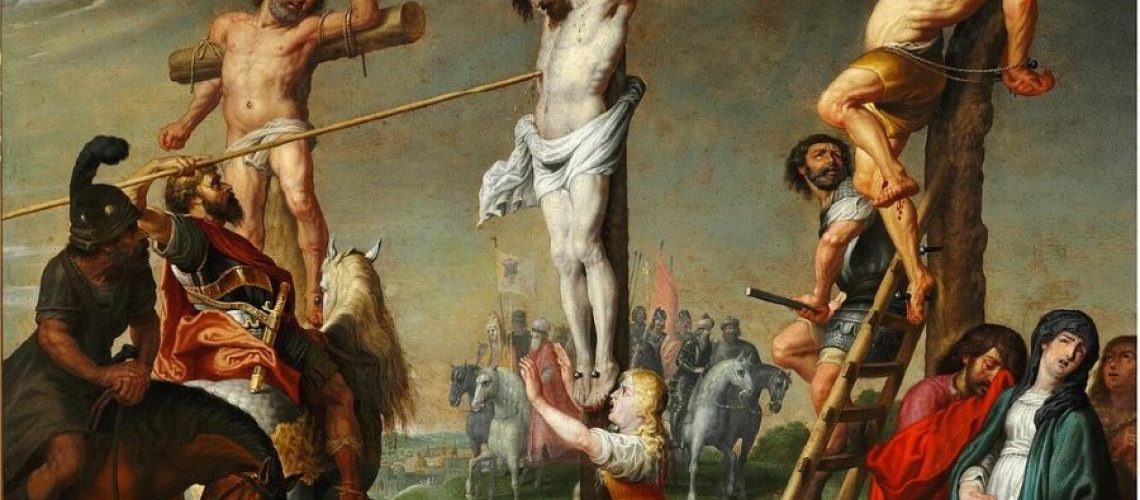
- The Crucifixion(Matthew 27:35; Mark 15:24; Luke 23:33; John 19:18): Nails driven through the hands and feet. Blood poured out in the supreme sacrifice. “Father, into your hands I commend my spirit” (Luke 23:46).
- The Piercing of the Heart(John 19:34): After His death, a soldier’s lance pierces His side, and “at once blood and water came out.” The Catechism notes: “The Blood and Water that flowed from the pierced side of the Crucified are the fountain of the sacraments” (CCC 1225).
St. Catherine of Siena, whose last words were “The blood! The blood!”, meditated deeply on these seven sheddings. She wrote: “The blood of Christ is the price of our redemption, the bath of our regeneration, and the drink of our refreshment.” In each shedding, human dignity is honoured – not because suffering is good, but because Christ’s suffering makes good what sin has broken.
Blood and Water: The Birth of the Church
St. John records: “But when they came to Jesus and saw that He was already dead, they did not break His legs. Instead, one of the soldiers pierced His side with a spear, and at once blood and water came out” (John 19:33-34). Then he adds a solemn note, “He who saw this has testified so that you also may believe. His testimony is true, and he knows that he tells the truth” (John 19:35).
The Catechism teaches: “The Church was born from the side of Christ as the new Eve was born from the side of Adam” (CCC 766). In his commentary on John, St. Augustine explains: “The blood was for the redemption of the people, the water for the cleansing of the people.” From that double flow arise the two great sacraments: Baptism (water) and the Eucharist (blood).
This is the dignity of the Church: she is not a human institution but a living body, born from the wounded heart of her Spouse. Every Christian is washed in the waters of Baptism and fed by the Blood of the Eucharist. We are not members of a club; we are children of the wound.
In Dominum et Vivificantem (1986), Pope St. John Paul II wrote: “The blood of Christ is the source of the Spirit, who is given to the Church.” The same Blood that flowed from Calvary flows into the sacraments, into the hearts of believers, and into the life of the world.
The Feast: Pope Pius IX and the Cry for Peace
The Feast of the Most Precious Blood has a history that speaks directly to our own times. In 1849, Pope Pius IX, exiled from Rome by revolutionary forces, found himself in Gaeta, Italy. The Church was under attack, and the Papal States were crumbling. It seemed the darkness would overwhelm the light.
A holy priest, Don Giovanni Merlini, counselled the Pope: “Holy Father, the precious blood of Jesus has not yet been honoured with a feast in the universal Church. Extend the feast, and you will see the peace of God return.” Pius IX listened, and on 10 August 1849, he extended the feast to the entire Latin Church, assigning it to the first Sunday of July. His decree, Vix dum e gravissimis, read: “The most precious blood of our Lord Jesus Christ, which was shed for the salvation of the whole world, has been the refuge of sinners and the consolation of the afflicted.” The Pope regarded the devotion as a remedy for the violence and division of his time.
The feast remained on the liturgical calendar until 1969, when the reformed calendar moved it to the Solemnity of the Body and Blood of Christ (Corpus Christi). Yet the devotion never disappeared. In his apostolic letter Inde a Primis (1960), Pope St. John XXIII wrote: “We earnestly exhort all the faithful to meditate more fervently on the precious blood of Christ.” Pope St. John Paul II frequently prayed the Chaplet of Divine Mercy, which opens with the words: “O blood and water, which gushed forth from the heart of Jesus as a fount of mercy for us, I trust in you.” In his 2017 homily for the Feast of the Precious Blood, Pope Francis reminded us: “The blood of Christ is the fount of salvation for the world.”
The irony is not lost: devotion to the Precious Blood flourished in times of crisis. We live in a time of crisis – of war, of division, of a culture that has forgotten the price of a soul. The Precious Blood speaks to our moment.
Living the Devotion Today
You can cultivate devotion to the Precious Blood in a busy, distracted world by taking practical steps rooted in tradition:
- The Litany of the Most Precious Bloodis a traditional litany approved by the Holy See, invoking Christ’s blood under forty-one titles: “Blood of Christ, the new covenant, save us. Blood of Christ, drink of the faithful, save us. Blood of Christ, price of the redemption, save us.”
- The Divine Mercy Chaplet – St. Faustina recorded Jesus’s words: “All the graces which I grant to souls are granted through the intercession of My Mother.” The opening prayer of the chaplet, “O blood and water, which gushed forth from the heart of Jesus as a fount of mercy for us, I trust in you,” clearly connects the Precious Blood to mercy.
- Receiving the Precious Blood in the Eucharist– When the Church restored the chalice to the laity after the Second Vatican Council, it was not a concession to modernity. Instead, it represented a revival of an ancient tradition and enhanced Eucharistic communion. Those able to receive the Precious Blood should do so with reverence and purpose, mindful that they are drinking the cost of their salvation.
- Adoration of the Blessed Sacrament— The Precious Blood is not a relic of the past; it is present in every tabernacle. Eucharistic adoration is an encounter with the living Christ, whose Blood still pleads for us – the sprinkled blood that speaks a better word than the blood of Abel (Hebrews 12:24).
- Making Reparation— Many souls blaspheme the Precious Blood. The Church encourages acts of reparation, such as prayers offered for those who dishonour the Blood of Christ, so that they may come to know its saving power.
Take-Home: The Price Has Been Paid
In a world that continually devalues human life – through abortion, euthanasia, war, and neglect of the poor and the elderly – the Precious Blood proclaims a different truth. It declares: “You are not a statistic, a burden, or a mistake. You are worth the blood of God.”
The Catechism declares the blood of Christ, which He ‘poured out for many for the forgiveness of sins’ (Matthew 26:28), as the foundation of the New Covenant (CCC 1365). That covenant is not a contract between distant parties. It is the marriage between God and humanity, sealed in blood.
“O precious blood, price of our redemption, bath of our regeneration, drink of our refreshment, medicine of our weakness, plea of our intercession, seal of our election, earnest of our inheritance!”
St. John Henry Newman (meditation on the Precious Blood)
In July, we are invited to wade into that stream of mercy, not to gaze at a relic of the past but to drink deeply from the fountain of life that flows from Christ’s pierced side. The price has been paid. The dignity is ours. All that remains is to accept it—and then to live as those who know their worth.
Sanguis Christi, inebria me. (Blood of Christ, inebriate me.)
*NB: Unless specifically stated, all Bible quotations are from the NRSVCE.


[…] Window of the Soul: The Evil of “A.I. Sacred Art” is Lying – Hilary White at TSIPThe Price of Dignity – Dr. Pamela Mandela at Catholic Stand […]