

The pause in our usual activities due to the COVID lockdown gave us the opportunity to take stock of our lives; the pause in regular communal worship gives us the opportunity to take stock of our liturgical life and so to celebrate Mass better than we did before the COVID lockdown. The importance of seizing this moment was well expressed by Cardinal Ratzinger (Pope Emeritus Benedict XVI): “[T]he Church stands and falls with the liturgy . . . the true celebration of the sacred liturgy is the center of any renewal of the Church whatever.”
As we return to a public celebration of the Mass, we have the opportunity to continue, with greater enthusiasm and greater effectiveness, the “New Liturgical Movement” for which Cardinal Joseph Ratzinger called in his Milestones and which is especially inspired by his The Spirit of the Liturgy.
New Opportunities
Last Fall, I experienced the Holy Sacrifice of the Mass in the form which makes the most sense to me. Early on a Sunday morning as I was leaving the home of an out-of-state friend, I asked him where I could stop for Mass. I trusted his judgment since he is an orthodox Catholic who is extremely bright, is very knowledgeable about the Faith, and has excellent aesthetic taste.
He did not tell me more than the name and location of the church. When I entered the church, I was surprised to see it had a Communion rail and no stand-alone altar. Rather, the only altar was a glorious one attached to the eastern wall of the sanctuary, a “high altar” or “main altar.” Had my friend directed me to a church where only the Extraordinary Form of the Mass (often referred to as the “Traditional Latin Mass” or “Tridentine Mass”) is celebrated?
Now, on the one hand, I am aware the Extraordinary Form is perfectly valid.I was glad when Pope Benedict XVI gave priests greater freedom to celebrate it, I have relatives and friends who prefer it to the Ordinary Form (the “Novus Ordo” Mass which has been in place since 1969), and I will occasionally attend Mass in the Extraordinary Form. On the other hand, I do prefer worshipping in English rather than Latin, I prefer the Liturgy of the Word in the Ordinary Form over the Extraordinary Form’s Mass of the Catechumens (roughly its Liturgy of the Word), and I like the greater participation the Ordinary Form gives me.
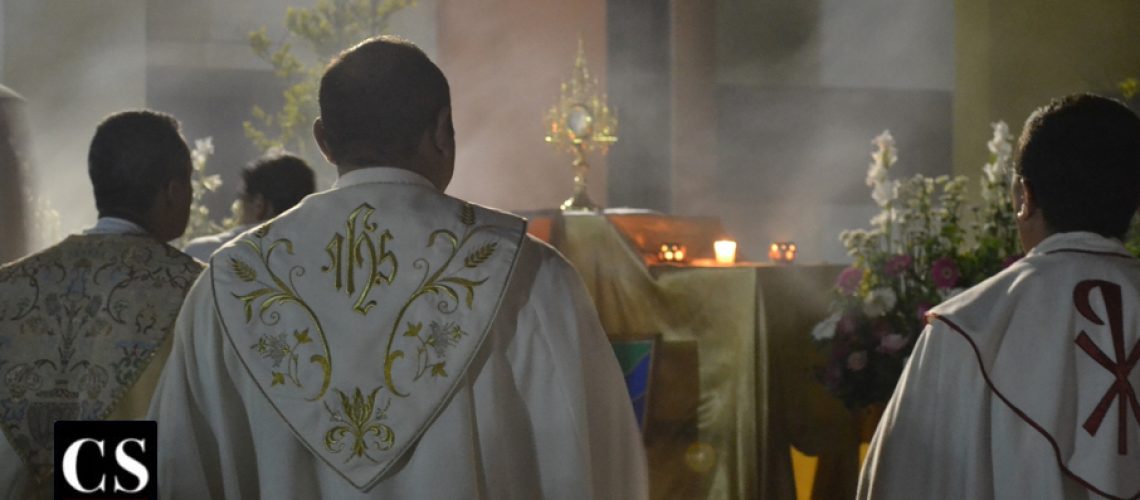
I was therefore glad to see as Mass began on this Fall Sunday morning that the Ordinary Form was celebrated. The Liturgy of the Word was conducted as usual, but the Liturgy of the Eucharist was conducted with the priest facing ad orientem (to the East)—facing the Tabernacle and the Crucifix just as the people face—except for when he addressed the people. When the priest had his back to us, we could still hear him perfectly, thanks to the sound system.
The Consecration was especially moving as the priest held the Host and Chalice high up to the Crucifix, to which he was so close. The fact that the Mass re-presents Christ’s atoning sacrifice on the cross was made especially vivid. The Presence of Christ outshone the presence of the priest. The reverence with which the priest celebrated the Liturgy of the Eucharist, along with the ringing of bells at the Epiclesis and Consecration, facilitated the sense of God’s majesty and thus the adoration of us in the pews.
In order to receive Holy Communion, we knelt at the Communion rail. Being on my knees made receiving the Body of Christ more prayerful for me. Being on my knees also made waiting to receive the Body of Christ far more prayerful than standing in line does. As I wait to receive the Body of Christ, I would much rather have an unobstructed view of the Crucifix instead of having in front of me the back of a person, over or around which I must look in order to focus on the Crucifix while trying to avoid stepping on the heel of that person.
God bless Bishop James Wall of the Diocese of Gallup, New Mexico. Last summer, he began the celebration of a Mass each Sunday at the Cathedral of the Sacred Heart with the presider facing ad orientem. Bishop Walls’ letter to his diocese introducing the ad orientem Mass is worth reading. That Mass at Sacred Heart is said at a stand-alone altar so the ad orientem Mass is not limited to a church with a high altar attached to the eastern wall. Hopefully, ad orientem Masses will be celebrated at more churches.
We should explore every way to find ways new to our own parish that further the “movement toward the liturgy and toward the right way of celebrating the liturgy, inwardly and outwardly,” as Cardinal Ratzinger called us to do.
The Opportunity to Do What We Should Have Been Doing
Another way to make the most of our return to communal worship is to start doing what we had been neglecting to do and to stop doing what we should not have been doing. As Vatican II decreed:
Regulation of the sacred liturgy depends solely on the authority of the Church, that is, on the Apostolic See and, as laws may determine, on the bishop. Therefore no other person, even if he be a priest, may add, remove, or change anything in the liturgy on his own authority.” (Constitution on the Sacred Liturgy, 22)
Mass is not the personal property of the priest, the liturgy commission, or the parish. The Mass belongs to God. It is high time to stop taking liberties with the rubrics of the Mass (the rules for celebrating Mass), which are found in documents such as the General Instruction of the Roman Missal, the Code of Canon Law, and Redemptionis Sacramentum. Some examples that come to my mind, some of my own pet peeves, follow.
To paraphrase Cardinal Ratzinger, we spiritually suffocate when man’s words, thoughts, and intentions replace the fullness of the Faith in the Liturgy of the Church. Those priests who ad-lib, when they are not supposed to, should stop doing so. For example, at the beginning of the Penitential Act, they should not say something other than “Brethren (or “brothers and sisters”), let us acknowledge our sins, and so prepare ourselves to celebrate the sacred mysteries.” Most egregious is when priests intentionally depart from the exact words of the Consecration. Priests should take greater advantage of the times when they are allowed to use their own words. They may give introductions at three points: to the Mass of the day after the Greeting, to the Liturgy of the Word before the Readings, and to the Eucharistic Prayer before the Preface. They may also make concluding comments about the entire Mass before the Dismissal (General Instruction of the Roman Missal, 31). Relatedly, priests who need to do so could also re-dedicate themselves to reading, practicing aloud, and reflecting on the Orations (also called the Presidential Prayers)—the Collect, the Prayer over the Offerings, and the Prayer after Communion—before Mass instead of stumbling through them for the first time during the Mass. Dear Priests, if you do not take the Orations seriously, many of us will not do so either.
In my opinion, now is a great time for priests and deacons to use the words Divine Revelation and doctrine in their homilies so the congregation knows what God has revealed and how the Magisterium has authoritatively interpreted that Revelation, as well as what God has not revealed and what are the priest’s opinions and prudential judgments. Every homily should explicitly make the case, to a lesser or greater degree, for why we should be Catholic. Many are the homilies I have heard that could have been given unaltered in a Protestant church, which suggests that we might just as well be Protestant and which partly explains why baptized Catholics leave the Catholic Church to join a Protestant denomination.
The Pause
The pause in public worship has also given the congregation the opportunity to follow the rubrics more closely. For example, when we recite the Nicene Creed, we should bow from our waist when we say “and by the Holy Spirit was incarnate of the Virgin Mary, and became man” (General Instruction of the Roman Missal, 275). Rarely have I seen this done at Mass. How beautiful it would be, how pleasing to God, how more worshipful if we all made this sacred act. Redemptionis Sacramentum, referred to earlier in this column, provides a thorough list of abuses of the Mass. An example of what no one should do, or at least be pressured to do, is to hold hands during the Lord’s Prayer since it is not required by the rubrics. A much more serious mistake is standing during the Eucharistic Prayer when healthy enough to kneel (General Instruction of the Roman Missal, 43). Those churches and chapels that do not have kneelers should have them installed as soon as possible.
The congregation should always know what to do. For example, with the wonderful increased use of blessing the congregation with the sprinkling of water, I have never heard the congregation told how to respond to it, so some of us make the sign of the cross when sprinkled and some of us do not. Much more serious is that many in the congregation have never been told when they are properly disposed to receive Communion and when they are not.
With gratitude to liturgical musicians who generously share their talents, I offer some thoughts. Hymns should be chosen mindfully that most of us in the congregation cannot read music and do not have a good cantor’s range of notes and keys. The cantor makes it difficult for the rest of us to sing with him or her when he or she sings as though he or she is giving a solo performance. Let’s stop singing hymns that are about us instead of God (“Gather us in . . .”), that have us play the role of God (“I go before you always . . .”), and that is sing-songy in a way which is more appropriate for kindergartners and first graders. Let’s not sing the Responsorial Psalm like a dirge when the lyrics are anything but a dirge. Let’s not sing four or five verses of a Processional or Recessional hymn when only two verses suffice. Music serves the Mass and Mass does not serve the music.
Some key ways our esteemed lectors can re-dedicate themselves are: be familiar with the Readings before reading them at Mass, be able to pronounce every word as it should be pronounced, know how to use punctuation, enunciate and project as necessary while being neither overdramatic nor monotone. Practicing in front of those who can give good, honest feedback would be very helpful.
Catechesis
All of this will take catechesis (religious instruction). The catechesis could aim for implementing significant changes on the First Sunday of Advent, which should also then include catechesis about the Liturgical Year.
There is also a need for catechesis on Mass that was begged by the COVID lockdown. Yes, it was good that our leadership in the Church told us how they felt our pain as we were deprived of the communal celebration of Mass. God bless those bishops and priests who explained why the Eucharist is truly “the source and the summit of the Christian life” (CCC 1324) and yet how we can stay close to Christ when we are not able to attend Mass. Especially needed is catechesis on grace and how the fullness of the means of salvation subsists only in the Catholic Church.
We can make up for the lost time by providing such catechesis as we continue to deal with COVID. There are about six months until the First Sunday of Advent.



4 thoughts on “The Pause: Our Liturgical Opportunity”
We can’t merge the two different Masses together. We must all worship God one way.
We do not have to worship God one way–that is, exactly the same way–according to Canon Law, the General Instruction of the Roman Missal, the Catechism of the Catholic Church, and the earliest documented history of the Catholic Church, which is why there is a Roman Rite and a Byzantine Rite, among others, in the Catholic Church, as well as allowance for Mass ad orientem and Mass versus populum. However, you’re right in that worship should be based on one Faith. We need to be unified on the true essentials of the Faith and respect valid differences in non-essentials.
Pingback: How to Reason Using Good Logic - Catholic Stand
Pingback: What Makes a School Catholic? - Catholic Stand