

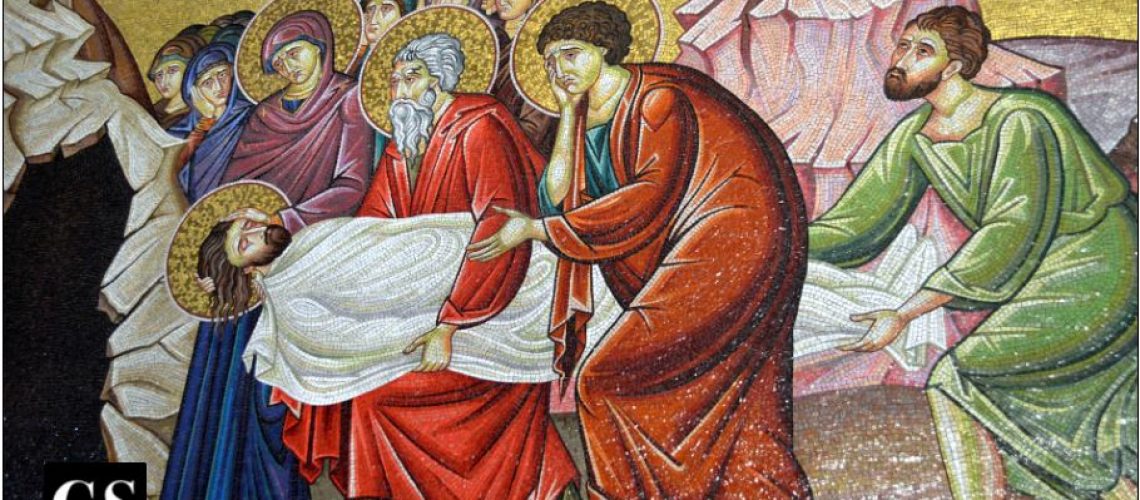
November is traditionally considered the month of the faithful departed because November 2nd is the day entirely dedicated to prayer for all those who are deceased; yet, the month begins with the solemnity of All Saints. The solemnity itself dates back at least to the 700’s. It was on November 1st during the reign of Pope Gregory III that an oratory was established in Saint Peter’s Basilica filled with relics “of the holy apostles and of all saints, martyrs, and confessors, [and] of all the just made perfect who are at rest throughout the world.”
Saints Are For Us
We all probably have our favorite saints and like to think of them and pray for their intercession. That is all well and good, but, when it comes to all the saints, Saint Bernard of Clairvaux, in an old homily, asks about the point of this celebration. He asks: “Why should our . . . celebration of this feast day mean anything to the saints? What do they care about earthly honors when their heavenly Father honors them? . . . The saints have no need of honor from us; neither does our devotion add the slightest thing to what is theirs. Clearly, if we venerate their memory, it serves us, not them.”
Saint Bernard isn’t diminishing the importance of the saints, of course, but is raising a good question. It’s great that we have saints, but when we think of them and pray to them, it doesn’t make them feel good. They’re already in heaven and are perfectly happy. When we do these things, what we’re really doing is helping ourselves get to heaven, and this is because the saints are an excellent model for us.
Our Final End
Perhaps something similar could be said of the commemoration of all the faithful departed; namely, the souls in Purgatory. To be sure, our prayers and sacrifices do help those who have died and are in need of purification. Yet, there is a very real way in which the consideration of mortality, the real and inevitable possibility of death, helps us as well. Too often our world tries to push aside the uncomfortable idea of death, but there is no escaping it. In Man’s Search for Meaning, Viktor Frankel tells recounts the following story:
A rich and mighty Persian once walked in his garden with one of his servants. The servant cried that he had just encountered Death, who had threatened him. He begged his master to give him his fastest horse so that he could make haste and flee to Tehran, which he could reach that same evening. The master consented and the servant galloped off on the horse. On returning to his house the master himself met Death, and questioned him, “Why did you terrify and threaten my servant?” “I did not threaten him; I only showed surprise in still finding him here when I planned to meet him tonight in Teheran,” said Death.
The avoidance of death . . . to what end? We will inevitably meet it.
The Reality of Spiritual Death
Perhaps this observation becomes more salient with the following question: what is the most dangerous job in the world? If you ask Time magazine and CNBC, they say loggers, followed by fishermen, followed by roofers. That’s because these professions have the highest rates of people who die on the job, and certainly that’s one way to consider danger.
Yet, it’s not the only way. For us as Christians, there’s a far more dangerous death than simply the end of our physical lives here. Christ tells us: “Do not be afraid of those who kill the body but cannot kill the soul” (Matthew 10:28). Truly, the most dangerous job is the one that makes us forget reality, the one that blurs the distinction between physical and spiritual living and dying.
The Business of Death
While working at the parish, I stumbled upon what might be the world’s most dangerous job. I was once asked to preside at a liturgy at a funeral home. The deceased was unknown to us, so I simply dusted off a standard, generic sermon for the event. To my surprise, when I arrived at 8:50 for a 9 am ceremony, no one else had yet arrived. I was led to the chapel, where it was just me and the deceased: Leroy, we can call him. I was led in by a young man, Jerry, who was probably a little older than me. Jerry simply led me in and asked me to wait until the family arrived. It was a while before they did.
If you spend enough time in funeral homes you start to realize just how artificial everything is. For instance, here was the constant background soundtrack of “On Eagles’ Wings” gently played on the synthesizer and looped ad nauseam, a song completely lost on those who hadn’t grown up in the US Church in the 80’s and 90’s. There is a lot of Asian artwork, with the occasional painting of a farm (perhaps a nod to those who bought the farm).
In any event, the family eventually arrived, and Jerry made a perfunctory announcement about turning off cell phones to the fifteen or so people who were there. I performed the ceremony, and the family requested some time to be with Leroy. Jerry came in and out, waiting for the family to finish, twirling a metal handle of some sort like it was his set of house keys.
When the family finished, he officiously inserted the handle into a round slot in the casket next to Leroy’s head and lowered Leroy with a sort of mechanical efficiency that could only have been obtained through years of callous experience. In a flash, and with equal efficiency, the flowers were removed, the casket closed, the beautiful display around the casket taken down, and Leroy was wheeled out to the hearse. Jerry then asked if I wanted to drive with him to the cemetery, which I did. It was just the three, er, the two, of us: Jerry, Leroy, and me, driving down the road at 35 miles an hour.
What do you talk about in a hearse when you have a dead body in the back? The weather? So I asked Jerry about his life. He wanted to be a doctor, a forensic pathologist but decided he didn’t want to study for four years, then do eight of residency, so he opted for the next best thing: he became a mortician, or, as he put it, he “studied mortuary science” at the “Cincinnati College of Mortuary Science,” the “Harvard of Mortuary Science,” he proudly told me.
Jerry was an interesting character, with many interesting tidbits picked up in school. He also told me that, legally, funeral processions have the right of way in traffic (except for trains, he hastened to mention: those win), but that he doesn’t go through red lights if the procession is small, like ours. What he does instead (and did often in our procession) is to loudly honk the horn, in a long series of three honks. Really, it wasn’t quite necessary, but I got the impression he liked the sound. As we was blasting our horn, loud enough to wake the dead (well, not really), our little procession passed through the intersections where the homeless and veterans of real or imagined conflicts begged for money; yet, at the sound of the horn and the sight of the hearse, many made the sign of the cross.
Then I asked the definitive question: “So . . . Jerry . . . what do you think about death? Does it bother you?” “Well, it used to,” he said. “At first it was hard, because it’s a loved one, but then you learn to separate your personal life from business.” I thought about that: to separate your business, which is death, from your personal life.
Certainly, you need to be detached; it’s the same with doctors, or even priests, in a sense. We deal with suffering, sin, and death, and, yes, you have to offer it to God and, yes, distance yourself from it, emotionally, but it’s such a part of our existence that it can never be separated entirely. It can be offered up, transformed, and renewed, but not detached. “So,” I asked him, “you just get used to death?” “Yes,” he said. Hmm.
We reached the cemetery forty-five minutes later and were directed to an area where two other burials were taking place. After the commendation and burial ceremony, as we headed back to the hearse, I told Jerry, “This is the grim work of a Friday.” “Yeah,” he said in a kind of matter-of-fact way. I guess it’s only grim for those of us who still think about death. Jerry made record time on the drive back: this time there were only two of us, since Leroy had remained behind, on the wrong side of the grass.
As he took the curves sharply, I thought it strangely fitting to be in a hearse, a vehicle made for death. The drive back was silent, punctuated by Jerry pointing out his favorite restaurants and talking about where he would send the kids when they got older. When we returned to the funeral home, we said our goodbyes, and Jerry went back to the business of death, because, for him, that’s all death is: a business. It’s nothing personal.
Memento Mori
In the rule of Saint Benedict, one of the instruments of good works (number 47, to be exact) is “to keep death daily before one’s eyes.” Saint Alphonsus Ligouri wrote, “St. Charles Borromeo kept on his table a skull, in order that he might continually contemplate it. Cardinal Baronius had inscribed on his ring the words, Memento mori. (Remember death.).”
Obviously, that doesn’t mean thinking about death in an abstract sense without thinking about oneself. Rather, it means to remember that death comes for all of us and, even if it’s technically our business, it is nonetheless, and will always be, highly personal. And, because it’s highly personal, I can grow accustomed to it, not in the sense of ignoring it, or displaying a skull on my desk, but rather by living in light of it.
The saints bear this out. “A holy hermit,” St. Alphonsus continues, “being asked when dying how he could be so cheerful, said: ‘I have always kept death before my eyes; and therefore, now that it has arrived, I see nothing new in it.’” In the Canticle of the Sun, Saint Francis even praises God for death: “All praise be yours, my Lord, through Sister Death, from whose embrace no mortal can escape. Woe to those who die in mortal sin! Happy those she finds doing your will! The second death can do them no harm.” The Imitation of Christ tells us:
See, then, dearly beloved, the great danger from which you can free yourself and the great fear from which you can be saved, if only you will always be wary and mindful of death. Try to live now in such a manner that at the moment of death you may be glad rather than fearful. Learn to die to the world now, that then you may begin to live with Christ. Learn to spurn all things now, that then you may freely go to Him. Chastise your body in penance now, that then you may have the confidence born of certainty. . . . Keep yourself as a stranger here on earth, a pilgrim whom its affairs do not concern at all. Keep your heart free and raise it up to God, for you have not here a lasting home. To Him direct your daily prayers, your sighs and tears, that your soul may merit after death to pass in happiness to the Lord” (Imitation, I.23).
If you are afraid of death, the problem probably isn’t with death but with the way you live.
Perhaps, then, the most dangerous job in the world is a mortician, not because it’s dangerous in this life, but because, if you get too numb to death, it can be very dangerous for the next.



5 thoughts on “The Most Dangerous Job in the World”
Pingback: VVEDNESDAY EDITION – Big Pulpit
To be numb to death is to not be fearful of it, but to be prepared.
St. Charles Borromeo kept on his table a skull, and became numb to it to the point where he could say: “I have always kept death before my eyes; and therefore, now that it has arrived, I see nothing new in it.” This was not much different than the mortician being numbed towards death, as long as the mortician is also prepared for it.
Hi Peter, and thanks for the comment!
Yes, I think you’re absolutely right that there is a difference between being afraid of death and being numb to it, just as there’s a difference between being fearful of death and being prepared for it. At least for me, I think that being numb to death means a sort of apathy to it, just not caring about it at all, whereas being prepared for it doesn’t mean being numb to it, but rather seeing it for what it’s worth: the end of my time on earth, and the passage to eternal life. I guess that, for me, when I think of being numb to death, I think of just not caring about it, thinking about it, or being concerned, either positively or negatively, about it; to be numb is just to ignore it. However, as Christians, we need to see death for what it’s worth: it’s not the worst thing that could happen, and, in fact, it could be the beginning of the beatific vision, which is excellent! That being said, we need to be prepared for it which, if we’re numb to it as I see it, we won’t be.
Thanks again for the comment!
Fr. Nate
Fr Nathaniel! I’m always excited when I see your name and with good reason. Down to earth, easy to understand, and relate to articles. Once again I’m not disappointed.
A wonderful and insightful story. I have no fear of death and look forward to once again meeting loved ones. When I say this, I do often get strange looks.
Thanks again, please send some more stories States side.
Hi Ida!
Thanks so much for your comment! I’m glad to know that the stories make it over to the other side of the Atlantic!
God bless,
Fr. Nate