
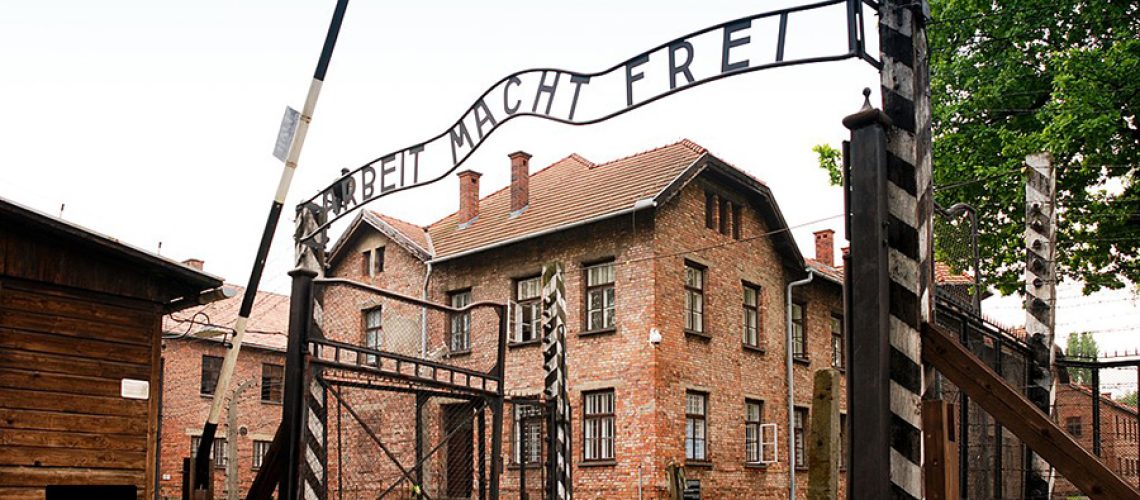
Caution: This column contains accounts of life in the Auschwitz maternity barracks, which may be deeply disturbing to some readers.
As you read these words, a family is struggling to comprehend an impossible situation: “I’m sorry,” the doctor has gravely told them, “But the fetus you are carrying has a condition that is incompatible with life. It will most likely be stillborn, or will die a few hours of birth.”
Elsewhere, a young woman’s heart sinks as she ponders her options. Despite her frantic prayers for a reprieve, the pregnancy test is clearly positive. Her life has not been easy up to this point, and she has just begun to climb out of the longstanding mess into a place of financial independence and emotional stability. Assuming responsibility for a tiny human being just might break her right now.
Is it morally acceptable to kill a child in the womb, so that its mother may have a fighting chance at life? Or to spare physical and mental anguish to the family whose preborn infant is almost certain to die within a few hours of birth? Since the 2022 reversal of Roe v. Wade in the United States, proponents for unrestricted abortion access have publicized a series of difficult pregnancy cases in order to demonstrate the catastrophic impact of abortion restrictions on women in dire circumstances. Those who previously leaned toward a wholehearted protection of life have paused to doubtfully ask themselves, “What would I do if I were in horrific situation X, Y, or Z? Or if it were my daughter or granddaughter?”
Defenders of preborn lives counter that when it is not possible to expect a positive outcome, the Christian disciple’s duty is not so-called mercy killing, but the alleviation of suffering lit by the steady flame of hope. According to this viewpoint, when we embrace dire circumstances with an unshakeable trust in the Divine Will, God is able to work through us and radically transform even the most difficult situation, because it is most in need of transformation. Those who seek to be more deeply immersed in this truth would do well to meditate upon the life of Servant of God Stanisława Leszczyńska.
In 1957, Leszczyńska delivered a paper to an assembly of colleagues in Łódź, Poland. Its substance was the Polish midwife’s two years of incarceration in Auschwitz-Birkenau toward the end of World War II. This straightforward narrative, which detailed the privations of labor and delivery in the camp’s harrowing “maternity unit,” was translated into English by Teresa Bałuk-Ulewiczowa and is worth reading in its entirety here: A midwife’s report from Auschwitz – Medical Review Auschwitz [E-library].
Comparable to everything else seized by the withering talon of Nazism, the tender care and pampering proper to a woman preparing for childbirth was subverted, in Auschwitz, into diabolical mockery. In her paper, Leszczyńska described expectant mothers huddled three or four to a bunk in unheated barracks with scant protection from the weather. The ceiling hung with icicles in deep winter; after a heavy rain, the floors stood several inches deep in water. Rats the size of house cats swarmed over the emaciated bodies of the women, their excrement mixed with the mothers’ food. Rampant typhus and dysentery resulting from the filthy conditions in the ward killed many of the prisoners there.
Leszczyńska was not the only health professional to have documented the inhuman treatment of pregnant women in the concentration camp. In her 1948 memoir, I Was a Doctor in Auschwitz, Hungarian Jewish gynecologist Gisela Perl declared that expectant mothers were specially selected for experimentation by the sadistic Josef Mengele. After observing pregnant women being beaten by guards and herded into gas chambers, the horrified Perl concluded that pregnancy in Auschwitz was tantamount to a death sentence.
Under the circumstances, Perl felt that she had no other choice than to sacrifice the child’s life with the intent of saving the mother. With each pregnant women she encountered, she would begin a frank conversation about the long odds of survival; for as long as possible, she would attempt to disguise the mother’s swelling belly with tape. When concealment proved no longer feasible, the gynecologist performed an abortion. Dr. Lucie Adelsberger, whose memoir, A Doctor’s Story, did not appear in print till 1995, also carried out abortions in the camp. Both women related that, in order to spare some little ones a worse fate, they were forced to kill living children who had survived their abortions—Perl by strangulation and Adelsberger with poison.
Stanisława Leszczyńska was not a doctor; she was a midwife, having felt a strong call to this work after the premature delivery of her firstborn son in 1917. She and her husband Bronislaw, who was a printer by trade, went on to have three more children. Meanwhile, Stanisława graduated from midwifery school in Warsaw with flying colors, after which the family returned to her native town of Łódź. Following the invasion of Poland in 1939, the Nazis established a ghetto for the thriving Jewish population there, and the Leszczyński family secretly helped the residents by providing food and false documents. However, in April 1943, Stanisława was arrested with three of her children. She and her daughter Sylwia, a medical student, were shipped off to Auschwitz.
Not long after her arrival at the camp, Leszczyńska quickly discovered that the babies born there were almost universally destined for a horrific fate. The camp’s medical staff had appointed Sister Klara, who was serving time for infanticide, and her assistant, a prostitute named Sister Pfani, to drown the newborn infants. Here is Leszczyńska’s frank account of the proceedings:
Each birth was followed by a loud noise of something gurgling coming from the room of these two, and then the sound of splashing water, sometimes for a fairly long time. Not long afterwards the mother could see her baby’s body thrown out in front of the block and being pulled to pieces by rats.
Leszczyńska’s return to the practice of midwifery was facilitated by a break in the ranks of the official maternity ward attendants. One of them was eventually transferred to another camp and the other fell sick. During roll call, one of the camp officials demanded to know whether there were any trained midwives among the prisoners. What happened next was retold this past January in a TVP World interview by Ewa Machaj Antosiewicz, whose 19-year-old, heavily pregnant mother Jadwiga arrived at Auschwitz in 1944, after the failure of the Warsaw Uprising:
“Stanisława Leszczyńska spoke up, and he said to her, ‘I don’t care what you do or how you do it, but you’re going to kill every newborn and record it as a stillbirth.’ It was a very risky thing to do, but she replied, ‘When I graduated, I swore an oath to God that I would help bring people into this world, not help them leave it.’ In other words, she refused. At the time, the punishment for refusing an order was the gas chamber. But he had no other choice…His fascist mug curled up in anger, but there was nothing he could do. He swung his hand—mom recalled that all the women prisoners were there at roll-call, and they all saw what happened—and he walked away.”
Ewa Machaj Antosiewicz also treasures a more personal connection to the midwife of Auschwitz. She was one of the babies who survived the camp. Before her birth, Ewa’s parents had decided on a boy’s name, but they had not chosen one for a female baby. Stanisława Leszczyńska said to Jadwiga, “Your little girl is so beautiful, why don’t you name her Ewa?” Maybe, the midwife suggested, naming the little girl after the first woman on Earth would bring God’s mercy upon the souls at Auschwitz and free them from their hellish existence. Moved by the faith of the pious midwife, Ewa’s mother agreed. From then on, Leszczyńska promised, the little infant was not just her mother’s baby but “our baby.”
Antosiewicz, a lively 80-year-old, described how Leszczyńska was forced to deliver babies with meager supplies—a kidney dish, the disinfectant potassium permanganate, and a small pair of nail scissors for cutting the umbilical cord. However, medical procedures formed only a small part of Leszczyńska’s daily care for the women of the barracks. The midwife regularly walked twenty minutes to fetch water for cleaning newborn babies and their mothers—water which sometimes fulfilled a sacramental function in the Baptism of Catholic and Christian infants. At night, she would stand guard duty on and off with another hardy soul to protect the sleeping women from the rats. With deep compassion, Leszczyńska distracted the laboring women from their pain and fear by telling them stories and singing softly to them.
Whatever their creed, the women welcomed the prayers of the helper they called “Mother” or the “Angel of Life.” No matter what horrendous fate lay before them at the hands of the Nazi butchers, their little ones would know, for a moment, the tenderness and warmth of earthly life in the arms of their mothers. At the same time, the mothers could cherish the wild hope that their children would survive. Though many infants soon succumbed to cold and hunger, or were murdered with phenol injections, Stanisława Leszczyńska’s refusal to advance the Auschwitz program of extermination gave eloquent testimony to the power of faith in a dark place.
During her time at Auschwitz-Birkenau, Leszczyńska estimated, she delivered more 3,000 babies. When the Lagerarzt, the official doctor of the camp, demanded that Leszczyńska submit a report on infant and maternal mortality, she responded truthfully that she had not lost a single mother or child at the time of birth. With withering skepticism, the Lagerarzt responded that the best German hospitals could not make such a boast. Nevertheless, it appeared that even Auschwitz, the death camp, was not immune to divine intervention. In the midwife’s own words:
“Contrary to all expectations and in spite of the extremely inauspicious conditions, all the babies born in the concentration camp were born alive and looked healthy at birth. Nature defied hatred and extermination and stubbornly fought for her rights, drawing on an unknown reserve of vitality.”
Leszczyńska also wrote of great charity and self-sacrifice toward the sick and dying in the ward, speaking eloquently of the physicians who assisted her from time to time:
These doctors fought to save lives that were doomed, and for those doomed lives gave their own…They were not working for the sake of a great reputation or blandishment, nor to satisfy their professional ambition; all these incentives had vanished. What was left was just the physician’s duty to save lives in all the cases and any circumstances she or he happened to encounter, augmented by the need to show sympathy for their neighbor.
As the Reich’s defenses began to collapse under the advance of the Soviet Red Army, Jadwiga Machaj and her tiny infant daughter were bundled westward on a chaotic transport organized by camp leadership. After stumbling 20 km through the snow with other prisoners, Jadwiga carried her baby into a cattle car and they were borne deep into Germany. Thus, as Auschwitz was being liberated in January 1945, they remained in captivity until May. Meanwhile, as fires blazed up in the chaotic remains of Auschwitz-Birkenau, Stanisława Leszczyńska went dutifully about the business of delivering babies, undoubtedly with greater serenity born of the knowledge that these children, however frail, would be spared the fate of brutal murder shortly after birth.
After a week of tending to the sick, the midwife finally left the camp, heading immediately for the town church of Auschwitz, where she attended Mass. Later she would discover that her husband had perished in the Warsaw Uprising, but that all her children had managed to survive the war. She continued to live a devout life in service to God as a midwife, praying for each mother and child in her care. On January 27, 1970, at a special ceremony on the 25-year-anniversary of the liberation of Auschwitz, the adult Ewa Machaj presented flowers to the woman whose courage had given her, and other young survivors of Auschwitz, their opportunity to life a full life beyond the horrors of the concentration camp.
Four years later, the midwife died, and her cause for canonization was introduced in the 1990s. In March 2024, the Diocese of Lódz observed a Mass in completion of its local investigation into her life. The story of her advocacy for tiny babies and their mothers still carries enormous relevancy for our culture eighty years after the liberation of Auschwitz. Catapulted into a world ruled by terror and the threat of extermination, Leszczyńska might have been reasonably expected to abandon the moral imperative implanted in her since she first memorized the Ten Commandments as a small child: “Thou shalt not kill.” After assessing the risks, she might have determined, as did Gisela Perl and Lucia Adelberger, that it was necessary to kill the baby in order to spare its mother.
With singular courage, the Polish midwife chose, instead, to surrender control of every birth outcome entirely to God. She knew that each child she delivered had only a miniscule chance of survival. Out of the estimated three thousand babies she helped to bring into the world, only about thirty of them escaped the camp alive. Nevertheless, concluding that it was not her place to be the arbiter of life and death, Leszczyńska embraced an astounding exercise of free will that cries out to us across the decades: “You CAN choose life, especially through pain. You MUST choose life. It is only through the preservation of the innocent, the guardianship of the truth, that you will save yourself…that you will preserve the integrity of your immortal soul.”
Let her stubborn devotion to the smallest and weakest among us be an inspiration for the young pregnant woman who chooses life for her tiny daughter when society’s deck is stacked against them both.
Let her compassion in the mouth of hell be a source of consolation for the grieving couple who whisper a heartbroken, “Yes,” cradling their little son for those few precious hours in the hospital before he slips away to the arms of Jesus.
Let her fierce moral courage be a clarion call to hearts grown cold, renewing their fight for the preborn and their families, until abortion becomes truly unthinkable and every life is treasured from conception until natural death.
Amen! Let it be soon.
You can watch Ewa Machaj Antosiewicz’s interview, given on the 80th anniversary of the liberation of Auschwitz, here: https://youtu.be/C81vDd3xPaI?si=CkWHfULL2RMjsbL1
For a fuller narrative of Leszczyńska’s life, particularly her time in Auschwitz-Birkenau, please consult “Servant of God Stanisława Leszczyńska: The Midwife of Auschwitz Who Delivered Thousands of Babies and Saved Thousands of Lives,” Meg Kilmer-Hunter’s excellent article for Church Life Journal at the University of Notre Dame, dated June 21, 2023.


[…] – The False Church’s Passion Project – Laramie Hirsch at The WeltgeistThe Midwife of the Holy Innocents of Auschwitz – Dorothy Osanna at Catholic Stand MagazineUK Christian, Isabel Vaughan-Spruce, Has Been […]