

In a 2017 interview with Aleteia, filmaker Barbara Nicolosi gives an astute insider perspective on the state of the Christian movie industry:
What happened was that the Evangelical world started guerrilla filmmaking for itself and found a way to turn a profit doing it. By comparison with mainstream movies, the numbers are generally small, but the studios noticed and have been very happy to distribute the films to the Christians and make a few bucks in that space. Every studio now pretty much has a faith division where they’re looking for content for that niche market. This is good and bad. The good part is the mainstream industry is talking to people of faith instead of thinking of us as what’s wrong with the world. The bad part is that it’s ghetto-ized us.
They’re trying to find the political spot that makes a movie something the Christian audience will rally around, as opposed to trying to make something beautiful. The truth is we don’t need a rally, we need to experience compunction ourselves, and we need to attract people who don’t believe what we believe.
I respect Ms. Nicolosi because she strives within a bottom-line, often godless, industry to “make something beautiful.” That is the purpose of art, or at least should be one of the ends of good art.
Films like The Passion of the Christ by director Mel Gibson, straddled that line between film as film and film as art. It was a moving, powerful cinematic project that earned well and made cinematic history in the modern age. While not without some controversy, its objective was to stir the spirit of man on the screen by depicting the graphic reality of Christ’s torture and death on the cross. To that end, I believe it accomplished its purpose.
Mark Wahlberg’s New Movie
Mel’s newest movie, Father Stu, starring Mark Wahlberg, is not art in the same way as The Passion, but it is also not a ghettoized, low-brow Christian film turning fifty-cent tricks, or a porcelain portrayal of the sanctity of the priestly calling you watch with your kids for movie night.
It is something else entirely, and may have come onto the mainstream movie scene at an opportune time. When a worldly audience hungers for purpose, redemption, and God Himself but finds overtly faith-based films unpalatable, Father Stu may have just found a curious niche.
Father Stu tells the true story of the life, redemption, and eventual grace-inspired ordination of Fr. Stuart Long, who as his mother says of her son, doesn’t do anything half-heartedly.
The Human Condition
When his past-prime boxing career fails to pan out and his foray into acting falls flat, Stuart struggles to find his purpose. He is passionate and unrefined, rough and hard scrabble, which comes out in his fighting (both in bars and in the ring). At his core, he carries a deep father wound as a result of the lack of affirmation from his own father (played by Mel Gibson), which brings with it the experience of anger towards God, especially in the shadow of his younger brother’s unexpected (and seemingly unfair) death at the age of five.
While working in the meat department of a local grocery store, Stuart is smitten with the beautiful Carmen (played by Teresa Ruiz), who he discovers is a devout and evangelistic Catholic and Sunday school volunteer. In his willingness to do anything to capture her affections, he agrees to be baptized and enters into an R.C.I.A Program (the Rite of Christian Initiation for Adults) at his local parish.
He’s trying – hard – to be “good” though shortly after his baptism he goes to the bar, gets drunk, and brushes up against death’s door when he T-bones a car on his motorcycle. Through an (unconvincing, in my opinion) encounter with the Virgin Mary while lying bloodied on the pavement, he appears to receive the much-needed grace to eventually turn away from the sins of his past life and give himself to God in service.
Grace Perfects Nature
While his seemingly impulsive “discernment” to become a priest as a means of carrying out this purpose appears at first to be just another one of his half-cocked fancies, his tenacity in exercising the will and not letting anything stand in his way actually works to his advantage to overcome obstacles. But as saints like Augustine knew, the strength of the “will alone” does not in itself suffice to make one good and holy; it must be aided by grace. And that grace comes in the form of his unexpected diagnosis with a muscular disease (similar to Lou Gehrig’s).
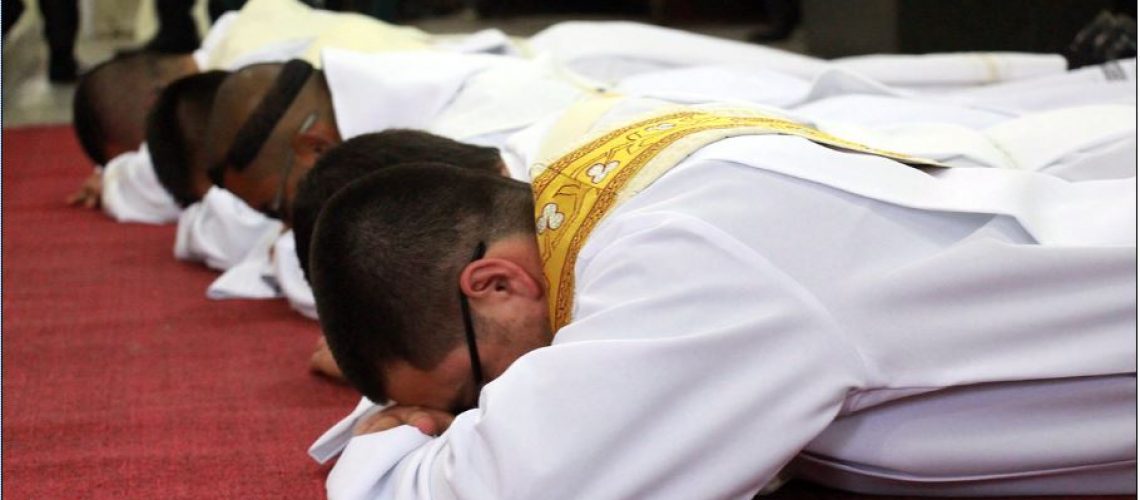
Suffering is the teacher of all teachers, and when it comes to learning humility and dependence, it is effective at exacting the lessons for its subject. As Stuart’s illness progresses and he is confined to a wheelchair, the bishop is initially reticent to carry out his ordination but is eventually persuaded, and Stuart does become “Father Stu.” He visits men in prison, hears confessions, and eventually dies at the age of fifty “a priest forever, in the order of Melchizedek” (Hebrews 7:17; Psalm 110:4). As the Angelic Doctor, St. Thomas Aquinas notes: “Grace does not destroy nature, but perfects it.”
A film is lost on its audience if its characters are not believable, especially when they are asked to step outside their comfort zone in viewing it. Thankfully, authenticity (aided by competent acting) is not lacking in the film. I think the film does over-compensate a bit in the excessive use of coarse language (and taking the Lord’s name in vain), which can be jarring and unnecessary at times to those with more sensitive consciences.
Again, this isn’t the type of movie you would watch on a Catholic movie channel like Formed – its R rating is deserved. If you can look past these deficiencies, the underlying story of God making smooth stones out of coarse rock has a redemptive and inspiring element that those of us with sinful pasts can well relate to.
The Grace of Redemption
Every sinner has a past, something we as Catholics sometimes forget. We should often reflect on what it’s like to sit in the back pew like a publican, not knowing when to sit and when to stand, offending others with our ignorance; or what it’s like to stumble while trying to find our footing after being washed clean in the waters of baptism. In essence, when we “become good” (by grace), we can sometimes get, well, religiously uppity, and we must guard against that tendency.
Father Stu as a film has the potential to bring “good” Catholics back down to the gritty earth while also inspiring those ignorant of the faith to look beyond the porcelain veneer of two-dimensional church going and unrelatable clergy. At the heart of the universal salvation story present in Father Stu is the meaty center of what it means to be a fallen man, ransomed and redeemed, transformed by the gift of suffering, and called by God into the vocation prepared for him.




7 thoughts on “The Grace of Father Stu”
Thanks for your comment SMK629. I am planning to write my next Catholic Stand Column about Father Donald Calloway. Look out for my Column on the Catholic Stand.
I do not think you will be disappointed, Mr. Ruffolo. When you go, make sure you see it all the way through. It moves quickly. Even the ending credits are outstanding, with film clips of the real Father Stu. Do not get distracted by the abundant profanity. The story is the important thing. Mark Wahlberg did a great service to the Church by financing and producing this, as well as portraying Father Stu. Lots of parallels with the life story of Fr. Donald Calloway, MIC – unstable childhood without religion, criminal arrest (Fr. Calloway was far worse), encounter with Our Lady, conversion to Catholicism, attending Franciscan University, and ordination to the priesthood. Best of luck with your hospital stay (ask for Fr. Stu’s intervention – he knows what it’s like to be hospitalized), and God bless and protect you – Susan, TOF
Mark well done! I stopped seeing hollywood movies when Mel Gibson’s Passion of The Christ was snubbed by the Oscars for any major awards. I thought the film was a masterpiece making it the best religious movie ever made. I saw the movie 3 times in theaters. That it was done in Aramaic, the language spoken by those living at the time of Jesus made it an especially special accomplishment. I can’t wait to see his follow up to the The Passion of The Christ. My only hope is that Gibson makes a film about Our Lady of Fatima. I plan to go see Father Stu once I get discharged from hospital.
“Passion of the Christ” was anti Semitic. Didn’t you notice? It was also what can only be called “torture porn”.
I saw “Father Stu” on opening night, and I was profoundly moved.
The language is filthy, but I think every bit of it is warranted. It is costuming, and does indeed serve to make the film authentic, but also underscores the great grace that Stu was given when he unbelievably not only converted to Catholicism but became a holy and very effective priest.
I also think the encounter with Our Lady was believable. I was not sure who it was at first – maybe Carmen? – but after a few words, I knew. It was very brief (as was Stu’s encounter with Jesus), but unmistakable.
I happen to know people like the pre-conversion Stu. They are often rough, with sketchy manners and questionable motives. But when they take on anything, they are all in. If you become friends, you are friends for life, and they would give you their last dollar if you needed it. And so it is with Stu, who gave up everything he thought he needed and wanted in his life in order to embrace Catholicism and to serve Jesus as a priest, no matter what the cost.
Jesus came not only to save the pure and pious, but also the vulgar and profane. And this film testifies to that, and that redemption is available through the holy Catholic Church.
Pingback: THVRSDAY EDITION – Big Pulpit
Thank you for the excellent review.