
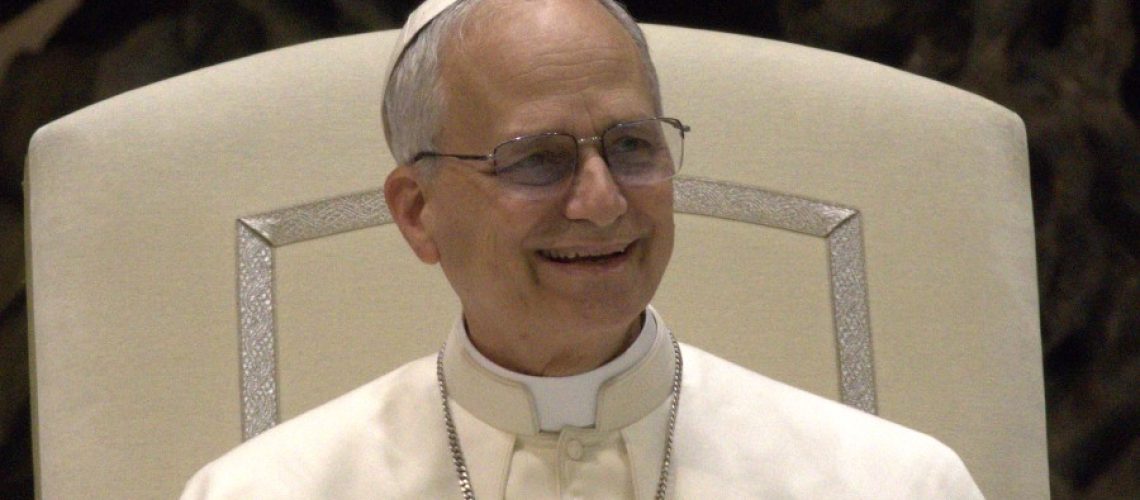
Pope Leo’s statement in Magnifica humanitas (192) that “just war theory . . . is now outdated” is rather curious. In what way, I wonder, is it outdated?
Try as I might, I can’t find anything in the appropriate section of the “Catechism of the Catholic Church” on just war theory, or in Chapter 11 (the chapter on Catholic just war theory teaching) of the “Compendium of the Social Doctrine of the Church” that needs updating (IMHO).
The Compendium is pretty clear that, “500. A war of aggression is intrinsically immoral” (emphasis added). No updating needed there. A nation cannot attack another nation just because it feels like it or wants something the other nations has.
It also states that a nation can defend itself from an aggressor nation. A state, like a person, has a right to self-defense.
A just war must also meet certain conditions. And all of the stated Catholic Church conditions make sense.
So what exactly needs to be “updated?”
Listening to the Pope
Pope Leo’s statement reminds me very much of many statements made by Pope Francis, particularly his statement that “the death penalty is inadmissible because it is an attack on the inviolability and dignity of the person.”
Pope Francis’ first talked about the death penalty in his Address to Participants in the Meeting Promoted by the Pontifical Council for Promoting the New Evangelization.
He initially stated, “ It must be clearly stated that the death penalty is an inhumane measure that, regardless of how it is carried out, abases human dignity. It is per se contrary to the Gospel, because it entails the willful suppression of a human life that never ceases to be sacred in the eyes of its Creator and of which – ultimately – only God is the true judge and guarantor.”
But as God told Noah (Genesis 9:6), “Anyone who sheds the blood of a human being, by a human being shall that one’s blood be shed; For in the image of God have human beings been made.” And while the Noahide Covenant has given way to the New Covenant, the New Covenant does not nullify the moral laws of the Old Testament.
Pope Francis also alluded to “the teaching of recent Popes” regarding the death penalty to justify his statement that the death penalty is an inhumane measure.
Past Popes
Pope St. John Paul II asserted in his encyclical Evangelium Vitae (The Gospel of Life), in 1995, that punishment “ought not go to the extreme of executing the offender except in cases of absolute necessity: in other words, when it would not be possible otherwise to defend society. Today however, as a result of steady improvements in the organization of the penal system, such cases are very rare, if not practically non-existent.”
So Pope St. John Paul only said the death penalty should be rarely used.
Pope Benedict XVI, in his 2011 Apostolic Exhortation Africae Munus said nations should eliminate the death penalty. In paragraph 83 he writes, “Together with the Synod members, I draw the attention of society’s leaders to the need to make every effort to eliminate the death penalty and to reform the penal system in a way that ensures respect for the prisoners’ human dignity.”
Prior to this, in 2005, the U.S. Bishops published “A Culture of Life and the Penalty of Death.” The publication also called for an end to the use of the death penalty.
Pope Benedict and the U.S. Bishops then, said nations should not use the death penalty.
At the same time, Catholic teaching allowed the use of the death penalty. And neither JPII, Benedict, nor the U.S. bishops said the death penalty is contrary to the Gospel.
Acceptable or Unacceptable?
St. Augustine says the death penalty is acceptable (“City of God,” Book 1, Chapter 21). St. Thomas Aquinas echoes this in his Summa Theologica (Second Part of the Second Part, Q. 64). Pope Francis, however, said that Catholic doctrine in regard to the death penalty had developed. Suddenly it was no longer acceptable.
However, as Prof. Michael Pakulak notes in regard to “development,” in a recent essay at the Catholic Thing, “the crucial move in development is not “we used to believe this, but now we believe this,” but rather, “we see that we have believed this all along.”
I don’t see how one can argue that the Church has always believed that the death penalty is “inadmissible” when at least two Church Fathers, and the Church itself for hundreds or years, said it is acceptable. And now Pope Leo, asserting the change in the Catechism of the Catholic Church, is also saying the death penalty is “inadmissible.”
So how did we go from acceptable to not acceptable? This is not a development of teaching. This is overturning previous teaching.
Others have pointed out that “inadmissible,” is a somewhat nebulous word. But it does mean ‘not acceptable.’ So Pope Francis overturned St. Augustine and St. Thomas Aquinas and centuries of Church teaching.
The section of the Catechism that explains “Respect for Human Life,” as part of the fifth commandment, includes Church teaching on the death penalty. Also included in this section is Church teaching on legitimate defense, intentional homicide, abortion, euthanasia, and suicide.
Contrast the ‘new’ teaching on the death penalty with what the Catechism says about homicide or abortion. Homicide is “gravely sinful. Abortion constitutes a “moral evil.” Euthanasia is “morally unacceptable.” The death penalty, however, is simply “inadmissible.” What does this mean? Is it sinful and if so, how sinful?
Apparently American Catholics are not sure what this means either. A recent Gallop survey showed Americans as fairly evenly split in support for the death penalty. A recent Pew survey, however, “found that 65% of American Catholics favor the death penalty for people convicted of murder, with 28% who “strongly” favor it.”
So, exactly where are we at on the death penalty? Is an entire nation (people and leaders alike) that allows the death penalty committing a sin when someone is executed? Or is only the person who orders the execution committing a sin? Or is the person who performs a state ordered execution guilty of the sin of homicide? Is a sin even being committed?
Closer to home, will the soldiers who make up the firing squad that will execute Nidal Hasan on December 5 be breaking the Fifth Commandment?
As Fr. John Zuhlsdorf wrote recently, “The role of the Church and of churchmen is to bring clarity, not ambiguity, calm not a “mess,” understanding not confusion. If what we are experiencing is, in the balance, ambiguity, a “mess” and confusion, then something has gone seriously wrong in the Church and with churchmen.”
Now Comes Pope Leo
Recent popes have also spoken out against war, but none have called for an update of just war theory.
Popes St. John Paul II, Benedict XVI, Francis, and other popes before them, have all stated that war is an evil and a tragedy. It results in the loss of thousands and even millions of human lives. And no sane person disagrees with this observation.
Even so, the Old Testament is rife with war. In fact, God sanctioned His chosen people waging war against pagans. But the New Testament introduces a New Covenant between God and man. As Jesus teaches in His Sermon on the Mount, “But to you who hear I say, love your enemies, do good to those who hate you” (Luke 6:27-28). Just how this plays out when one nation attacks another was not real clear, however. So, the Church developed just war theory.
Much ink (digital and real) has been spilled about the justness or unjustness of the War with Iran. Pope Francis, Pope Leo, and other Catholic prelates, have said the Iran War is an unjust war. And it’s a good bet this war was foremost in Leo’s thoughts when he made the statement about just war theory being outdated.
I have argued that the War with Iran is a just war. But since I probably don’t have the mental acumen of St. Augustine or a St. Thomas Aquinas, I could be wrong.
The “Compendium of the Social Doctrine of the Church” says (#500), “engaging in a preventive war without clear proof that an attack is imminent cannot fail to raise serious moral and juridical questions.” And this is one of the key issues raised regarding the War with Iran.
Was Iran already attacking or preparing to attack the U.S.? If the answer to this question is yes, then the war is just. If the answer is no, then the war might be unjust. It all depends on how much weight one is willing to give to paragraphs 513 to 515 of the Compendium – the section that expounds on terrorism.
But none of this offers a hint of what Pope Leo may be thinking. Simply saying Catholic teaching on just war theory needs to be updated is a confusing statement.
It’s true that too many non-combatants lose their lives in wars. And this has always been the case, even before the age of modern weapons. This is one of the factors that makes war evil.
But today modern technology can reduce civilian deaths. Precise targeting of aggressor nation military equipment and installations is now very possible. And for the most part, this is how the U.S. initially waged war against Iran. Iran however, has been indiscriminately killing civilians and attacking non-military targets via state sponsored terrorism for many years.
Development or Change?
David Gray offered an explanation on how Church teaching on the death penalty and on just war theory developed since Vatican II in a recent CS article.
In the article he wrote “it was already clear that the Church would eventually move away from her earlier tolerance of state‑sanctioned killing when Gaudium et Spes decisively rejected the long‑standing acceptance of torture, teaching: “Whatever violates the integrity of the human person, such as mutilation, physical and mental torture, and attempts to coerce the will itself… are infamies indeed.”
He then wrote, “That moment signaled a deeper moral trajectory, one that would later mature in Veritatis Splendor and culminate in the Church’s definitive judgment that the death penalty is now “inadmissible.”
But Veritas Splendor also noted (par. 29) that, “. . . within the context of the theological debates which followed the Council, there have developed certain interpretations of Christian morality which are not consistent with “sound teaching” (2 Tim 4:3). . . . Nevertheless, in order to “reverently preserve and faithfully expound” the word of God, the Magisterium has the duty to state that some trends of theological thinking and certain philosophical affirmations are incompatible with revealed truth.”
The Bottom Line
So . . . are these new “developments” in Church teachings truly developments? Or are they changes that are “incompatible with revealed truth?”
Edward Feser and Joseph M. Bessette, provided an analysis of why the death penalty does not contradict the gospel in their book, “By Man Shall His Blood Be Shed: A Catholic Defense of Capital Punishment.” Jimmy Akins also explained that the change in teaching on the death penalty is not infallible teaching.
“As a doctrinal development, it would qualify as authoritative teaching (as opposed to mere theological opinion), and it would qualify as non-definitive (i.e., non-infallible) Church teaching.
“According to Vatican II, such teachings call for “religious submission of mind and will” on the part of the faithful.” But any way one looks at it, it is still a change in Church teaching, not just a development.
I’m still having a hard time wrapping my mind around this change. This makes it difficult for me to religiously submit to this teaching in mind and will. Going from acceptable to not acceptable is a reversal of teaching. It’s much more than just a development.
Additional clarification is still needed in regard to the death penalty. How is it suddenly contrary to the gospel? And how does the use of it affect individuals and nations?
And now an explanation is needed from Pope Leo on just war theory. What about it needs updating?
Most Catholics will never have to take on the role of public executioner, but what if a Catholic is ordered to be a member of the firing squad that will execute Nidal Hasan? What kind of can of worms will be opened if he tells his superior, ‘sorry, my religion says the death penalty is not acceptable. I can’t be a member of the firing squad.’
Along these same lines, if there is no longer such a thing as a just war, how does this affect all the Catholics serving in the military? And should a Catholic thinking about enlisting now abandon such a thought?