

I was born in 1959, while my bride of nearly four decades was born in 1960. It is flabbergasting to now find that some of our elders have yet to embrace the wisdom of past generations, such as the permanence of marriage, the blessings of children/grandchildren, being thrifty, being generous, and worshipping God.
We still appreciate much of the 1960s’ music, but are amused that some aging big lights have trouble stepping off the proverbial stage. While not known for their own marital success or generosity to truly impoverished peoples, some have much to say about marriage laws and government wealth redistribution – often accompanied by pro abortion rhetoric.
More than 60 years after its conclusion, Catholics are still talking about Vatican II. Similar to 1960s’ general culture, Vatican II’s impact seems undeniable. Changes in the celebration of Mass may constitute the most obvious post Vatican II changes. There were 16 Vatican II document, including Sacrosanctum Concilium, its Constitution on the Sacred Liturgy.
To better understand Sacrosanctum Concilium and its call (though not terribly specific) for “restoration,”
- I turned to the Didache of the Church’s earliest days and its’ focus on liturgy.
- I then looked at how the Church called for implementation of Sacrosanctum Concilium.
The Didache (late first century A.D.)
The history of the survival of the Didache is nothing short of astonishing. Fragments were long known, but the complete text was thought lost to history. Amazingly a copy of that first century document (aka, “The Teaching of the Lord to the Gentiles by the Twelve Apostles”) was rediscovered in the late nineteenth century A.D.!
The second part of the Didache is especially pertinent to liturgy:
Chapter 7. Concerning Baptism
Chapter 8. Concerning Fasting and Prayer (the Lord’s Prayer)
Chapter 9. The Thanksgiving (Eucharist)
Chapter 10. Prayer After Communion
Chapter 11. Concerning Teachers, Apostles, and Prophets
Chapter 12. Reception of Christians
Chapter 13. Support of Prophets
Chapter 14. Christian Assembly on the Lord’s Day
Chapter 15. Bishops and Deacons; Christian Reproof
Chapter 16. Watchfulness; The Coming of the Lord
It boggles the mind that we should even have such evidence!
Sacrosanctum Concillium (12/4/63)
Sacrosanctum Concillium is the Constitution on the Sacred Liturgy from the Second Vatican Council. In addition to an introduction and appendix, it consists of seven chapters:
- General Principles for the Restoration & Promotion of the Sacred Liturgy
- The Most Sacred Mystery of the Eucharist
III. The Other Sacraments & Sacramentals
- The Divine Office
- The Liturgical Year
- Sacred Music
VII. Sacred Art & Sacred Furnishings
When I first read Sacrosanctum Concillium, I was struck that it did not mandate the Vatican II changes to the Mass with which I was most familiar. People always seemed to speak as though it did.
Sacrosanctum Concillium frequently calls for “restoration.” Is that a restoration to how the Mass was celebrated at the time of the Didache?
Inter Oecumenici (10/26/64)
Inter Oecumenici is the Instruction on Implementing the Constitution on Sacred Liturgy from the Sacred Congregation on Rites. Elsewhere, I presented highlights from Inter Oecumenici and thoughts on these 1964 implementation instructions:
Much was said about “active participation” of the laity and the use of vernacular languages. In 1964, any use of a vernacular language would have been quite novel and require an abundance of care to do correctly. Did the Vatican properly account for areas where Catholics had multiple vernacular languages? Especially in those areas, did dioceses have clerics with diverse linguistic skills? Wouldn’t there have been some areas where continuing in Latin would be a “pastoral” solution?
While most Masses are now celebrated in the vernacular, it strikes me as ironic that minimal attention sometimes appears given to ensuring that spoken words from celebrants, deacons, and lectors are clear and understandable.
Final Thoughts
Akin to “good King Wenceslaus…on the Feast of Stephen,” my 10 year old self and 57 year old dad trudged through a heavy Brooklyn snowfall on December 26, 1969. We headed to our parish church so I could serve as an altar boy for the very first time. This was far more thrilling than my Mets winning the World Series just two months earlier!
The crop of new altar boys of which I was part needed to learn absolutely no Latin. I do recall some mixed feelings about that. At that tail end of the 1960s, we were part of the vanguard to “modernize” the church. My class even sang “Age of Aquarius” in a Catholic grade school production. Out with the old and in with the new!
No, I absolutely cannot prove cause and effect. Yet, I doubt anyone saw the incredible drop that was coming in young women and young men pursuing religious vocations – including vocations to marriage and family! No one foresaw the scandals, the closures in parishes and schools, and Jesuits like James Martin who would try to convince us that what we clearly knew to be wrong was somehow right!
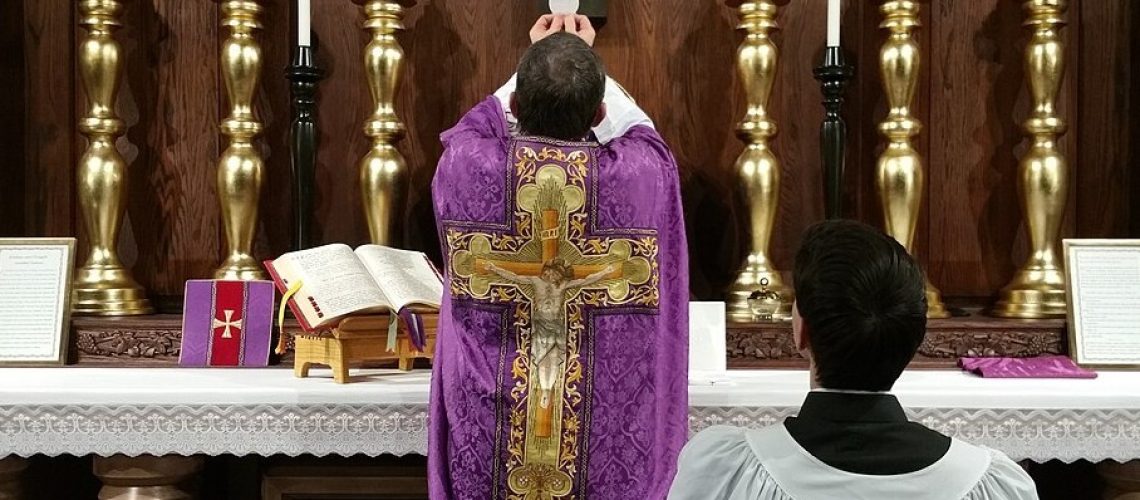
In my own experience, celebrations of the Traditional Latin Mass invoke a reverence that I do not see elsewhere.


7 thoughts on “The Didache, Sacrosanctum Concillium, and Inter Oecumenici”
Pingback: MONDAY EVENING EDITION – BIG PVLPIT
OP,
Having served at Latin Masses for 7 years, I am guessing that you are about 74. Among 74 year old Catholics, there seems to be a denial of what was seen in the early post conciliar years.
While there may not be simple infer cause and effect with the changed Mass, we saw convents, rectories, & seminaries empty in those years, as well as great increases in Catholic divorces.
The “Ray Repp” 🎵 songs 🎵 of that era survived for a much shorter time than the drop off in Catholic sacramental practice!
Joe, I was an altar boy for 7 years (Latin Rite) and none of us (12) were ever impressed
with parroting responses that were not translated in our head. It was meaningless as
reciting the times tables. I don’t see what the Vatican has against the TLM Mass, it
should be allowed everywhere, but anyone who thinks that it is going to usher in an age
of renewal is daydreaming. All these concerns over orientation, form and ceremony are
not the kind of cause célèbres that will refill those pews.
“I don’t see what the Vatican has against the TLM Mass, it should be allowed everywhere, but anyone who thinks that it is going to usher in an age of renewal is daydreaming.”
And yet, those who attend say it is packed with young families.
I agree, but if you returned to TLM in every church in, say America, the pews would still be
empty because it wouldn’t catch on to ensnare those 70% who left. What about this, Joe.
Why not have 30 different forms of holy Catholic mass, to fill the spiritual niches that a very
diverse Catholic world of men and woman, could, and would, resonate to.
To clariffy, “My class …[singing] ‘Age of Aquarius’ in a Catholic grade school production was highly inappropriate!
This paragraph is from https://www.catholic365.com/article/58269/inter-oecumenci-highlights-some-thoughts-on-the-1964-vatican-instructions-on-inplementing-vatican-iis-constitution-on-the-sacred-liturgy.html
“Much was said about ‘active participation’ of the laity and the use of vernacular languages. In 1964, any use of a vernacular language would have been quite novel and require an abundance of care to do correctly. Did the Vatican properly account for areas where Catholics had multiple vernacular languages? Especially in those areas, did dioceses have clerics with diverse linguistic skills? Wouldn’t there have been some areas where continuing in Latin would be a ‘pastoral’ solution?”
Funny I just saw this – On 31 December 1969, three days before RTC after two tours in ‘Nam’, we were standing on a hill overlooking the base camp with a transistor radio to ring in with Aul Lang Syne when what came over AFVN but ‘The age of Aquarius’ by the 5th Dimension.
I was so disappointed. But I’m glad it’s here now.