
Yes, I know how to laugh. I can’t blame the handful of people who regularly read my articles for wondering. While writing my previous column on artificial intelligence, I wondered about it myself. My seriousness has led at least one person to call me a pessimist and another a crank. But anyone who knows me in the real world sees a man whose every third or fourth comment is a wisecrack or a joke. And the thing that I love most about The Chosen is that creator Dallas Jenkins has given the Son of God a sense of humor.
God and Humor
Near the end of Christ the Lord: Out of Egypt, Anne Rice has a young Jesus struggle with a very early knowledge of his death. Eventually, he realizes that he has come not to die but to live—to experience the highs and lows of life as a human among other humans. (John 1:14: “And the Word became flesh and lived [Gr. “tented, i.e., pitched his tent”] among us …”) The Crucifix is not the sum of his telos. The gravity of his mission doesn’t prevent him from embracing those activities that bring innocent, authentic joy. He can laugh.
The Gospels focus almost exclusively on the significant events and acts in Christ’s ministry, the things the evangelists felt their Christian communities needed to know. So, naturally, these would have been his life’s more extraordinary, dramatic moments. However, because of this focus, we know nothing about the everyday Jesus—Christ in his “downtime,” so to speak. It’s difficult to believe he spent every waking hour teaching and preaching. What was he like when there were no crowds to preach to, no sick or distressed people who needed his attention, or no scribes and Pharisees to rebuke?
God, by His very nature, transcends human understanding. Any attribution of human qualities to Him can only be an imperfect analogy. But even within those limits and qualifications, we can believe that God delights in His creatures. Part of that delight must be amusement in some of our follies. I often think that probability theory is proof that God has a sense of humor because its summary is that life doesn’t have to go the way we expect it to: “If you want to make God laugh, tell Him your plans.” Murphy’s Law is a fundamental constant of the universe.
A Time to Laugh
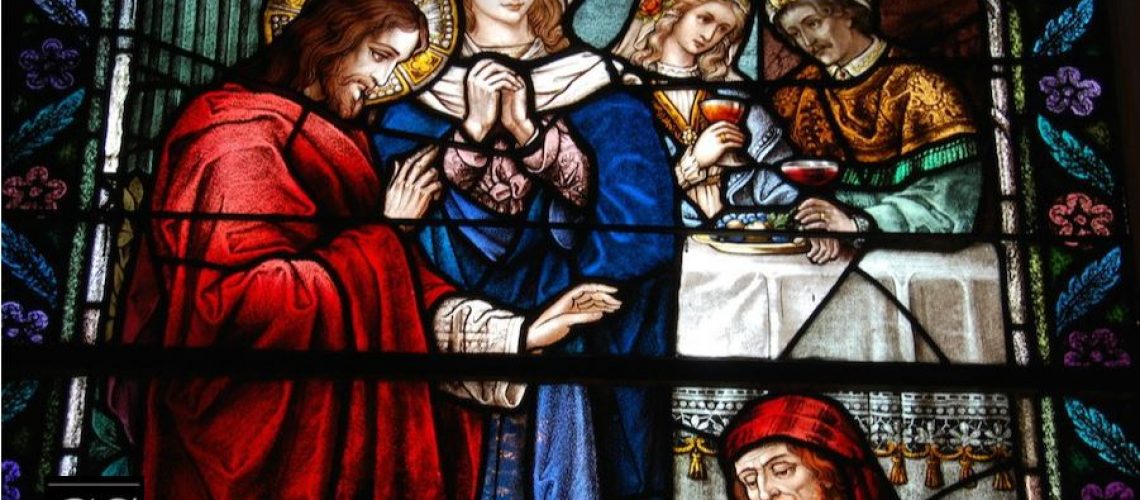
It makes sense to me that the Son of God, the Author of Life, would enjoy life so much that He would express it in laughter. Scripture tells us that Christ “shared our human nature in all things but sin” (Eucharistic Prayer IV; cf. Hebrews 4:15). Ecclesiastes tells us that there’s a time for everything, including “a time to weep, and a time to laugh; a time to mourn, and a time to dance” (Ecclesiastes 3:4). Jesus wept and mourned for his friend Lazarus’ death (John 11:35). Why wouldn’t he have laughed and danced at the wedding in Cana?
In “The Wedding Gift,” Simon Peter (Shahar Isaac) asks Jesus (Jonathan Roumie) if he can “help” Andrew’s awkward dancing, and Jesus laughs, “Some things even I cannot do.” But you can tell that Jesus enjoys Andrew’s dancing simply because he is dancing. He enjoys Andrew’s dancing not because it’s skillful or clumsy but because it’s exuberant, full of joie de vivre. In The Chosen, Christ doesn’t just sit at a table as a quiet yet ominous presence. Instead, he is a full participant in the wedding celebration. It’s not hard to draw the appropriate metaphor and lesson from the imagery.
Roumie’s Jesus is mischievous, but in a good way, often chuckling as he performs miracles. In “Intensity in Tent City,” Barnaby (Aalok Mehta, perhaps the later apostle Barnabas?) brings his blind friend Shula (Anne Beyer) to be cured by Jesus. Shula protests that she’s there to have Barnaby’s lameness healed. Jesus cures her blindness and lays his hand on Barnaby’s shoulder, thanking him for being such a good friend. As the two walk away, we see Jesus smirking in the foreground, whispering, “Right about … now.” And at that moment, Barnaby realizes that he’s been healed as well.
The Crucifix as Eucatastrophe
I’ve read that a saint once said, “My Savior is crucified, and shall I laugh?” (Unfortunately, I can’t source the quote.) It’s possible to put too much emphasis on either Christ’s divinity or his humanity, or to push narratives that are either too “Buddy Jesus” or too “Christ the Intolerant Master.” They’re part of the same story; to diminish either aspect is to diminish the whole. In the same way, it’s possible to emphasize either the Crucifix or the Empty Tomb too much since they’re both integral to the eucatastrophe.
But the Passion is a eucatastrophe.
The struggle between life and death, between good and evil, is full of dark moments, disasters, nadirs, and grievous losses. However, hope only begins to be really useful when things appear hopeless, and faith a virtue when there seem to be no rational grounds for certainty. The Crucifixion is a eucatastrophe because Death isn’t the end of the story. It is merely the moment before the peripeteia, the brief (in God’s time) respite between Death’s seeming triumph and Death’s destruction. No matter how hard and bitter the fight, in the end, Life will have the last laugh.
We may not be here to see it, but that doesn’t mean we won’t see it. For “we will all be changed, in a moment, in the twinkling of an eye, at the last trumpet” (1 Corinthians 15:51-52).
The Greatest Story Ever Told, Told Well
Not that The Chosen is all sunshine, lollipops, and rainbows. Jenkins tries to stay faithful to the Gospels and historical and cultural sources, though he conflates the Zealots with the Sicarii in Simon Z (Alaa Safi). Besides conflicts with Pharisees and tense moments with Romans, the disciples fight among themselves. One episode has Mary Magdalene (Elizabeth Tabish) lose confidence and run away to go drinking and gambling. In another multi-episode arc, Simon Peter’s wife Eden (Lara Silva) miscarries, leading him to be angry with Jesus. Eventually will come the darkest turn of all in the eucatastrophe at Golgotha.
Nevertheless, The Chosen moves with a lightness absent in Franco Zeffirelli’s 1977 miniseries Jesus of Nazareth. If The Chosen sometimes sins by too-idiomatic dialogue, Jesus of Nazareth sins by leaden dialogue that tries too hard to be dramatic. Robert Powell’s unblinking Jesus is unnerving, even dehumanizing—a cold and remote figure from whom words of compassion seem oddly detached. Vanessa Benavente’s Mary is warm and engaging, while Olivia Hussey’s Mary always seems frightened—even when reciting the Magnificat. Come to think of it, most Biblical epics have had this exaggerated gravitas. And the Greatest Story Ever Told suffers for it.
The lightness allows Roumie’s Jesus to be tender and affectionate, especially with his eema Mary, who plays a more significant role in his ministry than other Evangelicals might allow. (One of Jenkins’ theological consultants is Holy Cross Fr. David Guffey of Family Theater Productions.) The tenderness, in turn, permits scenes of great intimacy and compassion, as when Jesus explains to Little James (Jordan Walker Ross) why he won’t heal his lameness. Even the bad guys benefit from The Chosen’s lightness, as the Pharisees’ stiff-necked self-righteousness and the Romans’ callousness show in starker contrast. No wonder they found Jesus exasperating.
Conclusion
The Chosen isn’t completely orthodox, nor could it ever be. Jenkins’ story takes a centrist Christian position analogous to C. S. Lewis’ “mere Christianity,” which will inevitably displease the outliers and the hyper-traditionalists. He tries to not offend business partners who are Mormons, but some are concerned that he’s leaning into LDS errors. And while he takes pains to present Jesus’ and the apostles’ Jewishness respectfully, one writer has noted that the outcome is Judaism as seen by Christian Zionists. Nevertheless, The Chosen doesn’t have anything to offend someone who doesn’t want to be offended.
Unfortunately, some people simply must look for reasons to be offended.
As in orthodox Christianity, the Christ we get in The Chosen is not the Messiah that many people want—if, indeed, they want one at all. I get why some people want a humorless Jesus. Humorless people are also part of the human family. But a Jesus who can laugh and dance is more like one of us—more likely to get us—than the stern, unsmiling, constantly angry God-man some people evidently prefer. Being alike us in all things but sin, I doubt that Jesus would commit the sin of taking himself too seriously. That was Satan’s fault.


[…] A Response to Dennis Prager’s Defense of Immorality – Philip Primeau at Crisis Magazine The Chosen: Lightness & Letting Jesus Laugh – Anthony S. Layne at Catholic Stand Social Contagion is Driving the Astronomic Rise in […]
Another fine and thoughtful essay from Mr. Layne.
Yes, you’re right — some people live to be offended.
I saw the Zeffirelli film when it came out, monopolizing the TV in the dorm lounge, in front of outwardly cynical guys who were hiding discomfort by saying, “Time to tack him up!” Zeffirelli presented Jesus as a space case which I agree came off weird. Jeffrey Hunter was better, or even Ted Neely. But I got a kick out of Anne Bancroft’s fishwife Mary Magdalen, and Rod Steiger’s portrayal of Pilate as a harassed bureaucrat.
I happen to have a print of Debra Minnard’s ‘Laughing Jesus’ which lightens my day. There is also a story by Rev. Sam Trumbore that fits well with your essay.
If you’d be so kind as to post the link to Rev. Trumbore?