

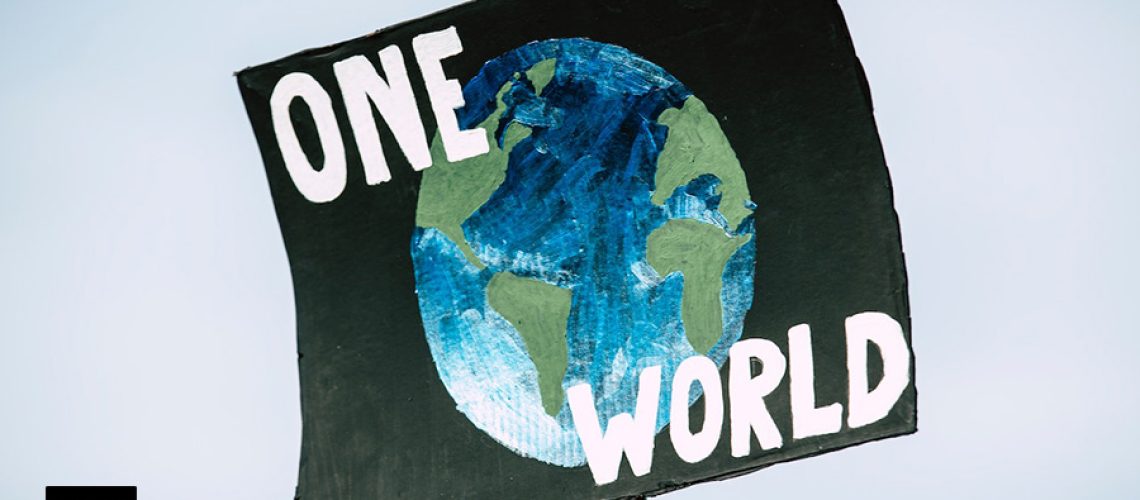
The headline on a recent article at The Stream was an attention getter. It read “After Vatican II, the Catholic Church Went Whole Hog for Globalism and World Government.” It definitely got my attention.
I found it somewhat surprising that The Stream would run an article knocking the Catholic Church. Sr. Editor John Zmirak’s disdain for Pope Francis and many Catholic prelates aside, The Stream is not an anti-Catholic publication. It promotes orthodox Christian values in its editorials and coverage of the news.
D’Hippolito’s Contention
In the 1,600-plus-word-article, author Joseph D’Hippolito tries to make his case. His assertion is exactly what the headline says — the Catholic Church fully supports globalism and world government.
According to D’Hippolito, “The Vatican’s embrace of utopian globalism began at the Second Vatican Council . . .” But, he says, Pope St. John XXIII started the bandwagon rolling with his 1963. His encyclical Pacem in Terris kicked off the call for globalism.
Vatican II’s Pastoral Constitution on The Church in the Modern World, Gaudium et Spes, kept the globalist wagon rolling. Pope St. Paul VI reinforced the demand for globalism in 1967 with Populorum Progressio.
Apparently D’Hippolito couldn’t find anything in Pope St. John Paul II’s writings reinforcing the call. As such, he jumped to Pope Benedict XVI. He said Benedict furthered the call for ‘one world government’ in his encyclical Caritas in Veritate.
“Benedict XVI urged the United Nations to govern both international and domestic economies,” D’Hippolito wrote. He backed up his claim quoting Benedict in Caritas in Veritate:
“There is a strongly felt need … for a reform of the United Nations … and, likewise of economic institutions and international finance, so that the concept of the family of nations can have real teeth,” Benedict wrote. “To manage the global economy … to bring about integral and timely disarmament, food security and peace; to guarantee the protection of the environment and to regulate migration: for all this, there is urgent need of a true world political authority.”
According to D’Hippolito, “Benedict’s “true world political authority” effectively would replace the nation-state, which he deemed ineffective and obsolete.”
A Call For Reform
A more careful reading of Caritas in Veritate shows that Benedict was not calling for world government. As he clearly stated, he was calling for a reform of the United Nations. Benedict even warns that globalization “could cause unprecedented damage and create new divisions within the human family” (Caritas in Veritate 33, par. 2).
The “worldwide financial regulation” Benedict does call for is a call for an economic system that serves all of mankind. But the “true world political authority” he references is not a call for “world government.”
Benedict even spells out what he means when refers to “political authority”:
“Political authority also involves a wide range of values, which must not be overlooked in the process of constructing a new order of economic productivity, socially responsible and human in scale. As well as cultivating differentiated forms of business activity on the global plane, we must also promote a dispersed political authority, effective on different levels. The integrated economy of the present day does not make the role of States redundant, but rather it commits governments to greater collaboration with one another.
So, Benedict clearly is not saying that nation states are “ineffective and obsolete.” He is calling the states to “greater collaboration with one another” as members of the United Nations.
Pope Francis
D’Hippolito also writes “Francis amplified Benedict’s view that individual nations must submit to a supranational power, as The Stream reported.” (Note that the “as The Stream reported” link links back to another article by D’Hippolito.)
“But unlike his predecessors,” D’Hippolito continues, “Francis bolsters his rhetoric with action.” D’Hippolito contends the ‘action’ was Francis joining “with international business and financial executives to create the Council for Inclusive Capitalism.”
D’Hippolito points to a statement on the council’s website to bolster his claim. The statement says the council was designed “to harness the potential of the private sector to build a fairer, more inclusive, and sustainable economic foundation for the world.” This “reflects Benedict’s call for worldwide financial regulation,” says D’Hippolito.
Francis, however, is also not calling for globalism or world government. He is calling for, as he said in his May 2, 2019 address to Participants in the Plenary Session of the Pontifical Academy of Social Sciences, “international solidarity.” He is calling for all nations to come together to put in place fair economic practices that benefit everyone.
As he stated in a letter to British Prime Minister David Cameron prior to a June 2013 G8 meeting,
“Every economic and political theory or action must set about providing each inhabitant of the planet with the minimum wherewithal to live in dignity and freedom, with the possibility of supporting a family, educating children, praising God and developing one’s own human potential. This is the main thing; in the absence of such a vision, all economic activity is meaningless.”
D’Hippolito’s arguments seem to make a case for his assertion. But a closer examination of the quotes and the documents he pulls the quotes from is required. Add in other documents and statements from the popes, and it is clear his contention is unfounded.
Catholic Teaching
The Church’s job is to spread the good news of salvation and make known God’s truths. But there are social problems that exist in the world that the Church points out from time to time. It is, however, mankind’s job to figure out how to fix these problems.
Toward this end, Papal encyclicals often point out the problems that need fixing. And one of these problems is an economic system that is not fair to all.
For instance, Pacem in Terris, as the name says, is a call for peace on earth. And this peace will only come about through solidarity. All the states and their leaders need to recognize the dignity of individuals and work together for the common good.
It is not a call for globalism or world government. It is call for nations to put the law of nature – God’s law – above man’s laws. And it is a call for all nations to get along with each other. Paragraph 80 says as much:
“80. With respect to States themselves, Our predecessors have constantly taught, and We wish to lend the weight of Our own authority to their teaching, that nations are the subjects of reciprocal rights and duties. Their relationships, therefore, must likewise be harmonized in accordance with the dictates of truth, justice, willing cooperation, and freedom. The same law of nature that governs the life and conduct of individuals must also regulate the relations of political communities with one another.”
That is hardly a call for globalism or world government.
Gaudium et Spes
Gaudium et Spes talks about economics, in Chapter III, Section 1:
“65. Economic development must remain under man’s determination and must not be left to the judgment of a few men or groups possessing too much economic power or of the political community alone or of certain more powerful nations. It is necessary, on the contrary, that at every level the largest possible number of people and, when it is a question of international relations, all nations have an active share in directing that development.
“66. To satisfy the demands of justice and equity, strenuous efforts must be made, without disregarding the rights of persons or the natural qualities of each country, to remove as quickly as possible the immense economic inequalities, which now exist and in many cases are growing and which are connected with individual and social discrimination.”
Clearly the encyclical is calling for cooperation among “all nations,” which is not globalism.
Solidarity is not World Government
D’Hippolito’s contention that the Catholic Church is going “whole hog for globalism and world government” is simply way off base.
In the eyes of recent pontiffs, the United Nations is the “organization of society on the international level” that can bring peace and promote the common good. As Pope St. John Paull II stated in his address to the 34th General Assembly of the United Nations, on October 2, 1979,
“I would like to express the wish that, in view of its universal character, the United Nations Organization will never cease to be the forum, the high tribune from which all man’s problems are appraised in truth and justice.”
Almost 14 years earlier to the day, Pope St. Paul VI delivered a similar message to the UN General Assembly:
“Our message is meant to be first of all a solemn moral ratification of this lofty Institution, and it comes from our experience of history. It is as an “expert on humanity” that we bring this Organization the support and approval of our recent predecessors, that of the Catholic hierarchy, and our own, convinced as we are that this Organization represents the obligatory path of modern civilization and world peace.”
What Pope Benedict XVI and Francis Said
In 2008, Pope Benedict XVI echoed these same thoughts when he addressed the UN General Assembly:
“The founding principles of the [United Nations] – the desire for peace, the quest for justice, respect for the dignity of the person, humanitarian cooperation and assistance – express the just aspirations of the human spirit, and constitute the ideals which should underpin international relations. As my predecessors Paul VI and John Paul II have observed from this very podium, all this is something that the Catholic Church and the Holy See follow attentively and with interest, seeing in your activity an example of how issues and conflicts concerning the world community can be subject to common regulation. The United Nations embodies the aspiration for a “greater degree of international ordering” (John Paul II, Sollicitudo Rei Socialis, 43), inspired and governed by the principle of subsidiarity, and therefore capable of responding to the demands of the human family through binding international rules and through structures capable of harmonizing the day-to-day unfolding of the lives of peoples.”
Pope Francis also views the UN as being an organization that can help bring about social justice and world peace. As he stated in his September 25, 2015 address to the UN:
“I can only reiterate the appreciation expressed by my predecessors, in reaffirming the importance which the Catholic Church attaches to this Institution and the hope which she places in its activities.”
Misplaced Hope?
In preparing his article, D’Hippolito either overlooked or ignored an article at First Things entitled “The Popes and the Economy. The article is an excellent explainer of papal teaching on economics. It looks at six encyclicals starting with the very first social justice encyclical Rerum Novarum, in 1891.
Author Francis Canavan states at the outset, “Papal doctrine on political economy has long been misunderstood as well as mistrusted . . .” He sums up this papal teaching about halfway through the article.
“. . . the popes do not believe that the common interest of society is adequately served by the profit motive and market forces alone, but requires some degree of governmental regulation and management of the economy.”
Popes have long looked to the UN as an organization that might be able to bring peace to the world. It’s really as simple as that. Such hope might be misplaced, but the idea of the UN is not. The nations that ratified the UN charter saw the UN as “an international organization designed to end war and promote peace, justice and better living for all mankind.” This is still a good idea.




12 thoughts on “The Catholic Church has NOT Gone ‘Whole Hog’ for Globalism”
Of course it is naive to think that the Vatican would openly call for a government of the world (globalist full takeover) but you need to look at actions and connections of the Vatican hierarchy in the last decades(since Vatican II) , not just for discurses.
.
Are the dates of commentary right? There is a coment that mentioned pope Leo with a date of 2023
A year-and-a-half later, DOGE is proving you wrong.
It just might be that you are reading the tea leaves wrong.
I’ve had quite enough of Catholic Social Teaching, which is tangential to the gospel and often directly contradictory to it. “Do you think that I have come to bring peace into the world? No, not peace but division.” Jesus did not appoint his disciples to be at-large teachers of morality to the world, and didn’t establish his church for the purpose of making the world a better place. Whenever any version of the social gospel gets a foot-hold in a church, it eventually becomes the main focus of that church, crowding out the gospel proper. Pope Leo made a mistake, a big one, and it is high time we acknowledged that.
As we say when we pray the Our Father, “thy will be done on earth as it is in heaven.” Sounds to me like we are very much asking God to help us make the “the world a better place.” And it would be a better place if we all tried our best to emulate Jesus Christ. Catholic Social Teaching is not nearly the same as the social justice that is often talked about by progressives today. For a VERY short course in Catholic Social Teaching you might want to read my CS article from January 1, 2018 [http://www.catholicstand.com/christmas-carol-luigi-taparelli-economics-almsgiving/]. You might also want to read the Compendium of the Social Doctrine of the Church [https://www.vatican.va/roman_curia/pontifical_councils/justpeace/documents/rc_pc_justpeace_doc_20060526_compendio-dott-soc_en.html].
You have no use for Matt 25:40 then.
It’s odd that some people are concerned about a “world government” when nobody has proposed anything that looks like one and there is zero chance that one would be instituted in our lifetimes.
But it’s good to see our resident liberal Gene say some good words about the UN. Conservatives tend to be in the “we’re strong enough to go it alone” camp but Gene is wise enough to see that we have to be adults here, and adults realize that there are other adults.
If by “liberal” you mean that I am (in the traditional sense of the word) in favor of free speech, a democratic form of government, the right to private property, free enterprise, and equality before the law, then you are correct. But if by liberal you mean that I support leftist, socially progressive policies and politics, you are mistaken. I have not voted for a Democratic since I voted for Jimmy Carter in 1976 (and I now view that as a mistake). I voted for Reagan in the next election and have voted for Republicans ever since. Even so, I consider myself an independent.
There’s got to be an understanding middle, a pendulum resting at the bottom, where these competing forces fight and fight but finally find accommodation?
For example:
No, immature teenagers should not be allowed to undergo hormonal or surgical therapy, before they understand themselves and might reverse their earlier impulses?
But — gender dysphoria is a real thing, and must be therapized and perhaps result in an outward result? Can’t humans born with a penis still be allowed to wear dresses and be identified as “she”?
You are straying from the article subject so this is the last word here. We stray from God’s truths at our own peril. Genesis 1:27 and Deuteronomy 22:5 are pretty clear, but consider too, that our souls are united to our bodies just as our bodies are united to our souls. A man is a man, in both body and soul. A man who says he is a woman is denying reality and also saying God made a mistake in how God created him.
Jesus the Christ and King of the Universe declared: “My kingdom is not of this world. If My kingdom were of this world, My servants would fight, so that I should not be delivered to the Jews; but now My kingdom is not from here.” Pilate therefore said to Him, “Are You a king then?” Jesus answered, “You say rightly that I am a king.” (John 18:36)