
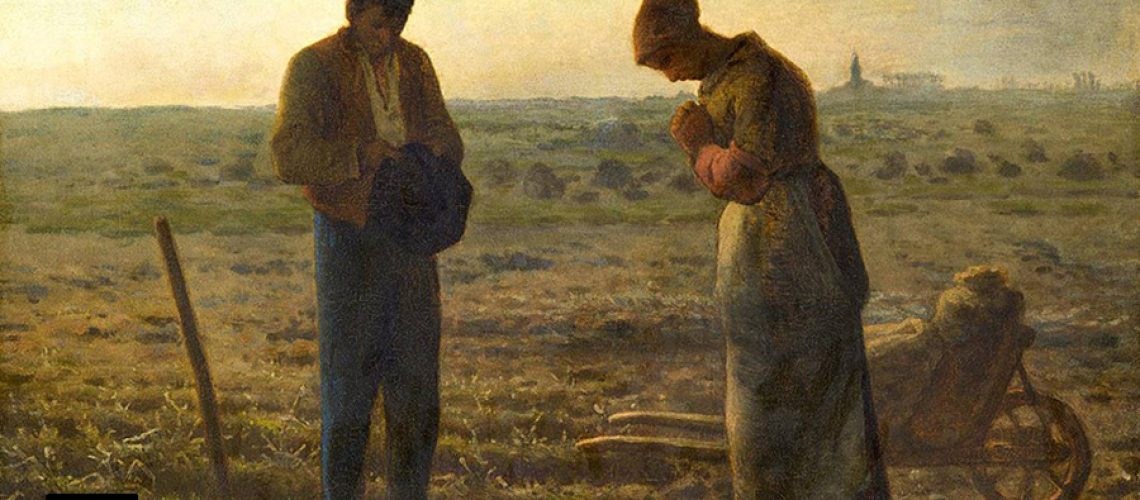
Two figures, a man and a woman in their 19th-century work clothes, stand in a farm field. Their heads are bent in prayer; their farm tools rest beside them. The sky depicts either a cloudy noontime or the beginning of dusk closing in. On the horizon, a mile or so beyond the couple, stands a church, its steeple distinct against the glare of the sun on a cloudy sky. Farther to the right along the horizon are what appear to be three factory chimneys. The darkness above them, if not impending twilight, is smoke from their day’s operation.
An Intriguing Painting
Without any formal training in art history, I can offer only the description above for Jean-Francois Millet’s painting, The Angelus. The work intrigues me, mainly because my childhood experiences in Catholic school instilled in me a devotion to prayer which inspired Millet’s work. The Sisters of Mercy at St. Mary’s School in Alpha, New Jersey prayed the Angelus daily, and of course, the 200 or so children in their care did likewise. Precisely at noon, schoolwork paused, we prayerfully recalled the Annunciation and the Incarnation, and lunch followed.
Years later, when teaching vacation Bible school in our parish, I introduced the Angelus to our elementary school children. Each of the five sessions in our program ended at noon, so before dismissal, we prayed the Angelus. One mother later told me that her son arrived home and reported, “We just said the strangest Hail Mary I ever heard.” Generations pass and devotions may go out of style, but the Angelus is worth teaching in our Catholic schools and religious education programs and praying in our parish ministries. It has merit in terms of catechesis as well as contemplative prayer.
Because Millet’s painting includes a church, I presume that the couple in the painting are responding to the Angelus bells, which rang at 6 a.m., at noon, and at 6 p.m. daily. According to custom, people would stop whatever they were doing when the church bells rang, and pray the Angelus. The cultivator and wheelbarrow in the painting are evidence of laborious work, which ceased abruptly upon the call of the Angelus bells.
A 1000-Year-Old Prayer
The Angelus recounts the Annunciation, Gabriel’s announcement and Mary’s reply, and the Nativity of our Lord. A Hail Mary follows each of three Scripture verses, and a closing prayer highlights the role of the Incarnation in salvation. When two or more people are praying the Angelus, the prayer uses an antiphonal, or “call and response” structure. Here is the traditional version of the Angelus:
Leader: The angel of the Lord declared unto Mary.
All: And she conceived by the Holy Spirit.
Leader: Hail Mary, full of grace, the Lord is with thee. Blessed art thou among women, and blessed is the fruit of thy womb, Jesus.
All: Holy Mary, mother of God, pray for us sinners, now and at the hour of our death. Amen.
Leader: Behold the handmaid of the Lord.
All: Be it done unto me according to thy word.
(Hail Mary…)
Leader: And the Word was made flesh.
All: And dwelled among us.
(Hail Mary…)
Leader: Pray for us, O holy mother of God
All: That we may be made worthy of the promises of Christ.
Let us pray. Pour forth, we beseech thee, O Lord, thy grace unto our hearts, that we to whom the Incarnation of Christ thy Son was made known by the message of an angel, may by his passion and cross be brought to the glory of his resurrection. Through the same Christ, our Lord. Amen.
For those looking to enhance their prayer life, the Angelus is worth considering. Praying it daily is an achievable goal. It takes only about two minutes, and if one likes the following tradition, can be scheduled for either the 6 a.m., noon, or 6 p.m. time slot. Some Catholic churches still ring the Angelus bells at those times daily, and in various shrine chapels, visitors recite the Angelus regularly at noon. There is solidarity in knowing that multitudes of people are praying the same prayer at the same moment each day. Moreover, we share this devotion with generations of Catholics who have prayed the Angelus since the 11th century.
Catechesis and Contemplation
More significant merit for the Angelus, of course, is in its meaning. For one thing, by giving the scriptural context, the Angelus reminds us why we pray the Hail Mary. The angel Gabriel’s words make for enriching contemplation. Immediately upon greeting her, Gabriel tells Mary that she is full of grace. Imagine hearing those words from an angel! The assurance that she was full of God’s grace and in his presence must have warmed Mary’s heart. Gabriel prepares Mary for the important question she must answer by telling her that she is blessed among women. She is singled out, as the most blessed woman in the world. Will she bear the Son of God?
The second verse of the Angelus delivers Mary’s answer. Her “Yes” is because she is the handmaid of the Lord. Mary’s “Yes” is not on her own terms; it is “according to thy word.” Furthermore, Mary’s “Yes” is prompt. As soon as she understands what is being asked of her, she accepts the will of God. If only our response to God’s calling in our lives were always so prompt and complete!
The Angelus affirms the doctrine about the Incarnation. First, it is through the power of the Holy Spirit that Mary conceives, upon her “Yes” to the angel’s words. Also, it is the Word of God, God’s very Son, who has become flesh. This is the Word who from the beginning was with God, and was God, according to the Gospel of John. This second Person of the Holy Trinity took human flesh so that he might dwell among us.
The Angelus also underscores Church’s teaching about angels. “Angelus” is the first word of the prayer in Latin, which means “the angel”. Angels are heavenly messengers, spirits without material bodies, whom God sends to do his bidding. It is fitting that an angel would announce the Incarnation of the Son of God, and would bring God’s question to Mary. Nine months later, it is equally fitting that a choir of angels heralded the Nativity, alerting nearby shepherds and singing to the glory of God.
Having reflected on the Annunciation and Incarnation, and asked Mary’s intercession three times, the Angelus concludes with the cross and the Resurrection. The events of Passiontide and Easter bring to fulfillment what began when the most blessed woman in all creation said, “Yes,” to the angel of the Lord.
Adding the Angelus to Advent Prayers
In these last days of Advent, praying the Angelus daily may help to prepare our hearts to receive the Christ Child. In fact, the Angelus during the Christmas season is especially meaningful. And once one is in the habit of a daily recitation of the Angelus, it may just become a year-long ritual, interrupted only at Easter, when the Angelus is set aside for several weeks while we pray the Regina Caeli. (But that is for another column.)
The Angelus inspires contemplation about the Annunciation, the Incarnation, and God’s plan for our salvation. In his profound love, the Word of God chose to live among men by first becoming the smallest and weakest of humans, an infant. Further, the Creator gave one human the grace to abandon herself to the will of God, and the freedom to make the choice herself. The example of holiness that this sets for us, the blessing that we all receive from Mary’s “Yes”, and the love that Jesus showed in assigning her to us as our Mother are treasures beyond any earthly gift. God has gifted these treasures to us in addition to the greatest gift of all, our Lord Immanuel.


[…] the Easter season, the Regina Caeli is prayed daily at noon, in place of a prayer called the Angelus, which is prayed daily all year except during the Easter season. The Angelus recalls the events of […]
TDUB,
Thanks so much for your kind words! A blessed last week of Advent to you!
~Mary Meo
Thank you! You are an outstanding educator & your students are blessed to have you. Your teaching on Mary could be used to gently remind our separated brethren the scriptural foundation for the Hail Mary.
[…] of Advent: The Angelus: A Prayer for Advent & Beyond – Mary Ennis Meo at Catholic Stand “Dashing” Through The Christmas Season – […]