

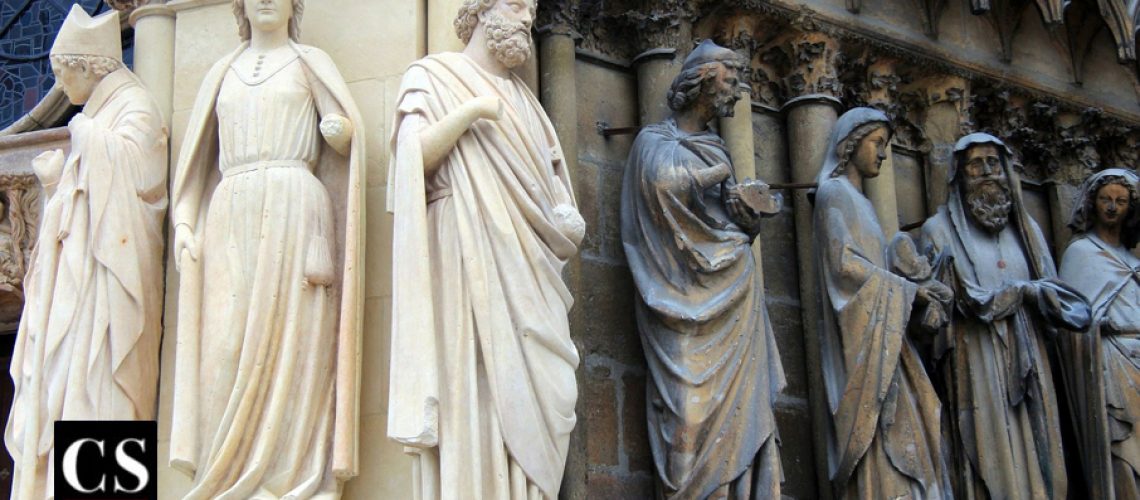
Caveat emptor….Okay, so I’m biased because my name is Raymond. When I started doing genealogy on my last name, I thought to myself, “Why not do this on your first name as well?” I’m certainly glad I did, because I discovered three really great holy namesakes. A good idea is always to have your Confirmation saint pray for you regularly, [Mine is the astounding St. Jude Thaddeus, cousin of Jesus and the patron saint of hopeless cases (ME!)], but even better, your namesake(s) who are in heaven are also ready, willing, and able to pray and intercede for you as well. Luckily (or providentially) for me, I have at least three really great ones.
St. Raymond of Penyafort
St. Raymond of Penyafort (1175 AD – 1275 AD) was born in Catalonia, Spain and was the son of a noble family from the royal house of Aragon. He had PhDs in both civil and canon law from the University of Bologna. He taught canon law for 15 years. He eventually became a Dominican at age 47 in Barcelona.
St. Raymond was one of the founders of the Mercedarians, a group dedicated to preaching about the mercy of God through the intercession of the Blessed Virgin Mary. Eventually, among many works of mercy, he became active in ransoming Christian captives of the Moors (Muslims). Accordingly, he established a school in Tunis where priests could study Semitic languages so that they could talk to the Moors in their own language.
Being a prolific scholar and writer, he also penned the Summa de Casibus Poenitentiae, a document that outlined sins and the recommended penances for penitents who confessed them. So impressed was Pope Gregory IX, that in 1230 he summoned Raymond to Rome to be his chaplain and grand penitentiary. It was here in Rome that Pope Gregory had Raymond organize the code of canon law into one book. Previously, this code had been scattered around in many documents, making it hard to find particular phrases and laws quickly. At this task, Raymond was hugely successful. This code became known as the Decretals of Gregory IX and lasted for around 700 years until the current code of canon law was redone and approved in 1917!
Raymond soon became the confessor of King James I of Aragon. While on the island of Majorca, he tried to convert the Muslims (Moors) there, and the King decided to come along to witness the discussions. However, the King brought his mistress along, an action that Raymond disapproved. Raymond preached to the King to get rid of her, but the King refused. When Raymond threatened to leave the island in protest, the King forbade any ship captain from taking him onboard. This didn’t stop Raymond, however. He went down to the water’s edge, took off his tunic, and tied one end of it to the top of his staff while standing on the remaining part of the tunic. His companion saw that he was making a little sailboat, but he refused to hop aboard. Raymond told them goodbye, made the sign of the cross, and proceeded out into the water, sailing around the boats that were forbidden to take him aboard. Needless to say, the sailors onboard were astounded and cheered him on. Six hours later, he arrived in Barcelona. The crowd there saw him landing, and many converted. When King James I heard about this, he got rid of his concubine and became a true believer.
After this incident, he reached the age of 60 and became a recluse for at least a year or so. However, the Pope soon appointed him as Archbishop of Tarragona. Sadly, he refused this honor, not wishing to have such a responsibility. Rather, he was elected the Master of the Order of Preachers in Barcelona, where he drafted a new set of rules for the Order. He soon resigned this office as well, only to become the advisor of King James I on the Inquisition. His deep sense of mercy and common sense prevailed, in stark contrast to the later abuses of the crown on suspected heretics claiming to be Catholic. He approved of conjugal visits of wives to male prisoners, keeping the wives from committing adultery and certainly making the temporary captivity a little easier to take.
But Raymond wasn’t through with his ministry. He encouraged St Thomas Aquinas to write a work known as “Against the Gentiles,” a document useful in converting Gentiles to Christianity. He encouraged dialogue between the Church and Judaism, for the purpose of converting Jews.
St. Raymond died in Barcelona in 1275 at the age of 100. He was canonized by Pope Clement VIII in 1601 AD. His feast day in January 7, and he is the patron saint of lawyers.
St. Raymond Nonnatus
St. Raymond Nonnatus (1204 AD – 1240 AD) only lived to be 36 years old, but he did so much with his life. He also was born in Catalonia, Spain. His mother died while giving him life during a C-section, hence the name Nonnatus (not born). Accordingly, he is the patron saint of childbirth, midwives, children and pregnant women. Additionally, he is also the patron saint of priests who uphold the confidentiality of the confessional.
The son of an aristocrat, his father had hopes for him to serve in the royal court of Spain. However, he wanted to become a priest and often attended an old country church dedicated to St. Nicholas. His father eventually had him tend sheep on one of the family farms so he could think about his future. After a while, his father conceded to his wishes, and Raymond became a Mercedarian in Barcelona. This order was dedicated to ransoming Christians taken captive by the Moors (Muslims) in North Africa. At this task, he was very successful in Algiers, ransoming some 250 Christians. In Tunis, however, the money ran out, so Raymond offered himself as a hostage in exchange for 28 Christians. Raymond took this opportunity to try and convert his captors by preaching about Christ to them. They rewarded him by drilling a hole in his lips with a hot iron and then padlocking them shut! His religious order eventually ransomed him out of captivity and brought him home in 1239. He died a year later, and many miracles were attributed to his intercession. He was canonized by Pope Alexander VII in 1657 AD. His feast day is August 31.
St. Maximilian Kolbe
Okay, so what is St. Maximilian doing in a litany of Raymonds? Well, his given Christian name, before he changed it, was Raymond. He changed it to Maximilian, because he said that he wanted to become a great saint. He was born in Zdunska Wola, Poland in 1894, to a German father and a Polish mother.
In 1903, at the age of 9, he had a vision of the Blessed Virgin Mary. He relates what transpired as follows:
“That night I asked the Mother of God what was to become of me. Then she came to me holding two crowns, one white, the other red. She asked me if I was willing to accept either of these crowns. The white one meant that I should persevere in purity and the red that I should become a martyr. I said that I would accept them both.”
In 1907, he joined the Franciscan order and was ordained as a priest in 1919. WWI was occurring during this time, and his dad enlisted in the Polish army to fight for freedom from the oppressive Russians. Sadly, his dad was caught and hanged by the Russians, which caused Maximilian great sorrow.
Maximilian studied at the Pontifical Universities in Rome, earning doctorates in both philosophy and theology. While there, he witnessed an in-your-face protest in Vatican Square by the Freemasons, who attacked both the Church and the Pope. According to his eyewitness account:
“They placed the black standard of the “Giordano Brunisti” under the windows of the Vatican. On this standard the archangel, Michael, was depicted lying under the feet of the triumphant Lucifer. At the same time, countless pamphlets were distributed to the people in which the Holy Father was attacked shamefully.”
As a response to this blasphemy, he organized a resistance movement in 1917 to the Freemasons and all enemies of the Church called the Militia Immaculata, or Mary’s Army. He amended the Miraculous Medal prayer to read as follows:
O Mary, conceived without sin, pray for us who have recourse to thee. And for all those who do not have recourse to thee; especially the Freemasons and all those recommended to thee.
This movement still exists today and publishes a newsletter. (Should you wish to enroll in the order, see militiaoftheimmaculata.com.)
When he returned to Poland in 1919, he took a strong stance against leftist causes, especially communism. He began printing a monthly magazine dedicated to the consecration to the Blessed Virgin Mary. In 1927, he founded a new Conventual Franciscan monastery at Niepokalanów near Wa1saw. This monastery was hugely successful, as hundreds of priests soon joined him in his devotion to Mary. His magazine reached thousands of Poles and laid the groundwork for St. John Paul II in the next generation to bring down the powerful evil empire of the Soviet Union through the power of Mary and her Rosary, without firing a shot. Along with the monastery, he also founded a Marian radio station. So powerful were the prayers of Maximilian that, when he prayed for money to buy new printing material, the exact amount of money would mysteriously show up on his desk.
Maximilian was also a traveling missionary as well. He founded a monastery in Nagasaki, Japan, on the side of a mountain facing away from the city. When the Americans dropped the atomic bomb on the city in 1945, the mountain shielded the monastery and saved all who lived there from the blast.
Upon returning to Poland, he managed to hide around 2000 Jews in the monastery from the Nazis. Eventually, the Nazis arrested him and sent him to Auschwitz as prisoner #16670. One day, another prisoner managed to escape, and the Nazi commandant of Auschwitz demanded that 10 prisoners would be starved to death in a bunker to deter further escapes. When one of the condemned men hollered out about what was to become of his wife and children, Maximilian stepped forward and offered to take his place in the starvation bunker. His request was granted. During his time in the bunker, he led the other prisoners in prayer and song and heard their confessions. On 14 August,1941, the Nazis inoculated his arm with carbolic acid, killing him. His ashes in the crematorium rose up to heaven on the eve of the Feast of Mary’s Assumption, thus fulfilling his goal of being a great saint in Mary’s honor.
Maximilian was canonized St. Maximilian Kolbe in October of 1982. The prisoner whose place he took was present to witness the canonization. St. Maximilian Kolbe is the patron saint of prisoners, drug addicts, families, and the pro-life movement.
Summary
While I am NOTHING like the three aforementioned Raymonds, I do take great solace in the fact that they are in heaven, praying for me also to become a saint. I’m certainly not there yet, but hopefully, one day, you and I will be chosen by Jesus to become saints like these three Sts. Raymond. AMEN!



2 thoughts on “The Amazing Sts. Raymond”
I’m a Raymond too. May God in his mercy make a saint of me through Our Lady’s Intercession.
Pingback: The Amazing Sts. Raymond MEK Enterprises Blog - Breaking News, SEO, Information, and Making Money Online!The Number 1 Online Blog Worldwide!