
Here in Italy, as in many parts of the world, the new scholastic or academic year has begun. And kids everywhere are jumping for joy! (Joke.)
Of course, the new academic year applies to students in elementary school, middle and high school, and even in the universities. Many of the kids in the parishes here took their comprehensive written and oral exams at the beginning of the summer. They have thus finished their high school, and have now started their higher studies.
As a teacher at various schools, this means that my labor has also begun. There is a surprising demand for teachers of philosophy here. For me this means a steady supply of requests and a full schedule of classes. Fortunately, unlike contemporary history or biology, the realm of medieval philosophy, philosophy of nature, and the like remains consistent in its material.
The students
With this in mind, however, there is one large variable which is both predictable and extremely unpredictable. The composition of the class, meaning, the students who make it up is that variable.
Of course, in one sense the makeup is quite predictable. I will be teaching lay students at a private university, or seminarians, or priests and sisters. And I know what classes they have taken before.
Some students have taken a set curriculum before they reach one of my classes. Conversely, my class on introduction to philosophy is the first philosophy class some students are taking. In either case, I can make some well-founded calculations as to their level of knowledge and experience.
But what I can never know, and what is always a surprise, is the sort of students that I have.
I have had classes filled with students who had trouble grasping the fundamentals. It is always a job to bring them up to speed while ensuring the others do not get bored. Likewise, I have had classes where almost no one does the required reading.
Occasionally, though fortunately only rarely, I have had students who adamantly refuse to learn. Their negative attitude is overwhelming. Sometimes though, they can be won over, but these students are, in my experience, the hardest to teach. There is no student as difficult as one who does not want to learn.
The Church as Teacher
The new academic year also brings the beginning of the catechetical year, the time of Christian instruction and formation. There are many ways that we might consider or view the Church, but one image that the Church has repeatedly recommended is that of Church as teacher.
For instance, the 1961 encyclical of Pope Saint John XXIII, Mater et Magistra [Mother and Teacher] starts off with the double invocation of the Church as both mother and teacher.
“Mother and Teacher of all nations—such is the Catholic Church in the mind of her Founder, Jesus Christ; to hold the world in an embrace of love, that men, in every age, should find in her their own completeness in a higher order of living, and their ultimate salvation. She is “the pillar and ground of the truth.” To her was entrusted by her holy Founder the twofold task of giving life to her children and of teaching them and guiding them—both as individuals and as nations—with maternal care. Great is their dignity, a dignity which she has always guarded most zealously and held in the highest esteem.
“Christianity is the meeting-point of earth and heaven. It lays claim to the whole man, body and soul, intellect and will, inducing him to raise his mind above the changing conditions of this earthly existence and reach upwards for the eternal life of heaven, where one day he will find his unfailing happiness and peace.”
Jesus Christ wanted His Church to be a teacher. In a particular way, the Church is the one who teaches us about human dignity, which is often forgotten or diminished in the world.
The mistakes students make
With centuries of experience as a teacher, the Church also knows what every human teacher has seen through experience. Year after year, students often fall into the same errors and mistakes. There seems to always be that student who tries to spell soccer with two k’s or q’s, or another who insists that two plus two is twenty-two!
Despite my warnings, injunctions, and grim predictions, I always have students who wait until the last minute to do their readings or submit their paper topics. I tell them it happens every year, that their grades will suffer, and that I have seen it all before. But it is all to no avail.
The mistakes people make
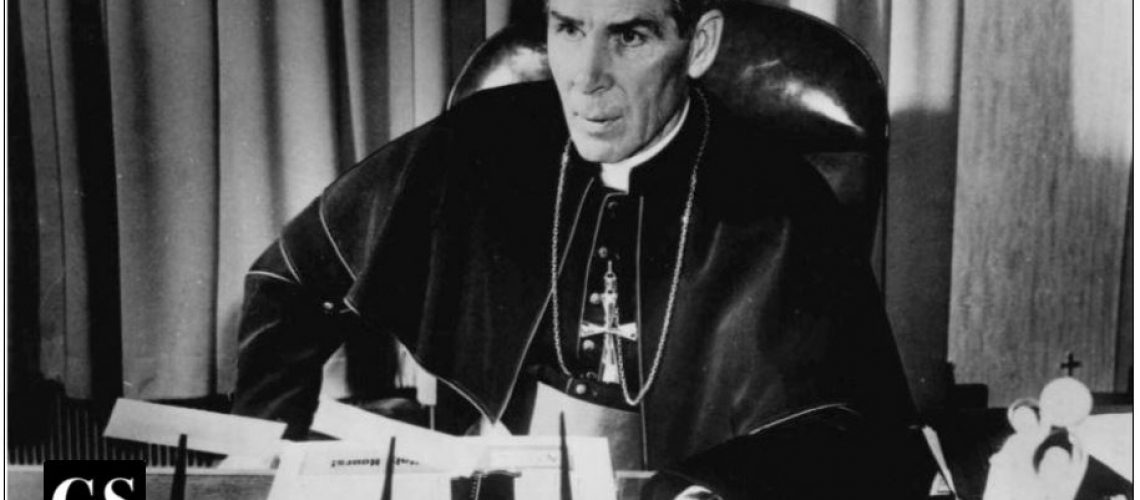
Fulton Sheen noticed this recurrence in the life of the Church as well. In his book “Old Errors, New Labels,” on page 50, he compares the Church to a teacher who has seen all the mistakes before.
“The Church is not only more fundamental than Fundamentalism, but she is also more modern than Modernism, because she has a memory that dates back over twenty centuries; and therefore, she knows that what the world calls modern is really very ancient ¾ that is, its modernity is only a new label for an old error. Modernism has an appeal only to minds who do not know what is ancient, or perhaps antiquated.
“The Church is like an old schoolmaster who has been teaching generations and generations of pupils. She has seen each new generation make the same mistakes, fall into the same errors, cultivate the same poses, each believing it has hit upon something new. But she, with her memory, which is tradition, knows that they are making the same mistakes all over again, for in the wisdom born of the centuries she knows very well that what one generation calls modern the next generation will call Un-modern. She knows also that Modernism is no more logical than a sect called “Three O’Clockism,” which would adapt our gods and our morals to our moods at three o’clock. The Church knows too that to marry the present age and its spirit is to become a widow in the next.”
The Church’s Teachings
“What the world calls modern is really very ancient – that is, its modernity is only a new label for an old error.” It is from this line that Sheen’s book takes its title. It reminds us that the Church’s memory stretches back over two thousand years. She has seen many errors, even some errors that we might never have heard of or imagined (unless you’re a theologian or a historian of theology). It also all reminds me of what a Jesuit priest once told me, “God put limits on our intelligence, but not on our stupidity.”
These hundreds upon hundreds of years of experience have been summarized first in the creeds, then in councils, and recently in the Catechism.
Like a wise teacher, the Church’s creeds summarize, in a simple way, the teachings of the faith against various wrong teachings. Phrases that roll off our tongues from memory every Sunday, “God from God, light from light, true God from true God, begotten, not made, consubstantial with the Father,” are the synthetic summary of years of debate, conflict, prayer, and reflection.
Sometimes these teachings are hard to accept; sometimes we might ask, “Well, why say ‘True God from true God’? What is that all about?” What it is about is our mother and teacher, the Church, reminding us of the price that was paid for our faith, the cost of our beliefs.
Like a good teacher, the Church calls us to listen to her wisdom, but, like any teacher, she can only invite and encourage: the response is ours.


[…] StylistTrad Godmother: How to Build a Latin Mass Community – Jodi Lacroix at 1 Peter 5Summer Ends and a New Academic Year Begins – Fr. Nathaniel Dreyer at Catholic StandReassessing Elite Claims This Columbus Day – […]
“God put limits on our intelligence, but not on our stupidity.”
A good parent would not unleash the limits of stupidity a child might make.
Hi Ordinary Papist,
Thanks for reading, and your comment.
That’s a good insight and, yes, I think that it’s true. Indeed, I think that that’s part of the reason why God has given us the natural law so that we can know that there are some things that will never be good for us.
God bless!
Fr. Nate