

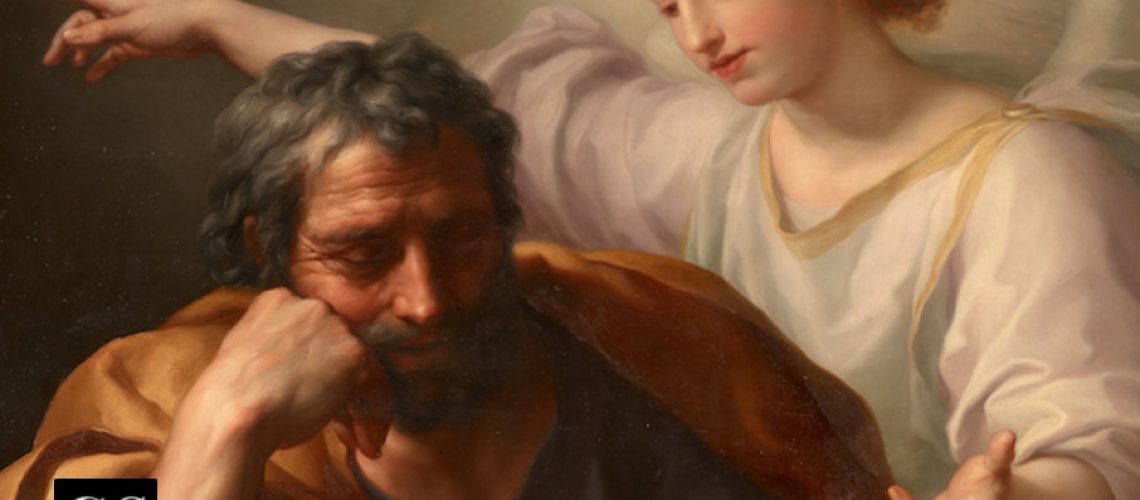
The Feast of the Annunciation celebrates Jesus becoming flesh in the womb of the Virgin Mary. We do not celebrate St. Joseph having the great privilege of receiving his own heavenly message, but it is a vital part of the Incarnation. Many mysteries and virtues present themselves for our reflection in this short story.
True Justice
Commentators have varying interpretations of Joseph’s surprise at Mary’s pregnancy. We know from Scripture that Joseph, “being a just man and unwilling to put her to shame, had resolved to send her away quietly” (Matthew 1:19, RSVCE). While many take this sentence and conclude Joseph’s negative judgment on Mary, Scripture is silent on his exact state of mind. For the undeniable shock, did Joseph really view Mary as capable of adultery?
We have to cast off our modern eyes and examine the word “just.” How could he be considered “just” and purposefully “bypass the full force of the law for Mary’s alleged violation of the Sixth Commandment?” In the same vein, “would Saint Joseph be considered just in abandoning Mary if he were confused over the origin of her child, even though he was convinced of her moral integrity?” (Fr. Frederick Miller, Joseph Our Father in Faith, pg. 17-18)
Fr. Don Calloway has recently written about a reverence theory that offers an alternative. Joseph’s “immediate resolve was to give God what Joseph believed was God’s due, that is, to distance himself from Mary since she belonged to God” (Consecration to St. Joseph, pg. 149). That is, Joseph saw himself as getting in the way of the divine plan. This theory comes from the writings of several doctors of the Church. Among them, St. Jerome, St. John Chrysostom, St. Basil, St. Ephrem, St. Bernard of Clairvaux, and St. Thomas Aquinas. It’s an impressive list and those whose opinions we should take seriously!
Hope of Israel
Then the message of the angel reassured Joseph and provided some much-needed context. From Matthew’s genealogy, we know that Joseph’s father was named Jacob (1:16). Yet the angel called Joseph “Son of David,” immediately putting the message into the context of the history of Israel. Whatever fears he had should be cast aside, said the angel, “for that which is conceived in her is of the Holy Spirit; she will bear a son, and you shall call his name Jesus, for he will save his people from their sins.” (Matthew 1:20-21).
Just like the Archangel Gabriel’s message to Mary (see Luke 1:26-38, RSVCE), there were missing details. In spite of the scant detail, there is little ambiguity in Joseph’s message. Conceived by the Holy Spirit? And who could save humanity from their sins but the messiah? Imagine Joseph growing up, hearing the stories of his ancestors, and celebrating the festivals every year. For his whole life, he had looked forward to the coming of the messiah.
Imagine Joseph contemplating that while holding baby Jesus–and hearing from his little lips, abba!
True Father
Jesus’ true Father is the Father of us all. Yet Joseph remained the father of Jesus on earth from the very beginning. St. John Paul II points out that the angel still honors the fatherhood of Joseph: it was the father’s job to name the child. By giving him the name of the baby, the angel was entrusting to Joseph “the responsibilities of an earthly father with regard to Mary’s Son.” (Redemptoris Custos #3)
Upon waking up from the visit from the angel, Joseph obeyed the command of God and took Mary into his home.
If Elizabeth said of the Redeemer’s Mother, “blessed is she who believed,” in a certain sense this blessedness can be referred to Joseph as well, since he responded positively to the word of God when it was communicated to him at the decisive moment… What he did is the clearest “obedience of faith” (cf. Rom 1:5; 16:26; 2 Cor 10:5-6). One can say that what Joseph did united him in an altogether special way to the faith of Mary. He accepted as truth coming from God the very thing that she had already accepted at the Annunciation. (Redemptoris Custos #4)
He acted. No more hesitation about what the Lord intended for Joseph: he was told, he obeyed, and he united himself to the divine plan. For those that may see Joseph on an unapproachable level, he experienced the same uncertainty that I think a lot of fathers go through. Although Joseph had direction from the angel, he still had to walk the walk. The things that laid in store for him became a challenge after challenge to reaffirm his commitment to the will of the Lord. I cannot imagine the amount of trust Joseph had in God’s plan. Out of everything a new husband might expect, walking to Bethlehem with a very pregnant wife or to Egypt with a newborn were likely not on his list.
Go to Joseph
St. Joseph models so many qualities that men of every age need: just, able to take action, and possessing immense trust in God. This is why Joseph is a model for all fathers, and why God the Father chose him to be His representative on earth. Aside from the honors bestowed on the Blessed Virgin Mary, is there any greater compliment?
No one on earth was so close to Jesus and Mary as St. Joseph. Take advantage of the year of St. Joseph and ask him for his powerful intercession!





3 thoughts on “St. Joseph’s Annunciation”
Many times I think that the reason why in 2 thousand years we’ve known so little of Saint Joseph is because he is reserved to become the paladin and defender of the family.
In fact, the prophecies say that at the end of times the family will be attacked, and we clearly see this in action today.
As such, he will suddenly become known and be used by God as the last bastion when all else has failed: let us not forget he is known as “terror of demons”
And feasts like the one you mention like justly become in place: we may already see this happen as we are in the Year of Saint Joseph
A very thoughtful and insightful article. A timely and tightly written reminder that St. Joseph is here for us today.
Excellent reflection on St. Joseph!