

When I graduated from high school, the extent of my knowledge concerning the stock market and securities amounted to the knowledge that there was a crash in 1929 and that we should probably avoid another. Turn the clock ahead fifty-some years and we have off-spring in their twenties selling stock options for fun—and doing very well at it. We have emerged from a long tradition of well-guarded financial games to an age where the lid is off and the genie is out of the bottle.
The same is true for a plethora of life’s other avenues: medical, nutritional, political, philosophical, theological—if you want to know anything about anything, you can easily quench your thirst for knowledge; the knowledge monopolies are no more. For example, back in the day, if you wanted to read St. Tomas Aquinas’ Summa Theologiae, it would at least require the effort to visit a library—and not just any library—and it was unlikely that you would find a copy you could take home with you.
Now, that fine document is but a click away. But, more to the point of this article, would anyone among the clergy have encouraged the layperson to take up such a task? A few years ago, the pastor of my former parish told me that he was throwing out his theological library (he said it out of the blue, having no particular reason to tell me other than that he liked to push people’s buttons).
When I asked if I could have the books (among them, a complete Summa), he questioned why I would want them, and eventually proceeded to ignore my request and throw them in the trash. What was his fear, the cause of his obstinacy? What propelled his need to keep truth—which he seemed to no longer respect—from the hands of a layman?
In a Crisis article about Bitcoin, Eric Sammons advised us to consider the advantages of a decentralized currency; advantages that may, in dark times, prove to be of incalculable value to persecuted faithful Catholics. Knowledge, as we’ve oft been told, is power—or, perhaps, currency. If so, power is flowing, ebbing, swelling, and waning in ways in which it never has before. Like Bitcoin, it is no longer a currency that is tightly regulated and centralized.
We have had to live daily with the insufferably smug, condescending malfeasance of party-politics oligarchs, technocrats, bureaucrats, academics, and their lap-dog corporate media. But what we don’t see is them sweating in the back room. Theirs is a constant, desperate effort to maintain a crumbling monopoly: a crumbling that daily grows more visible.
It started with the election of a populist president; an event that left them visibly jarred. They had owned the narrative. How could this have happened? Now we’ve got whistle-blowers and Project Veritas. Yikes! The intelligentsia’s waning control of the narrative is a snowball rolling down a growing hill, picking up speed, and not getting any smaller. In their desperation they have increasingly had to show their cards, attempting to reassert their absolute authority.
Only society’s spiritual/philosophical slackers remain impressed with their hand. And then, to their unabatable horror, Elon Musk threatened to—gasp! — make Twitter a platform of free expression. Social media had remained their last great bulwark until new platforms began popping up faster than they could slap them down, and now this? What’s to be done?!
CNN and other legacy outlets are dying a slow but steady death. And it is now official that more programs are being streamed than delivered via cable. The crumbling shows no sign of abating.
What remains to be seen is to what lengths the cabal’s desperation will take them as they attempt to stop the knowledge snowball. In my estimation, considering that all of the chips are on the table, and cognizant of the difficulty they face in restacking the deck, we can expect these cheaters and liars to get much more violent than they already have been.
Pope Francis has indicated that he believes clericalism to be one of the Church’s biggest problems (the pot calling the kettle black?). Indeed, nefarious actors within the clergy, at least at the local level, no longer are getting by with flaunting their position and authority. Many of them virtue signal about the need for the laity to have more power within the Church, but what they surely do not want is for the laity to exercise the growing power of knowledge available to the common man: a deeper knowledge of the transcendent beauty of the deposit of faith.
The Church hierarchy is not some secret society coveting the means to empire building, but the orchestrated obfuscation of clerical bad actors becomes a formidable knowledge suppressor—cabal maintenance—thereby achieving similar ends.
But that cabal is also crumbling. The game is all but over because they’ve been forced to show their hands. They are desperate and on the offensive. The shield provided by a clericalist mainstream Catholic press is wearing thin. There is a growing list of orthodox canceled pastors, to the point where they’re forming a club of sorts, and the laity has organized efforts to supply them with food and shelter and the funds required to support their canon law efforts toward reinstatement.
Thirty-six years ago, my wife and I attended a charismatic conference at Notre Dame University. I don’t remember much about the event, but I do remember a conversation with other attendees. The subject of heterodox priests had come up and I remember the conversation because it became the substratum for my approach to the faith.
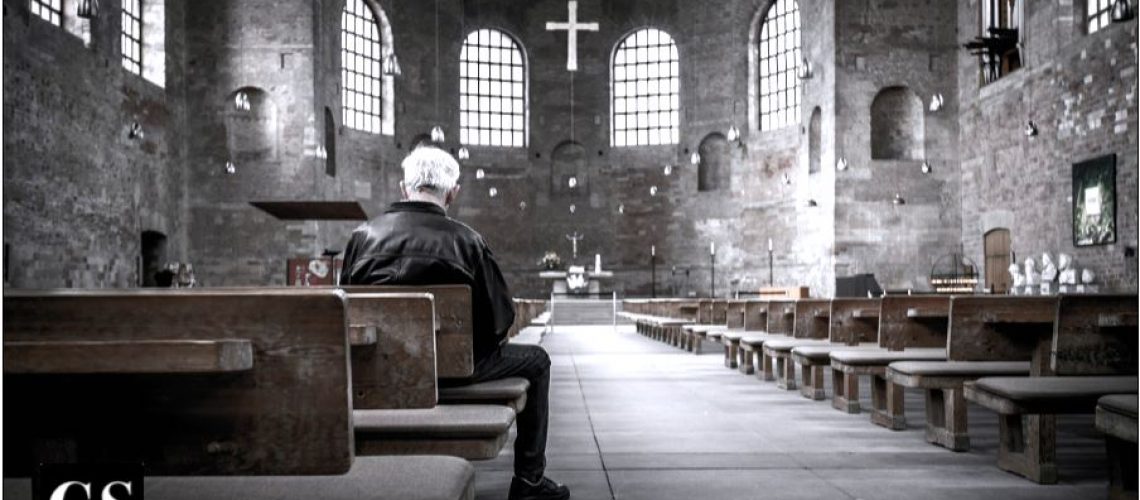
I had responded to the hand-wringing over the problems within the priesthood by simply stating that we could expect no holiness on the altar until there was once again holiness in the pews—that it would be the laity that rebuilt the Church. That conversation comes to mind after all these years because it is the very same message relayed by sidelined priests that have gathered in solidarity to proclaim their steadfastness in the faith.
Pride will always be the beginning of all sin, but pride requires maintenance. It feeds on ignorance and is watered by spiritual sloth, which happens to be the very things that enable and sustain the knowledge monopolies. As the patriarch of a growing clan, I have had occasion to make this point to those God has entrusted to me who are tempted, as we all are from time to time, to vote with their feet—to jump off of what seems to be a sinking ship.
But there is no other ship—just a bunch of make-shift, rudderless rafts bumping into each other and going nowhere. The deposit of faith does not belong to the pope, the bishops, the clergy; it belongs to all of us—past, present, and future generations. It is ours to lose; ours to pass on. We are all fathers and mothers in the faith, and our greatest duty, after embracing it and appreciating it for our own salvation, is to pass it on to future generations. That is our immediate mission, our job.
But one cannot pass on what one barely understands. We stand on a threshold: the knowledge cabals have been exposed, and for all practical purposes, vanquished. The only remaining reason for ignorance is sloth—spiritual laziness—a diabolically deadly vice.
Voting with one’s feet is an act of cowardice—it is to leave the battlefield of life. Voting with your feet says, in effect, that God cannot fix this; he cannot restore unity; that we have no recourse but to form a smaller, purer community. But the presumption of our own purity is always dangerous ground—it seems safe because such presumption removes us from the battlefield, but the battlefield is, paradoxically, the only safe place to be—the only means of purification. If the community is to become smaller and purer, the impure will depart; if your purity is true, they will not be able to stand being in your presence.
St. Paul told the Corinthians,
First of all, I hear that when you meet as a church there are divisions among you, and to a degree I believe it; there have to be factions among you in order that those who are approved among you may become known.
The prophet Simeon told the Blessed Mother, “Behold, this child is destined for the fall and rise of many in Israel, and to be a sign that will be contradicted.” How about us—is the way we live our lives a sign that will be contradicted? Canceled priests who have stayed the course and found solidarity with the faithful, have not voted with their feet.
Their bishops have largely justified these banishments by calling these priests “divisive”. The banished priests, in return, have accused their bishops of having left the battlefield—that is, of having abandoned an honest defense of the faith they profess to possess—effectively voting with their feet, AWOL through their sins of omission.
By this means, the approved among us become known. Some of these priests have indicated that, far from being out of the battle, they are perhaps all the more dangerous to the enemies of the faith, for the humble prayers of the exiled have the power to drown armies and humiliate pharaohs.
Humility is the door to true knowledge: knowledge that has no interest in monopolies.


6 thoughts on “Sidelined Priests Versus the Desperate, Failing Knowledge Monopoly”
Jerome-Thank you for making me think about all this. Bishops banning faithful priests for allegedly being “divisive” is like Clintons and Soetoro firing somone for purity. [With apologies to Eric Blair]: And they looked from the pigs to the bishops and then back to the pigs, and to the archbishops and the cardinals, and then again to the pigs, and then to the man wearing papal white with the bum leg, and then back to the pigs – and they could no longer tell the difference. Guy, Texas
I was very disappointed with this article, since it did not mention
Jewish space lasers causing forest fires; Democratic pizzagate; ivermectin and hydroxchloroquine; the return of JFK Jr to be Trump’s runningmate; and false flag operations like Jan 6.
Well said! Should have remembered those myself . Seems trump (small cap intentional) have selected memory.
Excellent article, Jerome! The Catholics-in-name-only crowd can’t stand this stuff because deep down they know they are the factious ones; the ones who love abortion, transgenderism, homosexual behavior, division by deceit, and a host of of other sins. Keep up the good work!
Who’s the populist president? Can’t be trump, lost the popular vote in both elections. And his populararity never reached above his base. Then calling the opponent a ‘cabal’ shows a lot of anger.
You cover too many topics too broadly and without data, specifics ,citations.
” You cover too many topics too broadly and without data, specifics ,citations. ”
You got that right.