

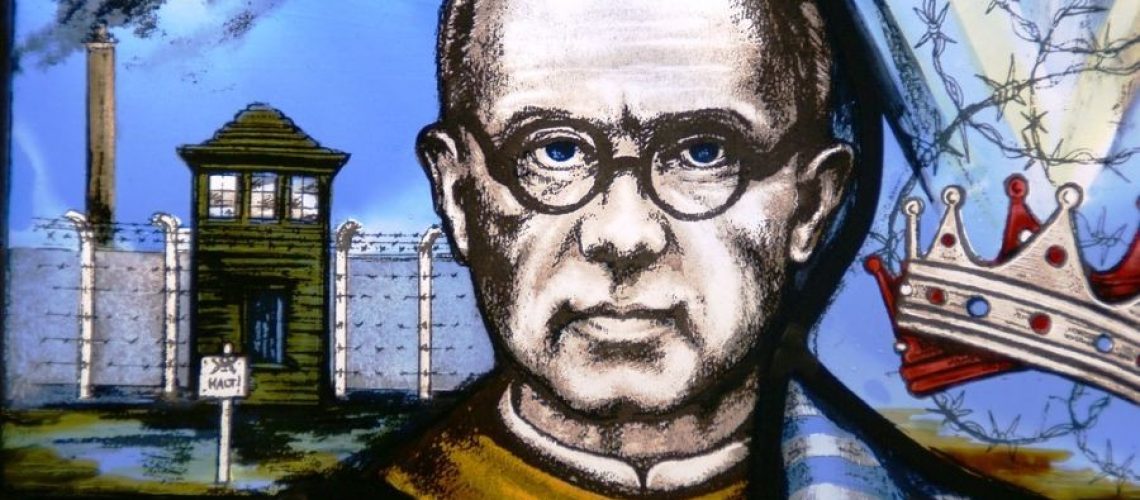
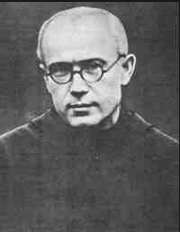
Born in Poland when it was still a part of the Russian empire, Raymund Kolbe was the son of a German father and a Polish mother. As a youngster, locals knew him for both his astute intellect and his profound piety. He also seemed inclined to follow a religious vocation, which was certainly underscored by his devout love for the Blessed Mother the Virgin Mary. All that shaped his devotion to God and his decision to serve God.
As Kolbe wrote as an adult, “That night, I asked the Mother of God what was to become of me, a Child of Faith. Then she came to me holding two crowns, one white, the other red. She asked me if I was willing to accept either of these crowns. The white one meant that I should persevere in purity, and the red that I should become a martyr. I said that I would accept them both.” And both events occurred in his life.
At the age of 13, Kolbe enrolled in a Franciscan seminary. In 1910, he was accepted as a novitiate and was given the name “Maximilian”. He took his final vows in 1914, then moved to Rome. There he earned a doctorate in philosophy from the Pontifical Gregorian University and later a doctorate of theology from the University of St. Bonaventure. While still a student, Maximilian Kolbe suffered his first bout of tuberculosis, an illness that caused him poor health for the remainder of his life.
Outraged at the disrespect in Rome shown to the Church and Pope in 1917, he organized the Militia of the Immaculata (Army of the Immaculate One) to work against enemies of the church, specifically the Freemasons. The foundation remains a worldwide movement that encourages consecration to the Virgin Mary as a form of both conversion and a movement to spiritually renew society. The organization is open to all Catholics over the age of seven, and members use prayer and self-sacrifice for spiritual victory of good over evil, and also use apostolic initiatives to witness Christ and Catholicism.
In 1918, he was ordained a priest. Completing his degrees, Maximilian Kolbe returned to now-independent Poland. His energies were always directed to supporting the church and to evangelizing. He traveled throughout Poland to promote Our Lady. To further spread the words of Christ, he founded a monthly magazine called Knight of the Immaculate. In 1927, he also founded a religious publishing center and a Conventual Franciscan monastery near Warsaw.
In 1930, Maximilian Kolbe traveled to Japan, where he served as a missionary and established a monastery in Nagasaki, which survived the atomic blast in that town. In 1936, because of failing health, Kolbe returned to Poland. He took up residence in the friary at Niepokalanow, which by then housed 650 friars.
When Poland was overrun by the Nazis in 1939, Maximilian Kolbe was arrested twice. In 1941, the second arrest had him sent to Auschwitz, where he had to work in its work camp. He was abused by the guards and forced to perform backbreaking tasks. In July, the guards sent 10 randomly chosen prisoners to an underground cell to starve them to death as a particular punishment for those plotting an escape. Kolbe volunteered to take the place of one of the men (Franciszek Gajowniczek) who still had a wife and family. Until their death, Kolbe led his fellow prisoners in prayers daily. To hasten the deaths of the few who survived, guards gave the men lethal injections. Kolbe faced his death calmly and with great courage.
Maximilian Kolbe was beatified in 1971 by Pope Paul VI as a Confessor of the Faith. Pope John Paul II canonized Kolbe in 1982, and the Pope declared that Maximilian Kolbe was a confessor and a martyr of charity. (Note: Kolbe is the Patron saint of prisoners, drug addicts, and the pro-life movement.)
A movie is coming out about Maximilian Kolbe: “Triumph of the Heart”. This is a new Film on Saint Maximilian Kolbe’s Final Days in Auschwitz


2 thoughts on “ Saint Maximilian Kolbe”
Pingback: SVNDAY EARLY-MORNING EDITION - BIG PULPIT
Poland has given the world some of the greatest saints of the 20th century. Saint Maximilian Kolbe was one of my favorite Saints. He volunteered to die in place of a man named Franciszek Gajowniczet in the the German death camp of Auschwitz. Kolbe was beatified as Confessor of the faith in 1971. He was canonized by Pope John Paul II and declared him a martyr of charity. Kolbe was way ahead of his times he operated amateur radio and several publications to evangelize.