
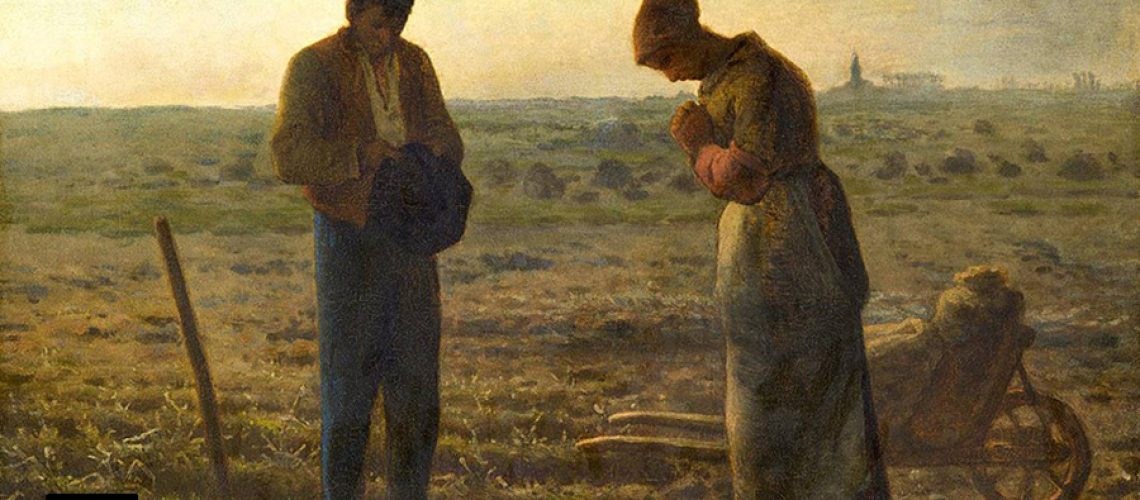
Rogation. Not a word many use; probably, even fewer know the word. The word comes from the Latin rogare, to ask. Before the reforms of the General Roman Calendar after the Second Vatican Council, there was one major Rogation Day on April 25th, and three minor Rogation Days that took place the Monday, Tuesday, and Wednesday before Ascension Thursday. But what are Rogation Days?
Until the past one hundred and fifty years, American Catholics were overwhelmingly an agriculture people. Like our forebears in Europe, we worked the land. Whether that consisted of growing sugar cane in Louisiana, rice in South Carolina, farming the “hollers” of the Smokey Mountains, the fields of southern Illinois, all of Iowa, and most of Missouri, or countless places from sea to sea, we could say that Catholics and the land had a special relationship.
Catholics who work the land, then as now, also have a special relationship with sacrifice and penance. Lent falls right in the middle of Winter, when most of the northern hemisphere goes without most fresh fruits and vegetables. The Sacrament of Reconciliation is a special thing whereby we acknowledge to ourselves and our Creator that we have sinned, and He forgives our sins, allowing us to go back to our lives and grow in holiness, just the way our crops grow in their holiness each season.
Rogation Days are days of supplication and procession when we look toward God’s bountiful goodness and celebrate the graces He has granted us. Each Rogation Day had litanies (also called major and minor). The Major Litany of the major Rogation Day was the Litany of the Saints we sing at Confirmations like during the Easter Vigil service. Minor Litanies were much shorter.
Pope Saint Gregory the Great tells us in his writings that saying a Greater Litany in supplication for God’s graces was already a custom in Rome before he began his pontificate. Saint Gregory wanted a feast to celebrate the beginning of Pope Saint Peter’s beginning his pontificate in Rome, so the date of April 25th was chosen. He also had that feast take on the role of supplication and processing. Rome celebrated everything it could, so Pope Gregory gave this feast day one of multiple meanings.
As Rogation days developed and more churches (dioceses) and parishes adopted the practices of these days, they took on an agricultural aspect while still maintaining the ambiance of supplication and penance. After all, because most of European Christendom was agricultural, these and many other days celebrated the agricultural life.
Incidentally, the Feast of St. Mark the Evangelist was moved to April 25 sometime in the Middle Ages, but if the Rogation Days were celebrated in a diocese, the bishop could transfer the Feast of St. Mark to the next day.
The major Rogation Day began with a Mass of Rogation, where the liturgical color was violet. The priest would lead a procession out of the church and into the town, out of the town and into the countryside. There he would bless farms, livestock, garden implements and tools, bee hives and chicken coops, barns and rabbit warrens, gardeners, and, of course, the crops and gardens. Most of the time, though, the priest would visit select ones of each of these. When ninety percent of your parishioners were involved in agriculture, this day could be very long if you wanted to go and bless every farm!
Like most processions today, some planning had to go into the idea. The candle bearers, crucifix holders, and those in charge of the incense had to be in the front leading everyone else. Cantors had to be positioned in various parts of the line of procession, each leading the litany. Just like a good procession today, what is being chanted or sung at the beginning of the line is not in sync with what is being sung or chanted in the middle, and the same to the end of the line. A procession can be a difficult thing, but if you do them often enough, even the laziest practitioners can master the undertaking.
There are not many sources available about what took place during the minor Rogation days each year before Ascension Thursday. We know that processions were still done, but whether they were simple ones within the church, or around the church grounds, around the block, or around town we do not know. Perhaps they also had an agricultural blessing of some kind. Or maybe they kept the core virtue of supplication and they became days of penance and reconciliation.
Today, Rogation Days are celebrated in traditional Catholic communities, but they are taking root in others, as well. Word has it that some groups of families who have begun to live the Benedict Option have begun to celebrate the major Rogation Day, provided their parish priests will participate.
Even if a whole parish does not celebrate Rogation Days, you and your family can. Get a cross, even a wall cross, grab a candle or two, and go out into your yard and garden, process around. Any small child can be taught to say or sing “pray for us” (chanting those words, like we do in Mass, is only four syllables and four notes). Have a small litany while you process. Mom and dad can stop periodically and say a prayer over the herb garden or pumpkin patch, chicken coop or rabbit hutch, or other garden section. Maybe you can invite your parish priest to come and say the prayers, even if there is no procession.
The minor Rogation Days happen in the southern United States (east and west coasts) about the time the first crops start ripening on the vines, bushes, and plants. And further north, there are some berries or maybe some green-leaved crops that are ready to harvest. The Biblical practice of offering first fruits to the church might entice some families to take their first harvest, even if only a little, and bring it to daily Mass one of these days and ask the priest to bless the food before it is donated to the parish food pantry. Maybe the priest or some parishioners can organize a day of blessing of agricultural food products at Mass with donation to the soup kitchen. And there could still be some food left over for a little celebration – how many of those happen after a daily Mass?
However they are celebrated, Rogation Days can bring some zest into your gardening practices. Maybe you can also go to Confession on the major and one of the minor Rogation Days?

