

Something New, Something Different, Something Wrong
Having overslept, my wife and I missed the daily Mass at our Parish. We went to another Catholic Church not too far away. Upon our arrival, we were directed to the Church Hall because the Church’s interior was being renovated. It was different. The hall area for the Mass was small and narrow; we sat almost shoulder to shoulder. There was an altar, but no tabernacle, and no priest, which meant no Mass. The communion service began with greetings and prayers; there was no penitential rite. The Liturgy of the Word was as follows: The first reading, followed by a responsorial psalm, then the reading of the Gospel by one of the ushers, a brief homily by the same person, followed by the intercessory prayers. Thus ended the first part of the communion service.
The Liturgy of the Eucharist consisted of the communion rite or the lord’s prayer, followed by the elevation of the sacred host and the proclamation: “Lord, I am not worthy that you should enter under my roof, but only say the word and my soul will be healed,” and finalized with the distribution of Holy Communion.
I was grateful to receive our Lord in the consecrated host, but I missed the ordinary Mass, far superior and more sacred in every way compared to a communion service. I don’t know why the Priest was absent; there was no announcement or explanation given.
Reflections
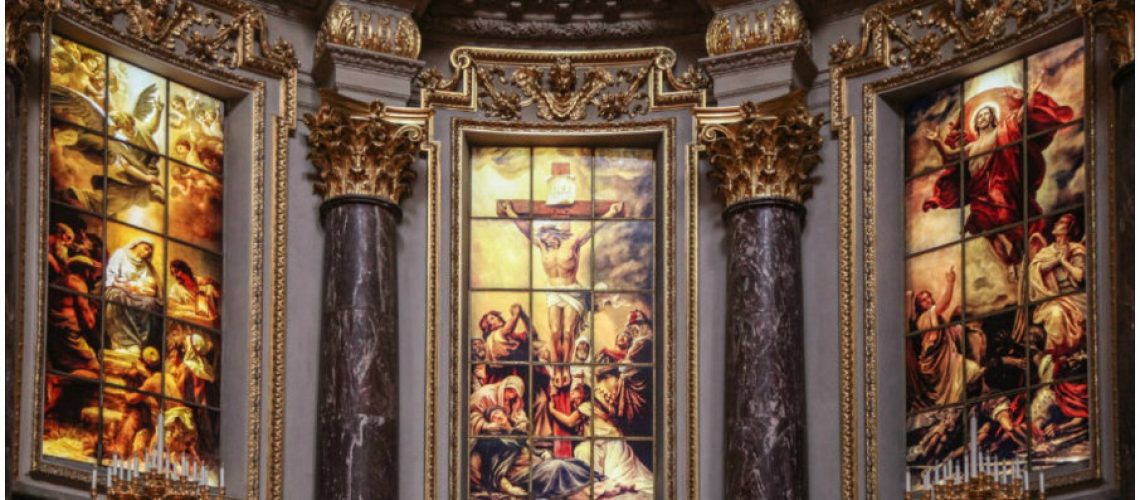
During the communion service, I was more of a witness than a participant. I didn’t like being in the church hall and to compensate my mind shifted to memories of the old and beautiful churches I once visited in Mexico City. Looking at the bare and windowless walls of the Church Hall, I saw the artistic and sacred paintings on the stained-glass windows of an old and beautiful Catholic Church in Mexico and noticed the mysterious way the sun’s rays projected and enhanced the stained-glass figures. It was a sight to behold in reverence and memory. As the communion service progressed, so did my reverie: Looking at the plain white ceiling of the church hall my mind shifted to see the divine art painted on the walls and ceilings of the old Catholic Churches in Mexico. I could see the intricate mix of elegant colors, laced with gold, in religious murals displaying some aspect of God’s revelation to man.
During the Liturgy of the Eucharist, my focus turned to the altar. Once again, I was inside an old and sacred Catholic Church in Mexico looking at an impressive granite altar which stood majestically and holy before me, with the crucified Christ on his cross looking down on the altar, and beside him stood the Holy Tabernacle. The altar, the cross, and the tabernacle all seemed oriented towards the Communion Rail which separated the divine from the natural and united the same through the Holy Eucharist. In my mind’s eye, I could also see life-size statutes of the Holy Family, angels and saints forming a half-circle from one end of the Communion Rail to the other. Their presence served as a reminder that the communion of saints are not far away and that they surely visit the Church during the Holy Sacrifice of the Mass to participate with us in our worship.
I’ve been to communion services before held within the Catholic Church, and I’ve gone to Holy Masses held in Church Halls or in someone’s home, and these events are appropriate and not disturbing. But, attending a communion service outside of a Catholic Church plus no priest and no Holy Sacrifice of the Mass is a double whammy! For A moment, being a convert, I felt like I was once again inside a Protestant Church. So, I escaped through my imagination and the aforementioned reveries of those old and beautiful Catholic Churches in Mexico City.
Fear In The Shadows
Though the reveries were pleasant, in the shadows of my mind stood the darkness of fear. A fear that neither beckoned nor welcomed, but a fear that was present nonetheless. And what was that fear? How can I describe it? I can best describe this with three hypothetical questions: What if the Hosts distributed during Holy Communion were not consecrated Hosts? How would I know? And who would tell me? The basic premise supporting these questions is that wherever we find the Holy Eucharist, we find the Catholic Church. And where the Eucharist is absent, so is the Catholic Church.
Our culture, and the world in general, stands against God, religion and especially the Catholic Church. And the Catholic Church itself is now going through a crisis where Catholic Doctrine and Tradition are being called into question, especially by the German Bishops in their “Synodal Way.”(1)
Faith Trumps Fear
My fears did not last long. All of my doubts and uncertainties submitted to Faith when I turned to prayer and sacred scripture. Jesus promised us that the Church he created, The Catholic Church, will endure until the end of time. This promise is clearly stated in a conversation our Lord had with St.Peter and the Apostles, as follows:
When Jesus came to the region of Caesarea Philippi, he asked his disciples, “Who do people say the Son of Man is?” They replied, “Some say John the Baptist; others say Elijah; and still others, Jeremiah or one of the prophets.” “But what about you?” he asked. “Who do you say I am?” Simon Peter answered, “You are the Messiah, the Son of the living God.” Jesus replied, “Blessed are you, Simon son of Jonah, for this was not revealed to you by flesh and blood but by my Father in heaven. And I tell you that you are Peter, and on this rock I will build my church, and the gates of Hades will not overcome it (Matthew 16:13-18).
When Jesus told us that “the gates of Hades will not overcome it (the Catholic Church)” this can only mean that Christ will protect his Church, the Holy Sacrifice of the Mass, and the priesthood because where you find the Eucharist, there is the Catholic Church. I have nothing to fear, and those things Catholic will endure because the stained-glass windows, statutes, communion rails, Christ on the cross, The Tabernacle and, of course, kneelers all pertain to our worship and result from and bring us back to Christ in the Holy Eucharist.
End Notes
Catholic Church in Germany considering alternative teachings on homosexuality, marriage, female priests, and church governance.
Pope Francis on Thursday took a swing at the Catholic Church’s leadership in Germany, reminding the faithful in the country that the German bishops do not have the authority to propagate new theology or alter church governance.
The statement was released by the Holy See on Thursday morning. In the message, the pope expressed concern for the laity and clergy of Germany if their leaders broke with established church teaching. The statement claimed that Catholics would be negatively affected by the many proposed changes to the church pushed by Cardinal Reinhard Marx and other liberal German leaders in their “Synodal Path.”
The “Synodal Path” — sometimes called the “Synodal Way” — is a controversial church committee in Germany. The synod, organized by the German Bishops’ Conference and the Central Committee of German Catholics, aims to discuss and address four loose topics: sexual ethics, the structure of church governance, women’s role in the church and the vocation of the priesthood.




9 thoughts on “Remembering Old, Beautiful Catholic Churches”
Peter referred to Christians as the living stones of the Church. and to Christ as the living stone that the people rejected. (See 1 Peter 2.4,5.) At 2 Peter 1.13,14 he refers to his body as a tabernacle. In the Greek text, the word “naos” (sanctuary) is used, while this is mistranslated in English texts as “temple.” The Greek word for “temple,” however, is “hieron.”
Our bodies are intended to be made holy in order to meet with God concerning the needs of human activity. We are to meet with God in prayer in our private chamber (Mt. 6.5-8). We were taught to not stand up in the temple and pray, to be seen by other men — using a lot of words.
Therefore, brothers and sisters, let us restore the Church to its pristine setting, and draw closer to God through the study of His word.
Thank you John for reading my article and for your sagacious comments.
Thanks for offering a very thought provoking article, Richard!
Your writing brought to mind for me the “excruciating” memory of the recent church closings (worldwide) and austere restrictions of the sacraments that resulted from the COVID pandemic…
What I wouldn’t have given for a “mere” communion service back then! As for me, I don’t EVER want to forget the “hunger” that I felt during those few months of NO communion OR mass except for live screening…EVEN on Easter Sunday that year! I don’t ever want to forget seeing Pope Francis completely alone in St Peter’s Square that Easter, leading the world’s Catholics in prayer while we could not physically attend services!
While I agree with the premise of your writing that a communion service cannot compare to an actual mass, I would have to say that it is a matter of perspective. We must not forget that the Eucharist is the Eucharist, whether attained in a communion service or at a mass. It certainly helps to bear in mind the “countless” people throughout the world who cannot even have the Eucharist (at all) because it is forbidden by tyrannical regimes. For many of these people the “most” that they can possibly hope for is a “spiritual” communion…which is of itself a very powerful experience (by the way) when sought with a prepared heart!
Honestly, I applaud that “usher” for offering the communion service that you attended. Were it not for his effort and that of the others who helped him, there might not have been even a partaking of the Eucharist for those who sought it that day! There are so many people who “hunger” for the Eucharist these days in hospitals, in nursing homes, those who are home-bound, and the like – as a direct result of the priest and/or nun shortage. They are doing the best that they can with their time and energy. Thankfully, there is no shortage of confected Eucharist though – thanks to the many dedicated priests that we do have!!!
It is up to (we) laypersons to carry the precious Eucharist to the many, many people that want or need it. We must do our part, as “the harvest is great, but the laborers are few!”
One other thing that I’d like to comment about from your article – and that is the “beauty” of the churches that you wrote about. YES! I have been to so many incredibly beautiful churches all over the world! The beauty of countless churches is breathtaking and certainly honors the great God for whom they were designed! I think it is important to bear in mind that the beauty is not so much for us but for Him!
I “loved” how you gave the details of the bland “hall” in which you received the Eucharist – while contrasting the experience to the beautiful churches of your memory. In similar circumstances, I have learned to make it a point to close my eyes and “see” the beauty of the Lord in that particular communion – no matter where I am receiving Him. It is only when I “take custody” of my eyes (by closing them) that I am able to go to that place. I remember how perplexed I was (as a cradle Catholic) that I hadn’t learned about the importance of taking “custody of the eyes” until I was well into my mid life. After reading about it one day and learning of its value, I went to my pastor and asked why I hadn’t ever heard of it in my life up until then in as much as its importance? He had no idea why I’d never been taught about it – but readily validated its significance! By taking custody of the eyes (and other senses) we are better able to remain focused on the Lord.
The “closeness” that I feel (today) with Jesus in the Eucharist is not something that I take for granted. Otherwise I know that I will invariably lose it. Some years ago, a spiritual director instructed me to spend no less than an hour a day with Jesus whenever possible, preferably in a church where He is present in the tabernacle. That one hour a day has become the “rock” of my deepening faith. Like anything else, I have learned that I (really) must do “my” part!
Terrific article! Thank again!
to: Fr. John Higgins,
Thank you for reading my article and for your comments.
I hope that more priests come out of retirement and help as needed.
The Holy Sacrifice of the Mass trumps a communion service every time.
I am a retired Pastor in the Archdiocese of Los Angeles. I still live in the Parish where I served for many years and am still involved in parish life, just not administration, which is a huge relief. I love doing ministry. We have five Priests in our parish, but that is very rare.
I am encouraged by the faithful who are praying constantly for vocations to the Priesthood and religious life. But I am discouraged because many parents do not want their children to serve the Lord and His Church as a Priest, Monk, Sister or Nun. “Let somebody else do it!” or even worse “You know what kind of boys want to be Priests!”
With fewer and fewer men in the seminary and still fewer women entering Religious life we are shooting ourselves in the foot, or perhaps other folks are shooting us all in the foot. The garbage talk I hear about Priests and Sisters (none in this article) is eating away at our Church.
What do we do about it?
I have my own ideas… perhaps all of us should pray and think of ways to encourage young people to give themselves in love and service.
The reward? Well, not a glorious spot on the Internet or a Villa in the Coast but a life full of something much better…
JOY! And the goal of Heaven which is Love and Joy beyond our wildest imaginations!
Exactly! Pray, Pray, Pray for vocations! Afterall, Jesus told us:
“ask the master of the harvest to send out laborers for his harvest.”
John, if you place artificial, post apostolic restrictions on who may be ordained, in direct conflict with what was practiced in the early church and was clearly recommended and attested to in the New Testament, you reap what you sow .
There is no vocation crisis – the crisis is one of misplaced fidelity
Pingback: TVESDAY AFTERNOON EDITION – BigPulpit.com
My Sister-in-Law is a woman religious (Sister) in the Philippines. She recently conducted a “dry Mass” (communion service) “up in the mountains” for a group of very poor tribal folk. I believe she said that she paid about $3.50 for the motorcycle-side-car trip (“Tricycle”). The collection raised some herbs and spices from their garden and maybe $4.00 in cash. In other words, she lost money on the round trip! She laughed about it at the time. She is paid about $50/month (I’m guessing), but she will continue to spread the faith.