

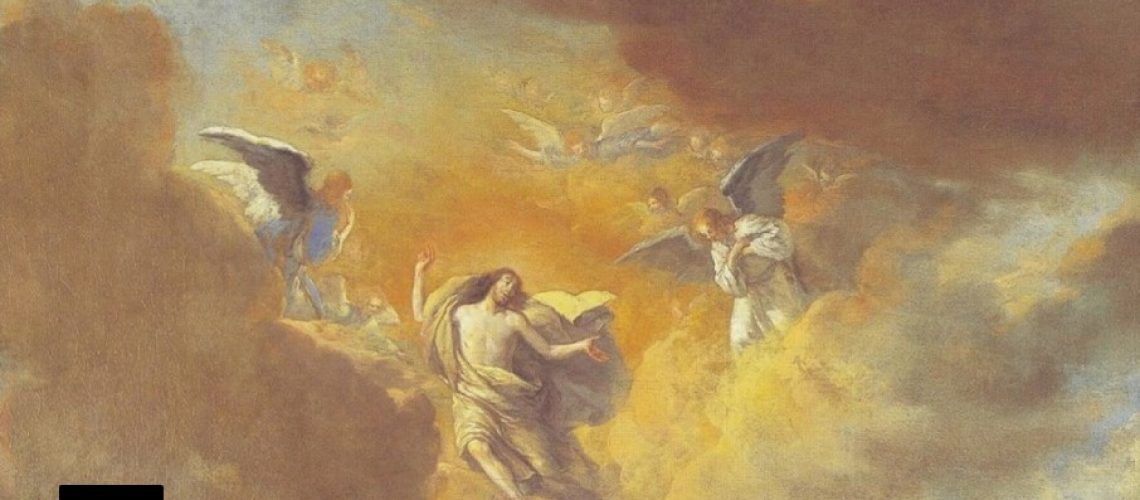
Recently, we celebrated the feast of the Ascension. The Ascension is an interesting solemnity. Since I encounter it most often in praying the rosary, it always seemed to me to be one of the lesser emphasized of the mysteries, a stop in between the Resurrection and Pentecost. Though I’m a lifelong Catholic, I never thought of the Ascension much. Unlike most of the other mysteries, the Ascension seemed to be just a brief “something” that happened. Rather than dying another ordinary man’s death after being resurrected; Jesus just went straight up to Heaven like the King He is. That by itself seemed pretty simple—His earthly mission was done, so He went back home. This year, though, I got to thinking more about this unassuming solemnity and realized there was more to learn from it that I had yet to consider.
Scriptural Texts
In order to better understand the mystery, I turned to the Scriptural texts that describe it. Though the Gospels of Mark and Luke mention it briefly, the most complete description can be found in the book of Acts:
[A]s they were looking on, he was lifted up, and a cloud took him out of their sight. And while they were gazing into heaven as he went, behold, two men stood by them in white robes, and said, “Men of Galilee, why do you stand looking into heaven? This Jesus, who was taken up from you into heaven, will come in the same way as you saw him go into heaven.”
Let’s take a closer look at the words of the angels: “Men of Galilee, why do you stand looking into heaven? This Jesus, who was taken up from you into heaven, will come in the same way as you saw him go into heaven.” Judging by the men’s gazing up and the angels’ response, I might guess that the apostles wished at that moment that Christ had not just left them again. In fact, in trying to imagine their situation from a purely earthly perspective, it might even feel more like a second Good Friday than a moment of glory and triumph. Just as on that day, He was leaving them in a way that left no earthly reassurance He’d be back. They could have thought something like “He has left again. Can I go on without Him?” Surely on a human level, they would have at least preferred He stay with them.
Another way it may have been like Good Friday is, although He told them, “And behold, I send the promise of my Father upon you,” not only is it plausible that they might not have believed Him, Matthew 28:17 even says, “And when they saw him they worshiped him, but some doubted.”
The Ascension Filled the Disciples With Joy
Then, too, as much as the Ascension may have been similar to Good Friday for the apostles, it was also different. They had already had their faith in Jesus shaken with the Crucifixion, and realized they were wrong. That, more than likely, increased their faith. Furthermore, Christ stayed with them for forty more days following the Resurrection. His teachings during those forty days are essentially unknown to us, but we may be sure that they were great, necessary, and helped to build on what He taught the apostles already. In those forty days, the apostles were changed more fully from ordinary men into the instruments of God they were meant to be. We know this because Mark writes that after the Ascension, “they went forth and preached everywhere, while the Lord worked with them and confirmed the message by the signs that attended it.” Luke’s account says, “And they worshiped him, and returned to Jerusalem with great joy, and were continually in the temple blessing God. ” Clearly, after Christ ascended, they were filled with the love of God. Of course, they still made mistakes, as indeed we all do, but at the point of the Ascension, Christ had strengthened them enough that He no longer needed to be with them on earth. This is how they were able to fulfill such a great and weighty commission as “Go, therefore, and make disciples of all nations.” I think that is another important reason why He left them, so they in turn could realize fully that, “lo, I am with you always, to the close of the age,” rather than thinking He would need to be there with them in human form.
Return to Heaven
Christ’s returning to Heaven also shows the contrast of Heaven and Earth, in the necessity of His return to Heaven. The Second Person of the Trinity was not meant to stay on earth indefinitely. When man fell and God no longer dwelt on earth with him, the earth became a fallen place too. But, looking to the Incarnation, the purpose of Christ’s coming was to redeem man so that he could come and dwell with God forever. Thus, Christ’s triumphant return to Heaven was to bring that purpose full circle—as God the Son opened the gates of Heaven by His death so the righteous souls could enter their one true home, so He followed them and man and God were home together at last.
One other thing that stood out to me about the Ascension was how the disciples asked Him in Acts 1:6, “Lord, will you at this time restore the kingdom to Israel?” This shows the same basic idea as the way they stared up into the sky; as they wanted the kingdom to be fulfilled, so they also wanted Christ to stay with them in Body as well as Spirit. In the simplest terms, though they may not have realized it, they did not want an earthly fulfillment; what they wanted was Heaven. After all, their ordinary closeness to Christ was a foretaste of Heaven. Let us not say that the Apostles were impatient, though, since every mystic who has seen Heaven has longed to stay there and not return to Earth. Being near Him taught them, first, that they were meant for Heaven. They further learned, starting with Christ’s call to follow Him, to the Passion and all the way through Pentecost, to wait for fulfillment in God’s time. They were only men, but Christ’s two partings from them, one sorrowful and one glorious, served to reinforce their patience, trust, and obedience through earthly separation.
Though I would still say the Ascension is not my favorite solemnity or rosary mystery, I would say we can definitely learn from it. One suggestion is, when meditating on this mystery, ask for the intercession of the Eleven and the grace to have the virtues they showed on that day, patience, obedience, trust, longing for Heaven, and finally, the joy and gratitude reflected in Mark’s gospel. After all, for the Eleven, their desire to follow Him was fulfilled. May we all receive that same fulfillment, in God’s good time.





3 thoughts on “Reflections on the Ascension”
Pingback: Appreciating Jesus’ Ascension + Genuflect
Thank you for your thoughts. I personally have loved the Ascension. The words. The very imagery. The way i have understood the Ascension is the re opening of heaven so that “man” is again in communion with his creator.
The loss of relationship between God and man in the Garden followed by placing the angels with fiery swords, Jesus removes those swords and introduces man into paradise.
Thanks for your article Cecily! I can relate with you. The ascension is the mystery in the Holy Rosary that I struggled, in its content, what to chew and digest as we contemplate its mystery. That’s something I can add to my Rosary journal.
from Cesar