
Like many, I thought I had a decent understanding of Psalm 23 (The Lord is My Shepherd). But there may be some nuances I missed!
I have recently begun the 19th Edition Ignatian Exercises, and my most recent meditation involved Psalm 23. My subsequent research made me realize how much of its meaning I was missing. This miss, however, was simply the product of my Western perception. I may just have been ignorant of the context of this beautiful Psalm, which most scholars attribute to David.
Two Possible Views of “Pasture”
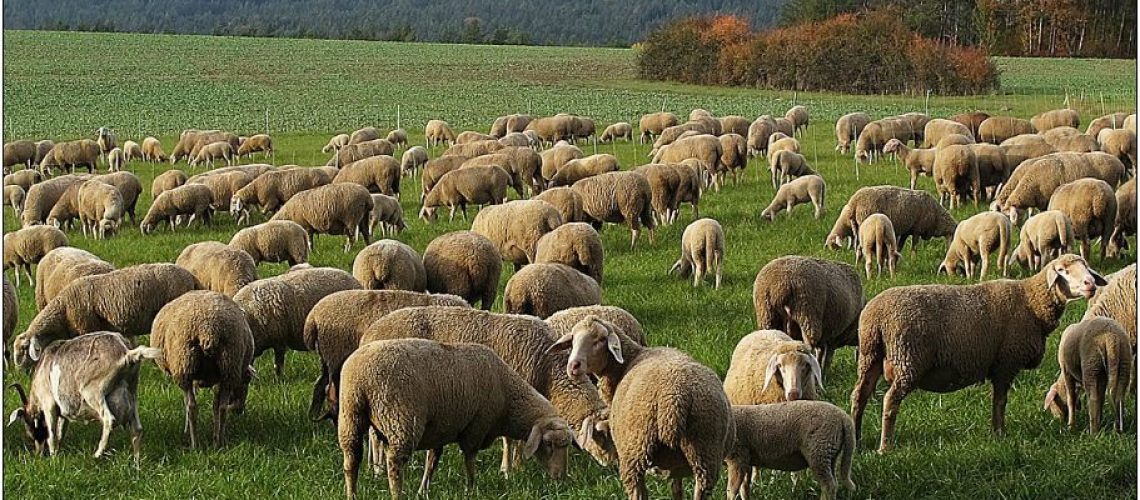
Psalm 23 mentions “pastures,” but there is some debate about what kind of pasture David was referring to in this wonderful Psalm. Some sources suggest that the pastures mentioned in Psalm 23 are indeed lush, green pastures. And such a view is certainly not contradicted by tourist descriptions of Israel.
However, other sources suggest that the kind of pastures referred to in Psalm 23 are anything but endless or lush as we perceive that term. This contention is based on the observed interaction between the barren desert regions in the area and the humid air coming in from the Mediterranean Sea. This interaction allows only sprigs of grass to grow here and there among the rocks and dirt.
One possible reason for these seemingly contradictory views of “pastures” in Psalm 23 may also involve the bias of Western translations and perceptions resulting in Western translation of “tender grass” into “green grass.”
So, while everyone may agree that David could be referring to lush fields with abundant grass, the question is whether that is the only possible reference to pastures indicated in Psalm 23. The “sprigs of grass” perspective provides a different way to think about the psalm.
Both realities are visible today, so the ultimate questions are: 1) Does it matter to which version Psalm 23 refers? 2) Can both versions be reconciled with God’s Message embedded in this wonderful poem and song of praise?
Does It Matter
The short answer to the first question is ‘not at all.’ We can each have our own opinion and view on this issue, but the overall message and lesson remains the same. Ultimately, it remains for each of us to base our opinion on how we reconcile the ideas presented here.
The not-so-short answer, to the second question, in view of Scripture, is yes.
It is commonly accepted that God is the Shepherd and we are the sheep. We are simple-minded animals in need of constant guidance and we would be lost without a shepherd. We would be unable to find food effectively and on the road to starvation without our shepherd.
Two Views, One Outcome
In a harsher, more barren desert environment where survival depends on finding sporadic sprigs of young grass, sheep would need a shepherd more than ever. The sheep would be incapable, on their own, to find the nutrition necessary for their survival.
Scripture tells us that God wants us to recognize our total dependence on Him (John 15:4-5). And common experience with this world reminds us that this world is indeed a spiritual wasteland. It is barren of the faith and love of God needed for salvation.
Such a barren, harsh environment would make total trust on the shepherd imperative for survival. Only the shepherd knows where his sheep can find the nutrition needed for survival. And, once again, Scripture reminds us that our spiritual survival depends on total trust in God (Isaiah 12:2). It also reminds us that God is the rock near which that salvation can be found (Isaiah 26:4).
Is it not a coincidence that, in a barren, desert environment, survival depends on finding the small tufts of young grass found near the humid rocks?
Having shown a strong connection of Scripture to the desert view of pastures, we may ask how the lush view comes in.
Scripture tells us that God is the oasis in the desert Who will guide us to salvation (Psalm 107:35-36). Given this, we know that if we trust in God and follow His Word, He will lead us to the spiritual nutrition we need for our eternal salvation. He will convert the barren spiritual environment that surrounds us into an oasis of love, peace, and continued growth toward sharing Heaven with Him (2 Peter 1:4).
Going in Circles
Another thing that I learned in my research was shepherding in a desert environment is tricky. Shepherds guide their flocks in circular paths going down around a hill. They do not take the sheep directly down a hill. They do this because going down directly the hill can be dangerous given the steepness of that hill. It seems that guiding sheep directly down the hill, while perhaps a shorter and seemingly more practical or straightforward strategy, is likewise far more risky.
We are often told that the shortest distance between two points is a straight line. However, very often, the safest and most practical approach toward our goals is more roundabout. The ups and downs of life we all face are the reason for the more practical approach.
The important thing is to be patient and trusting that God will show the best path for us as imperfect travelers journeying toward Him. Scripture reminds us that God’s timing is not ours (Peter 3:8) and patience comes from trusting God completely. Often, we have a choice between going to hell quickly or reaching Heaven in God’s time.
We often compound the delusion of demanding only what we want from God with the delusion of demanding that God respond on our time. Shamefully, we are infinitely less patient with God than He is with us. Yet He is Perfect and All-Knowing and we are anything but perfect and all-knowing.
We consider our prayers unanswered if they are not answered how and when we want the answer. But recall how God took the Israelites on a roundabout, seemingly indirect and even wasteful path toward the Promised Land. Despite being freed from bondage and repeatedly shown the blessings and protection of God, the Israelites constantly complained. They griped about how long it was taking and if it would not have been better to stay in slavery!
All of this reminds us that total trust in God often means total trust in God’s methods and timetable. He has His reasons and purpose for guiding us in one way or the other. How beautifully consistent all of this is with the shepherd who guides his sheep in circles around a hill, protecting them from themselves!
Conclusion
Psalm 23 is a most beautiful song and poem of praise and trust in God. In its profound words we find the proper relationship and perspective we need to answer God’s love and care. However, as with many other things, we usually look at this Psalm through our own idealized and biased eyes.
We feel comfortably wrapped up in the idea that God swoops in as our hero to rescue us from a rough world. As such, we may dress up this penetrating poem as a promise that our journey toward God will always be a pleasure cruise. We’ll always be surrounded by lush, green grass.
However, upon further research and reflection, we may get a different perspective. Still, Psalm 23 is a wonderful reminder that the grass is always greener when we trust completely in God. It is God on Whom we depend completely for our spiritual salvation.


[…] Sanctified via Tan·Direction Putin’s Megalomania – George Weigel at Catholic World Report Psalm 23: The Grass is Always Greener on God’s Side – Gabriel Garnica at Catholic Stand Replacement Morality – Fr. David Nix at Pilgrim […]