

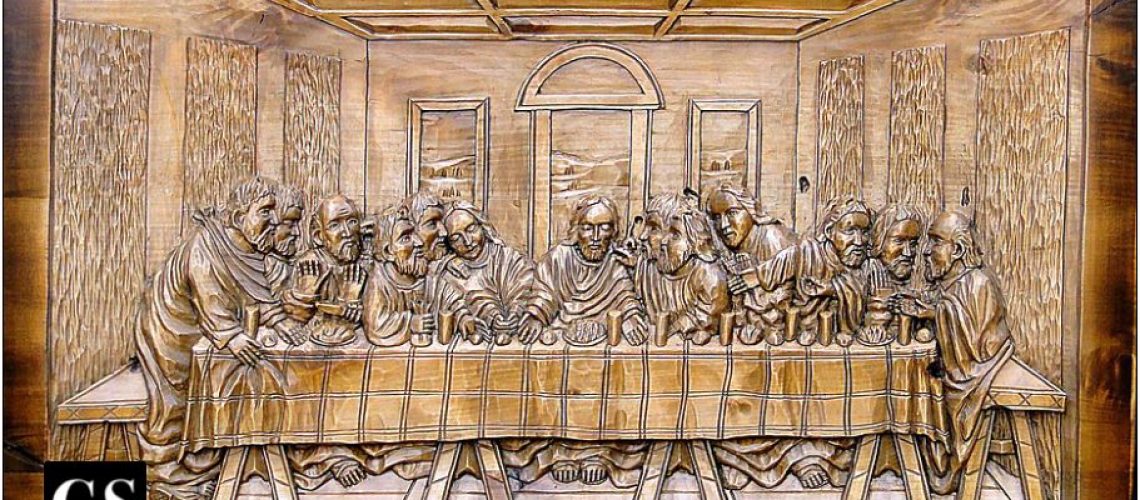
The Gospel reading for Holy Tuesday had a great impression on my reflections. We join the Lord Jesus soon after He is done washing the feet of His disciples and also has predicted that one of them will soon betray Him.
We take note with St. John that at this moment, the Lord is troubled in spirit. To think that the Lord shows the extent of love He has for His disciples by sharing His meal with all of them and teaching them one more time about serving by washing all their feet. Only to then drop a bombshell by revealing that one of them is going to hand Him over to the Pharisees to be put to death.
Jesus has just spoken some grave words, which give some inkling to the anguish that is gripping His heart. He must be aware of the horrific death that awaits Him. We notice the disciples looking at one another. They are at a loss of knowing of which one He is speaking (cf. John 13:1 – 20).
Reclining with the Lord
One of the disciples, the one said to be loved by Him, is reclining on the chest of the Lord (i.e. leaning very close to His heart). I take a moment and stay with this picture bringing it to my discipleship. I think of the moments that I (we) take time off to relax with the Lord.
We have just finished with Holy Mass, and we remain to spend some time with the Lord in the Blessed Sacrament. We may sit quietly before the Tabernacle, or we may enter the adoration chapel and sit before the exposed Eucharist.
Either way, we are here to spend some time “reclining” with the Lord. He shares what is weighing heavily on His heart with us. But our fickle minds can only think someone else (not me) will betray the Lord. We look around instead of looking within to see where and how this can be possible from our side. We miss this opportunity to re-examine our own relationship with the Lord while we busy ourselves with looking for somewhere to point our fingers at a possible culprit.
Anyway, here we are. All of us, in the presence of the Lord; but some of us decide to pull a Peter.
Simon Peter, therefore, motioned to him to ask Jesus of whom he was speaking (John 13: 24).
Instead of speaking to the Lord directly, we ask someone else (the one we think of to be closer to the Lord) to make a petition for us. John does not disappoint. He takes on the task as any resolute intercessor ought to. He simply gets closer to the Lord and asks.
He then simply leaned back on Jesus’ chest and said to Him, “Lord, who is it?” (John 13:25).
The Art of Listening to the Lord
The Lord is faithful all the time. Despite His troubled spirit, He gives an answer to the beloved disciple. He tells him and proceeds to show him who would betray Him. At this point, I am thinking (not rewriting the gospel) The Lord did not whisper this to the beloved disciple only; He says it aloud.
Jesus then answered, “That man is the one for whom I shall dip the piece of bread and give it to him.” So, when He had dipped the piece of bread, He took and gave it to Judas, the son of Simon Iscariot (John 13:26).
Everyone must have heard and seen him do it; including Judas! Or did they hear but not listen (i.e. pay attention) to the actual words and actions? Why did the Lord answer them thus? He saw their hearts. He probably knew that they would take His word at face value. Like I do many times. Why did they want to know? At what point did the beloved disciple inform Peter about the answer he had received from Jesus?
Why did they not do anything to dissuade Judas after knowing it? Were they not “close enough” with Judas to want to persuade him otherwise? Let’s forget about them for a moment. Let us come back to us (to me). How many times have I asked the Lord for something and immediately received an answer? Do I pay attention to what the Lord does with my petitions? Do I return the answer to those who ask me to pray for them? Or, do I choose to interpret the Lord’s answer to suit my own thinking?
Now, none of those reclining at the table knew for what purpose He had said this to him. For some were assuming, since Judas kept the money box, that Jesus was saying to him, “Buy the things we need for the feast”; or else, that he was to give something to the poor (John 13: 28).
Ok! What was their assumption again? Why was their focus so much on the money and how it was being spent (used)? Does this behaviour ring a bell to anyone else or only with me? Right, it is not about them. It is about the goodness of God and His compassion and generosity. He must have sent him to go and quickly do what, again?
According to the narrative, to “Buy the things we need for the feast”….Hmmm! Seriously?!… or else, that he was to give something to the poor….now I am cracking up with this. I know, someone is wondering why I am being so hysterical. Actually, I am not. I am just replaying this in my head (and my life)….because a little further on we are told that it was night (cf. John 13: 30b), and with night comes darkness.
Then Comes the Darkness
The darkest time in the earthly ministry of the Lord Jesus has come. The darkness itself has entered Judas. It is scary to think that his happened fearlessly in the presence of the Lord. It means that this can also happen to us even when we are in the presence of the Lord. How should we guard ourselves against allowing this to happen?
The saddest thing is that Judas seems to have surrendered himself to the betrayal. He chooses to walk into the darkness, away from Jesus, who is the true light whom the darkness cannot overcome. Judas shows no hesitation and departs to carry out this evil deed. Unbeknownst to him, He will die in despair. He will die in pride so stiff-necked that it selects the misery of damnation over the happiness offered by a compassionate God.
So often we do not realize that when darkness enters one who is close to us, we all are overshadowed by it. We all experience the consequences of such an event. In the case of this night, things will become progressively worse until the worst evil ever (the created will crucify the Creator). But before that, there will be other sorry events to note (cf. John 18:1 – 19:42):
- The disciples will be unable to stay awake in the garden to join Jesus in prayer
- The Lord Jesus will be arrested
- Jesus will be abandoned by all his disciples
- Peter will deny Jesus three times
- Jesus will be struck in the face by one of the religious officials
- The Jewish leaders will hand over one of their own to the Romans and demand his execution
- Jesus will be questioned and humiliated before the crowd by Pilate
- Jesus will be flogged, mock-crowned with thorns, struck in the face, jeered upon by drunken soldiers
- A murderer will be set free while Jesus who is sentenced to death
- Jesus will carry His own cross to the place of the crucifixion
- Jesus will be crucified and die on the Cross
- The disciples will go into hiding.
The Glorification
It is amazing to note that the Lord knew all this was coming. But after Judas leaves, the Lord continues to minister to His disciples notwithstanding the troubled spirit. He chooses to speak words of comfort and hope to His disciples. Judas’ departure leaves a pall and the tone of the evening changes. Judas departs with his evil presence (satan entered him), leaving room for events that lead to the glorification of Jesus.
We know that the Lord Jesus has been working according to a divine schedule, at a time when the hour had not come (cf. John 2:4; John 7:30; John 8:20). That is until the hour came for the Son of Man to be glorified (cf. John 12:23).
Therefore, when he had left, Jesus said, “Now is the Son of Man glorified, and God is glorified in Him; if God is glorified in Him, God will also glorify Him in Himself, and will glorify Him immediately (John 13:31-32).
Here we have a redefinition of what glorification means. The Lord gives us a unique insight into the mind of God. The shameful, violent, degrading and unfair treatment of Jesus is about to happen. Humanly speaking, there is nothing of redeeming value in such an event.
However, in God’s perspective, this is the means by which He will be given glory. The glorification of the Lord Jesus will involve His being lifted up on high. It means His death on the Cross for love of us and in obedience to the Father. It is through His death, burial, and resurrection that Jesus will bring the Father glory.
This is how He will fulfill the Father’s Plan for our salvation from the bondage of sin and death. The end result will be justice for sin and mercy for those who are deeply loved by God. The Lord goes further to indicate that when God is glorified in Him, God will also glorify Him in Himself; and this glorifying will happen only days after His death. The reason for this is that the death He dies to sin happens once for all time; but the life He then lives, He lives to God. The point is that we who put our faith in Christ also should consider dying to sin so that we are alive to God in Christ Jesus (cf. Romans 6:10 – 11).
A Denial Predicted
In the Gospel, all seems to be going well with Jesus giving a new commandment which will distinguish His followers – the commandment of love. He mentions that for the time being they cannot follow Him where He is going. Then Peter decides to show off his loyalty.
Peter said to Him, “Lord, why can I not follow You right now? I will lay down my life for You” (John 13:37).
There is nothing new here, for we have seen this earlier at the washing of the feet when Peter would not stop insisting that he will not cooperate. With all patience, the Lord corrected him at that moment with stern assurance why this has to be (cf. John 13:8 – 10). Nonetheless, Peter allows his bravado and emotions to get the better of him. He makes a remark that probably was the one thing that Peter regretted for the rest of his life.
In fairness to Peter, we cannot say he was pulling a fast one on the Lord. He truly believes he is loyal. He is so pumped up with self-confidence and courage that he is not afraid to say it out loud. He will even prove himself later that night when he draws his sword and chops off someone’s ear. But that bravery will only last until Peter faces true danger head-on and gives in to fear. To make matters worse, the Lord responds incredulously and predicts that Peter will deny Him not once, but three times before the cock crows (cf. John 13:38).
Betrayals- Still Pointing Fingers?
Now I am trying to decipher what the rest of the disciples who are present during this conversation are thinking. Remember how they conveniently overlooked the person who was clearly identified as the betrayer. But now, someone else has been told what he will do; and I imagine fingers pointing at Peter as the probable betrayer. Little do they know that in the end, all of them are going to abandon the Lord. One finger is pointing at the probable betrayer and three fingers are pointing at you!





3 thoughts on “Predicted Betrayals”
Most welcome.
All glory to the Lord Jesus!
Thank you for your thoughtful spiritual writing!
Pingback: THVRSDAY EDITION – Big Pulpit