

Scene: A pristine spit of sand, surmounted by a cerulean blue sky dotted with puffy clouds. Three men in white robes and matching skullcaps, easily recognizable as the late Popes Francis, Benedict XVI, and John Paul II, are having breakfast on the beach. One by one, each pope bites into a waffle and then beams at his two companions, perfectly contented.
When I first stumbled across this recent social media video, I felt conflicted. My first impulse was to share the post with my twenty-one Facebook friends; my second was to jettison it as just a bit too Hallmark-y. After less time than it takes to insert and pop a steaming waffle out of the toaster, my tortuous brain had started churning over the hazard of reducing the heavenly realm to an Eggo-laden oceanside paradise.
Then, I debated with myself whether the glib assumption that our Popes are in Heaven rather than Purgatory does not cheat them of much-needed prayers from the earthly faithful. (I expect this last sentence will earn me at least one rebuke —either along the lines of “Who are you to judge?” or “At least one of these people has the word ‘Saint’ before his name.” Thank you in advance, friends. You keep me humble).
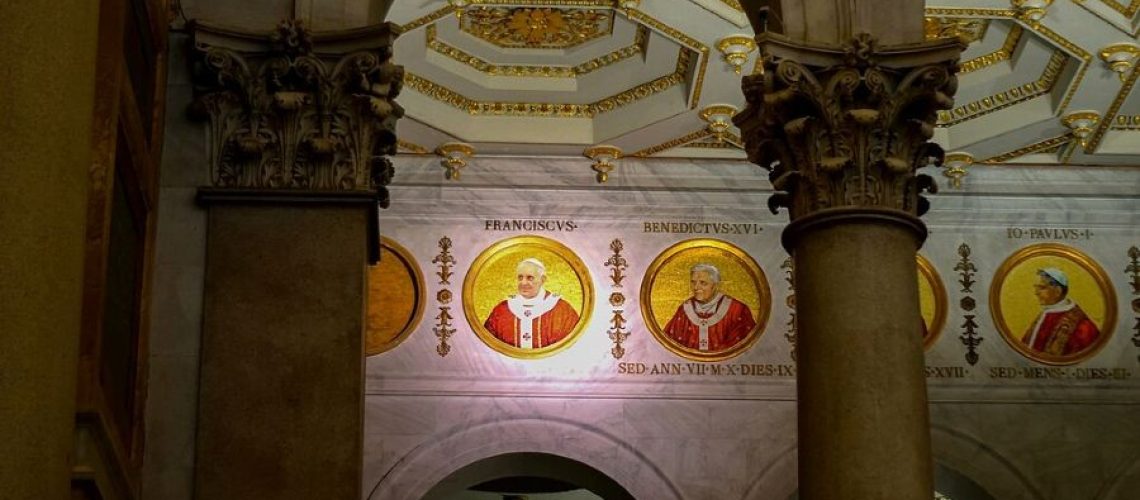
But bear with me. After I began seeing a rash of these “Three Popes” videos over the last week or two, I found myself imagining the mysterious workings of grace that must permeate the moment when our Holy Fathers meet after death. Undeniably, there is something terribly lonely about being the supreme leader of the Universal Church.
As Cardinal Robert Francis Prevost stepped out onto the loggia of St. Peter’s a few days ago under his new title of Pope Leo XIV, what a feeling of dread must have crept through the exaltation of the moment! Foreseeing his imminent election, after he had hoped to retire to the humble position of Vatican librarian, Joseph Ratzinger prayed, “God, please don’t do this to me.” Even with the special graces poured out on Peter’s successor, the pope’s task of bearing, in persona Christi, the full weight of shattered humanity, the heart-cries of each child of the Church, is heavy indeed. It is no wonder that the chamber in which the newly elected pontiff robes in his white cassock before his first appearance to the world is called the Sala de Lacrima, the “Room of Tears.”
Let us consider the magnitude of the papal mantle as it descended on the former Cardinal Jorge Bergoglio, seen through footage of his first loggia appearance. Darkness had already fallen; flashbulbs exploded again and again like stars out of place, and someone had made the questionable decision to preface Pope Francis’s words with an orchestral march of a rather bombastic sort, given his resistance to the grander trappings of his office. The first moments of Francis’s papacy unfolded as close-up shots of a figure in white, smiling gently, but hesitantly awaiting the moment when he would be called upon to speak. He seemed to approach the future with trust, but his head must have spun with the intensity of it all. Surely, the embrace of the papal duty confers more melancholy than glory.
How much it elevates the spirit, then, to consider popes at play! I like to recall the oh-so-correct “Panzerkardinal” Benedict sneaking over to see his old office mates the day after his election, unwittingly causing a traffic jam in the streets of Vatican City as well-wishers mobbed the car he was riding in. Simply by donning a pair of sunglasses, Karol Wojtyła made the whole world grin.
As I stumbled upon more of the lighthearted “popes in heaven” videos in recent days, I found myself more deeply considering the question of what lies beyond for our Holy Fathers. One snippet happened to depict a meeting between Francis and John Paul II, staged against a background of towering purple mountains. Once again, the popes were feasting, munching on rich squares of a cream-filled pastry that I could not identify, and apparently exchanging views on how good it was. Eventually, I discovered that they were sharing a delicacy that has been affectionately renamed “papal cream cake” in honor of a childhood escapade by the Polish pope.
In 1999, on a visit to his hometown of Wadowice, JPII mischievously recalled the day that he and his young classmates celebrated the end of final exams by going to the bakery operated by the father of his friend Karol Hugenhaber and gorging on slices of kremówka, a traditional Polish dessert made of thick, luscious custard sandwiched between squares of flaky pastry. After finishing only fifteen pieces of cake, the intrepid (and stuffed) future pope had to concede bragging rights to a young rival from a town nine miles away.
As a man of undeniable suffering, “accustomed to infirmity,” who endured the deaths of every immediate family member, clandestine seminary training during the Nazi occupation, the dangerous existence of an outspoken Catholic leader in a Communist-bloc country, and an assassination attempt foiled only by a Lady with gold roses on her feet, Pope John Paul II retained a lightness of heart that echoed the words of St. Phillip Neri: “Let us aim for joy, rather than respectability. Let us make fools of ourselves from time to time, and thus see ourselves, for a moment, as the all-wise God sees us.” Neri practiced what he preached, occasionally walking down the street after having shaved only one half of his face. He preferred to be thought a buffoon rather than occupying the pedestal of sanctity some of his friends were inclined to place him on.
Though we can agree that there is something magnetic about the joyful person we encounter here on earth, we can only wonder what joy is like for those who have been through the crucible of death. It is something we struggle to guess at, sitting in the pew at a dear friend’s funeral perhaps, quietly pondering the words of Scripture:
The souls of the righteous are in the hand of God,
and no torment will ever touch them.
In the eyes of the foolish they seemed to have died,
and their departure was thought to be an affliction,
and their going from us to be their destruction;
but they are at peace (Wisdom 3:1-3).
If Heaven is truly the “balm in Gilead, that makes the wounded whole,” what does “peace” mean for our departed popes, whose years in the public eye have exposed them to both the seeds and fruits of uncontrolled war, the knowledge of unthinkable acts of abuse that have robbed the innocent of their childhood, the attacks of Hell’s minions on the bastion of Truth that they fear the most—and the awareness that they have been been, in Benedict’s words, utterly “imperfect instruments?” In the final chapter of THE SILVER CHAIR, the penultimate book of C. S. Lewis’s Narnia series, the author speaks of “the healing of harms,” a theme which throbs with great poignancy as the long-lost Prince Rilian is finally reunited with his ailing father the King:
They could see King Caspian raising his hand to bless his son. And everyone cheered, but it was a half-hearted cheer, for they all felt that something was going wrong. Then suddenly the King’s head fell back upon his pillows, the musicians stopped and there was a dead silence. The Prince, kneeling by the King’s bed, laid down his head upon it and wept.
As the two children at the center of the story attempt to respond to this grievous blow, they are whisked away to Aslan’s mountain, where the Great Lion meets them. While they stand before Caspian’s inert body, Aslan directs young Eustace to drive a thorn into his paw. Unwillingly the boy complies, and the Lion’s blood spurts over the body of the dead King, precipitating a great change:
At the same moment the doleful music stopped…His white beard turned to gray, and from gray to yellow, and got shorter and vanished altogether; and his sunken cheeks grew round and fresh, and the wrinkles were smoothed, and his eyes opened, and his eyes and lips both laughed, and suddenly he leaped up and stood before them—a very young man, or a boy.
Fully alive, the King rushes into Aslan’s embrace. Almost the next thing that ensues is a madcap scene in which the Lion whisks the gallant monarch and the two children through time and space, enabling them to bloodlessly but thoroughly put the fear of God into a gang of modern bullies at Jill and Eustace’s psychologically twisted English boarding school.
Is such a romp in keeping with the greatness of the King’s transformation? Is it an act of holy imagination to imagine a trio of popes sharing cream cakes, released from the weight of their earthly imperfections and cares, saying, one to another, “Do you remember how terrified you were, standing on that balcony and looking down on St. Peter’s Square? Could you ever have imagined the full weight of that Cross…and the full joy of this Life?” When we pass through the portals of Heaven, is it possible that Our Risen Lord, having healed our wounds with His Precious Blood, will beckon us to His charcoal fire with the perfectly natural invitation, “Come, have breakfast?”
Yes, I expect He can. I’m going to go make myself a waffle, and think about it.




1 thought on “Popes, Waffles, and “The Healing of Harms””
Rather than promoting a pious certainty, it invites readers into the spiritual responsibility of praying for the dead—regardless of their status in life. It is a reminder that holiness is not automatic, and that even saints, canonized or not, are part of a mystery that we can only approach with reverence and humility.