

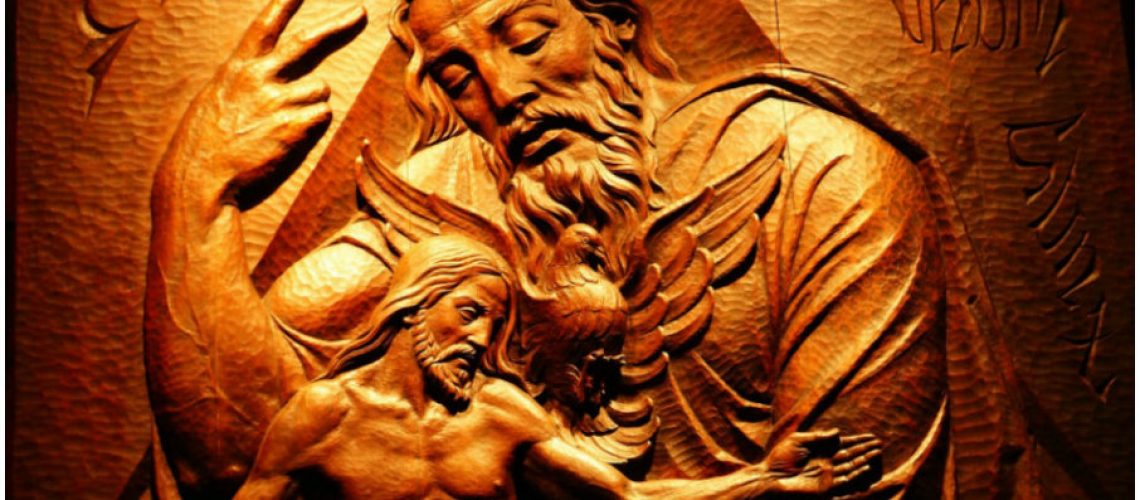
Recently, I had the honor of presenting to our parish RCIA group on the topic: Christology, the Holy Spirit, and the Trinity. It was a daunting mission. In my graduate theology program, Christology and the Trinity were each full-semester courses. Now I had about an hour to teach adult catechumens mysteries of the nature of God, which theologians have for centuries studied and elucidated in spiritual and scholarly writing.
Before the class, Deacon Mark, who runs the RCIA program, acknowledged to me that this was a lot to present in one session. He had taught the class another year and found himself speaking rapidly, trying to fit each essential point into his talk. I was relieved that he understood the challenge I faced.
A Persistent Inquisitiveness
In our pre-class discussion, I shared with him an experience I had lately noticed in my prayer life. My recitation of the rosary would pause after just the first few lines of the Apostles Creed, as I slipped into a curious pondering of the nature of “God the Father almighty, Creator of heaven and earth, and in Jesus Christ, his only Son, our Lord.” My theology courses enriched my understanding of each Person of the Trinity, and of the processions and mission of the Son and the Holy Spirit. However, rather than satisfying my curiosity about the Almighty, the knowledge only sparked a persistent inquisitiveness about that nature of God. I would fall asleep contemplating concepts of the almighty Father and the eternal Word, not having reached even the first decade of the rosary. When I told my husband of this phenomenon, he raised his eyebrows and, half-joking, asked me when I thought I’d ever get around to actually saying my prayers.
In turn, Deacon Mark shared questions that had occurred to him on the topic. What did Jesus know, and when? As an infant in the manger, what did he understand? As a human, he is like us in all things except sin. Does that include immaturity in childhood? Innocent mistakes made as an adolescent? It would seem so. Yet as true God, he could not have forgotten the Father and all he had known from eternity, could he?
Pondering as Prayer
Then Deacon Mark said something that changed my view of my wandering thoughts during the rosary. “This pondering is prayer,” he said. That idea is a game-changer for me in my prayer life. Contemplation as prayer is a new avenue to explore.
It makes sense in light of the definition of prayer my Confirmation class received. “Lifting up our minds and hearts to God” is prayer. When one ponders the mystery of God, that person’s mind and heart are surely lifted to God. Whatever increase in understanding or perspective that the praying Christian receives is God’s reply. Thus, prayer is more than a list of requests, thanksgivings, and apologies. Prayer is dialogue. Furthermore, this pondering, contemplative prayer is not of our own making. We ponder and question and meditate on God and his Word because he calls us to it. Whether we realize it or not, our prayer is always a response to God, who never ceases to call to us.
The Holy Trinity
In the RCIA session, I shared doctrine about the three Persons in one God. I began with Scriptural evidence, such as the Genesis creation account in which God says, “Let us make humankind in our own image, according to our likeness” (Gen 1:26). Who is the “us” and “our”, if not the Persons of the Trinity? In the introduction to John’s gospel, the Word exists from the beginning, and the Word is “with God.” This implies that the Word and God are two distinct Persons. Yet “the Word was God,” which means they are One. A bit later, “the Word became flesh and lived among us” (John 1:1, 14). The many doctrinal points in these two excerpts include the presence of multiple Persons in one God, God as Creator, the Son’s existence from eternity, and the Incarnation of the Word of God.
When I paused to check for understanding, one of the catechumens asked a question. His question led me to suspect that I had spoken perhaps too literally or too legalistically. “Which one of them do I pray to?” he asked. Caught off-guard, I gave a few examples of times when I would pray to Jesus as the Divine Physician, or to the Holy Spirit to give me the best words to use in a difficult situation. What I did not think to say is, it does not matter to which Person of the Trinity we address our prayer, because God is One. God will hear you, and whether your circumstance requires inspiration, comfort, forgiveness, physical healing, or one of the gifts of the Spirit, the Almighty will fill your need.
Mysteries of the Trinitarian Persons
As class proceeded, I probably went over the basic doctrine of Father, Son, and Holy Spirit a bit too briefly. I moved on to what I found to be compelling questions and perceptions of God. We know that God is almighty, omniscient, beautiful, all-good, and all-loving. Moreover, God is not just beautiful; he is beauty itself. He is not only good; he is goodness itself. He is not just loving, but he is love itself. God is the origin of all good things, and so all that is good, loving, and beautiful comes from him.
Christology contains another set of mysteries. Proceeding from the Father, the Son is the Father’s Word, the Father’s expression of himself. Some theologians say that the Son is the only Word which the Father ever had to utter. The words of the Nicene Creed attest that through the Son “all things were made.” All good things in the universe are expressions of God the Father, made through his one Word, the Son.
As perfect Persons, the Father and the Son love one another in perfect unity. Their love is so profound that it is another Person, the Holy Spirit. One RCIA candidate, an expectant mother, related to this point with enthusiasm. “Two people loving one another so much that a third exists – that makes sense to me,” she said.
Regarding the eternity of God, human logic fails to fully grasping this. God exists, not bound by time and space, as earthly beings must be. Time and space began when God created the universe. God transcends this time and space; from all eternity, there is God. Further, the Son and the Holy Spirit exist from all eternity. As long as the Father has existed, his self-reflection and self-expression, which is the Son, has existed. As long as the Father and the Son have existed, their Love, the Holy Spirit, has existed.
Existence and Essence
One concept which I ran across late in my theology studies regards the essence of God. We have said that God is love, beauty, and goodness. Because we experience love, beauty, and goodness on earth, we understand something of the substance that is God. However, a more nebulous concept is termed the “simplicity” of God: God’s existence is his essence. Maybe my intellect is too weak to grasp it, but I could turn that fact over in my mind for a long time. God revealed himself in the Old Testament as “I am.” The first fact about himself that he chose to make known to us is that he exists. And that existence, that uncreated “I am”, is his essence.
Of course, this writing is a minuscule glimpse into the vastness and splendor that is the Supreme Being. It barely begins to address what the Father uttered in his one Word. Saint Augustine wrote that “because the total transcendence of the godhead quite surpasses the capacity of ordinary speech, God can be thought about more truly than he can be talked about” (Augustine VII, 7). Human words, and certainly this writing, fail in expressing the substance of God. Still, knowing that God has substance, even as he is a spirit, is a mark of faith. Our thought, our pondering, is better than our expressing them in words. This is because our pondering leaves room for God’s reply, for God’s message to us.
Works Cited
Augustine. The Trinity. Translated by Edmund Hill, New City Press, 2019.




3 thoughts on “Pondering the Nature of God”
Pingback: VVEDNESDAY EDITION – Big Pulpit
I like your article; it is informative and well-written. I teach RCIA also and I’d like to present your article to my class. Do I have your consent to do so?
Hello, Richard,
Thank you for reading the article and for your compliments.
Yes, you have my permission to present the article to your RCIA class. May God bless your work and your RCIA students.
Mary Meo