
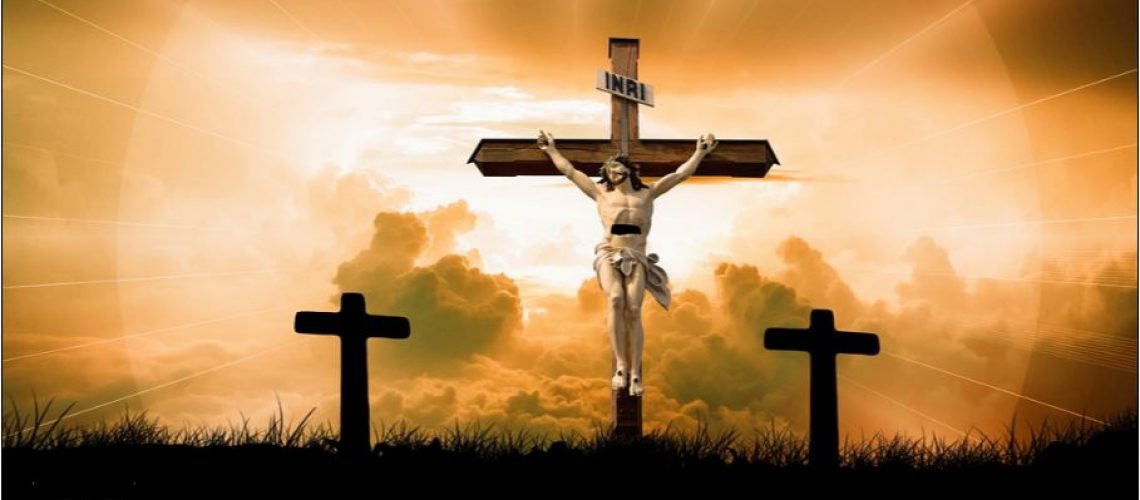
My first form master told me that there are usually two ways of looking at most things, two different perspectives with which to view different circumstances – his and mine. As his was invariably right we would get on fine if I realised this from the start. We never did get on! There are two different ways of looking at the Easter mysteries, two different perspectives with which to view them. The first is the way in which God views them from his perspective, which is, of course, the most important because it was he who planned them. St John presents us with God’s view, his perspective, in his Gospel.
The Easter Mysteries from God’s Perspective
From God’s point of view, the very moment of Christ’s death was the very moment that the Easter mysteries were brought to completion and fully consummated. Why? Because this was the very moment when Our Lord was victorious over the power of evil working through humankind to destroy him. It was at the same time that he entered into his glory. That is why St John refers to the moment of Christ’s death and Resurrection as his Glorification. It is his Glorification because the very instant of his death is the very moment when he is reunited with his Father who sent him, but this time with his human body now flooded with divine life, the life of the Holy Spirit. This would enable him to transmit the Holy Spirit to other human beings. This was so important for St John because he was actually there when this world-shaking event took place. He insisted that he actually saw what happened the moment Christ died, the moment when he saw the last drops of blood trickle out of Christ’s dead body, immediately followed by the outpouring of the Holy Spirit, symbolized by the water that poured from his side. St John, therefore, tells us all that happened simultaneously on the first Good Friday at the very instant that Christ died. St John describes the Easter mysteries from God’s point of view then, from his perspective. However, there was another perspective too that is described by Matthew, Mark, and Luke.
The Easter Mysteries from the Human Perspective
They tell the same story but from the human point of view. After all, Christ came to explain God’s great plan for humanity in a way and in words and events that ordinary mortals like us could understand. So in the Gospels, they relate what St John saw and described happening at a particular moment in time, but happening gradually, in a world of matter and form, in a world of space and time. It was in this way that we who live in that world could see these mysteries made seeable, visible, and even touchable so that seeing we could come to believe. In order to see how this epoch-making event that took place on the first Good Friday was understood by the earliest Christians, we will have to pause for a moment or two to try and understand how the ancient Jews visualized the Cosmos in which they lived. The reason why we must do this is because it was the way they viewed and understood the world around them that was used to teach them the most profound mysteries of their faith. The first Christians were predominantly of Jewish extraction and so their understanding of redemption was firstly formed by their belief in the way God created the world.
Ancient Jewish Cosmology
They believed that the world in which they lived had three floors. On the first floor, upheld by pillars to stop the earth from falling into the primeval waters below, men and women lived out their lives until when, after death, they were sent down to the ground floor to live in the shadowy world of what they called Sheol. What we would call the sky they called the firmament. God was seated on a thrown above it is using it as his ‘footstool’. The firmament was visualized, as something solid, rather like a transparent baking bowl that enabled God to observe how human beings were behaving. The firmament was supported on either side by the ‘eternal hills’ and had flaps strategically placed enabling God to send down rain and snow, wind and thunderbolts and angels too when their services were required. Although the sun shone as it arched its way across the firmament, the ground floor and the first floor was plunged into spiritual darkness. These were now the places where the demons ruled, ever since the first man and woman rejected God.
Putting the Demons to Flight
When Jesus was born onto the first floor, his physical presence radiated the love that shone out of him to bring light where darkness prevailed before. This love like all human love was communicated through touch, by a kiss, an embrace or by the washing of feet for instance. They were all common practices in the world into which he was born. The very moment after his death on the cross the New Testament pictured Christ descending into Sheol on the ground floor to ‘harrow hell’ and redeem those who had died before him with the fullness of love that he had just received. It was believed that all who died before Christ’s coming would have to wait for his redemptive action. The same demons that were put to flight ‘as he descended into Hell’ to release the ‘captives’ were put to flight for a second time, as he ascended through the air above making a holy corridor through the earth’s atmosphere as they were led back to his Father in heaven on the first Ascension Day. Now, seated at God’s right hand they could both send the Holy Spirit through this holy corridor made through the realm of the demons at his Ascension. This enabled the love that the Apostles had already received to be surcharged on the first Pentecost Day with the Pleroma or the fulness of love that he had received on being reunited with his Father immediately after the Ascension. Now they in their turn literally handed on what they had received from Jesus to all who freely chose to receive it. That is why all the sacraments involve the laying on of hands, so that what Christ handed on to the Apostles could be handed on to generation after generation all the way down to us.
Love is Communicated Through Touch
So it is absolutely true to say that the love that Jesus experienced after his Resurrection is handed on to us today through the hands of the priest who baptized us and through the hands of the bishop who confirmed us. The measure in which that love possesses us is only limited by our capacity to receive it. The common belief of the first Christians in a universe with three floors was of course totally erroneous, but it is worth understanding for the insight which it can give us into the essential meaning of ‘Physical Redemption’ as understood by the first Jewish Christians. This means of explaining how redemption came to us might be long since out of date but its influence still remains with us in the Easter Liturgy enabling us to reflect on each part of this profound mystery over fifty or more sacred days.
It is the physical presence of Christ bursting with uncreated life and energy which brought and still brings to this world the love that impelled God to create it in the first place. This love is first received by us at Baptism when the infinite loving that had and will continue to bind the Father to the Son from and to all eternity, is poured out on us to draw us up into the Risen Lord. Because this love is freely or gratuitously given to us in space and time, it is called grace. And it is because his Risen body cannot be seen it came to be called his mystical body, the place where we receive that grace. From the very moment that the mystery of new birth inserts us into his mystical body we are henceforth and at all times open to receive and to be nourished by God’s grace or the Holy Spirit who is the spiritual lifeblood of the Risen Lord, and of those therefore who are drawn into his mystical body at Baptism. We call the Risen Lord, Our Lord, not just because he came to tell us of God’s plan for us, but because he himself would be the means of taking us into God’s inner life and love, into his mystical family to come to know and experience the infinite loving that is the very heart and soul of his divine nature.
The Source, and Fountainhead of all Love
This is the love that we can receive in ever greater depth and in ever greater intensity as we reside in the mystical body of Our Divine Lord. It is the source, the origin and fountainhead of all loves that we experience as many in human life on earth but is as one in God’s divine life in heaven. On earth, we can experience his love indirectly through fatherly love, motherly love, sisterly love, brotherly love, married love and through all other forms of pure love that make life what God created life for from the beginning. If we have, by accident of birth or human mishap been deprived of any or even all of these expressions of divine loving reaching out to touch us through human loving, then all is not lost. For the love of God direct that comes to us through prayer can more than make up for the deficit, as we can see exemplified in the lives of the great saints.
God’s divine love, his Holy Spirit is the spiritual lifeblood of our Risen Lord, of his mystical body and that, as baptism places us within this mystical body we can receive this love. The operative word however is can because Christ is not a magician and so we can only receive the divine life that is the heart and soul of his inner being if we freely choose to receive what God has freely given to us through him.
Everything, therefore, depends on prayer because prayer is the traditional word used from the beginning to describe how we practise turning to God to raise our hearts and mind to him, in with and through Our Risen Lord. Do this and our spiritual life goes forward and becomes ever deeper. Do not do this and it goes backwards and becomes ever shallower and ever more superficial. Although there may be two or even more ways of explaining how we are redeemed by God’s love, all we need to know is that there is only one way to receive it. Those who pray therefore will come to experience that love in this life and ever more fully in the next. Those who do not, will not because only love can redeem us and only prayer can enable us to receive it.


It is fortunate that Easter and Passover are generally linked by calendar and religious meaning in Christian tradition. It would also seem appropriate to have greater recognition of our Old Testament Jewish heritage through such events as Purim and Hannakuh. The lessons of the Jews are a most appropriate prefiguring of the coming of Jesus and a little more familiarity with them could also benefit our understanding of God’s plan for salvation.