
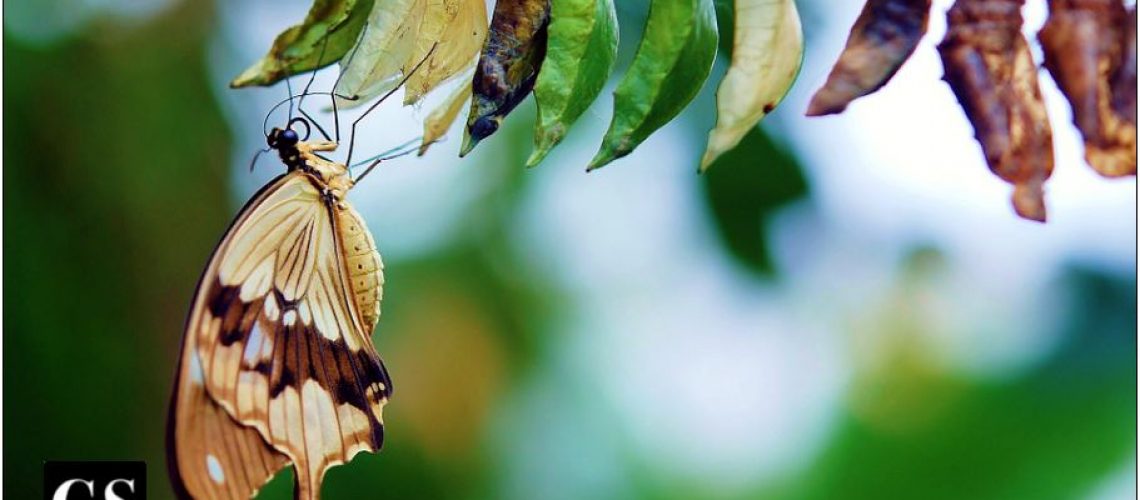
Looking to what could be as a means to give what is.
A homemade box crafted from spare delivery packages and a piece of my daughter’s long-outgrown Tootoo sits in her room silently. It is the near-perfect example of potential. You see, inside the semi-well-crafted container is a single monarch cocoon. Rescued from the mob of Mockingbirds who more than likely devoured its siblings, this universe in miniature is doing something we Catholics are all challenged by God to do…transform. It is this fundamental aspect of reality which undergirds the above painting sharing this essay’s title. as has been said in abundance, “art imitates life.”
I didn’t set out to create a grand allegory for transformation; like many artists, I simply wanted
to create beauty for the adorning of walls in a patron’s home or other some such space. Narrative, it would seem, continues to flow from the brush as if it were the creative and I were simply the brush. This is probably closer to reality than the idea that I created this work independent of other energies at work in the world.
Regardless, the narrative is inescapable and worth pondering if for no other reason than we are, at this very moment, caught up in a grand transformation. The world is changing, has been changing, and forces of all shapes and sizes are vying for control of the outcome. That is for a different essay. Here, however, we are interested more in the philosophical reality of transformation, and less so about the cultural and geo-political swarm buzzing about on nearly every electronic device we encounter. We change, regardless of design or desire, but much to our detriment, we’ve been removed from the cognizant presence of the manner in which we’re changing, or worse, we’re being duped into
believing that we should do all things possible to stunt, if not completely halt this natural process. If we can, through no small effort, return to an inner awareness of our own cocoons we can, I believe, nurture and guide that change as a gardener shapes the plants in his raised beds.
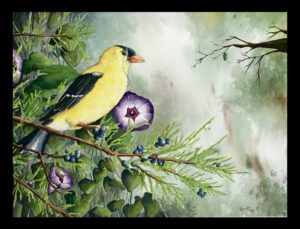
Allowing the visual representation to guide us through the discourse, let’s take first the American Goldfinch, and more specifically, its monocle. Birds, as a species, have for ages represented freedom, among other things (looking at you Odin’s Ravens), but by in large they are a feathered guidepost calling us to greater expressions of unshackled existence.
It would be worth noting here, that to cultivate our own transformation, guided of course by God, there is a necessity for freedom. No one can be at once a slave, and also attempt to pursue transformative living. The expected argument here might be something like “no one is truly free, we all wrestle with the chains of depravity,” to which one could naturally respond, “True, but there is a canyon of difference between he who is willfully (and unapologetically) in bondage, and he who striving alongside the Lord to see every link in his shackles demolished but failing at times to do so”.
Just because we aren’t fully free, doesn’t preclude us from being free. The Gold Finch in its radiant plumage reminds us that the light of Christ’s freedom is a part of our being especially as more of us become free and walk in the humility of faith and repentance. Glory to God as we take baby bird-sized steps daily to walk in the freedom purchased for us by Christ.
That said about our avian friend, let’s look at the monocle adorning his face. This piece of symbolic imagery is first and foremost about attention; that great piece of human consciousness which tech giants try so desperately to brain-box like Rulons. The question I hope viewers of this piece ask sounds like “Why a monocle, and not glasses?” This a valid question considering monocles left societal usage more years back than my Grandfather could recount. Why then such a relic? Because it’s about focused, undivided attention. The monocle represents singular focus, verses say a pair of glasses which “splits” the focus. Think also of the ways in which singular focus is portrayed throughout ancient myth; there’s Odin’s one eye, the single eye of Egypt’s god Ra, and Perseus’ three witches with their one eye looking to the future.
When we seek transformation, we must do so with undivided attention. Yes, this will take a lifetime of
practice, but it is worth it. In a contemplative practice, unifying your attention can simply mean returning to a sacred word while allowing the river of thought to continue flowing without needing to grab at every thought that drifts past. With our attention undivided, we can view our thought habits graciously, examine them without judgement, and with the Holy Spirit’s guidance use the experience as stepping stones toward transformation.
If this is true, that we need honed attention, what is it exactly that we’re aiming our attention at? As Jordan Peterson says, we are after all forward aiming creatures; we need to aim this attention at something meaningful. Therefore the finch aims his singular attention at the caterpillar in its house of transformation. The cocoon, like the egg, unwrapped gift, and blank canvas, represents potential. It is the perfect representation of what can be, might be, and may never be.
Last year, our passion vine was cram-jam full of Gulf Fritillary caterpillars. It was a sight to see, as these wriggly icons of creation’s uniqueness crawled over the varying leaves and devoured them without remorse. Then they ventured off to all corners of our property looking for eaves and steady places by which they could suspend their tiny bodies and undergo Nature’s great metamorphosis. Some of these magic creatures did exactly as expected and became the autumn-colored marvels flittering off on their next great adventure. Some, emerged but for various reasons found their journey’s cut short, while others yielded to the fate that awaits all living creatures. Those were the hardest cocoons to experience, especially as we removed them from parts of our home.
Inside a cocoon resides the potential which God has woven into the fabric of being, we are no different. Inside each of us is a unique potential awaiting the attention needed to see and release it as seasons come and offer us times for transformation. Within the contemplative moment, we can set our attention on the ways in which we operate in the world, and in time, discover the potential that resides underneath the layers of action.
Who are we really, what is it in us that we are afraid of facing, or embracing? In what ways are we sabotaging our spirit’s best efforts to release our genuine potential? These are all questions we should ask as we step inward and explore the universe of being within us. As we telescope our inner expanse, and discover God’s potential woven therein, we are then able to bring that potential out to our communities.
That brings us to the third symbol within this painting, the purple flower. We are all of us, at our very core, designed to be cultivators. We were placed inside a garden and told to steward it, to cultivate it, to take the raw elements bursting from between our toes and shape it into life. Nestled inside our potential, is the capacity to cultivate beauty in the world around us. For as many unique people exist in our world, there are many expressions of this reality. Some will bring beauty through mothering a flock of children, some by defending the lives of the men around them, and others by creating businesses that meet the needs of a community.
We all have the ability to create beauty, if, (and here it’s important to state that this if is a blue whale size “if”), we are willing to set our attention inward, do the work of internal development with Christ, and take what’s generated out into the world. If the beauty we bring to the world is to last, it must come from a place where Christ’s transformative power is at work within us, and thereby flowing out of us into the river beds of the communities where we dwell.
Near the conclusion of this essay, the Monarch dwelling in my daughter’s room broke loose from its transformative fortress and took to the wind. Its journey advances into the next stage of life, as it was designed to. Each time we successfully release a butterfly this way, I marvel at the magic of God’s creation. What was a squishy little bug, is now an elegant awe-inspiring treasure floating on the currents of existence. I experience the same sense of awe when I encounter a person in my life who has passed through their own cocoon experience. Life encapsulated them into a type of death, and yet, rather than succumb, they allowed the experience to transform them and catapult their lives into transformation in and with God. So I’ll ask, have you looked contemplative, looked inward and asked God to walk you through a season of transformation? Are you becoming more than you once were?

