

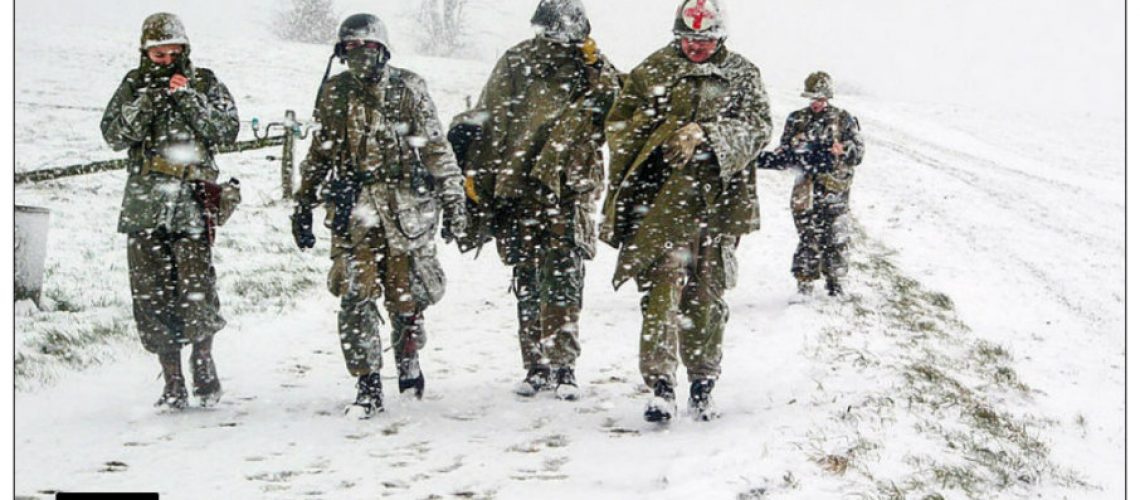
This past Memorial Day weekend, I drove over the lengthy Walt Whitman Bridge, between Philadelphia and New Jersey over the Delaware River, to get to the Pentecost Mass at the Cathedral Basilica of Saints Peter and Paul. This bridge extends approximately 2.5 miles long! Not only did I think of the veterans that fought, served, and died for God and their Country in the two World Wars during the time of the building of these bridges in the U.S. but I recall that many continued risking it all in heroism by staying in the military, and/or joining local or state police. Many worked the tough life of a tradesman. They understood what carrying one’s cross in daily duties means; it is an all-encompassing task for any family man or woman, whatever their capacity in life (cf. Luke 8:23).
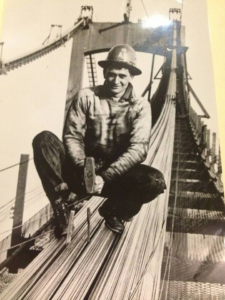 As I was thinking of the way many of our early and mid-past century bridges in the United States were built, from my vehicle I could see the heads of the rivets used to connect the massive steel I-beams, as they are called since the shape looks like the letter “I” from the top or bottom. I’ve always thought of the workers who risked life and limb putting these bridges up. I owe our forefathers a walk along one of these bridges to pay honor and check out how they fastened all the beams together – up close and personal.
Imagine, the many Catholic and Protestant Christians involved in these mega endeavors across the USA. How many first- and second-generation immigrant Catholics? I really thought about the veterans who took great pride in building this, and upon finishing this mega-task, they looked back on it and saw it was good. cf, Gen 1:31. Man takes pride in his work, with that spark of divine inspiration, and being made in God’s image and likeness his is that joy of accomplishment at the end of each day, and especially upon full completion.
The Walt Whitman Bridge alone was open for traffic in four years, starting construction in 1953 people were driving on it in 1957! Vets take great honor in their work, being selfless simply by enlisting to defend their country, they are also taught there is no room for error, as is required in a battlefield, at sea or air. Imagine, that same strictness was applied to building bridges that our lives and livelihood depend upon; doesn’t that put you at ease when commuting way up over the water?
When I made that drive across the Walt Whitman, in my mind’s eye I could see workers on the I-beams, most with no harnesses or ropes, as they drove rivets using a bulky, heavy pneumatic gun, or fastened probably 1-2inch diameter nuts and bolts with heavy wrenches. Many days were “hot as hell” and ice-cold in the winter. Clothes probably covered in dirt, steel marks, paint and oil; the machinery didn’t take care of itself! No air-conditioned car to drive home in, no AC-cooled home to walk into, no recliner to put their feet up in; but many came home to a loving wife and children and ate supper at the table. Many did not. Lots of those guys ate alone in diners after working all day I imagine. Many modern soldiers still do. Perhaps, that was the “last supper” for many workers; eight lives were recorded to be lost in building the Walt Whitman Bridge alone.
The conditions of the elements and more rugged lifestyle, even at home, remind me of the words of the late Friar, Fr. John Schug, who lived in my childhood hometown in Springfield, Massachusetts, played a major part in St Padre Pio’s canonization behind the scenes. He once said in regard to Padre Pio and the sanctity of him and others at that time: “It makes one wonder if central air conditioning and wall-to-wall carpeting are a help or a hindrance in becoming a Saint?” That city of Springfield still has its WWI-era Memorial Bridge going strong, which extends about 1/3 of a mile over the Connecticut River.
During the holiday, I really thought of my late maternal grandfather Kendrick of Welsh descent. He fought and served in the US Navy on a destroyer in WWII and last served on the USS Texas; I can see him up there on a power line making repairs in the snow, or on a caboose of a train in mid-July, fixing a fastener that is loose, thinking about his family while at work. May all our veterans rest in the peace of Christ.





9 thoughts on “Nuts and Bolts”
Pingback: MONDAY MORNING EDITION – Big Pulpit
One of the most entertaining pieces I’ve read in a long time. Thank you! And yes, I stand in awe when I look at what was accomplished with hand-held tools and horses.
Thank you IDA, I’m flattered… it was great to write it!
I have to laugh at a plaque below the Valley View Bridges near Cleveland which commemorates the feat of their construction. They are side-by-side bridges with a length 4,150 feet and height of 215 feet. Yet they pass over the Ohio Canal, which was built in the same amount of time with hand-held shovels and horses, and is 308 miles long with 146 stone-carved locks and at least 7 aqueducts (bridging one river over another).
…pronouns probably were not a thing back then.
WOW… no, no pronoun criteria back then… men kept their mind on their work!
It is insane, when you think about it, their is a plaque for something done in the 1970’s with the massive amount of machinery, tools and transportation available (and AC and TV to come home to), and the Canal was built in the same time frame with horses and shovels (probably some steam locomotive, too, I imagine). Still a lot of work, and dangerous as heck either way, in the 1970’s or 1830’s! I’ve heard that guys from the 1800’s were work-oxes. I heard when the loggers used to get in brawls at the bars in the 1800’s, it would last for hours, because they were so d**n tough back then!
Nothing is insane with faith the size of a mustard seed, you can say to a mountain, “‘Be lifted up and thrown into the sea’”.
…no surprise that Ballpark Mustard was invented in Cleveland.
Amen.
Pingback: Nuts and Bolts - Catholic Stand - Cookingaffiliate.in