


This is the “Conclusion” of my book, Natural Family Planning: Trojan Horse in the Catholic Bedroom? The book is available on Amazon and Kindle.
Marriage is intended to be fruitful; God said so Himself! God\’s plan for the sanctification of the married couple includes their cooperation with God in procreating new souls destined for Heaven. NFP doesn\’t explicitly fly in the face of such an understanding, but it is dramatically not submissive to God. NFP is all about a degree of control that is objectionable in any traditional Catholic understanding of marriage or Catholic spirituality in general.
NFP promoters attempt to elevate non-abstinence (that is, the circumvention of the need to abstain from the marital embrace) to the level of a virtue, achieved by gaining knowledge of God\’s designs so as to frustrate them. In other words, NFP promoters see the marital act as having “unitive” value that trumps its procreative value; therefore, engaging in marital intimacy when there is no risk of pregnancy is considered good in and of itself.
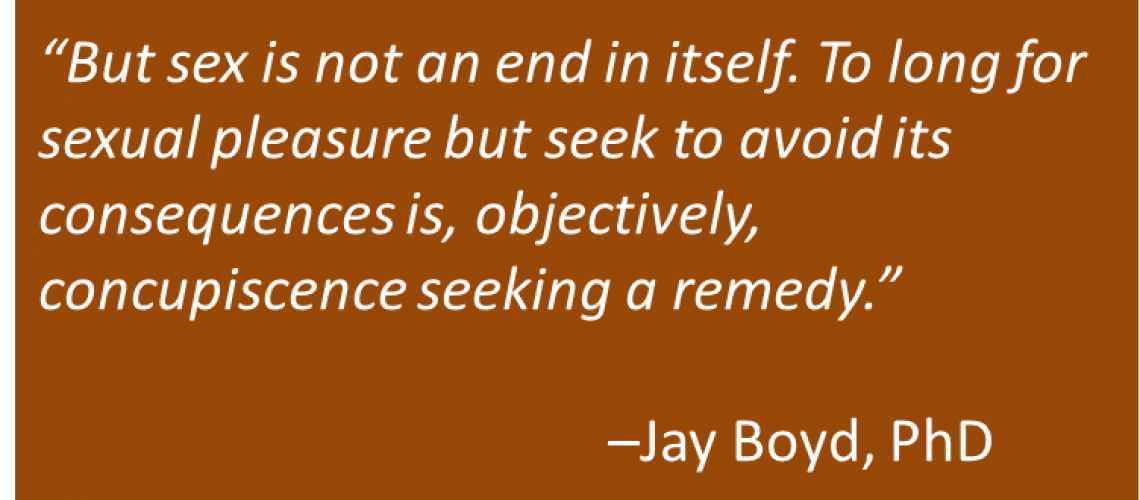
But sex is not an end in itself. To long for sexual pleasure but seek to avoid its consequences is, objectively, concupiscence seeking a remedy. Certainly we would say this of an unmarried couple (it’s called “fornication”). The traditional understanding of marriage is threefold: 1) the procreation and education of children; 2) mutual care and support for the married couple in their journey to Heaven; and 3) a remedy for concupiscence. And once upon a time, people actually got married first and then realized those ends. Nowadays, people seek the “remedy for concupiscence” (i.e., sex) first, and only afterwards might consider the other two ends. In the past, some couples probably got married primarily as a remedy for concupiscence, knowing that indulging their sexual appetites might lead to pregnancy; today we have a Pill to take care of the anxiety about the possibility of pregnancy, and many consider that license to satisfy their sexual appetites outside of marriage.
Taking the traditional view of marriage, if a man and a woman long to engage in the marital act, but are not prepared to have children, they should postpone marriage until they are truly “open to life”. They should not be thinking of ways to have sex that allow them to avoid that “consequence.”
The same goes for a married couple, really. When a married couple thinks the time is not right for pregnancy, the first option is abstinence; but, if desire is too strong, then charity demands that they engage in the remedy for their concupiscence. This remedy may be NFP. NFP as a “remedy for concupiscence” sounds, to me, a lot more honest in its presentation than touting it as a “way of life” or a “virtue.” From a marketing standpoint, though, NFP as a “remedy for concupiscence” doesn’t sound nearly as appealing as “NFP as a way of life”, or “God’s plan for the family”.
It seems silly to claim that one is “open to children” when one is organizing one\’s life around having sex not likely to be fruitful! The NFP “way of life,” when not practiced to achieve pregnancy, is all about sterile sex – sex that is meant only to make the couple feel good, with no consequences attached to that pleasure. The “background music” of the NFP way of life is always about sexual intimacy: “when we can, when we should, when we can\’t, and when we shouldn\’t”.
Our culture has a lot to do with our understanding of human sexuality. In a recent article addressing this issue, an insightful author notes that “Teen Pregnancy is Not the Problem”. Instead, she says, the problem is how the world presents the topic of “sex”:
The world says sex is primarily for pleasure. That sex doesn’t have to be for unity or procreation. That everybody’s doing it. That there is something wrong with you if you aren’t.
…The world tells us to act on all our urges as soon as possible. To get what we want, when we want it, always. To control our fertility instead of ourselves if we aren’t prepared to become parents.
…It’s time to use our lives to tell the world sex is primarily for procreation and unity…
Couples marry today with certain expectations about both marriage and sex shaped by public media. Sex is supposed to be “good” with a “good partner” and “personally satisfying”; in other words, sex is “all about the couple” – a variation on the theme of “it’s all about me”. People enter marriage today with a culturally-conditioned expectation that “sex is like what I\’ve seen in the movies” – which is to say it looks really great, and fun, and exciting! The NFP ideology (and that is what it is) does little to teach the true meaning of marriage, sex, or chastity, but is an unwitting participant in the unchaste sexuality that is rampant in our culture. To teach engaged couples about “family planning” of any kind is conceding that “family planning” (a.k.a., birth control) is a presumed need and value in today\’s Catholic marriages.
Certainly, today, the Church is failing badly in this area. Part of the reason for that stems from the 1960’s Church taking seriously the warnings from secular “experts” that the world was becoming overpopulated. Birth control was cautiously embraced because Church leaders didn’t recognize the errors in the overpopulation argument. The apparent needs of the temporal world loomed larger than the spiritual needs of parents that are met through generous parenthood providentially orchestrated by God. It seems as though, for a brief moment, Church leaders wondered if God maybe needed a little help in controlling population: hence, the concept of “responsible” parenthood, and the subtle movement from condoning periodic abstinence in certain serious situations to the idea that couples should rely on their own consciences to determine when to conceive a child.
I predict that, in the future, the Church will clarify what it teaches today, dramatically redefine the “serious reasons” necessary for use of NFP, and encourage it as a “remedy for concupiscence” rather than a positive, virtuous practice. My prediction stems in part from my belief that what is being taught today, and the verbiage being used to teach it, is, for the most part, wrong – at least on the very liberal end of the NFP spectrum.
There’s another, more pragmatic reason for my prediction: far from becoming overpopulated, the world is now beginning to suffer from the effects of decades of population control. We need more babies. People are now coming to an understanding of some principles of the economics of population growth which were previously unknown, unexplored, or ignored. I’m not an expert in this area, but even in the secular media we are beginning to see a growing awareness and concern about the need for more young people. And so if the Church wants to continue to meet the needs of the “modern world”, She will have to acknowledge that birth control should never be touted as a Catholic principle, and that now more than ever Catholic couples should be open to life, open to “generous parenthood” that puts the procreative end of marriage in its rightful place of primacy.
In the end, I think that might be called “virtuous parenthood”.
© 2013. Jay Boyd. All Rights Reserved.




150 thoughts on “NFP: Trojan Horse in the Catholic Bedroom?”
The key to a life-long love are for two virgins to marry and explore their love till death do they part. Short of that, a wife will be happy if needed, and a husband happy if desired. Sometimes there are those who resent the above requirement of the wife. This is the basic summation of Our Lord’s instructions in Genesis. St. Paul and all The Epistles echo the same. The war on boys by feminism, the past 50 years, has turned the culture into a cesspool of transmogrified, androgynous shells afraid to be authentically feminine or masculine. People with doctorate degrees actually expect you to take whatever LGBTQIOUBLT is, or other such gibberish, seriously.
If you’re married, do what your spouse loves, but be open to life at the end, with no hint of the many variations of the sin of Onan. God did not make a woman fertile every hour of the day. He has set her cycle, and it could change, but if it does.. then Blessed be God, Blessed be His Holy Name, and Blessed be His Holy Will.
If you love someone you want them happy. The greatest happiness is to be with God forever. So unless it offends God, attending to the above caveat, love your spouse as hard and with as much spontaneity, passion, and variety as you can!
If your thinking shifts, from how I will love my spouse to what I get out of it, have recourse to a re-doubled prayer life, spiritual reading, and making use of The Sacraments.
Then when you’ve connected with Your (And Our) first love in the presence of The Most High..
Get back in there and be the love warrior God made you to be! =+)
(After all, in Heaven, we all become brothers and sisters, becoming like the Angels, and are not given in marriage. So what that means for all you married couples right now is..YOU’RE ON THE CLOCK!) =+)
VIVA CHRISTO REY!!!
I feel that reading this article creates a rift in many that use NFP. It is kind of hard to understand and it might be misunderstood that the author says no to any form of fertitilty awareness. I personally do not feel this way, however I would clarify my own personal experience regrading thinking about the ways NFP will be in my life. My girlfriend and I are not married, and we are being good stewards of the Faith in waiting until after we would tie the knot. Marriage is about bringing together a man and a woman, to be the bearers of a little piece of Heaven on earth in the joining of Christ and His Church. To not take part of one end, the unities one is to deny what the sacrament means. We are not using NFP to beat around the bush, that’s not the primary reason. We are not going to use it because we want to say no to God. I understand the world needs kids. There is a shortage, due to population control. However being blind to how hostile the powers that run the country and others over the world to the build up of the family is to not see a train coming at you when your standing in the middle of the tracks. I would like it just as much as you to have 3+ kids in a family, and maybe that is what God has in store for my girlfriend and I as a couple. With that being said Marriage is a twofold deal an delaying one does not mean being being closed to it, but the cathedrals are bed chambers, the poles attest to the divine will, and that is what is true. God put cycles in a Woman, that is just how it is, and using them to postpone pregnancy is not being closed to God. He leaves that 2% there and that’s fine by me. We as a couple would never be closed to him and his plans for us, but the joining is well joining, and we use the means God has put to us in order to make that happen. We do not throw the other part out, but the first end of the marital ceremony is to combine first, then multiply.
Thank you for talking about NFP and its proper uses. This is one of the most thoughtful, logical, beautiful and faithful ways I’ve heard it described, and the way most respected doctors and other experts on NFP speak about it. I’m having a hard time following this discussion because, regardless of what the author says, NFP is pretty much being condemned as thwarting God’s will if sex is avoided during fertile periods, as well as strongly implying that are no actual “serious reasons” to delay pregnancy, and anyone saying that they have serious reason is engaging in contraceptive mentality. The author states that she’s not telling people to NOT use NFP, but if it’s wrong for a couple to use NFP to postpone pregnancy, then NFP becomes nothing more than a chart to show the doctor when you likely conceived. And, again, I’ve never heard views like these uttered in a Catholic setting, only in a Protestant setting with self-proclaimed members of the “full quiver” movement, who also find the idea of NFP a sin against God’s Will, believe being able to have a large family is a blessing from God, and imply that families who don’t have a lot of kids, for whatever reason, is a sign God is not happy with them.
Thank you Shawna. It means a lot to me. Part of my job as a hopefully future husband is to keep my wife’s soul ready for Heaven. Not that I need to do a lot of work my girlfriend is a Saint already, but still it’s her happiness that I would need to keep. I see so often and I experience much backlash over coming out saying that my girlfriend and I are going to use NFP. It’s hard because being a 24 year old male, you stand out for wanting to do that. Other do not see what you are giving, they do not see the call you heed to love your spouse like no other.
When my girlfriends Newman club talks about chastity and how a man should treat a Woman my girlfriend always smiles, because she knows she has one that does, and knows the sacrifice that I am making. Maybe not in a full way, but that way will come in time. I do not need another mans approval that I am doing a good job, I follow Christ Crucified, his grace is enough. Never before have I had the self control I do now, and I work on it daily in preparation for marriage. While it is a fight, more each day it gets a little better, so besides Chasity, NFP will be a triumph for us because of what all the nay-sayers said. We smiled in giving, the giving of ourselves and that is victory.
Thanks, Fr. Gardner!
WPR…I’m going out of town for a few days, so any further response on this will be delayed. Sorry!
Interesting article. I have a few questions:
1) For Dr. Boyd: You stated that: “When a married couple thinks the time is not right for pregnancy, the first option is abstinence; but, if desire is too strong, then charity demands that they engage in the remedy for their concupiscence.” First, I want to make sure I am understanding this correctly. Are you saying that if a married couple who desires to avoid pregnancy for serious reasons is capable of complete continence, they are obliged to practice it? In other words, would it be a sin to engage in the conjugal act with another “secondary end” of marriage in mind, such as “the cultivating of mutual love?” Casti Connubii 59.
2) For Dr. Boyd or her supporters: With reference to the statement from Dr. Boyd that I quoted above, has this ever been explicitly taught by the Church? If so, where?
3) For Dr. Boyd or her supporters: In your view, are there different considerations for married couples between: 1) marital sex during an infertile period when trying to avoid pregnancy; and 2) marital sex during pregnancy? Put another way, is a married couple ever morally obliged to refrain from the conjugal act during pregnancy, given that the end of procreation cannot be (further) satisfied?
4) For anyone: How should the following statement from Casti Connubii be understood?: “24. This mutual molding of husband and wife, this determined effort to perfect each other, can in a very real sense, as the Roman Catechism teaches, be said to be the chief reason and purpose of matrimony, provided matrimony be looked at not in the restricted sense as instituted for the proper conception and education of the child, but more widely as the blending of life as a whole and the mutual interchange and sharing thereof.” I am a little confused about how the “chief reason” of marriage can be different depending upon how marriage is “looked at.” I am sure this is mainly due to my own ignorance though, so I was hoping someone had some insight into where in the tradition Pope Pius IX drew this from. Since this is a comment box, I should clarify that I only want answers to this question that include citations to some sort of authority, not speculative personal opinions.
Thanks a lot.
There can be lust in matrimony if you view your spouse as an object. A spouse should be viewed as a love only second to God and Heaven. You should serve that love with all your energy as much as any priest or bishop. Still, the procreative part of the marital act is NOT the Sacrament of Matrimony, but the UNITIVE act is. The Sacrament of Matrimony does not happen during the wedding, but in the wedding chamber. Look at the swirly, marble bed-posts that surround every altar in every Cathedral or Basilica in the world. That’s not a reception hall, that’s a HONEYMOON SUITE! Our Lord could have used any imagery in the world to describe his relationship with The Church. HE chose Bride and Bridegroom.
What does Our Lord say at the end of his Passion? “It is consummated..”
That’s a mystical, Spiritual marital act going on. Like any good husband, Our Lord has “suffered” by delaying the moment so everything, every joy, and every gift may be given to His Bride. At that time, at 3 p.m., He and His Bride become one flesh, One Body, and we are all the subsequent off-spring of that union.
Neither the Annunciation, nor the Nativity, are the central part of Our Faith. Easter is the celebration of the communion of God and man that’s possible in the reception of The Blessed Sacrament, but all of the salvation, mercies, graces, and privileges, for any of God’s children, were paid for by the sweet romance of The Saviour on The Cross and the Sanctification of His Bride.
Aristotle, St. Augustine, and St. Thomas Aquinas all say there is something of The Divine in a man’s seed which is why offenses against the casual dissemination of same in ways, that are not open to life, even among the married, is the origin of every offense against The Sixth Commandment.
Finally, do not our mystics, our holiest Saints, are they not said, to experience “Ecstasy”? Married folks know those fleeting, fading seconds, but imagine that, ever increasing in intensity, for eternity?
VIVA CHRISTO REY!!!
Thomas, I’m not prepared to give an answer to that question; I haven’t thought it through to the extent I would like to. I will say, though, that it is certainly meritorious to choose NOT to eat something that is for pleasure, and to offer that sacrifice, as the Fatima children did, for the love of God, the conversion of poor sinners, in reparation for sins against the Immaculate Heart of Mary, and for the Holy Father.
If we could all (myself included, of course) focus on sacrificing our earthly pleasures for these ends, there would be great benefits to the souls in purgatory, to those who remain unconverted in this life, and to our own souls as well.
Hello Jay,
Does this refine the analogy?: Overindulging in dessert could be likened to married couples having sexual relations during a time when they know they will not conceive; such as, during the time of pregnancy. St. Thomas would excuse this in view of granting the marriage debt. But periodic continence is more akin to overindulging in dessert in such a way as to nullify any nutritional value whatsoever of that extra dessert.
Jay, in your analogy, you used the term “overindulging” in having a dessert for pleasure. But are you saying that ifsomeone eats anything for pleasure, that it is venially sinful?
Mr. Tuckerr,
Rest assured, Aquinas is not stating that experiencing pleasure during sex, or even liking that pleasure, is sinful. This comes not from Aquinas, but from reading ones own ideas into Aquinas. I actually just wrote a little bit on this (click the link on the name) and I might more in the future.
Feel free to contact me if you would like any more insight into what Aquinas says, but based on your comment, I think you’ve already understood the gist of it. I will be busy this weekend with wedding stuff, but I should be able to reach you on Monday should you do so.
Blessings,
Kevin
Perhaps Aquinas is simply wrong on this matter, as in others.
Thomas, I don’t pretend to know what all Aquinas said with regard to human sexuality. ..Which is precisely the problem. As I mentioned elsewhere, I’ve read too many opinions that literally quote ..someone..only to find that this someone..says something even a little different.
I think if we want to know what Aquinas thinks on this subject, we need to examine several portions of the Summa Theologia and his other works. We’d need to consider each portion in context within itself, then also in context amongst all portions. Aquinas wrote one heck of a lot; I think it unlikely that he contradicted himself, but he might be misunderstood fairly easily.
Thomas, St. Thomas Aquinas says that engaging in the marital act for pleasure only “is one of the daily sins, for which we say the ‘Our Father’. Now these are not mortal sins.” That is, he counts it as a venial sin. This seems so foreign to us, I think, because we are not at all used to thinking of pleasure as possibly being sinful. After all, doesn’t God want us to feel good?! But think, for instance, about overindulging (“pigging out”) on a fine dinner or dessert; this really involves the sin of gluttony. In the same way, engaging in the marital act purely for pleasure can be thought of in the same way – like eating a second bowl of ice cream when already stuffed. St. Thomas says, “There are only two ways in which married persons can come together without any sin at all, namely: in order to have offspring and in order to pay the marriage debt; otherwise it is always at least a venial sin.” (Supplement, Q. 49, art. 5). If that seems harsh, I think it’s because we’re just not used to considering most of our venial sins to truly be sins! And before anyone rushes in to call me a Puritan, don’t. I’m not. I’m quoting Aquinas here. And I’m suggesting that we’ve become habituated to some forms of sin that used to be more recognizable. I think a couple of recent popes have said similar things.
The second quote shows why it’s not a sin if the couple is “paying the marriage debt” and coming together for the sake of each other. Using your spouse for your own selfish pleasure is wrong, but not all sexual pleasure — only the selfish kind.
It seems people on both sides of the debate are missing this distinction (or I haven’t read the comments well enough).
Okay, let me ask this question. I am not a moral theologian. Are you saying that my desire for sexual pleasure with my wife, in and of itself, is sinful, if that pleausure and, not procreation , is our reason for having relations?
We’re all adults here, so some observations from an NFP adherent before the mother of my children had our marriage annulled.
-NFP does not mean you have to wrap yourself in super-glue and styrofoam packing-peanuts during fertile periods. The Couple-to-Couple League does a nice job of explaining how communication is engendered concerning what would qualify as tipping-points so couples can be affectionate, mindful of each other’s unique sexual appetites, but always be conscious of Church teaching. The Marital Act need not be an end in itself. With such periodic continence and discipline, husbands might find themselves being a bit more caring and skilled when the Main Event is actually mutually desired or possible.
-Women are most interested in coitus during their fertile period and least interested when they are not. That can be a huge difficulty for the fairer sex.
-NFP totally relies on a woman being competent, or honest (A woman’s body, especially for those yet to have a child, screams PROCREATION. We all know young, childless women in their 20’s, who suffer from the terminal “Mommy’s”. That is a holy an instinct as the male’s UNITIVE one. Both these passions, however, must be tempered by reason and prayer.), about the deeply personal goings-on of their body. In my case, I’m almost sure my wife lied about our, and her, first child when juxtaposed at the total disappointment at finding out we were having our second. My response was joy for both. Her behavior in another marriage confirmed my hunch.
The problem is not really NFP. Parenting is the most important job in the world. To be a wife or husband is more than plumbing and desire. To be a wife you must be a woman who knows what authentic femininity is. To be a husband you must be a man who knows what authentic masculinity is. For 50 years Society has had the demonic idea that the sexes were interchangeable.
NFP is a band-aid on a gaping wound. If you don’t come from a home that remotely resembles the House at Nazareth, St. Anne and St. Joachim’s domicile, or the warm environs of the lovely couple who were St. John The Baptist’s parents, you can’t learn from anywhere how to properly do the job. NFP is an awkward effort to deal with those fears.
Broken homes lead to an awful lot of broken hearts. Typically, you become your same-sex parent or model, so unless you’re exceptional, the same sad legacy can redound to generations.
The flip-side of the argument is that you wind up saying to poor Catholics that God and love are not enough. If you don’t feel you can provide for as many children as God gives you don’t get married, some would say. Even if a young couple both get Master’s degrees in 5 years, not 6, they could find themselves owing 300k before they get a job. Forget about owning a home. Without exceptionally strong, committed families of origin, you can almost see the devil whispering “cohabitation”, “contraception”, and worse.
I have very much enjoyed the discussion.
VIVA CHRISTO REY!!!
Stacy, for heaven’s sake! I’m not advocating shaking a finger at couples and saying “No NFP!” I never have said such a thing. I want people to come to the conclusion on their own that God’s plan is best. As you say, and as I have said, it takes time, and often people will have to grow into it. Priests and confessors can help with that by teaching the value and desirability of large families. They can still be sensitive to the issues of couples with infertility and other problems and doubts. They can encourage other parishioners to support and offer practical help to those who have many children. I’ve suggested all of these things in my blog posts on NFP.
But many of our shepherds are out of practice at doing these things, and they don’t correct the uncharitable comments that are made about large families. Let’s pray that they grow in their awareness of these issues and their ability to counsel families.
So you’re not finger-wagging…and yet you are? What is God’s plan?
Stacy, I still disagree that this needs to be a defining part of the discussion. Even if people accuse me of doing so, I am not telling people how much suffering they should be able to endure. I think God has a way of orchestrating that Himself, and giving people the grace to endure the suffering that He allows to come to them. (And I try to avoid saying that individuals “need to” do anything. I prefer to point out what the Church teaches; people certainly are supposed to form their own consciences, but they are to do so by conforming them to Church teaching.) Suffering can have salvific value, but we don’t get a lot of teaching on that subject these days.
Would you use the same line of thinking (about avoiding suffering) to support couples using artificial contraception? I know Catholics who use precisely that argument. But generally, NFP supporters would say, no, just because you want to avoid suffering and you’ve had miscarriages or births that have caused injury, etc., that is not a reason to use artificial contraception. That’s because the Church has stated unequivocally that artificial contraception is immoral. NFP has been declared licit, but I think for those who are seeking to grow in holiness, it is not unreasonable to look at why the Church allows NFP, and to wonder if it is really virtuous, as Fr. Gardner has mentioned in his writings in other places. It is not unreasonable to think that because God desires souls, He might be asking us to sacrifice and suffer more than we want to. It’s a tough question, and that is why we need a solid foundation for understanding the morality of NFP, and the ways in which it might be immoral. You are correct that the Church has not provided that, but it is something that could be provided, and perhaps will in the future.
For now, the Church allows NFP for serious reasons – but doesn’t give much guidance on what is “serious”; we need to ask if that is simply because our shepherds are trying to tempt couples away from using artificial contraception. What are we really saying when we endorse or use NFP? Is what we are saying really compatible with Catholic thought?
No, not a defining part, but a part. Testing at the extremes helps bring clarity to what’s in the middle.
You are right, the Church has always declared contraception illicit, but the Church has not declared NFP illicit.
And I think you understand my concern here. What is at the root of the issue is the ability to define serious reasons, and thus the caution to realize that “serious” has a subjectivity to it.
The couple panicking about their own ability to handle 1 more child to the group of 4 may have a serious reason to avoid for a time, prayerfully, whereas the couple with 9 who are all potty-trained may feel that needing to buy another car to welcome a 10th child is not a serious reason to avoid.
Morality is objective, but there are subjective aspects to human behavior as well. I don’t think that’s anything new to the Church because conversion itself is a journey.
My ex-wife and I used NFP. She felt frustrated with NFP and wanted to have sex more often and ended up having an affair. She divorced me and is now married to that man for the last 17 years.
Stacy, I’m not sure I agree that the topic of chronic miscarriage “should be part of the discussion” about the underlying philosophy of NFP, and I’m not really sure what you mean by saying it gets to “an even deeper heart of the question”. But I don’t object to responding to your questions! And I am not unsympathetic to the situation you describe, as you know.
I have said before that I think that a history of miscarriage is certainly a “serious reason” to avoid pregnancy. And if a couple wants to be absolutely sure to avoid pregnancy, abstinence will do the trick. I haven’t read much on infertility and miscarriage problems, but I do recall that NFP techniques might be helpful in identifying problems and solutions. So be it. NFP is licit for serious reasons, and a couple who uses it both to conceive and to conceive at a point in the period of fertility that optimize the health of the baby is doing so morally. I think there are others on this thread who can also speak to that issue, and perhaps they will if they have the time and inclination.
You’ve highlighted why miscarriage needs to be part of the discussion:
It gets to a deeper question about serious reasons.
Avoiding conception to avoid miscarriage is an effort to avoid suffering.
Avoiding conception to avoid financial failure is also an effort to avoid suffering.
All the arguments presented above could apply to a couple avoiding conception for fear of miscarriage:
You need to trust God’s Providence.
You need to be open to life even if it’s hard.
You need to be open to accepting as many children as possible.
Since conversion is an ongoing process, we should use caution when telling people how much suffering they should be able to endure. I think that is why the Church has wisely omitted listing X, Y, and Z as serious reasons, but has instead urged couples to grow in virtue and holiness.
In other words, there’s a subjectivity to “serious reasons”.
I’m older and have many kids, I’m at peace about miscarriage, finally. But I would never tell a young couple who just lost a first child to miscarriage that avoiding conception for a time was sinful because they just didn’t trust in Providence enough. I think we all can understand that would be manipulative and prideful, it would not help the couple to advance in holiness.
It is the same for other, less clear, issues too. Young newly wed couples can indeed be terrified of having baby after baby if they do not have a steady income. They can be terrified of it period, it is very difficult work, frightening even. When you are raising 3-4 very young children at once, some days there’s a very real fear that you won’t even be able to keep them all safe. I can’t tell you how many times I’ve slammed on the brakes and turned around to count heads in my truck.
My point is, what may not seem serious to one couple may indeed be most serious to another. Assuming the worst about them is not going to help them, and if a parish were to say, “No NFP! You are sinful if you don’t have lots of babies!” well, that could do more harm than good, and I think most pastors understand that.
I think the reasons you outline are a terrific reason why this should be the issue primarily between spouses and competent confessors/spiritual directors, not lay psychologists writing in catholic webzines.
Many of you speak in terms of “birth control.” What you really mean is “conception control.” It is not a given that all conceptions lead to births, in fact some medical experts estimate that more than half do not.
What do you say to that? Anyone?
For discussion: Should a couple with a history of chronic miscarriage keep trying to have as many children as possible? That is, keep conceiving and miscarrying?
A. Yes, children are a gift, let God plan your family.
B. No, try find out why they die and abstain until you do.
A lot of couples struggle with this (myself included), and I think it should be part of the discussion. It gets down to an even deeper heart of the question.
Stacy,
I think your question quite relevant.
It seems to me that you essentially ask whether it’d be wise to avoid conceiving a child when you have reason to believe that you may not be physically capable of bringing the child to full term, thus live birth.
While I’m not likely to encounter too many couples–young or old–who’re dealing with this in my current line of work, I have heard suggestions before that many (most?) couples deal with at least one miscarriage before they’re older and less fertile.
Seems to me the overall idea of NFP would suggest that a couple take steps to better discern if particular medical difficulties might be contributing to higher incidence of miscarriage; there may be corrective measures–possibly even involving comparatively small expense–that might be taken to better foster a child’s birth.
Again, in this sense, NFP isn’t so much a “Catholic contraceptive” technique, so much as a frame of mind that addresses a large part of a couple’s marital state.
I think we need to be very careful in making our distinctions here. We can claim that the others are going to answer to God because their actions led to a bunch of babies not being born yada yada yada, or we can have a serious discussion without the hyperbole and melodrama. Everyone is free to come check back on me in 5 years, and see if my marriage is the kind that isn’t open to human life.
Now as far as the rest of the quotes, I see again that the challenge really hasn’t been met with any pre-vatican II moral theologians who teach that NFP is sinful. The citation by Canon Ripley, while interesting, is also irrelevant to the discussion at hand. As Fr. Slater points out in the preface to his work “A Manual of Moral Theology” (another staple of Pre-Vatican II seminary training)
“Here, however, we must ask the reader to bear in mind that manuals of moral theology are technical works intended to help the confessor and the parish priest in the discharge of their duties. They are as technical as the textbooks of the lawyer and the doctor. They are not intended for edification, nor do they hold up a high ideal of Christian perfection for the imitation of the faithful. They deal with what is of obligation under pain of sin; they are books of moral pathology. They are necessary for the Catholic priest to enable him to administer the sacrament of Penance and to fulfil his other duties… Moral theology proposes to itself the humbler but still necessary task of defining what is right and what wrong in all the practical relations of the Christian life.”
Canon Ripley’s work is precisely meant for that kind of edification and instruction, but it is not a work of moral theology, which questions whether or not the practice of NFP is sinful, or “opposed to traditional catholic spirituality”
None of this is to say that mindset isn’t abused, and even abused in the way that Cardinal Ottaviani states. If a family were to say “We will only have 3 kids, and we will use NFP to accopmlish that” or “I’m done having kids for good, lets use NFP to see to it” then yes, all things being equal, they are having a contraceptive mindset. Yet if one says “due to just losing my job, it would probably be wise to practice periodic continence during times of fertility, so that another child is not brought into the world, but once I have my job, then we shall have a child” that’s something entirely different.
I’d also wager that this is why these discussions about NFP normally use to occur between spouses, doctors, and confessors. By it’s very nature, this is something which cannot have a universal application, and is of the utmost sensitivity. It doesn’t help to have psychologists turned amateur theologians dissenting from established moral teaching (and papal teaching!) in a public venue. It is why during the glory days Dr. Boyd cites before the council, she would be forbidden from speaking on these matters, and rightly so.
The rest of the ideas about catholic couples putting themselves in the occasion of sin, again, not even the “rigorist” manuals before the Council take the approach that “Fr. Campion” and others are taking. In the end, I will stick with the Church, which has the authority to bind and loose, rather than the counsels of men, even good ones.
Kevin Tierney said,”In the end, I will stick with the Church, which has the authority to bind and loose, rather than the counsels of men, even good ones.”
Yes, please do. That is excellent advice. But be sure to know the real thinking and teaching of the Church.
Since you say that you are engaged to be married, I urge you to read the “Address to Large Families” given by Pope Pius XII. If you embrace the spirit of love and joy and generosity and fruitfulness that he proclaims in this message to Catholic couples, then you will be sure that any motives for the use of NFP will truly qualify as “grave reasons.” If your heart is in the right place, then you will be able to deal with the circumstances that arise.
There is no better way to prepare for your coming marriage than to determine to be thoroughly imbued with the spirit of joyful, generous fruitfulness which will flourish into happiness both temporal and eternal:
http://www.catholicculture.org/culture/library/view.cfm?id=5370
“Large families are the most splendid flower-beds in the garden of the Church; happiness flowers in them and sanctity ripens in favorable soil. Every family group, even the smallest, was meant by God to be an oasis of spiritual peace. But there is a tremendous difference: where the number of children is not much more than one, that serene intimacy that gives value to life has a touch of melancholy or of pallor about it; it does not last as long, it may be more uncertain, it is often clouded by secret fears and remorse.
It is very different from the serenity of spirit to be found in parents who are surrounded by a rich abundance of young lives. The joy that comes from the plentiful blessings of God breaks out in a thousand different ways and there is no fear that it will end. The brows of these fathers and mothers may be burdened with cares, but there is never a trace of that inner shadow that betrays anxiety of conscience or fear of an irreparable return to loneliness, Their youth never seems to fade away, as long as the sweet fragrance of a crib remains in the home, as long as the walls of the house echo to the silvery voices of children and grandchildren.”
Mr. Galvin,
I would say that what is essentially unanimous teaching on moral theology, several Curial departments during this time, 4 popes, a Catechism, all of these things establish pretty well a “mind of the church.”
My issue isn’t with the contention NFP is abused, or that the current approach in many quarters to NFP isn’t flaw. It is abused, and it most certainly is flawed.
I also think that many Catholic families really should hear more about the blessings of large families, including from such things as Pope Pius XII stated. Lord willing, I will have such a family.
Yet as with so many things Pius XII did, he presented the whole truth. He also said the following in his allocution to midwives:
“Serious motives, such as those which not rarely arise from medical, eugenic, economic and social so-called “indications,” may exempt husband and wife from the obligatory, positive debt for a long period or even for the entire period of matrimonial life. From this it follows that the observance of the natural sterile periods may be lawful, from the moral viewpoint: and it is lawful in the conditions mentioned. If, however, according to a reasonable and equitable judgment, there are no such grave reasons either personal or deriving from exterior circumstances, the will to avoid the fecundity of their union, while continuing to satisfy to the full their sensuality, can only be the result of a false appreciation of life and of motives foreign to sound ethical principles. ”
Also important is that Pius XII goes on to say that this should not be presumed, and that when in doubt, one should default to the heroism of abstienence in these situations. This is why at my church, where NFP is mentioned, it is also mentioned one should be reluctant to adopt it, and adopt it only after speaking with a doctor and your confessor/spiritual director.
Pius XII provides the proper way forward, and I would submit it is a bit different than the idea that those who practice NFP for proper reasons are doing so with something alien to catholic teaching and spirituality. In the end, that’s the only thing that really draws people’s ire. Dr. Boyd set herself up as the Magesterium and attempted to bind and loose on questions that are way above her on the qualifications totempole.
I also think in the end Pius XI essentially settles this matter when he states:
“Nor are those considered as acting against nature who in the married state use their right in the proper manner although on account of natural reasons either of time or of certain defects, new life cannot be brought forth. For in matrimony as well as in the use of the matrimonial rights there are also secondary ends, such as mutual aid, the cultivating of mutual love, and the quieting of concupiscence which husband and wife are not forbidden to consider so long as they are subordinated to the primary end and so long as the intrinsic nature of the act is preserved.” (Casti Conubii, 59)
I’d suggest people give the entire encylical a read. Especially in the immediate context, as he cautions against abusing this interpretation to essentially adopt a contraceptive mindset, or treat children as a burden in marriage, rather than a great blessing. He also points out immediately before that if you frustrate the natural power of the marital act, you are engaging in a grave sin.
There are questions on how this teaching should be applied. But they are seperate from the idea Dr. Boyd advanced that “NFP is all about a degree of control that is objectionable in any traditional Catholic understanding of marriage or Catholic spirituality in general.” If we’ve established anything in this lengthy and interesting discussion, it is that this claim must be rejected, since she is dangerously and scandalously wrong on both counts.
I asked at moment, when the angel convinces JOSEPH to respect the virginity of his wife for the rest of his life: what convinces him? It has been said that the angels quoting ISAIAH would imply a political task JOSEPH would have to fulfill, a task that we can only understand if we understand a great danger Israel had to overcome in history – http://www.crivoice.org/immanuel.html . I thought, however, at the moment: the precise explanation is in the angels calling JOSEPH a “SON OF DAVID” – “MATTHEW 1:20”. I thought, that BATHSHEBA, the wife of the hittite warrior, can give us the explanation and that Rembrandt’s painting a decision on her face that nobody ever knew of interprets what she explains – http://commons.wikimedia.org/wiki/File:Rembrandt_Harmensz._van_Rijn_016.jpg (I contributed to the “Wikipedia”). – I couldn’t repeat the WORDS OF JESUS, who tells the disciples to baptize in the name of the HOLY SPIRIT before they know the HOLY SPIRIT, “MATTHEW 28:19”, without her either.
Dear Fr. Gardner,
I am a priest, but I’m not a Jesuit, and my real name is not Edmund Campion. This is just a pseudonym.
God bless!
@Fr. Edmund Campion…
I am glad we have a Jesuit commenting on this blog!
I think the Church is in a rough spot. Many traditionally Catholic countries (such as Spain, Italy, Poland…) have less than replacement level birth rates. Accordingly, most developed nations are producing fewer and fewer young people who can address the problem of an aging population. This is a serious apologetics issue for the Church, for we preach Christ, Who is the Lord of life and the Author of grace. But our Church is in decline; and society in general is suffering because of it.
Perhaps we should not so easily dismiss the teachings of St. Augustine on marriage as being archaic, irrelevant, or symptomatic of a negative view of human sexuality. If St. Augustine viewed sterile sexual relations among married spouses as being at least venially sinful, perhaps it was precisely because he saw the disastrous consequences of diminishing the procreative end (purpose) of marriage. Clarity of purpose regarding one’s state in life tends to focus one’s efforts and decisions towards perfection, fulfillment, and ultimate happiness. Since children are the supreme gift of marriage, it follows that procreation is correctly identified as the primary end of marriage. And married couples who live by this principle tend to produce faithful, stable, child-rich families. These families are the true wealth of the Church, which are sadly and steadily disappearing from our parishes.
Perhaps a reclamation of St. Augustine and about 1500 years of subsequent Catholic teaching on marriage is worth considering, for the current approach is clearly not working.
Something else I think I should mention:
I’ve seen a few comments that mention what Sts. Augustine and Aquinas said regarding sexuality. Essentially, they seem to condemn much of any understanding of sex beyond procreation. Trouble is, I’m not so certain that these men precisely declared this, or that such a view would be consistent with the Church’s teaching.
Aquinas lived a monastic life, intentionally neglecting sexuality, and writing many works, including the Summa Theologia. Augustine, before reverting to Christian faith, lived scandalously and fathered a child out of wedlock. Both would have reason to be more than a little suspicious about sexual desire.
Yet taken in context, their writings aren’t necessarily condemning sexual wants per se, so much as they caution rigorously against abusing the act.
I can’t say that I’ve read the other references here, but I’d offer a cautionary note: I have read other postings on various matters in the Church, some who quote a pope, a theologian, or other noteworthy authority. Unfortunately, upon more rigorous review of such a reference, I discern that the pope or theologian..said something a little different from what an advocate declares. I don’t know if anyone has misinterpreted anything here, but I think there’s a risk.
Dr. Boyd,
Thank you so much for your book and all your work! Some parishioners of mine have borrowed it and it is truly working wonders among them and their friends. As you know, I’m the pastor of a Novus Ordo community and also of a Traditional Latin Mass community. Both communities need to be admonished against the perils of misunderstanding NFP.
Kevin Tierney says that he is against these statements by Dr. Boyd:
“NFP doesn’t explicitly fly in the face of such an understanding, but it is dramatically not submissive to God. NFP is all about a degree of control that is objectionable in any traditional Catholic understanding of marriage or Catholic spirituality in general.”
“It seems silly to claim that one is “open to children” when one is organizing one’s life around having sex not likely to be fruitful! The NFP “way of life,” when not practiced to achieve pregnancy, is all about sterile sex – sex that is meant only to make the couple feel good, with no consequences attached to that pleasure.”
Kevin Tierney says also: ‘the Church since the 1850′s clearly backed NFP.’ Well, we’re not so sure about that. Actually, Canon Francis Ripley, in his more than famous work: This is the Faith (a pre-Vatican II work, by the way), has some very interesting words about NFP:
‘A word also needs to be mentioned about Natural Family Planning and periodic continence. Each method of limiting the birth of children relies on the use of the reproductive faculty only during the woman’s infertile periods, thus avoiding pregnancy. The use of the term “Natural Family Planning” has come under sharp attack from traditional Catholic writers in recent years because it implies the right of the couple to “plan” their family; whereas the Catholic norm is to let God plan one’s family and to accept the children when (and if) God gives them – as a blessing from Him on the marital union and on society. Except for the use of NFP for fertility reasons (i.e., to aid in a legitimate way in conceiving a child), the planning aspect of NFP would appear to reflect acceptance of the neo-pagan practice of “family planning” – albeit using “natural” as opposed to artificial means. Proponents of NFP, it would seem, are confusing a legitimate means during an emergency situation or for a ‘serious reason’ with an illegitimate end in the case of no family emergency or ‘no serious reason,’ and presume then to conclude that NFP is morally acceptable as a way of life. The end purpose of NFP – that is, “planning” one’s family – is not acceptable in principle, being against Natural Law and the teachings of the Church. A couple does not have the right to “plan their family” even though the means used are those of NFP and do not violate the Church’s proscriptions against artificial birth control. As Cardinal Ottaviani [since Kevin is a traditionalist, I’m sure he likes Cardinal Ottaviani], former head of the Holy Office… declared before the assembled bishops at Vatican Council II, ‘I’m not pleased with the statement in the [draft] text that married couples may determine the number of children they are to have. Never has this been heard of in the Church.’ …The control of births, therefore, should always be the exceptional situation in marriage, never the normal. Further, “The modern Catholic couple must be reminded that parenthood is the business of marriage. This is their vocation… …You should want children; and parenthood, God willing, should be more than an incidental experience in your married lives. If you have a truly Catholic conscience and a love of children, you will find that alleged obstacles can be overcome. Far from losing happiness, you will gain great long-range satisfaction” (this last bit from The Catholic Marriage Manual, 1958, by George A. Kelly).
By the way, most of these words from Canon Ripley are included in Dr. Boyd’s work.
It seems to me that Canon Ripley, and Cardinal Ottaviani, would condemn the acceptance of ‘a degree of control that is objectionable in any traditional Catholic understanding of marriage or Catholic spirituality in general,’ just like Dr. Boyd does. I’m sure that Fr. Reginald Garrigou-Lagrange, who wrote so much on relying on God’s Providence, would think the same way.
It seems to me that a statement like this: ‘It seems silly to claim that one is “open to children” when one is organizing one’s life around having sex not likely to be fruitful! The NFP “way of life,” when not practiced to achieve pregnancy, is all about sterile sex – sex that is meant only to make the couple feel good, with no consequences attached to that pleasure…,’ it seems to me that such a statement is just pure common sense (therefore, I’m sure Dr. Boyd has also Saint Thomas Aquinas’ allegiance in these matters… he’s always been the champion of common sense… Chesterton even called Thomism ‘the philosophy of common sense’).
When Kevin Tierney writes this: ‘When one seeks “pleasure only”, yes, that is sinful. Yet does the couple who practices NFP do that? Absolutely not. The marital embrace, in addition to its procreative aspect, does have a unitive aspect. Dr. Boyd scoffs at this, but it is pretty established medical and psychological science, to say nothing of its theological truth. This unitive aspect can never override the procreative. Yet if one uses an act which is meant to be the gift of self meant to strengthen a bond, and instead uses it for only (or even primarily) seeking the pleasure and gratification of your own senses, yes, that’s a problem. But to anyone who is actually familiar with what NFP teaches, no, that is not what they do…’ When Kevin Tierney writes this, he shows a little bit of ignorance in regards to original sin and its dire effects on fallen human nature. He forgets that there is that selfishness ever so present in most of our actions… He forgets that there are myriads of passions trying to make us succumb, all the time… The best way to counteract them is virtue, which can be accomplished with the assistance of divine grace. If the spouses eliminate the responsibility of bringing children into the world and fail to practice the virtue of generosity and total surrender to the Will of God, they are putting themselves in the occasion of sin. To refuse to avoid the near occasion of sin can be a sin itself. A possible way for spouses to make sure that their giving themselves in the marital embrace is free from selfishness and not done only for seeking pleasure, is by not eliminating the responsibility of new children, by not eliminating the possibility of new children, as they can actually do with NFP.
In another pre-Vatican II book (A Brief Catechism for Adults, 1951), Fr. William J. Cogan says: If lack of money or poor health make it difficult for you to have children, consider that this is the cross Jesus wants you to carry and that He will give you the strength to carry it.
As I said to you once in the past, Dr. Boyd, there will be a great number of people in Heaven who will thank you for all eternity. They will do so because the fact that they will be enjoying the Beatific Vision and God’s everlasting happiness will be made possible because they came into existence and were born thanks to your work, to your efforts, to the holy influence you are having on so many people, and to your willingness to endure persecution and insults for the sake of the Truth. On the other hand, all the NFP ninjas, including those who call your work ‘garbage’ (like Kevin does in his blog), will have to stand in judgment for all those babies that will never come into existence due to the proliferation of the NFP ‘way of life.’
Mr. Galvin,
I’d say your comments offer a risk of desperately misinterpreting the Church’s actual teachings. If love of money poses serious spiritual risks, we also must say that adamant rejection of money or incompetence in handling finances ALSO poses grave moral risks. If you attempt to avoid the vice of greed by means of trying to live poor, you take a serious risk of the sin of willful neglect.
Again, this article seems to pinpoint NFP as the source of many a vice. Yet the evidence given doesn’t seem to me to point to NFP, itself, so much as it points to rampant ABUSES of NFP, and a willing distortion of what NFP actually requires of a couple.
For what I’ve understood of it, NFP essentially collaborates with the catechism’s view: A couple may legitimately refrain from bearing more children in cases where family economics or medical reasons dictate that another child right now might pose a serious problem. In other words, one needs to have a reasonably decent comprehension of economics, among other things, that one might know when life poses particular unacceptable risks. Regrettably, for what I’ve seen of the Church’s behavior in the last century or two, leadership seems all too interested in a collectivized frame of mind. Too often, we’ll see over-emphasis on a community as a means of solving problems, while individual skill in particular fields of endeavor suffer neglect. This has not only led to many occasions in which Catholics wind up demonstrating a fair degree of incompetence in various efforts, but we also see over-justification of unions and government intervention in life. Such efforts wind up being proffered because the populace have literally been “dumbed down” too much and can’t solve problems on their own.
Chastising NFP isn’t going to solve that. Facing the genuine problems of economics and provoking the medical community to care about morals will be a start.
John Flaherty said, “In other words, one needs to have a reasonably decent comprehension of economics, among other things, that one might know when life poses particular unacceptable risks.”
I believe it is the kind of thinking enunciated by this sentence which motivated Dr. Boyd to write her book. Is it really true that Catholic couples need to have “a reasonably decent comprehension of economics” before they decide whether or not to have more children?
Or is it rather the case that on their wedding day Catholic couples take a vow to accept children willingly from God, and from then on they don’t have to worry about it all the time? Isn’t the decision made on the day the man and woman marry, and from then on they leave to God the question of the blessings He decides to send them? Was Catholic marriage ever designed by God to require a university degree in economics?
Like the apple in the Garden of Eden, NFP introduces questions and doubts into the heart of the marriage which don’t belong there and never need be there. Married Catholics who rely on divine providence don’t have to perform economic calculations before they decide whether or not to avoid conception. No matter which way you answer the question, innocence and purity of intention are lost once you bring economic calculations into the marital bedroom.
Does a nun need to have a “comprehension of economics” before she takes her vows of poverty? No, she willingly gives all to God and places her entire confidence in Him to support and sustain her. Pope Pius XII told Catholic families that they should have that same spirit.
Mr. Flaherty, I hope that you will please read his “Address to Large Families” to which I will once again provide a link. All married Catholics will benefit from the spirit of faith and hope and joy that Pope Pius XII imparts in his Address to Large Families, which stands in stark contrast to the nit-picking, cheese-paring, legalistic, casuistic spirit that too often accompanies the contraceptive mindset whether the method used is artificial or natural.
http://www.catholicculture.org/culture/library/view.cfm?id=5370
Though I think Mr. Galvin is overstepping his bounds, the concerns he addresses are legitimate. NFP should not be the norm for Catholic couples. And if you are deciding if you can have a child over a spreadsheet or economic formulae, yes, you really are doing it wrong, and I suggest you speak with a confessor immediately. Yet I think one needs to reject the distinction between “trusting in God’s providence” and “using NFP.” Since couples are free to engage in periodic continence, even during fertile times, and engage in the marital embrace, even during infertile times, there’s a little more nuance than Mr. Galvin implies here, even if he is (mostly) correct on that which he responds to. Not only is the distinction false logically, but the Church has stated there need be no distinction, both before and after the Second Vatican Council.
One cannot state that those who are following Church teaching repsonsibly are not trusting in divine providence.
OK, Mr. Galvin,
So I followed the link you provided and read the Pope’s comments. Unfortunately, I completely disagree with you regarding the conclusions we should draw from his views.
I agree that the content arguably helps make the case for why Dr. Boyd chose to write a book; I think it sad that it appears to me that her view likely makes a demon of NFP where none need lie.
You offer the following:
“Is it really true that Catholic couples need to have “a reasonably decent comprehension of economics” before they decide whether or not to have more children?”
Um, yes. People who don’t exercise even a basic understanding of economic principles frequently become routinely dependent upon the State or Church to sustain their own lives and those of their families. In brief, they tend to inflict the alleged need for a welfare State. But such a society cannot sustain itself for very long. Witness the hideous degree of debt that our United States government now faces. ..Which has been building for a long time. (Yes, other concerns by than welfare certainly contributed, but welfare itself has inflicted a grave drain on society’s resources.)
I don’t think a person needs a degree in Economics to be married. I DO think it’d be best if the couple has taken a college course in Economics though.
“Or is it rather the case that on their wedding day Catholic couples take a vow to accept children willingly from God, and from then on they don’t have to worry about it all the time?”
Well, I might comment that not having to worry about it would seem to be a pretty reckless attitude. In my experience, whether wealthy or impoverished, couples (Catholic and not) DO worry about finances. All the time!
It stands to reason that they might.
A couple cannot expect to make certain that they’ll have a roof over their heads, clothes on their backs, and food on the table if they don’t.
Keep in mind, the pope referred to Matthew 6:25; taken in context with the rest of the Bible, this passage does not suggest that we should not worry at all about anything. Rather, it makes clear that we should not be anxious about those things we cannot control. I’d say it’s pretty noteworthy that other portions of the Bible either imply or state quite plainly that one must be prudent in all things, including family finance.
Speaking of family finance, I noticed His Holiness made particular reference to the pride a young man might feel in bringing home his first wage, or how a young woman might begin to help her mother with a child. Let’s be bothered to admit that such things require that jobs for young man and father both need to be available to be had in the first place, while a young woman might not have the option of aiding her mother with a child, especially if the young lady might have legitimate other tasks to address, homework not being the least.
His Holiness also makes other references which, while certainly laudable, also tend to assume a relatively close-knit and geographically small community. Such a situation doesn’t necessarily happen as much now.
Finally, I think you fail to realize just how nitpicky, legalistic, and caustic of a debate likely came before the pope’s letter. I would suggest that his letter likely came about precisely because there may well have been straight out verbal battles (hopefully not physical fist-fights) amongst both laity AND clergy about how life ought to be lived.
Hopeful yes, but not necessarily without strife having come before.
..And I think NFP could certainly be used as a means of bringing about a pretty large family over time. It’s not to be an alternative means of contraception, but a method of viewing life in a way that allows the conception and birth of a new child to be a less tumultuous, thus more fulfilling and thrilling event.
“And if you are deciding if you can have a child over a spreadsheet or economic formulae, yes, you really are doing it wrong, ”
I disagree. I think if you review your finances and realize that you won’t necessarily have money available for doctor bills, hospital stays, and what-not, it’s pretty foolish to intentionally say “the heck with it” and go about having a child anyway.
Please don’t give the usual bit about “God will provide”, I know that. I’m emphasizing the idea that one needs to be reasonably self-sufficient and capable of meeting reasonable financial expectations. This column and some comments seem to me to imply that it’s perfectly OK to allow oneself to become dependent on others to pay the bills and survive.
Perhaps that’s not the intent, but that’s the notion that I usually get from views of this type.
I think it horrific that we don’t, as Catholics, insist on learning how money and the business world–which typically pays all our paychecks–actually work.
All too often we insist that we abandon sensible precautions because we wish to make believe that someone will pay for it somehow.
Mr Flaherty said, “OK, Mr. Galvin, So I followed the link you provided and read the Pope’s comments.”
Thank you very much. I really appreciate the time and effort you invested in following my suggestion. Your charity is commendable.
Mr Flaherty said, “Unfortunately, I completely disagree with you regarding the conclusions we should draw from his views.”
That’s okay, we don’t have to agree on everything. You have your view of economics, and I have mine. But having read these words of Pope Pius XII, your views of divine providence will hopefully be enlarged. “Just like the rain comes down from heaven and does not return without making fruitful the earth, so the word of God shall not return void.”
John Galvin wrote:
“Isn’t the decision made on the day the man and woman marry, and from then on they leave to God the question of the blessings He decides to send them?”
God didn’t make us omniscient, but he didn’t make us complete fools either. What good is prudence, then?
I’ve never heard anyone talk about NFP like this. Actually, I’ll take that back- I’ve have heard these arguments before. They weren’t from Catholics, though – they were from proponents of the Protestant “full quiver” movement. They, too, reject NFP because they think not having sex when you’re fertile is circumventing God’s will. They also think that there is no such thing as serious reasons to delay pregnancy, and even thinking there are is, again, thwarting God’s will. This is the first time I’ve ever seen a Catholic use the same arguments. Interestingly, these arguments against NFP versus how NFP is explained by most of the respected doctors, canonists, and theologians in the field show differing views of how people understand how God works and how His Will works.
Seems to me this column carries a distinctive prejudice against NFP. The essential argument seems to be that, well, NFP is being rampantly abused. Certainly we can agree that many couples who could be fruitful have chosen NFP as a means of artificial contraception. Trouble is, this column appears to assume that MOST, if not ALL, couples who’re married and using NFP must surely be using the method for sinful reasons.
I should think that borders on smashing that commandment about bearing false witness against one’s neighbors.
This column seems to imply that any form of sexual contact that even hints of any sense of pleasure ought to be considered sinful, motivated by concupiscent lust, not love. Yet I have yet to hear any such statement from the Church.
God didn’t give us a sexual nature merely to see if we could overcome our desires and make love merely as a duty. Married couples aren’t to seek sex merely to populate the earth, and oh yes, it feels good so they’ll actually be bothered to do it.
I believe the catechism teaches something about how natural means can be legitimately used in cases where married couples might have genuine concerns regarding how much they can afford to spend on a family or for genuine health reasons or whatnot. If you feel that too many people have been too loose with these criteria, you might want to address that concern with the bishops, who could be making much more vigorous of a stand with their priests on these matters. Arguably, this would be a good bit of material to address with marriage counseling.
On the whole, I find this article rather patronizing; it seems to me to imply that we’re all morally obligated either to be married, but celibate and wealthy–because we’re not having families much–or else dirt poor with giant families–because we think we’re not allowed to control our fertility in any way, shape, or form.
In other words, I think this article takes a relatively sinful tack toward being responsible.
I have yet to see appropriate evidence to demonstrate that we’re obligated to populate large Catholic ghettoes, which might well come about from having families that we can barely afford.
John Flaherty said: “this article … seems to imply that we’re all morally obligated either to be married, but celibate and wealthy–because we’re not having families much–or else dirt poor with giant families–because we think we’re not allowed to control our fertility in any way, shape, or form.”
It is true that God wants us to rely on divine providence. And it is also true that God wants us to practice the virtue of poverty. And it is also true that for married people who have chosen not to take religious vows of poverty, then accepting children gratefully from God in whatever number He chooses to send them is one of the primary ways in which they can practice the virtue of poverty despite living in the world.
Having a large Catholic family which one “can barely afford” is an excellent method of “being in the world, but not of it.” It sets us apart instantly, in the grocery store, for example. People immediately ask, “You must be Catholic or Mormon,” with the unstated assumption, “since you don’t look like Orthodox Jews.”
Since Scripture tells us that “Love of money is the root of all evil,” then it is equally true that evangelical poverty is the foundation of all virtue. A man cannot love both God and Mammon. As long as we still love money, then we cannot begin to make our hearts temples of the Holy Ghost.
Religious who take vows of poverty have simplified this question by cutting the Gordian knot once and for all. We who have taken the path of the married life face more challenges. But still we must practice the virtue of poverty within our own state of life. What better way to do this than by embracing wholeheartedly the words of Pope Pius XII in his “Address to Large Families”:
“But God also visits large families with His Providence, and parents, especially those who are poor, give clear testimony to this by resting all their trust in Him when human efforts are not enough. A trust that has a solid foundation and is not in vain! Providence — to put it in human words and ideas — is not a sum total of exceptional acts of divine pity; it is the ordinary result of harmonious activity on the part of the infinite wisdom, goodness and omnipotence of the Creator. God will never refuse a means of living to those He calls into being.”
http://www.catholicculture.org/culture/library/view.cfm?id=5370
I find it interesting that Vedic teachings put a heavy emphasis on
married life. Holding that sex is for procreating and not pleasure.
It teaches that sex in married life should end after the children are raised to adult status. Jesus too hinted at this when he said that a man should leave mother, father, wife and children to follow Him throughout the remainder of life. In the 15th century Catholic Spain it was a requirement that a man and wife put a heavy cloth with a slit in it across their upper and lower torse to restrict skin contact aka: (pleasure) during sex.
However, all this begs the question as to why a book of this nature was composed. Was it to remind us of universal beliefs and mores or to actually try and influence 21st century Catholic thinking on the matter. I, for one believe that the number of people who practice Dr Boyd’s methodology could be counted on toes and fingers.
John Galvin wrote:
“Having a large Catholic family which one “can barely afford” is an excellent method of “being in the world, but not of it.””
It’s an excellent method of failing to use one’s gifts to provide adequately (yes, I said adequately, not extravagantly) for one’s children, which has a whole lot less to do with the ‘love of money’ than you seem to think.