


This is the “Conclusion” of my book, Natural Family Planning: Trojan Horse in the Catholic Bedroom? The book is available on Amazon and Kindle.
Marriage is intended to be fruitful; God said so Himself! God\’s plan for the sanctification of the married couple includes their cooperation with God in procreating new souls destined for Heaven. NFP doesn\’t explicitly fly in the face of such an understanding, but it is dramatically not submissive to God. NFP is all about a degree of control that is objectionable in any traditional Catholic understanding of marriage or Catholic spirituality in general.
NFP promoters attempt to elevate non-abstinence (that is, the circumvention of the need to abstain from the marital embrace) to the level of a virtue, achieved by gaining knowledge of God\’s designs so as to frustrate them. In other words, NFP promoters see the marital act as having “unitive” value that trumps its procreative value; therefore, engaging in marital intimacy when there is no risk of pregnancy is considered good in and of itself.
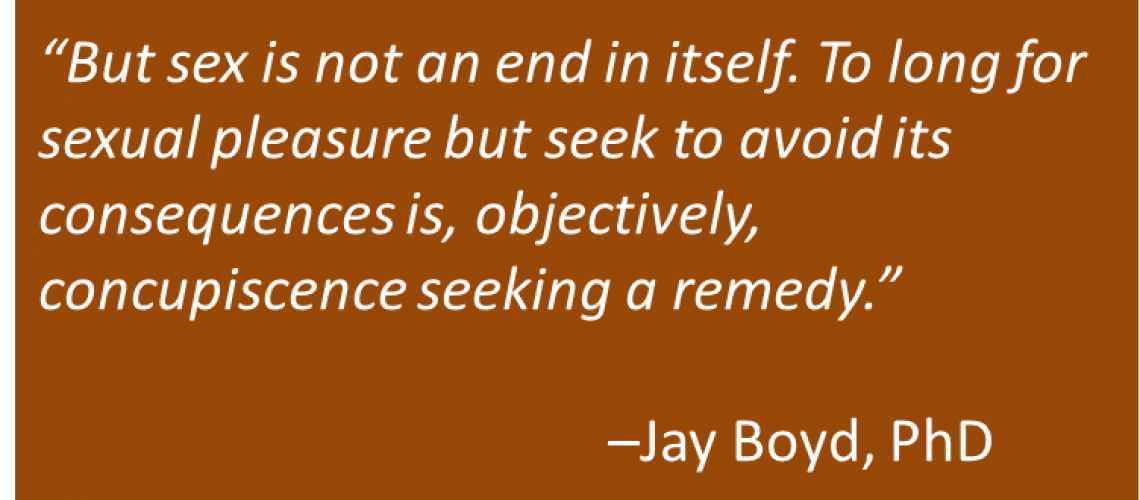
But sex is not an end in itself. To long for sexual pleasure but seek to avoid its consequences is, objectively, concupiscence seeking a remedy. Certainly we would say this of an unmarried couple (it’s called “fornication”). The traditional understanding of marriage is threefold: 1) the procreation and education of children; 2) mutual care and support for the married couple in their journey to Heaven; and 3) a remedy for concupiscence. And once upon a time, people actually got married first and then realized those ends. Nowadays, people seek the “remedy for concupiscence” (i.e., sex) first, and only afterwards might consider the other two ends. In the past, some couples probably got married primarily as a remedy for concupiscence, knowing that indulging their sexual appetites might lead to pregnancy; today we have a Pill to take care of the anxiety about the possibility of pregnancy, and many consider that license to satisfy their sexual appetites outside of marriage.
Taking the traditional view of marriage, if a man and a woman long to engage in the marital act, but are not prepared to have children, they should postpone marriage until they are truly “open to life”. They should not be thinking of ways to have sex that allow them to avoid that “consequence.”
The same goes for a married couple, really. When a married couple thinks the time is not right for pregnancy, the first option is abstinence; but, if desire is too strong, then charity demands that they engage in the remedy for their concupiscence. This remedy may be NFP. NFP as a “remedy for concupiscence” sounds, to me, a lot more honest in its presentation than touting it as a “way of life” or a “virtue.” From a marketing standpoint, though, NFP as a “remedy for concupiscence” doesn’t sound nearly as appealing as “NFP as a way of life”, or “God’s plan for the family”.
It seems silly to claim that one is “open to children” when one is organizing one\’s life around having sex not likely to be fruitful! The NFP “way of life,” when not practiced to achieve pregnancy, is all about sterile sex – sex that is meant only to make the couple feel good, with no consequences attached to that pleasure. The “background music” of the NFP way of life is always about sexual intimacy: “when we can, when we should, when we can\’t, and when we shouldn\’t”.
Our culture has a lot to do with our understanding of human sexuality. In a recent article addressing this issue, an insightful author notes that “Teen Pregnancy is Not the Problem”. Instead, she says, the problem is how the world presents the topic of “sex”:
The world says sex is primarily for pleasure. That sex doesn’t have to be for unity or procreation. That everybody’s doing it. That there is something wrong with you if you aren’t.
…The world tells us to act on all our urges as soon as possible. To get what we want, when we want it, always. To control our fertility instead of ourselves if we aren’t prepared to become parents.
…It’s time to use our lives to tell the world sex is primarily for procreation and unity…
Couples marry today with certain expectations about both marriage and sex shaped by public media. Sex is supposed to be “good” with a “good partner” and “personally satisfying”; in other words, sex is “all about the couple” – a variation on the theme of “it’s all about me”. People enter marriage today with a culturally-conditioned expectation that “sex is like what I\’ve seen in the movies” – which is to say it looks really great, and fun, and exciting! The NFP ideology (and that is what it is) does little to teach the true meaning of marriage, sex, or chastity, but is an unwitting participant in the unchaste sexuality that is rampant in our culture. To teach engaged couples about “family planning” of any kind is conceding that “family planning” (a.k.a., birth control) is a presumed need and value in today\’s Catholic marriages.
Certainly, today, the Church is failing badly in this area. Part of the reason for that stems from the 1960’s Church taking seriously the warnings from secular “experts” that the world was becoming overpopulated. Birth control was cautiously embraced because Church leaders didn’t recognize the errors in the overpopulation argument. The apparent needs of the temporal world loomed larger than the spiritual needs of parents that are met through generous parenthood providentially orchestrated by God. It seems as though, for a brief moment, Church leaders wondered if God maybe needed a little help in controlling population: hence, the concept of “responsible” parenthood, and the subtle movement from condoning periodic abstinence in certain serious situations to the idea that couples should rely on their own consciences to determine when to conceive a child.
I predict that, in the future, the Church will clarify what it teaches today, dramatically redefine the “serious reasons” necessary for use of NFP, and encourage it as a “remedy for concupiscence” rather than a positive, virtuous practice. My prediction stems in part from my belief that what is being taught today, and the verbiage being used to teach it, is, for the most part, wrong – at least on the very liberal end of the NFP spectrum.
There’s another, more pragmatic reason for my prediction: far from becoming overpopulated, the world is now beginning to suffer from the effects of decades of population control. We need more babies. People are now coming to an understanding of some principles of the economics of population growth which were previously unknown, unexplored, or ignored. I’m not an expert in this area, but even in the secular media we are beginning to see a growing awareness and concern about the need for more young people. And so if the Church wants to continue to meet the needs of the “modern world”, She will have to acknowledge that birth control should never be touted as a Catholic principle, and that now more than ever Catholic couples should be open to life, open to “generous parenthood” that puts the procreative end of marriage in its rightful place of primacy.
In the end, I think that might be called “virtuous parenthood”.
© 2013. Jay Boyd. All Rights Reserved.




150 thoughts on “NFP: Trojan Horse in the Catholic Bedroom?”
Thank you, Fr. Gardner, for your wise contribution to the discussion!
Dr. Boyd,
Thank you for your post and book… and especially for your research and writing on this topic. It is said that when you’re over the target, you get the most flak!
Despite all the clamoring and subtle distinctions; there is no denying that having sexual relations exclusively during the infertile times is sterile sex. St. Augustine taught that is this is always, at least, venially sinful. St. Augustine is a Doctor of the Church. As far as I know, St. Thomas Aquinas did not reject this teaching. Pope Innocent XI came close to affirming it. The question is: Is it true?
Ven. Archbishop Fulton J. Sheen taught that purity is love awaiting fecundity. In other words, pure love desires fruitfulness. Thus single people are to remain celibate until marriage when they are ordained to be fruitful. And married people are to remain docile to the gift of children, for God depends on their cooperation in the procreation of human life.
It seems to me that among married couples periodic continence can be licit for serious reasons, but not virtuous of itself. Therefore, I agree with Kevin’s frustration with the widespread promotion of NFP (planificacion familiar natural as they say in Spanish…). The last thing we Catholics need now is birth regulation!
There is this quote from Fr. J. Visser, C.SS.R. (1955, moral theologian-adversary of Bernard Haring): “Such a system, precisely, implies a positive right of use of conjugal rights together with the sensual pleasures inherent therein, as well as the fulfillment of the secondary ends of coitus (including especially the experience and expression of mutual married love), with, at the same time, the negative will of avoiding procreation. And it is precisely this union of two contradictory ends with gives rise to those problems as to its value…”
Fr. Gardner,
Thanks for your insights. In regards to your quotation from J. Visser, are you referring to Fr. Jan Visser, in his work Problems in Conjugal Life? Since there isn’t a citation, I’m stuck relying on Google here, but this seems to be legit as the sentences which appear before what you quote. Can you please provide a more accurate citation?
“The chief characteristic of the systematic use of periodical continence lies in its twofold finality – one positive and one negative. In truth, it is not, as its name would lead us to believe, a purely negative affair, simply abstaining from conjugal acts during specific times. Such a system, precisely, implies a positive right of use of conjugal rights together with the sensual pleasures inherent therein, as well as the fulfillment of the secondary ends of coitus (including especially the experience and expression of mutual marital love), with, at the same time, the negative will of avoiding procreation. And it is precisely this union of two contradictory ends which gives rise to those problems as to its value.”
I think the positive aspect is what is important to us here, in that no, periodic continence during times of fertility is not sinful, and since couples can use the marital right when they choose or not by mutual consent (Fr. Halligan), and that the “safe” method (of abstaining from sex during the fertile period) has been declared as “lawful” by the Church (according to Pummer), I still don’t see how this helps out Dr. Boyd’s assertions.
As far as Mr. McCreary, there’s a reason I asked for actual moral theologians before Vatican II. Even when Church fathers say things, they are not necessarily right. Moral theologians were the only ones qualified to speak on these issues before the Second Vatican Council (and the ones today we should honestly be focusing on.) These were the ones who were actually trained in how to diagnose what was and wasn’t sinful. They make the necessary distinctions that, with all due respect, neither you no Dr. Boyd make.
First, there’s simply no way to go against what was included in the teachings everyone has cited that the Church since the 1850’s clearly backed NFP. Yet when they did this, nobody objected to it. Not even the Old Catholics, who were pretty active around that time. So trying to place the teachings of the 1850’s against the teachings of earlier sounds, I dunno, rather Protestant?
Then there is the statement that “No pope has infallibly declined that NFP is without sin”, and acting as if since that has not yet taken place, you are free to argue as you do. That just isn’t the case, as Humani Generis makes perfectly clear, in addition to the Dogmatic Constitution Lumen Gentium on the infallibility of the Roman Pontiff and the bishops when they speak in communion with him. Since the Church in the 1850’s specifically said that an issue was not sinful (NFP), and hence not to be confessed in the confessional, that also comes right down to binding or loosing, which, as we know, the Holy Spirit protects the Church from error.
But what about your statement from the Holy Office, condemning the following proposition? “The act of marriage exercised for pleasure only is entirely free of all fault and venial defect.” Again, when the Church speaks about something, she does so in very precise terms.
When one seeks “pleasure only”, yes, that is sinful. Yet does the couple who practices NFP do that? Absolutely not. The marital embrace, in addition to its procreative aspect, does have a unitive aspect. Dr. Boyd scoffs at this, but it is pretty established medical and psychological science, to say nothing of its theological truth. This unitive aspect can never override the procreative. Yet if one uses an act which is meant to be the gift of self meant to strengthen a bond, and instead uses it for only (or even primarily) seeking the pleasure and gratification of your own senses, yes, that’s a problem. But to anyone who is actually familiar with what NFP teaches, no, that is not what they do.
So no, three moral theologians have not been cited. And we also know that a Pope has not been cited either. Then you added a bunch of faulty understanding of Church authority to go along with it, as well as a few insults and derision.
When one grasps at straws to draw a line between theologians and “moral theologians” and in the process disparages the Saints and Doctors of the Church, Augustine and Thomas Aquinas, as not “qualified to speak on these issues before the Second Vatican Council”, and not “trained in how to diagnose what was and wasn’t sinful”, you’ve already lost the argument.
It seems to me that any ‘problems as to its value’, or whether the conjugal act during the infertile time is virtuous or not depends on the reason for avoiding fertility.
If there is nothing to sex but procreation, then it does seem that one can only shake one’s head at the weakness of human beings for having to resort to sex when they do not desire a pregnancy.
However, since the Church teaches that there is also a unitive side to sex it seems that the conjugal act could be a positive virtuous thing in itself even during the infertile times, depending on the reasons they are avoiding.
The only circumstances under which ‘having recourse to the infertile times’ is virtuous is when the reason for doing so is consistent with the unitive meaning of the act. That is to say that the act can be ‘making love’ when the reasons for avoiding are themselves motivated by love.
If the ‘serious reasons’ are just and motivated by charity for one’s spouse and the good of one’s family, then love unites both the abstaining and the coming together into one seamless whole.
It seems to me that the arguments appearing in this article and comments are implicitly denying the unitive side of the conjugal act, perhaps because the unitive is mistaken with mere pleasure. This is aided by using the misleading language of ‘primary and secondary ends’. But I prefer the new language of the Church, because it’s in harmony with the old language, that of the ‘proles’, ‘fides’, ‘sacramentum’, because the unitive side is implicit within them.
Some questions:
1. Is sex during pregnancy or menopause or natural infertility also just a concession to weakness? If not, why not?
2. What morally distinguishes NFP users from contraception users? Anything?
3. Must serious reasons always be rare? Is it never possible for serious reasons to be common?
Hey Kevin! You have offered a challenge: “Cite me three moral theologians before Vatican II who advocate what you do.” Why don’t we start with you providing a concise statement of what you think Dr. Boyd advocates, so we don’t waste our time trying to guess what you think she is saying?
Boil it down to something simple like maybe, “Dr. Boyd says that NFP is only permitted for serious reasons” or “Dr. Boyd is advocating the strange idea that the marital act has a primary purpose and it’s not as an expression of love” or “Dr. Boyd thinks sex within marriage can actually be subject to lust and concupiscence” or “Dr. Boyd, contrary to all sane moral teaching, is encouraging married couples to trust in God’s Providence in their married lives” etc.
I have no idea what you think Dr. Boyd claims to teach beyond your powerfully verbose and distracting rants that I can’t begin to summarize coherently. Speak to little minds like ours. Make your allegations simple enough that we can actually do some research on something specific instead of a broad “I strongly disagree with whatever you seem to be saying. Show me three moral theologians who agree with you.” If we don’t get what you want Dr. Boyd to prove, it’s not likely that three moral theologians can be found to prove it.
Oh! And consider buying the book instead of fulminating from raw ideology uninformed by the contents of Dr. Boyd’s book. You only THINK you know what Dr. Boyd says and why. Until you actually read the book, you’re little more than noise.
I am going on what the article says here. Dr. Boyd states:
“NFP doesn’t explicitly fly in the face of such an understanding, but it is dramatically not submissive to God. NFP is all about a degree of control that is objectionable in any traditional Catholic understanding of marriage or Catholic spirituality in general.”
And
“It seems silly to claim that one is “open to children” when one is organizing one’s life around having sex not likely to be fruitful! The NFP “way of life,” when not practiced to achieve pregnancy, is all about sterile sex – sex that is meant only to make the couple feel good, with no consequences attached to that pleasure”
I think those statements speak for themselves. Those who practice NFP are doing something that is somehow of less dignity than “traditional” understandings, and that those who engage in it are engaging in “sterile sex” if they intentionally engage in the marital embrace during infertile times but not during fertile ones.
Find me moral theologians who actually teach that. I can cite you several competent church authorities as well as standard pre-vatican II moral theology textbooks which argue the precise opposite of Dr. Boyd, and I have in my counteressay.
What her book says for the moment is irrelevant. I’m going by what this article states. And this article states something that is completely alien to traditional catholic understanding of marriage and procreation.
To Kevin Tierney: In answer to your challenge that “nowhere do the Popes teach that choosing to engage in the marital embrace specifically during times of infertility and abstaining during fertility for sufficient reasoning is sinful. Nor do moral theologians before Vatican II teach that.” … I hope you … as a self-proclaimed so-called traditionalist will accept: 1) a decree from the Holy Office from A.D. 1679 (far earlier than your A.D. 1853 reference), 2) St Augustine — Saint and Doctor of the Church, surely he qualifies as a moral theologian before Vatican II, and 3) St Thomas Aquinas — another Saint and Doctor of the Church, who also surely qualifies as a moral theologian before Vatican II. I’m certain that you, as a self-proclaimed, so-called traditionalist will clearly see the constant and undeniably consistent Tradition that spans from A.D. 419 to A.D. 1679 (that’s 1260 years), which far outweighs the weak and pathetic span of A.D. 1853 to A.D. 2013 (a mere 160 years), that contradict the previous Traditional teachings of over 1260 years.
You can claim that the Holy Office in A.D. 1679, St Augustine, and St Thomas are not infallible, but I can respond with NO POPE has INFALLIBLY declared that NFP is WITHOUT SIN. So you … as a self-proclaimed, so-called traditionalist … are left with what argument has the GREATER amount of Tradition backing it. Refuse to accept the weight of Tradition, and you are no traditionalist.
First, from a decree of the Holy Office, March 4 1679, listing various errors on moral subjects, to include: “The act of marriage exercised for pleasure only is entirely free of all fault and venial defect.” … which the Holy Office condemned and prohibited, as here expressed, at least as scandalous and in practice pernicious. [D. 1159]
Then, “It is, however, one thing for married persons to have intercourse only for the wish to beget children, which is not sinful: it is another thing for them to desire carnal pleasure in cohabitation, but with the spouse only, which involves venial sin. For although propagation of offspring is not the motive of the intercourse, there is still no attempt to prevent such propagation, either by wrong desire or evil appliance. They who resort to these, although called by the name of spouses, are really not such; they retain no vestige of true matrimony, but pretend the honourable designation as a cloak for criminal conduct.” [Augustine, On Marriage and Concupiscence, Book I, Ch 16]
And more, “[…] they make a perverse use of it,—not alone all kinds of lawless corruptions […] even in the marriage state itself, whenever husband and wife toil at procreation, not from the desire of natural propagation of their species” [Augustine, Treatise on the Grace of Christ & Original Sin, Book II, Ch 43]
Finally, “The aforesaid act does not differ from the act of fornication except in the aforesaid goods. But the act of fornication is always evil. Therefore the marriage act also will always be evil unless it be excused by the aforesaid goods.” and the “aforesaid goods” are “One of these is required on the part of the agent and is the INTENTION OF THE DUE END, and thus the OFFSPRING is accounted a good of matrimony; the other is required on the part of the act, which is good generically through being about a due matter; and thus we have faith, whereby a man has intercourse with his wife and with no other woman.” [Thomas Aquinas, ST Sup. Q. XLIX A. II & V]
So, you’re challenge is answered. The Holy Office, with the permission of the Pope, St Augustine, and St Thomas Aquinas … all before Vatican II do “teach that choosing to engage in the marital embrace specifically during times of infertility and abstaining during fertility for sufficient reasoning is sinful.”
And that’s three. Three that you would have been given if you actually read Dr Boyd’s book, and one of which she provided for you here in the comments (St Thomas Aquinas’), which you just ignored.
If anyone is actually interested in what moral theology and the Catholic church taught about NFP before Vatican II, they will find it tends to be worlds different than what Dr. Boyd is positing.
http://commonsensecatholicism.blogspot.com/2013/04/jay-boyd-and-traditionalist-trojan-horse.html
My goodness. I’m more than a little confused about this conclusion. I don’t know where you got your education on NFP, but it certainly doesn’t sound like any Church-approved NFP teaching I’ve heard!
The *entire* premise behind the Church’s teaching on NFP is that Catholic couples should be “open to life” and “generous parenthood.” That using NFP to avoid pregnancy should be *only” for “serious reasons”. Every teaching session I’ve ever seen has included a discussion on what “serious” reasons generally mean, though it’s disclaimer-ed as not an all-inclusive list. And there is plenty of teaching that a contraceptive mentality about sex is inherently sinful.
I mean, if you’re being properly taught the tenets of NFP, then all of these issues are made first and foremost, clear. Half of teaching NFP is teaching on why a contraceptive mentality is inherently wrong, because too many people either 1) don’t even know they have a contraceptive mentality or 2) don’t know there’s anything wrong with a contraceptive mentality.
I propose that if you think any differently about these topics, your education on NFP, its aims, and it proper use is deficient. Whether or not that is a widespread problem, I cannot say. I honestly don’t know… but everyone I know who uses NFP merely uses it to space their children so they don’t end up with babies that are so close together that one is deprived of his natural right to his mother’s milk or because of serious health concerns.
Additionally, like many others who decry NFP, you are seeming to forget that avoidance of pregnancy is only HALF of the use of it. The other half is how to ACHIEVE pregnancy! For example, how to overcome fertility problems so that people aren’t herded en masse to the IVF clinic because their doctors cannot figure out what is wrong and don’t want to be bothered with details like whether or not a woman’s hormones are balanced!
That, if nothing else, is worth its weight in gold to a newly married couple– the idea that if you have fertility problems, there are Church-sanctioned ways to overcome them, without all kinds of artificial hormones or insemination or or or!
The posting above is the “conclusion” to Dr. Boyd’s book which, with appendices, is 265 pages long. No one in the comments posted so far gives any evidence of having read her book and, quite disrespectfully, presumes that she is completely unaware of the various quotations from the Magisterium that appear to contradict what she has posted in this “concluding summary.”
Personally, I don’t think that Humanae Vitae is in any way contradictory to Dr. Boyd’s thesis. Humanae Vitae clearly says that NFP is permissible for serious reasons. So does Dr. Boyd. How is it possible to miss Humanae Vitae’s recognition of “remedy for concupiscence” in its description of the marital act during infertile periods as a means to “safeguard their fidelity toward one another.” Nowhere in Humanae Vitae is the marital act described as “an end in itself.”
When pompously encouraging fidelity to the Magisterium both before and after Vatican II, is it really conceivable that what is routinely taught today about married sexuality is remotely consistent with CENTURIES of teaching about marriage prior to Humanae Vitae? Did Humanae Vitae just cancel out all prior teaching on marriage? I think it would be fair to say that much pastoral teaching and practice on marriage and married sexuality today is a RADICAL departure from CENTURIES of prior teaching. Sex is talked about today in ways that would make most canonized Saints, including married ones, blush in shame. Can you even imagine “NFP language” in the mouth of Our Blessed Mother? Doesn’t it say something important that you can’t?
Sexual intercourse during infertile periods is PERMITTED for SERIOUS REASONS because the primary purpose of marriage and the marriage act is and can only be procreation. If couples MUST engage in the marital act without risking pregnancy “to safeguard their fidelity toward one another” then they MAY make use of the infertile periods. This is clearly a concession to human weakness, not a definition of a new and virtuous way to live the vocation of marriage.
Whatever JPII is thought to have said or intended in his Theology of the Body talks, it cannot be understood in contradiction to what the Church has always taught. Sex is not an end in itself, but within marriage AND properly understood as a cooperative act with God Himself, it is worthy of mystical contemplation. But the marital act is NEVER an end in itself, any more than the secondary ends of eating — like fellowship and community building — can ever be judged as acceptable ends for the purpose of eating itself, which is nutrition.
Minor “enlightenments” that may or may not have proceeded from relatively minor Church responses to narrowly defined questions cannot be seeds for a complete overhaul of the centuries of Church teaching that went before it. Current Church teaching hasn’t achieved any degree of consistency to consider it as having reversed everything (or anything) that came before. St. Thomas Aquinas and St. Augustine still have something to say to us today. The avalanche of embarrassing silliness that has proceeded from the response to a simple dubium of 1853 ought to sober us to the possibility that we just may be radically wrong in how we are proceeding today.
‘If couples MUST engage in the marital act without risking pregnancy “to safeguard their fidelity toward one another”’
You make it sound like a chore. If that’s the case, forget marriage.
I am catching a faint Gnostic whiff from much of the content of this post and combox. Impossible, right?
Dr. Boyd,
As was cited above in the previous article, and by Pius XI in Casti Conubii (as well as his magesterium explicitly allowing NFP in their directives to the worlds bishops) this very easily reconciles.
While indeed everything that comes after Vatican II must reconcile with that which comes before it, it is also just as true that what comes after can clarify that which existed before, provided it does not contradict. That’s what Paul VI did in Humanae Vitae, and JPII did in Familiaris Consortio.
Thomas and Augustine have not been declared “null and void” by the Magesterium. but nor is everything they say infallible. So even though their statements can be reconciled with what later popes said, if they can’t, so what? I don’t have to reconcile the teachings of later Popes on heretical baptism with St. Cyprian, or Augustine’s (by his own admission) Neo-Platonist views on sex in his early writings with later ones. Besides, I’m not the one claiming that an accepted practice of the Church since the 1850’s (when medical science started to understand fertility cycles to the level NFP was possible) is destroying a Catholic view of sexuality, marriage, etc. You are, so the burden of proof is on you to back it up.
So my challenge remains. Cite me three moral theologians before Vatican II who advocate what you do. If you can’t do three, give me two. If you can’t do two, give me one. Don’t have to give the full quotes, you can leave that to your book if you cite them. yet let’s just see the citations, so we can all do the research on our own.
This isn’t a matter of anyone being “close-minded.” As someone about to be married, I get the whole “responsbile parenting” crap all the time when I indicate there will be kids, and there will be several of them. I also don’t like that dioceses make it mandatory for perfectly orthodox catholics who clearly have no intent to contracept being forced to take classes by some lay teachers who clearly are unqualified. I also think it would be a good idea for the Magesterium to offer better guidance on what constitutes grave and serious reasons.
Yet that’s different than challenging the teaching itself, or trying to do so by denying it with the death of a thousand qualifications.
Kevin, I’m not saying I disregard everything that comes after Vatican II! I’m saying there needs to be continuity between the two time frames. Anything that comes out of Vatican II has to square with solid Church teaching; if it doesn’t, there’s a problem.
I also don’t pretend to be a “qualified moral theologian”; but I do cite Church teaching extensively in my book. You’re setting up a straw man here. I am a thinking adult who can read the documents, as well as what “qualified moral theologians” and other “qualified” experts have to say on the issue. I’ve come to a conclusion that is supported by traditional Church teaching and NOT UNsupported by Vatican II or Humanae Vitae.
You say you’re a “traditionalist”, yet your comments indicate a lack of willingness to consider what has been traditionally taught. You have yet to show that Thomas Aquinas and Augustine have been declared null and void by “the Magisterium”.
Frankly, I’m not interested in engaging in a debate with those with closed minds. I’m interested in reaching out to those who have a vague feeling that there’s something a little off-base with NFP, but who are pressured and criticized by family and friends who want them to practice “responsible parenthood”. Anyone who has waded through these comments and feels that way, feel free to contact me privately by email ([email protected])if you don’t want to brave the com box.
I think Dr. Boyd should also look at someone who is a traditionalist, and unlike her, actually is a qualified moral theologian has to say about NFP and its roots before the Second Vatican Council:
http://www.catholicculture.org/culture/library/view.cfm?recnum=6452
The money quote, from a formal dubium….. in 1853.
“The first time Rome spoke on the matter was 1853, when the Sacred Penitentiary answered a dubium (a formal request for an official clarification) submitted by the bishop of Amiens, France. He asked, “Should those spouses be reprehended who make use of marriage only on those days when (in the opinion of some doctors) conception is impossible?” The reply was: “After mature examination, we have decided that such spouses should not be disturbed [or disquieted], provided they do nothing that impedes generation” (quoted in J. Montanchez, Teologia Moral 654, my translation). By the expression “impedes generation,” it is obvious the Vatican meant the use of onanism (or coitus interruptus, now popularly called “withdrawal”), condoms, etc. Otherwise the reply would be self-contradictory.”
I hope anyone who reads this article also manages to read the comments here below, where actual Church teaching is cited, rather than just mere opinions trying to skirt the obvious.
Dr. Boyd,
There’s a problem with what you are saying here:
1.) You cannot say you “stand with the Magesterium before Vatican II” without also standing with the Magesterium After Vatican II. We are not the SSPX. Humanae Vitae is just as much a part of the Magesterium as was Castii Conubii, and they give the same teaching about the validity of NFP, and nowhere do the Popes teach that choosing to engage in the marital embrace specifically during times of infertility and abstaining during fertility for sufficient reasoning is sinful. Nor do moral theologians before Vatican II teach that. I’ll issue an opening challenge for you to find 3. Then two. Then finally one. You won’t. One doesn’t need to consider Dr. Smith here, though at least on this aspect, she is right. (Though wrong on a great many things.) So let’s stick entirely within Pre-Vatican II. Show me the moral theologians who teach as you do.
You are correct that couples, when choosing NFP, should do so for “serious” reasons by utilizing the mind of the Church. And you are also correct that many do not. I think I presumptiously speak for Bruce when I say that what you outline here and on your other blog posts is most certainly not the mind of the Church, since the mind of the Church includes what was written in Humanae Vitae.
I’m a traditionalist. I think its absurd that couples should be forced to undergo NFP training, and then told that they must practice it in order to be married in many dioceses. Yet that doesn’t change the fact that not only is NFP not sinful, Humanae Vitae is part of the Magesterium to which you owe your allegiance.
Before Vatican II Moral theologians (who were only priests) were severly limited on what they could speak about in regards to this stuff for popular publications. It seems that when you talk about the “glory days” before Vatican II, you mean the glory days except the part where your bishop would forbid you from publishing this work in public for mass consumption. With all due respect, the traditionalist in me wouldn’t mind a return to those days.
Kevin and Bruce, I have not set myself up as “the Magisterium” (and I might remind you that Janet Smith is not “the Magisterium” either!). I have aligned myself with the Magisterium of the Church that includes the doctors and fathers of the Church who preceded Vatican II by a good many years…centuries in some cases, but even the popes who reigned just prior to Vatican II would have been appalled at where the personalistic ideas underlying much current thinking on NFP have led us! The Church did not come into existence at the conclusion of the Second Vatican Council! All I’ve done is approach the concept of NFP with the words and thoughts of learned and holy minds that predate Vatican II and that reflect the longstanding traditional teaching of the Church on marriage.
Bruce, the Church currently teaches that it is licit to use NFP, but only for serious reasons. Whenever I state that, NFP promoters jump in to say that “serious reasons” are up to the couple to decide. This is not entirely true. We must always form our conscience in accord with the mind of the Church. It is true that there is no “list” of what constitutes a “serious reason”, but that does not mean that every reason a couple thinks of to avoid pregnancy is a serious one.
Our current culture is not in much danger of becoming overly scrupulous, I would say. The emphasis on sex is detrimental to the spiritual growth a couple might experience when they think of eternity, and souls to populate heaven. God loves to give us children; He doesn’t promise that having children will not involve sacrifice. In fact, it does involve sacrifice – sometimes a lot. And that is our path to holiness.
I think Germaine Grisez and Janet Smith have covered this comprehensively already.
I think NFP is abused in a lot of cases. but the ideas you promote here quite simply aren’t what the Magesterium teaches. They do not teach “sex for pleasure is always venially sinful”, as if husband and wife are not meant to enjoy their coming together to renew their vows.
And the simple fact is Humanae Vitae takes a far more permissive line doctrinally and pastorally than you do. You can say it should be strengthened (which you do) but to say others are wrong for following its guidelines, well, that’s just something you can’t say.
Respectfully, I don’t see how your blogpost skirts around these facts of Humanae Vitae. Yes, the document in many instances was not as thorough as it should have been, or started from incomplete premises. John Paul II said as much when formulating his Wednesday audiences for “Man and Woman He Created Them” because HV, while speaking the truth, its anthropology (the underpinnings of the human person that the ban on contraception speaks from) was incomplete at best. Yet it still spoke the solid truth.
I’m with you Kevin. Dr. Boyd is not the Magesterium and the Church has spoken on this issue. I may or may not agree with her, but her opinion is not binding while the Church’s is.
Thomas Tucker: I address HV in the book in a couple of places, but in particular in a chapter entitled “Everything I Didn’t Want to Know About Humanae Vitae”, which appeared as a post on my blog: http://philotheaonphire.blogspot.com/2012/05/everything-i-didnt-want-to-know-about.html. That will give a better answer to your question than a few words here.
Erik, thanks for your feedback.
Mary Ann, there’s much I could say. It’s in my book. But your statement “when the Church asks us to joyfully accept children in our marriage, there should be no strings attached.” I’m not sure what you’re getting at. The Church doesn’t attach strings, but those seeking to limit the number of children they have sure do! “Yes, God…but not till we have a bigger income” etc…
Concupiscence is defined in Webster’s dictionary as “ardent sexual desire, lust”. By choosing this word, it seems to me that you are implying that sex between a husband and wife is somehow lustful and selfish if it is not always seeking to create new life… or, at the very least, less meaningful. Your suggestion that a married couple should completely abstain from sex rather than take the “easier route” of using NFP when they want to space their children, is both unnecessary and unnatural. It effectively creates a ‘burden of proof of love’ that needs to be met before every marital act can be performed. Do you actually mean this?
Far from being an easy way out, NFP takes discipline and restraint to practice correctly. It respects the dignity and fertility of the woman, but also acknowledges the unitive value of expressing intimate love in a healthy, married relationship. To imply that NFP is somehow unvirtuous or unbecoming to Catholic married life is quite a stretch.
While every child is a blessing, not every couple has the economic means or the physical/mental fortitude to have a large number. This doesn’t make them selfish or materialistic. As with everything, God gives us free will. Likewise, when the Church asks us to joyfully accept children in our marriage, there should be no strings attached.
You probably have a point buried behind the sweeping generalizations you make in the opening paragraphs, e.g., “NFP promoters see the marital act …”.
How do you know how these people see something? Perhaps you meant “The consequences of a philosophy that promotes NFP point to …” or something similar.
I’m sure you meant well, but you may take as one data point that I didn’t read beyond what I viewed as uncharitable phrasing.
Outwardly keeping the law while breaking the heart of it, it’s really not that complicated.
Interesting comments and article. So, Dr. Boyd, what is your take on Humanae vitae in light of your other research?
LJP (and indirectly, Kevin),St. Thomas Aquinas discussed marriage in the Summa Theologica Supplement, question 49. Though he doesn’t use the term “remedy for concupiscence”, he certainly addresses whether or not there is sin in the marital act itself. He says that there can be something sinful about the marital act, but of course there is no sin in the sacrament of marriage. This means that the Church “indulges” us by allowing and sanctifying marriage, but: “…wherever there is indulgence, there must needs be some reason for excuse. Now marriage is allowed in the state of infirmity ‘by indulgence’ (1 Corinthians 7:6). Therefore it needs to be excused by certain goods. “ I don’t think it is unreasonable to see this section of the Summa as addressing marriage as a “remedy for concupiscence”.
St. Augustine composed a treatise on “Marriage and Concupiscence” (see http://www.fordham.edu/halsall/source/aug-marr.asp), which addresses the issue of marriage as a remedy for concupiscence; it describes how the sacrament of marriage doesn’t eliminate the potential of venial sin in the motivation behind the marital act, but does render that sin venial as opposed to mortal.
In Casti Connubii (written in 1930), Pius XI says: “…For in matrimony as well as in the use of the matrimonial rights there are also secondary ends, such as mutual aid, the cultivating of mutual love, and the quieting of concupiscence which husband and wife are not forbidden to consider so long as they are subordinated to the primary end and so long as the intrinsic nature of the act is preserved.” (59)
The 1917 Code of Canon Law discussed “mutual assistance and the remedy of concupiscence” as the secondary end of marriage, although the 1983 CIC does not use that language. However, the fact that “remedy of concupiscence” doesn’t appear in current canon law, and the fact that post-Vatican II popes have not addressed it does not mean that the traditional view of marriage which holds that “remedy” to be part of the second end of marriage has ceased to be a Catholic truth.
The issue is addressed in several places in my book, especially in the chapter entitled “Sex for Pleasure: Always a Venial Sin”. (You can read it at http://philotheaonphire.blogspot.com/2012/06/sex-for-pleasure-always-venial-sin.html). In fact, you can read all of the chapters at my blog – look for the NFP tab at the top of the page. The book does include additional material.
Catholic Stand readers can receive a $5 discount off the retail price of the book by ordering at https://www.createspace.com/4176340 and using discount code 2Y3Q6U8S.
Thank you for the reply and the $5 discount link!
Your comments address well your point in using the term “remedy for concupiscence”, but the article remains easily misinterpreted and gives natural family planning a much different look than HUMANAE VITAE does, and to that effect I think it does a disservice to those truly seeking help and clarity on this issue.
No time, but can you answer this: Does the Church teach that natural family planning – performed correctly – is okay or not?
I assumed that she did and does.
What lies beneath that – the details – are the domain of the individual couple and their priest and/or spiritual director.
Simple as that.
Promoters of NFP can certainly get it wrong, but I believe this is not the common occurrence as you state. A contraceptive mentality is always wrong and harmful to marriage and family, no matter what method is being used.
Your traditional ends of marriage do not coincide with the Church’s ends of Marriage. The Catechism only states the first 2. If someone is lustful before marriage, their getting married is not going to remedy that. They will just transfer that to their spouse.
The Church is in clear support of natural methods of family planning. I quote HUMANAE VITAE here: “If therefore there are well-grounded reasons for spacing births, arising from the physical or psychological condition of husband or wife, or from external circumstances, the Church teaches that married people may then take advantage of the natural cycles immanent in the reproductive system and engage in marital intercourse only during those times that are infertile, thus controlling birth in a way which does not in the least offend the moral principles which We have just explained.”
CONTROLLING BIRTH IN A WAY THAT DOES NOT IN THE LEAST OFFEND THE MORAL PRINCIPLES. It is indeed possible. This is the goal of NFP.
Another quote from HUMANAE VITAE clearly shows that using NFP is much more than a “remedy for concupiscence”. quote: “And when the infertile period recurs, they use their married intimacy to express their mutual love and safeguard their fidelity toward one another. In doing this they certainly give proof of a true and authentic love.”
The only way I can see your point being valid is if I use your statement, “the very liberal end of the NFP spectrum”, to mean your whole article is to point out just those people’s flawed thinking, and not NFP itself being the problem.
Your article is misleading and could be cause for scrupulosity among people who don’t understand this topic more fully. I hope to read your book and see if it clarifies your views to be well-ordered and morally secure.
Pingback: Music as a Character-Forming Force - Big Pulpit
Dr. Boyd,
Thank you for giving me a perspective on NFP that I hadn’t fully considered. I knew that it could be abused; retaining a contraceptive mentality while technically following Church teaching. I had never heard of your third aspect of the traditional understanding of marriage as a ‘remedy for concupiscence’. Could you lead me to some background on this? Is this more thoroughly expounded upon in your book? It does make sense though.
When one says marriage (and specifically the marital embrace) is a remedy for concupisence, all sacraments in a certain sense lessen the impact of concupisence in our lives. Since marriage is meant to be modeled upon the union of Christ and the Church, this happens in a special way. Everytime you positively affirm your marriage (in doing things for your spouse, living up to your obligation of fidelity) you are “dying to self” a little bit, and living for the other, as we should die to ourselves and live for Christ. This is a remedy.
When spouses come together in the marital embrace, this is a remedy for concupisence in the sense that every time this occurs (with the right intention) they are renewing their marital covenant and their vows to each other
One place to look for more about marriage as a remedy for concupiscence in Augustine’s On the Good of Marriage.
Pingback: NFP: Trojan Horse in the Catholic Bedroom? - CATHOLIC FEAST - Sync your Soul
I think this topic hits at the root of many, if not most, of the moral ills of our society! Acceptance of and practice of contraception in our society has changed sex from being primarily about creation of immortal souls (persons) destined for heaven to “my pleasure.”
Here’s the analogy I use. Tonight, at a hospital near you, a little baby is going to be born. The life of that little baby began about nine months ago. One day, that hospital won’t be there. Neither will the city, the state, or the country. But that little baby will still be around! He or she will be around forever, according to God’s plan! And what the contracepting couple are telling God is this: “We know, that by this act, it may be Your Divine will that we participate in the creation of a person who will live forever. We know that may be Your will. But WE won’t let YOU do it!” An in-your-face “NO!” to God! We call that sin. And sin always has dire consequences.
Nice try but periodic abstinence, even when guided by NFP science, is not contraception. Not ever.
Now go and sin no more, Steve.