

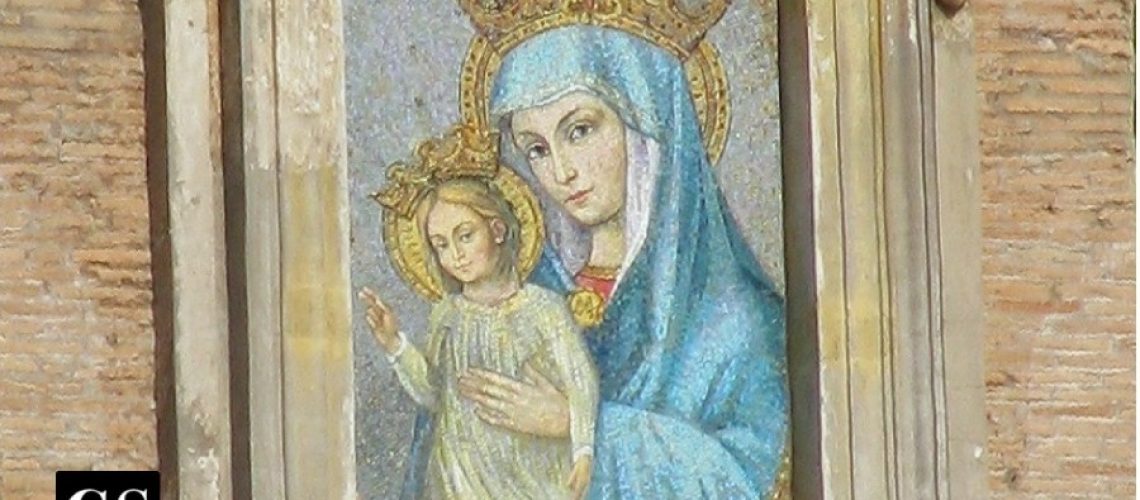
May is the month of Mary. At our parish, early in May all the children are invited to participate in a Mary crowning. They gather at the back of the church and every child gets a flower, a vase of flowers, or the pretty, floral crown. Then, right before Mass they process up to crown Our Lady in blossoms.
It’s a delightful, little tradition. The big statue looks so spring-like and well-loved in her abundance of blooms. The children come up in little clusters. Some chewing the ends of their flowers, others helping tiny siblings walk up. It’s noisy and a little chaotic. This year the crown came tumbling off during the Kyrie and had to be reset by a smiling grandfather in the front pew.
This little tradition, with all its folksy charm and casual devotion, reminds us all that Mary is our Mother – the perfection of motherhood. She loves receiving all our tiny acts of affection and presenting them to her Son. When we approach our Mother with tenderness and devotion, she can see in us the tenderness of the Child Christ who rested His head on her heart.
This year, our parish crowning happened on Mother’s Day. I’m not a big fan of Mother’s Day in general, but it was nice this year to see it pulled from its secular, and often self-congratulatory moorings and centered around the Mother of God. In fact, starting the day with the crowning seemed to change the flavor of the day entirely. Instead of the commercialized day of indulgence it’s become, it began to look more like the Medieval “Mothering Sunday.”
Mothering Sunday in Medieval England
There’s still a celebration of Mothering Sunday in England today, but these days, it bears a strong resemblance to the American Mother’s Day. Originally though, this little celebration on Laetare Sunday celebrated the Motherhood of the Church, Mary the Mother of God, and each individual’s own “mother church” – the church in which he was baptized.
Catholics throughout the British Isles would make pilgrimages to their own “mother churches” or to the local cathedral on Mothering Sunday. These pilgrimages usually also enabled them to visit family members who still lived in the mother parish.
As with all medieval devotions relating to motherhood of any sort, devotion to the mother church quickly expanded to embrace the motherhood of Mary. While one’s natural mother was often visited on Mothering Sunday, the primary focus was on the Mother of God, and the Church.
Making Do with Mother’s Day
As much as I would prefer the medieval option, I’m not a stickler about it. After all, I may not care much about Mother’s Day, but my own mother and my mother-in-law do. In my own house, I try to spend the day being a little bit more nurturing to my little family and my extended family as well.
Mother’s Day is in a bit of turmoil right now (what isn’t though, right!). Listening to the radio or skimming through advice columns online, I find a host of advice for adult children whose mothers “don’t deserve your time on Mother’s Day.” There are grievance articles from grown children to the “parents who failed us completely,” and even how-to articles on “talking to your boomer parents” about what they did wrong.
Honestly, these are all unnecessary. Of course, we all make mistakes, and yes, your parents made a lot of them too. So did mine. So do I. But unless your mom was an actual monster, it’s likely she did a lot of good too. Looking back to our parents with eyes of judgement is rarely helpful – instead, I like to look at my parents as the poet Rilke encourages us to look at a work of art, remembering that “only love can touch and hold them and be fair to them” – just as I hope God will look at me when, at the end of my life, all my sins and virtues are spread out between us for His Judgement.
Approach With Love
My own mother is coming home to her woodland cabin a few days after Mother’s Day. I can already picture her stepping down from the truck after they pull into the drive – eyes alight with love. She knows she has a place here, in the hearts of her children and grandchildren. A place imperfectly but oh-so-lovingly carved year after year.
The older I get, the more I see the Marian aspects in her. The more grateful I am for her gentle visitations. Once, not long ago, my priest gave me the penance of “complimenting someone in the spirit of the Visitation.” I had such a hard time figuring out exactly what that meant, but when – half the day later – I did fulfil my penance, I felt so close to Our Lady.
In the month of Mary’s Motherhood, I’d invite you to do the same. Greet your own mom (whether living or not) in the spirit of the Visitation. Draw close to her with all her virtues and all her faults. Find a way to appreciate the former and forgive the latter. “Only love can touch and hold and be fair to” our parents. So be gentle with them. Greet them as the works of art they are and love them “like locked rooms and like books that are written in a very foreign tongue.” They’re mysteries, made in the image of Christ, waiting to be loved fully in eternity.
In this time of constant judgment and criticism, let your mother see in you a fragment of Mary’s Visitation to Elizabeth. Let her rest in your love and feel the joy of old age in the heart of her family. Let the dead gather around you to soak up the comfort of your prayers. Let your life be a light to those now resting from labors and a ray of hope to those staring into the sunset. I’m still learning to be that visitation, but May is a perfect month for practice and new beginnings.





1 thought on “Mary, Motherhood, and Visitations”
Ah, Marsha, when I see your name I drop everything and start reading. And you do not disappoint.
Thanks for this. My mom is long gone, and I only have good memories. I didn’t see much of her growing up, I was a boarding school brat. My parents were farmers—long dirt roads and no school bus system – another era.
But I remember only her love and sacrifice and all she did for me.
I would love to meet you some day. Take care and here’s a cyber hug.