

The twentieth century was fully consecrated by Our Lord to the Blessed Virgin Mary. This benediction began a few years earlier with the marvelous apparition of Our Lady in the poor village of Knock, Ireland, witnessed by fifteen men, women, and children, ranging in age from 5 to 74 years old. On the evening of August 21, 1879, she appeared accompanied by Saint Joseph, Saint John, and the Eucharistic Lamb in front of the Cross, surrounded by angels. The immobile vision lasted several hours and was completely silent.
Then the wonderful apparitions of Fatima in 1916–1917 were the final proof of this consecration of an entire century to the Virgin Mary. She appeared to three Portuguese children. Two of them, Jacinta and Francisco, died shortly afterward and will be canonized, and the third, the elder Lúcia, eventually became a Discalced Carmelite sister in a monastery in Coimbra, Portugal. She lived there until the age of 97, surrounded by the love and attention of Catholics. She died in 2005 and is now in the process of beatification.
At Fatima, the Virgin Mary revealed the deep crises of European and world humanity involved in the terrible war of 1914–1918. She acted as the powerful and suffering Mother of all humanity. Her apparition was a profoundly moving act of maternal love, inspired by the love of Our Lord for human beings. After the apparitions of the Angel in 1916, the Blessed Virgin appeared to the three children six times in 1917, from May 13 to October 13, and confided to them profound heavenly truths and serious secrets.
In particular, Our Lady warned at Fatima that the atrocities of the First World War could provoke another world war. And indeed, the Second World War began.
We now present the later intervention of Our Lord and Our Lady during and immediately after this second war. It occurred in occupied France in 1943, amid the misery of defeat by Nazi Germany. French Catholics remembered that the centenary of the apparition of Our Lady at La Salette (September 19, 1846) was approaching. For about twenty years they had already been celebrating Marian Congresses with pilgrimages to the most famous shrines of the Blessed Virgin Mary in France. These began in 1926 and continued every four years.
Because of the war, no celebration could take place in 1942; it was replaced by a penitential pilgrimage of young female students to Notre-Dame de France. The apparition at La Salette, however, was deeply French and of great importance, with a well-preserved public memory. At that time, one could even wonder whether the Grenoble–La Salette Congress could really take place, since the end of the war was not yet in sight. Nevertheless, the National Committee chose the option of faith.
Thus His Excellency Mgr Caillot, Bishop of Grenoble, and the Very Reverend Father Cruveiller, Superior General of the Missionaries of Our Lady of La Salette, asked that La Salette be included in the series of Marian Congresses for the year 1946, to commemorate the centenary of the apparition. This proposal was accepted in principle. On November 25, 1943, a letter was sent to Pope Pius XII, ending with these words:
Most Holy Father, the French National Committee of Marian Congresses aspires to be a modest but very active instrument of Christian renewal, through Our Lady, ever more known and ever more loved (Marie corédemptrice – La Salette, MC-LS, p. X).
The Pope replied on December 31, 1943, with sincere sympathy for the humiliation of France and generous approval of their plans:
France, the Kingdom of Mary, so sorely tested by current events, will unite to celebrate the Centenary of the Apparition of La Salette and rekindle its filial piety toward its august Protectress. No one doubts that many graces will be bestowed upon it on this occasion.
The war continued on all fronts, and hope for the liberation of France was nearly nonexistent. France was only partly occupied by the German army; the southern part collaborated with Nazi Germany and was its weak military ally. For this reason, the German occupation tolerated purely civil religious manifestations of the Catholic Church, including pilgrimages and celebrations.
But when the time of the centenary arrived, the war had ended. France was free. The celebration thus became an act of thanksgiving by the people of France, who in humility offered it to Our Lord and Our Lady in gratitude for the end of this terrible ordeal.
By chance, I purchased the book Marie corédemptrice, La Salette, published in 1948. It is a powerful and tragic account, over 400 pages long, of how the centenary celebration of the apparition of La Salette was prepared and organized from 1943 to 1946. The tone of the book is calm and restrained, yet it conceals the immense poverty of French life during and after the war. The following passage expresses, in both modest and vivid terms, the difficulties caused by the war in preparing the centenary:
The date of 1946 fell within an immediate post-war period fraught with difficulties. The preparation for the Congress, which had to be planned well in advance, took place during the war (MC-LS, p. 1).
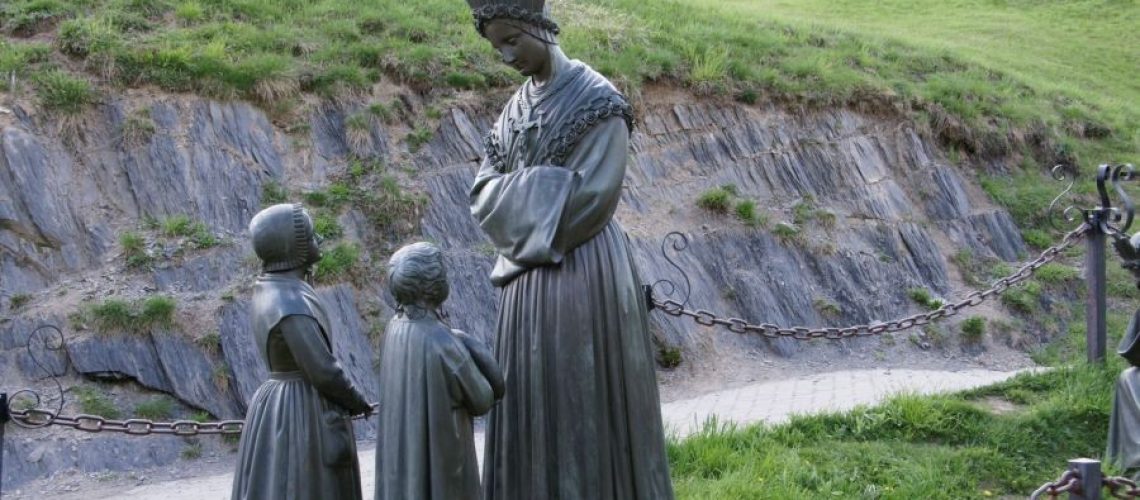
The book opens with a pastoral letter from Bishop Caillot of Grenoble (MC-LS, pp. XVII–XXXVII), recounting calmly and in detail the story of the Virgin Mary’s sorrowful visit to the mountains. The story was extraordinary and, in the end, marvelous, but in truth it was profoundly sad. At the very beginning of the apparition, on a bright sunny day, the Virgin sits down and weeps bitterly. She appears in a deserted place used only for grazing cattle, in a beautiful but sparsely populated mountain region.
She came to speak to two shepherd children from the same village below, who did not know one another. One was a girl of fifteen, the other a boy of eleven. Each had come separately with small herds of four or five cows. The children were illiterate and scarcely knew how to pray. They did not understand who the Lady was or what she was saying to them in French, for she first spoke to them in beautiful French and later continued in this way for much of her message.
This was an extraordinarily sad beginning. As Bishop Caillot remarks:
And the Beautiful Lady begins to speak without preamble: ‘If my people will not submit, I will be forced to let my Son’s arm fall…’ and so on, for several phrases (MC-LS, p. XX).
This sorrow concerned, on earth, only three persons: the Virgin Mary and the two children, who themselves were not aware of the grief. Because of their simplicity, the Virgin appeared to them merely as an unknown Beautiful Lady, inspiring curiosity and admiration. Later she spoke to them tenderly in their local dialect, the only language they truly understood. Yet they remembered all her words in French, even though they did not understand them at the time, until adults later explained them.
Bishop Caillot continues:
When the Beautiful Lady had finished what she had to say to them, she took her leave. After a few steps, she turned around and twice gave them this final instruction: ‘Well then, my children, you will pass this on to all my people.’ Then she rose until she disappeared—‘melted into the light,’ as they would later say (MC-LS, p. XXI).
He also observes:
Two major fundamental ideas can be distinguished in the Message of La Salette: the obstinate refusal of men to submit to God and the ceaseless intervention of Mary, Mother of God and Mother of men, to reconcile them with God (MC-LS, p. XXVII).
One can only admire the honesty, faith, and spiritual depth of the Catholic authorities of Grenoble and La Salette, who, despite the hardships of war, strove to manifest—within their limited means—the fruits of a century of devotion since the apparition. This centenary celebration was the most sincere and successful ecclesiastical expression of Catholic France’s love and fidelity to the Virgin Mary and, most evidently, to Almighty God.
The centenary of La Salette resembled the apparition of the Virgin a hundred years earlier, but on a far greater scale. This time, it was not only two poor and abandoned children who were the object of the Virgin’s lamentations; rather, it was France itself, having lost its independence to Nazi Germany. The Lord granted victory and liberation, responding to the prayers and preparations for this celebration, so that France might once again “pass this on to all my people”—to all His people on earth.




1 thought on “Marie Corédemptrice”
Well said, it is an intriguing apparition. Our Lady spoke Patois to them when the regular French was not easily understandable.
There is a lot to this apparition indeed. Maybe experts like Doctors Fastiggi or Miravalle know the nuances. She was dressed differently than what we are accustomed to.