
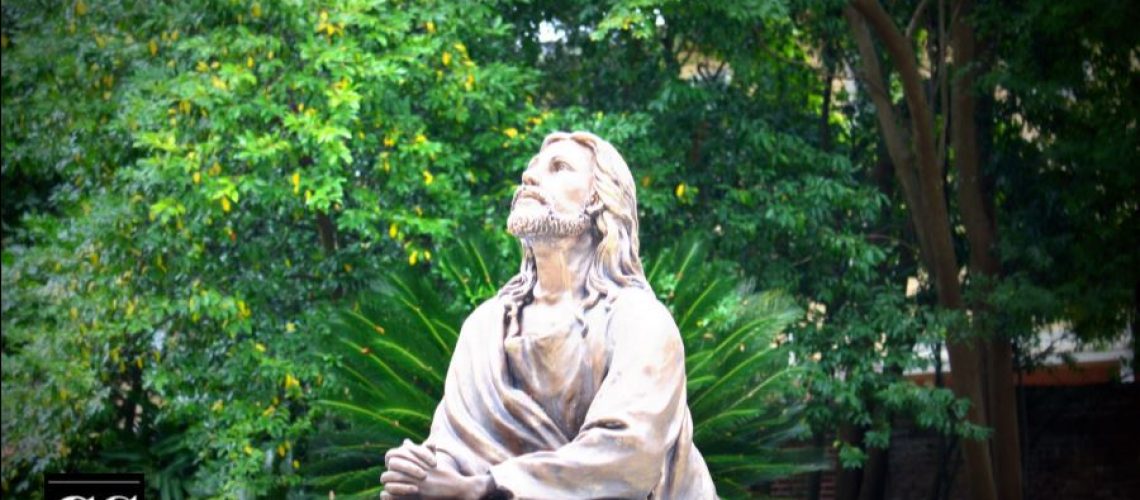
Our Lord never intended that we should merely learn by heart the Our Father and recite it day and night. No doubt it is very beautiful and very simple, and can be meant quite easily by anyone who cares to use it. But that is not the purpose (although it is one purpose) of His gift of it to us. He evidently desires that we should take it to pieces, study its composition, and make it the model of our conversation with Him and the Father. (Fr. Bede Jarrett OP, Classic Catholic Meditations, p. 300)
During each Mass, the Our Father is prayed.
During the Latin Mass, however, the Our Father is prayed in Latin, and the difference is extraordinary, for me, in tone and meaning.
First, the Pater Noster is sung or chanted as it has been for hundreds of years. Catholics gathering together, no matter where they were from or what language they spoke at home, could sing the Pater Noster together.
Second, and most importantly, the Latin Pater Noster is different in tone and more succinct in meaning than the English version. When it is interpreted line for line, as it should be from the Latin, you become aware of its deeper and more spiritually aspirational meaning. While the original was most likely said by Jesus in Aramaic, it was immediately translated to Greek and, soon after, to Latin by those Apostles and disciples who spread the Gospel.
Let us look line by line at this prayer that Jesus Himself gave us.
Pater Noster: Our “dad”
The Latin word Domine means Lord or Master, and we may refer to God in this way, but this is not what Jesus used. Rather He used the common term abba, in Latin pater, to mean a familial father. We are God’s familial children. We are His beloved sons and daughters, and Jesus is our brother.
quis es in Caelis: who is in Heaven,
Sanctificetur nomen tuum: may your name be treated as holy.
Sanctificetur is the passive subjunctive form, and this changes the reading of the entire line. The passive indicates that the action is being done to the subject. The active would read “Your name makes holy or treats as holy,” but the passive is read “Your name is made holy or treated as holy.” But this is the indicative form, i.e., a statement of fact. Sanctificetur is also the subjunctive, which is used when a statement is either contrary to fact (“If I were a rich man”), or something that we hope or wish would happen but do not know if it will. Therefore, the correct reading of this line is, “Let or may your name be treated as holy.” This is, therefore, spiritually aspirational in meaning, and not merely a statement of fact. It means that we must be seeking to uplift His name and make His name holy through our thoughts, words, and actions.
Adveniat regnum tuum: May your kingdom arrive, happen, come into existence.
Adveniat is the active subjunctive form, which is why the English translation uses the subjunctive verb “come” and not “comes.” The English, however, doesn’t show the full effect of the subjunctive form, which, again, is to show our hopes that something will happen. The Latin, once again, shows this hopefulness and indicates that we must actively be inspired in word and deed to have His kingdom come into existence. Note that Adveniat may be translated as “arrive, happen, or come into existence.”
Fiat voluntas tua: May your will take effect, be done, or come into being.
Fiat is active subjunctive as well, again indicating that we must be seeking and working toward this occurrence. Again, note the three ways in which fiat can be translated.
sicut in caelo, et in terra: as it is in heaven, (may it be also) on earth.
This ends the final spiritually aspirational sequence in the prayer, in which we seek to have God’s will have the same effect on our earthly world as it wholly does in heaven.
Panem nostrum quotiadianum da nobis hodie. Our daily bread grant to us still—or—Continue to grant us our daily bread.
Da is the imperative form of “to give or to grant,” indicating a command or a request. In this context, it would be best interpreted as asking God to “grant us” our daily bread. Hodie is an adverb which means “today” or “still.” Because quotiadianum means “daily,” it seems repetitive to translate hodie as “today,” rather than “still.” God grants us what we need each day, and by recognizing this, and asking Him to continue still, we are showing continuing gratitude to Him for our daily care, even for our smallest needs.
Et dimitte nobis debita nostra: And settle our debts with us,
Again, dimitte is the imperative form, and “settle” is the common meaning of dimitte when referring to debts. Here we are requesting God to release us from or let go of our debts to Him.
Sicut et nos simittimus debitoribus nostris: just as we settle those of our debtors.
Et ne nos inducas in tentationem: And may you not bring us to the test/trial—or—And may you keep us from the test/trial.
This is a much better and more accurate interpretation that the current “Lead us not into temptation” because inducas is not the imperative, but rather the subjunctive form meaning “may you lead, introduce, or bring (us) into.” The negative ne indicates that we are seeking to avoid such activity. Finally, tentationem is from the Latin word for test, trial, or attack, and in this instance, it refers to the test of evil. This section asks God tokeep us from the great battle with Satan and all of his temptations.
Sed libera nos a malo: But free us/release us from evil.
Libera is the imperative form, so we are begging God to free or release us from evil or, following on the previous clause, to avoid the temptation of evil. Libera, when combined with the ablative preposition a, is also interpreted as “acquit” us from evil. We already commit evil acts, and in this part of the prayer, we are asking not only to stop committing them but to be acquitted for the evil we already have committed.
Thank you, Jesus, for such a perfect and powerful prayer! The Latin brings out its beauty even more.


[…] Love Letters to the Latin Mass: The Our Father – Cynthia Millen at Catholic Stand […]
[…] Love Letters to the Latin Mass: The Our Father – Cynthia Millen at Catholic Stand […]
[…] Love Letters to the Latin Mass: The Our Father – Cynthia Millen at Catholic Stand […]
[…] Body of Saint, Patron of African Americans, Badly Damaged in Sicilian Church Fire – The Reg Love Letters to the Latin Mass: The Our Father – Cynthia Millen at Catholic Stand The Mafia’s Last Gasp Against the Catholic Church […]
Oh, Cynthia! This is amazing. I must read this a couple of times. Sadly I have no Latin. Long story there! But I do understand what you are explaining. I have found that The Our Father also has different nuances in my mother tongue, Afrikaans. I have even found it in the Bible. I read something in English, go to my Afrikaans Bible, and it means something different, at least to me.
I am grateful to be exposed to these differences. It makes me think. Thank you, Lord, that at the end, there is only one Holy Trinity!
Dear Cynthia,
I have written to you before about this subject.
The Lord’s Prayer recited in Latin has a majesty that the English version simply doesnt
capture. It links you with nearly two millenia of religious observance and leaves you with a sense of reverence and awe as you approach your Maker. Indeed when I hear my favorite Mozart Mass , The Coronation Mass , the Latin words are sublime
I say this as a Jew whose religious services are in Hebrew .When I approach my Maker in prayer I feel that my ancestors are with me. I am sure you feel the same way .
May God bless you .